

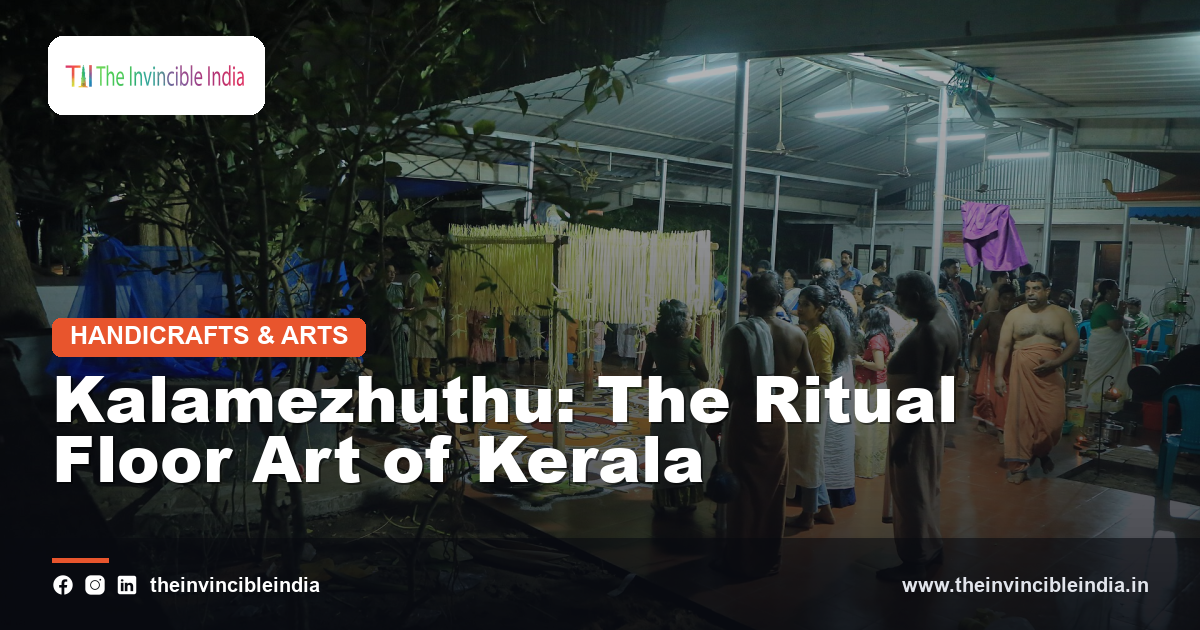
Kalamezhuthu is the traditional ritual floor art of Kerala, in which an image of a deity is drawn on the ground with finely powdered natural colours. The name combines kalam, meaning a ritual floor design, and ezhuthu, meaning writing or drawing, and the art is also called Kalam Ezhuthu, Kalamezhuthum Pattum or simply kalam drawing. It is performed in temples, sacred groves and family homes, usually as part of worship of deities such as Bhadrakali, Ayyappan and the serpent gods. The impermanent design is closely related in spirit to the festive drawings of the Madhubani tradition, yet it exists only for a single ceremony.
Quick answer: Kalamezhuthu is a ritual art of Kerala in which a large image of a deity is drawn on the floor using five natural coloured powders. Specialist families draw the kalam by letting powder flow between their fingers, and it is accompanied by sacred songs and offerings. The drawing is erased at the end of the ritual, so the art is meant for worship rather than for lasting display.
Key Takeaways
- Kalamezhuthu is a ritual floor drawing tradition of Kerala, drawn in honour of a deity.
- The images are made with five natural coloured powders, usually white, black, yellow, red and green.
- Common subjects include Bhadrakali, Ayyappan, Shiva and serpent deities (Nagas).
- The drawing is accompanied by ritual songs known as Kalamezhuthu Pattu, and is erased at the end of the ceremony.
- Families such as the Kurup, Pulluvan and Theyyampadi Nambiar communities have traditionally practised it.
- Kalamezhuthu is also the opening phase of performing arts such as Mudiyettu and Thiyyattu.
The sections below explain the ritual setting, materials, deities, technique and continuing life of this art.
Quick Facts
| Detail | Information |
|---|---|
| Type | Ritual floor drawing with powders |
| Region | Kerala |
| Meaning of name | Kalam (ritual space) + ezhuthu (drawing) |
| Colours | White, black, yellow, red, green |
| Main subjects | Bhadrakali, Ayyappan, Shiva, Nagas |
| Accompaniment | Kalamezhuthu Pattu ritual songs |
What Is Kalamezhuthu?
Kalamezhuthu is a ritual art of Kerala in which a deity’s image is drawn on a prepared floor space with powdered natural colours. The drawing, called a kalam, can be quite large, with detailed faces, ornaments, weapons and flowing decorative borders. It is made as part of a worship ceremony and is not intended to last, because the image is rubbed out once the ritual is complete. The art is both visual and devotional, combining skill in drawing with song, offerings and prayer. Because of its sacred purpose, Kalamezhuthu differs from decorative art made for sale or display. It is a form of worship in which the act of drawing is itself an offering to the deity.
Where Is Kalamezhuthu Practised?
Kalamezhuthu is practised across Kerala, in Bhagavathy temples, sacred groves known as kavus, serpent shrines and family homes. It is found in both the northern and southern parts of the state, with local variations in style and ritual. In many places the ceremony takes place in a pandal or a covered space set up near the temple or at the household. Families commission the ritual for reasons such as seeking blessings, fulfilling vows or removing hardships. The art is closely tied to Kerala’s temple culture and village festivals. Its wide spread across the state shows how deeply the practice is rooted in the region’s devotional life and cultural landscape.
How Did Kalamezhuthu Originate?
Kalamezhuthu is believed to have developed from very old traditions of drawing sacred diagrams and images on the ground in worship. Exact dates cannot be given, and the origin of the practice is understood mainly through ritual texts, oral tradition and living custom. It is linked with the worship of the Mother Goddess, serpent deities and warrior deities found in Kerala’s folk and temple religion. Over time, specialist families developed detailed rules for the forms of each deity and the proper way to draw them. These rules were passed on by teaching within the community. The art thus grew as a ritual system, shaped by faith and by the shared knowledge of hereditary practitioners.
Who Draws the Kalam?
The kalam is drawn by hereditary families who have specialised in the ritual for generations. The Kurup community is widely known for drawing Bhadrakali kalams, the Pulluvan community for serpent kalams along with their songs, and the Theyyampadi Nambiar families for related ceremonies in some regions. These practitioners learn the art from elders, usually beginning as assistants and later taking over the drawing. Several people may work together on a large kalam, each drawing a part under the lead of the senior artist. Their role is both artistic and priestly, since they must know the ritual as well as the images. Kalamezhuthu therefore depends on a living chain of teachers and students.
Which Colours and Materials Are Used?
Kalamezhuthu uses five natural colours made from plant and household materials. White is made from rice powder, black from burnt paddy husk or charcoal, yellow from turmeric, red from turmeric mixed with slaked lime, and green from powdered leaves such as those of the vaka tree. The colours are ground into very fine powders that can flow smoothly between the fingers. No brush, paint or artificial dye is traditionally used. The powders are simple, edible or organic materials, which fits the ritual idea of offering natural gifts to the deity. The restrained palette of five colours, combined with skilled use of light and dark, gives the kalam its characteristic vividness and clarity.
How Is a Kalam Drawn?
A kalam is drawn by first preparing and purifying the floor and then marking the outline with a thin stream of white powder. The artist takes a pinch of powder between the thumb and fingers and lets it fall in a controlled line, creating curves, borders and details without any tool. Colour is then added section by section, from the outline inward, until the figure is complete. Skilled artists work without a drawn sketch, relying on memory and trained hands. The process can take several hours for a large image. Because there is no room for correction in the flowing powder, the method demands steadiness, precision and long practice.
Which Deities Are Depicted in Kalamezhuthu?
Kalamezhuthu depicts several deities, with Bhadrakali among the most prominent. Bhadrakali kalams show the goddess with many arms, weapons, a fierce expression and ornate crown. Other images include Ayyappan, Shiva, Vettakkorumakan and Subrahmanya, as well as serpent gods known as Nagas, who are drawn with coiled bodies and rich ornamentation. Each deity has its own prescribed form, colour scheme and ritual setting. The choice of image depends on the temple, the household and the purpose of the ceremony. This variety shows how Kalamezhuthu serves different strands of Kerala belief. All the images share the common idea that the deity is invited into the drawing and honoured through it.
What Is Kalamezhuthu Pattu?
Kalamezhuthu Pattu is the group of ritual songs sung during and after the drawing of the kalam. The songs describe the deity, praise its deeds and invite its presence, and they are sung to the beat of traditional percussion and sometimes string instruments. Different communities have their own song traditions, such as the Pulluvan songs sung for serpent kalams. The singing builds a devotional atmosphere and often leads to a heightened state in which the deity is believed to be present. Music and image therefore work together as parts of a single ritual. Without Kalamezhuthu Pattu, the drawing would be incomplete, since the sound gives voice to the form that has been drawn on the floor.
How Does the Kalam Ritual End?
The kalam ritual ends with the erasing of the image, a step that is as meaningful as the drawing itself. After songs, offerings and worship, a participant, often one possessed or inspired by the deity, may dance over the kalam and wipe it away. The powders are then collected and treated with respect. The destruction of the image expresses the idea that the deity has been invited, honoured and then released. It also shows a Kerala understanding of art as offering rather than possession. Hours of detailed work vanish within moments, and this impermanence is central to the meaning of Kalamezhuthu. The ritual teaches that devotion lies in the act, not the object.
How Is Kalamezhuthu Linked to Mudiyettu and Thiyyattu?
Kalamezhuthu is closely linked to ritual performing arts such as Mudiyettu and Thiyyattu, which begin with the drawing of a kalam. In Mudiyettu, a ritual theatre of Kerala dedicated to Bhadrakali, a large image of the goddess is drawn before the performance, and the story of her battle with the demon Darika is then enacted. Thiyyattu, performed by the Thiyyadi Nambiar community, also opens with a floor drawing of the deity. Mudiyettu has been recognised internationally as an element of intangible cultural heritage. The kalam thus serves as the sacred space from which the performance begins, linking visual art, music and drama in a single living tradition.
Why Is Kalamezhuthu Important?
Kalamezhuthu is important because it preserves a distinctive form of ritual art that combines painting, music and devotion. It records Kerala’s religious imagery in a form that has been handed down for generations without permanent materials. The tradition shows a deep link between art and ecology, since its colours come from plants, grain and household substances. It also supports specialist families whose knowledge covers iconography, songs and ritual procedure. For scholars of Indian culture, Kalamezhuthu offers a window into how sacred images are made and understood. Its survival helps keep alive a form of artistic skill that cannot be learned from books alone but only through guided practice.
How Does Kalamezhuthu Compare With Other Indian Floor Art?
Kalamezhuthu belongs to the wider family of Indian floor art that includes rangoli, kolam and alpana, yet it differs in scale, purpose and complexity. Rangoli and kolam are often made daily or on festivals to welcome prosperity, and they usually consist of geometric or floral designs. Kalamezhuthu instead portrays complete figures of deities with detailed anatomy and ornament, and it is bound to a formal ritual with songs and offerings. It is also performed by specialist hereditary artists rather than by every household. Despite these differences, all these arts share the use of powders, the impermanence of the work and the belief that the floor can be a sacred canvas.
What Are the Skills and Training Involved?
The skills of Kalamezhuthu are acquired through years of training within the practising family. Apprentices first learn to prepare the powders and to hold the correct posture for drawing. They then practise producing steady lines, basic shapes and borders before attempting full figures. Memorising the iconography of each deity is a major part of the learning, as is mastering the songs that accompany the drawing. Training is traditionally informal, based on watching, assisting and repeated practice. Today some institutions and cultural bodies also offer workshops to keep the knowledge from fading. The demanding apprenticeship ensures that the art retains its standards, and it highlights the value of living teachers in preserving intangible heritage.
What Challenges Does Kalamezhuthu Face?
Kalamezhuthu faces challenges linked to changing social patterns and fewer young practitioners. The ritual requires time, space and resources, and not all families or temples can sustain it as before. Younger generations may find other careers more secure than hereditary ritual work. The temporary nature of the art means that records depend on photographs and documentation rather than lasting objects. There is also a risk of the ritual being shown as mere spectacle without its devotional meaning. Cultural bodies, temples and community groups are responding with documentation, training and respectful public demonstrations. Protecting Kalamezhuthu means supporting both the artists and the faith that gives the art its purpose.
Can Visitors See Kalamezhuthu?
Visitors can see Kalamezhuthu at certain temples, festivals and cultural programmes in Kerala, although it is primarily a ritual and not a tourist show. The art is most often seen during temple festivals, serpent worship events and the seasons when Bhagavathy kavus hold ceremonies. Some cultural centres and festivals present demonstrations that show how a kalam is drawn and erased. Visitors should observe quietly, follow local customs, avoid stepping on the powders and ask before taking photographs. Respect for the sacred setting is essential, because the drawing is an act of worship. Careful and sensitive viewing allows travellers to appreciate the art while honouring the community that practises it.
Kalamezhuthu Today
Kalamezhuthu today remains a living ritual in Kerala, performed in temples and homes, and it is also presented in cultural programmes, documentaries and workshops. Families of hereditary artists continue to draw kalams with the same five natural colours and to sing the traditional songs. Some artists have introduced the visual style into paintings and murals, though the original ritual form is still treated with reverence. Researchers and cultural bodies document the art so that its details are not lost. The tradition endures because it is rooted in faith, community and skill rather than in objects. Kalamezhuthu stands as a graceful reminder that art can be an offering that lives fully in the moment of worship.
Sources & Further Reading
- Sangeet Natak Akademi (sangeetnatak.gov.in).
- Ministry of Culture, Government of India (indiaculture.gov.in).
Frequently Asked Questions
What is Kalamezhuthu?
Kalamezhuthu is a ritual floor art of Kerala in which an image of a deity is drawn with natural coloured powders. The drawing is part of a worship ceremony and is erased when the ritual ends.
What colours are used in Kalamezhuthu?
Kalamezhuthu uses five natural colours, namely white, black, yellow, red and green. They are made from rice powder, burnt paddy husk, turmeric, turmeric mixed with lime, and powdered leaves.
Which deities are drawn in Kalamezhuthu?
Bhadrakali is the most prominent deity drawn in Kalamezhuthu, and Ayyappan, Shiva and serpent gods are also depicted. Each deity has a prescribed form and ritual setting.
Who performs Kalamezhuthu?
Kalamezhuthu is performed by hereditary families such as the Kurup, Pulluvan and Theyyampadi Nambiar communities. They learn the drawing, songs and ritual procedure within the family.
Why is the kalam erased after the ritual?
The kalam is erased because the ritual treats the drawing as an offering and an invitation to the deity, not as a lasting artwork. Wiping it away marks the release of the deity and the completion of the worship.
How is Kalamezhuthu connected to Mudiyettu?
Kalamezhuthu is the opening phase of Mudiyettu, the ritual theatre of Kerala devoted to Bhadrakali. A large kalam of the goddess is drawn before the performance begins.


