

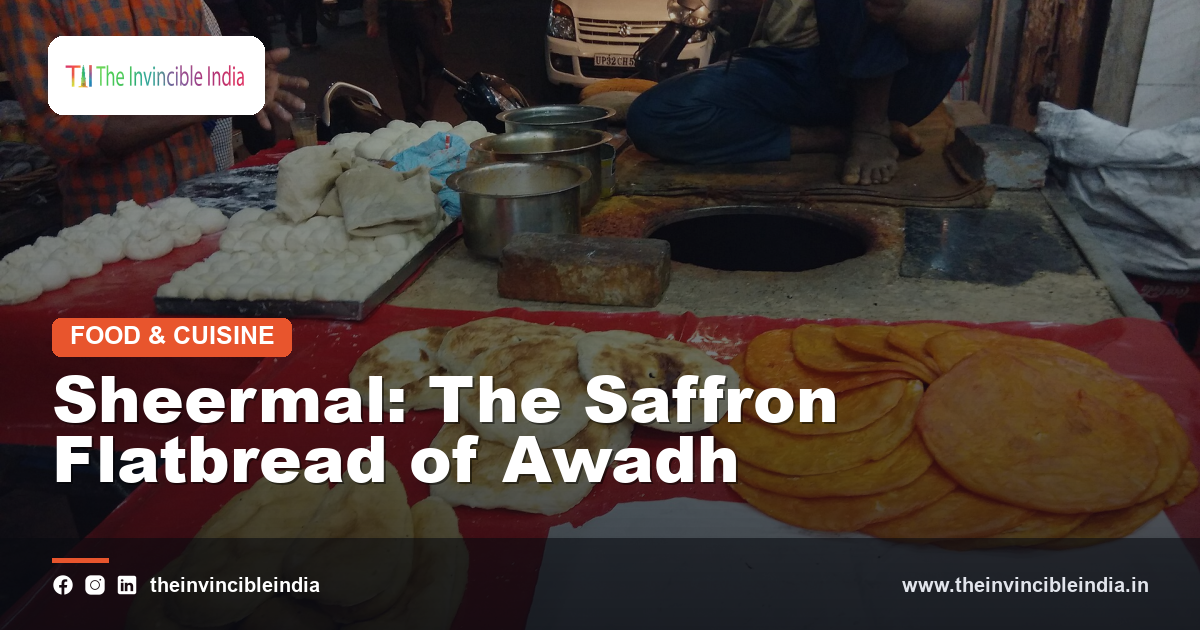
Sheermal, also spelled shirmal or sheermaal, is a soft, lightly sweet flatbread enriched with milk and perfumed with saffron, long associated with the royal kitchens of Awadh and the city of Lucknow. It belongs to the rich bread traditions of Persianate and Mughal cooking, and it is a close companion to the slow-cooked meats described in our guide to regional cuisines of India. Its golden crust, tender crumb and delicate aroma make it different from everyday rotis and naans. It is baked in a tandoor or oven and is most often eaten with nihari, korma or kebabs. This guide explains what sheermal is, how it is made, and why it remains a mark of festive dining in Awadhi cuisine.
Quick answer: Sheermal is a saffron-flavoured, lightly sweet flatbread of Awadh, associated with Lucknow, made from refined flour enriched with milk, ghee and sugar and baked until golden. The name is commonly explained as combining the Persian words for milk and rubbing. It is traditionally eaten with rich dishes such as nihari, korma and kebabs, especially at festivals and feasts.
Key Takeaways
- Sheermal is a saffron-scented, mildly sweet flatbread of the Awadh region, with Lucknow as its best-known home.
- The dough is made from refined flour enriched with milk, ghee and a little sugar, rather than water alone.
- Saffron gives the bread its pale golden colour and delicate fragrance.
- It is baked in a tandoor or oven, and brushed with ghee, so the crust is golden and the interior soft.
- Sheermal is traditionally eaten with nihari, korma, kebabs and other rich Mughlai and Awadhi dishes.
- It is a favourite at Eid, weddings and other festive feasts, and is also made in Hyderabad, Delhi and Kashmir.
Read on for the ingredients, method, serving customs, and cultural role in detail.
Quick Facts
| Detail | Information |
|---|---|
| Dish | Sheermal (shirmal, sheermaal) |
| Type | Saffron-flavoured sweet flatbread |
| Region | Awadh, centred on Lucknow |
| State | Uttar Pradesh |
| Main ingredients | Refined flour, milk, ghee, sugar, saffron |
| Typical accompaniment | Nihari, korma, kebabs |
What is sheermal?
Sheermal is a rich, lightly sweet flatbread made with refined flour, milk, ghee and saffron, and it is one of the best-known breads of Awadhi cuisine. Unlike the plain roti or the yeasted naan, it is kneaded with milk instead of water and carries a hint of sugar, so the dough is soft and the baked bread is tender and slightly cakey. A wash of saffron-infused milk gives the surface a golden shade and a subtle aroma. The bread is round, often marked with a pattern of small dots, and brushed with ghee when it comes out of the oven. It is usually eaten with savoury dishes, which makes its gentle sweetness a pleasing contrast. Sheermal therefore stands between a bread and a pastry, and it is prized for that balance.
Where does sheermal come from?
Sheermal comes from the Persianate food culture that developed in northern India under Mughal and regional courts, and it is most closely associated with Awadh and Lucknow. The bread is part of a family of enriched flatbreads that travelled from Iran and Central Asia into the subcontinent, where court bakers adapted them to local ingredients and ovens. In Awadh, whose nawabs were celebrated patrons of cooking, the bread became a refined accompaniment to meat dishes. Its exact origin and the date it reached Lucknow are not firmly documented, so it is best described as a product of the court and bazaar baking traditions of the region over time. Today the bread is also made in Hyderabad, Delhi, Kashmir and Pakistan, each with local touches, but Lucknow remains its emblematic home.
What does the name sheermal mean?
The name sheermal is commonly explained as joining two Persian words, sheer meaning milk and mal meaning rubbing or kneading, which together describe a bread worked with milk. This reading fits the way the dough is made, since milk replaces water and gives the bread its soft crumb and mild sweetness. The word appears in several spellings, including shirmal, sheermaal and shirmaal, because of different transliteration habits. In some regions it is simply called a milk bread. Linguists and food historians note that the origin of many food names is hard to prove with certainty, so the etymology is best treated as a widely accepted explanation instead of a settled fact. In any case, the name captures the defining feature of the bread, which is the generous use of milk.
What are the main ingredients of sheermal?
The main ingredients of sheermal are refined wheat flour, milk, ghee, sugar and saffron, with a leavening agent used in many recipes. The flour provides the body of the dough, while milk supplies richness and softness. Ghee is rubbed into the flour and brushed over the baked bread, adding flavour and a short, tender texture. A small amount of sugar gives the faint sweetness that defines the bread, and saffron strands soaked in warm milk supply colour and perfume. Yeast or baking powder helps the dough rise in some versions, and cardamom or rose water may be added by cooks who want extra fragrance. Salt balances the flavours. The list is simple but luxurious, and the use of saffron and ghee reflects the courtly cooking from which the bread descends.
How is sheermal made?
Sheermal is made by kneading flour with milk, ghee and sugar into a soft dough, resting it, shaping it into rounds and baking until golden. The cook usually rubs ghee into the flour first, which makes the finished bread tender, and then adds warm milk gradually to form a smooth dough. After a rest of an hour or more, the dough is divided, rolled into thick discs and pricked or patterned with a tool to prevent puffing. The surface is brushed with saffron milk, and the discs are baked in a tandoor or a hot oven. When the bread comes out, it is brushed again with ghee. Careful control of heat is important, because the sugar and milk cause the surface to brown quickly. The process is straightforward but depends on practised judgement.
Why is saffron used in sheermal?
Saffron is used in sheermal because it provides a delicate aroma, a golden colour and a sense of luxury that suits the festive nature of the bread. Saffron is one of the most prized spices in the world, and in Mughlai and Awadhi cooking it has long marked dishes meant for special occasions. For sheermal, a few strands are steeped in warm milk until the liquid turns a deep yellow, and that milk is brushed on the dough before baking. The result is a pale gold surface with a gentle floral scent that does not overpower the other flavours. Cheaper versions may use food colouring or turmeric, but traditional bakers insist that real saffron gives the characteristic fragrance. Its use links the bread to Persian culinary heritage.
How is sheermal baked?
Sheermal is baked in a tandoor, a clay oven, or in a domestic oven, and the high heat gives the bread its golden crust and soft centre. Professional bakers in Lucknow use large ovens in which the discs are placed on the walls or on trays and baked quickly. The bread is checked closely, since its milk and sugar content make it brown fast, and it is removed when the top is golden and lightly spotted. Home cooks often use a preheated oven or a covered pan on the stove, adjusting the time to achieve a similar result. A final brush of ghee adds sheen and softness. Baking at the right temperature is essential, because too low a heat dries out the bread while too high a heat burns the sugar, so experience guides the baker.
What is sheermal eaten with?
Sheermal is eaten with rich, savoury dishes such as nihari, korma, kebabs and spiced meat curries, and its mild sweetness balances their heat and depth. Nihari, a slow-cooked stew, is the classic partner in Lucknow and Delhi, and a piece of sheermal torn and dipped in its gravy is considered a perfect bite. Kebabs from Lucknow, including the soft galouti, may also be served with the bread. Some people eat sheermal with a cup of tea or with a dessert of kheer, since the bread suits both savoury and sweet company. At festive meals it is often served alongside biryani or other special dishes. The pairing shows that the bread is meant not as a neutral staple but as a distinctive part of the plate.
Why is sheermal central to Lucknow's food culture?
Sheermal is central to Lucknow’s food culture because it embodies the refined, courtly style of Awadhi cooking for which the city is known. Lucknow’s old markets, particularly in the Chowk area, have bakeries and eateries that specialise in rich breads, and sheermal is among the most famous. The city’s cuisine is associated with slow cooking, subtle spicing and elegant presentation, and the bread fits that mood. Residents often buy sheermal fresh for guests and special meals, and visitors seek it out as part of the local food experience. Food writers regularly place it alongside kebabs, biryani and nihari as an essential element of the city’s table. The bread thus carries both flavour and identity, and it is a point of local pride.
How is sheermal different from naan and roti?
Sheermal is different from naan and roti because it is enriched with milk, ghee and sugar, which makes it sweeter, richer and softer. A roti is a simple unleavened whole wheat flatbread cooked on a griddle, and naan is a leavened refined-flour bread usually made with yogurt and baked in a tandoor. Sheermal also uses refined flour and a tandoor, but the milk-based dough and saffron give it a quite different flavour and crumb. It is thicker than a roti, less chewy than many naans and more fragrant than either. Because of this richness, it is eaten with strongly flavoured dishes and not served with everyday meals. The comparison shows how the Indian bread tradition spans simple staples as well as luxurious festive breads.
When is sheermal eaten?
Sheermal is eaten mainly at festive and celebratory meals, and it is especially associated with Eid, weddings and other family gatherings. During the festive season, bakeries in Lucknow and other cities prepare large quantities, and families buy them to serve with nihari, korma and kebabs. The bread is also a common choice for dawat, a formal invitation to a meal, because it conveys generosity. In some places it is eaten during Ramzan after the evening fast, along with other rich foods. Because it keeps its softness for a day, it can be bought ahead and reheated. While it is not strictly tied to a single festival, its richness has made it a signal of hospitality and occasion across communities that enjoy Awadhi and Mughlai food.
What are the regional variations of sheermal?
Regional variations of sheermal differ in sweetness, thickness, fat content and the way the bread is baked, and they appear in Lucknow, Hyderabad, Delhi, Kashmir and Pakistan. The Lucknow version is known for its soft, pale gold appearance and saffron aroma, while versions in Kashmir may be thicker, crisper and baked in a different style of oven. Hyderabad has its own enriched breads that resemble sheermal, and Delhi bakeries produce their own variants for festive menus. Some bakers add nigella seeds, dry fruits or a sprinkling of poppy seeds, and others make a smaller, denser round. The differences show how the bread adapts to local taste and ingredients, and they remind readers that sheermal is a family of related breads and not one fixed formula.
Can sheermal be made at home?
Sheermal can be made at home with a standard oven or a heavy covered pan, and the main requirements are good flour, real saffron and careful baking. Home cooks should rub the ghee thoroughly into the flour, use warm milk and allow the dough to rest properly. The bread should be rolled to a moderate thickness, pricked evenly and brushed with saffron milk before baking. An oven preheated to a fairly high temperature produces the best colour, and a baking stone or tray helps. The bread must be watched, because the sugar encourages quick browning. A final brush of ghee gives shine and softness. With a little practice, the result is a fragrant golden bread that approaches the quality of the bakery version and makes any festive meal feel special.
Is sheermal healthy?
Sheermal is a rich festive bread and is best regarded as an occasional food, because it contains refined flour, ghee, milk and sugar. These ingredients provide energy, some protein and calcium from the milk, but also make the bread denser in calories than a plain roti. The use of saffron adds aroma without adding significant calories, and traditionally the bread is eaten in modest portions alongside protein-rich dishes. People who wish to lighten it may use part whole wheat flour, reduce the sugar or use less ghee, although such changes also alter the traditional taste and texture. As with other celebratory foods, balance and moderation are sensible. It is intended to be enjoyed on special occasions, when its flavour and symbolism matter more than daily nutrition.
How should sheermal be stored?
Sheermal is best eaten fresh, but it can be stored in a covered container for a day or two and reheated gently. The milk and ghee in the dough keep the bread soft for a short time, though it dries out if left uncovered. To reheat, wrap it in foil and warm it in a low oven, or sprinkle a few drops of water and heat it on a griddle, which restores softness and aroma. Microwaving is possible but may toughen the crust. Bakers in Lucknow typically sell the bread warm, and customers often take it home the same day. Freezing is possible for longer storage, though the delicate texture is best when fresh. Proper handling preserves the saffron fragrance and the tender crumb of the bread.
Sheermal Today
Sheermal today remains one of the most admired breads of Indian cuisine, and it continues to be baked in the old bazaars of Lucknow as well as in restaurants and home kitchens across the country and abroad. Bakers and chefs have introduced variations such as mini sheermal, stuffed versions and sheermal made with whole wheat flour, while traditionalists maintain the classic method of milk, ghee and saffron. Food festivals and heritage walks in Lucknow often highlight the bread as a symbol of the city’s culinary legacy. Its popularity with nihari and kebabs has helped it travel to menus in many cities. Despite changes in technique and ingredients, the essential qualities of the bread endure: a golden crust, a soft crumb and the quiet fragrance of saffron.
Sources & Further Reading
- Ministry of Culture, Government of India (indiaculture.gov.in).
- Ministry of Tourism, Government of India (tourism.gov.in).
Frequently Asked Questions
What is sheermal?
Sheermal is a saffron-flavoured, lightly sweet flatbread from Awadh, best known in Lucknow, made from refined flour, milk, ghee and sugar. It is baked until golden and brushed with ghee.
What does sheermal taste like?
Sheermal tastes mildly sweet, rich and buttery, with a soft crumb and a gentle saffron aroma. Its sweetness is subtle, which is why it pairs well with savoury meat dishes.
What is sheermal made of?
Sheermal is made of refined wheat flour, milk, ghee, sugar and saffron, often with yeast or baking powder. Some cooks also add cardamom or rose water for extra fragrance.
What is sheermal eaten with?
Sheermal is eaten with nihari, korma, kebabs and other rich Mughlai and Awadhi dishes. It can also be taken with tea or a milk-based dessert such as kheer.
Is sheermal the same as naan?
No, sheermal is not the same as naan, although both are baked flatbreads. Sheermal is enriched with milk, ghee, sugar and saffron, making it sweeter and softer than the usual naan.
Where is sheermal most famous?
Sheermal is most famous in Lucknow, the capital of the Awadh region in Uttar Pradesh, where bakeries in the old city specialise in it. It is also made in Hyderabad, Delhi and Kashmir.


