

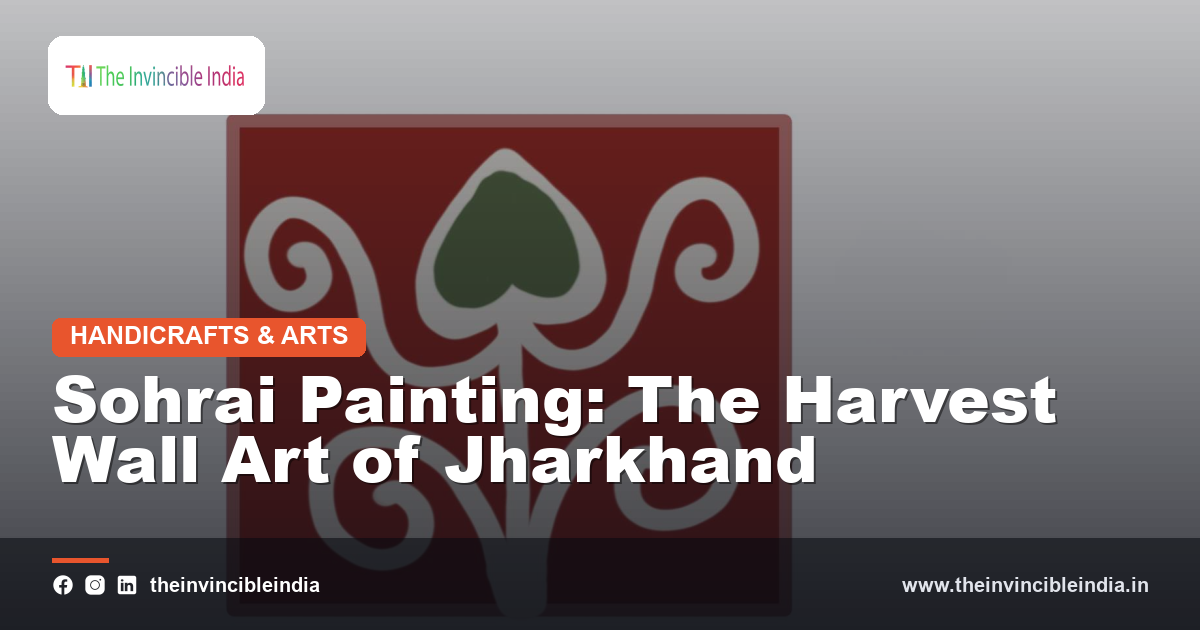
Sohrai painting is a seasonal mural tradition of the tribal and village women of Jharkhand, practised most famously in the Hazaribagh region. Each year, around the harvest and cattle festival of Sohrai, women replaster the walls of their mud houses and decorate them with animals, plants and symbolic patterns in natural earth colours. The art is also known as Sohrai Khovar painting, because a related style called Khovar decorates marital chambers. Like the ritual wall art of the Saura tribe and the village murals of Warli painting, it shows how homes themselves can become canvases for community belief.
Quick answer: Sohrai painting is a traditional mural art practised by tribal and village women in Jharkhand, especially around Hazaribagh, during the Sohrai harvest festival. Women paint animals, trees, birds and abstract patterns on freshly plastered mud walls using natural earth pigments, applied by fingers, cloth or chewed twigs. The related Khovar tradition decorates wedding rooms, and both styles are now recognised as distinctive heritage crafts of the state.
Key Takeaways
- Sohrai painting is a mural tradition of women in Jharkhand, centred on the Hazaribagh region.
- It is painted during the Sohrai festival, which celebrates the harvest and honours cattle.
- The paintings are made on mud walls using natural colours such as white clay, red ochre, black and yellow earth.
- Common motifs include animals, birds, plants, trees and geometric patterns that express fertility and abundance.
- Khovar is a related style painted in marriage chambers, usually during the wedding season.
- The art is passed from mothers to daughters and has gained wider recognition through craft revival efforts.
The sections below explain the festival, materials, motifs, techniques and continuing life of this wall art.
Quick Facts
| Detail | Information |
|---|---|
| Type | Tribal and village mural painting |
| Region | Jharkhand, especially Hazaribagh |
| Occasion | Sohrai harvest and cattle festival |
| Painted by | Women of tribal and village communities |
| Surface | Freshly plastered mud walls |
| Related style | Khovar marriage chamber painting |
What Is Sohrai Painting?
Sohrai painting is a traditional form of wall art created by women in rural Jharkhand during the Sohrai festival. The paintings are drawn on the outer and inner walls of mud houses and show animals, plants, birds and flowing patterns in a simple, bold manner. They are made with natural pigments and the work is usually done freehand, without sketches or fixed templates. The art is closely tied to the farming year, since it marks the end of the harvest and expresses thanks for the fertility of land and cattle. Because it is part of festival preparation rather than a commercial product, Sohrai is first of all a living ritual art of the home and the village community.
Where Is Sohrai Painting Practised?
Sohrai painting is practised mainly in Jharkhand, and the Hazaribagh district is its best-known centre. Villages in the surrounding plateau, with their forests, fields and mud-walled homes, have preserved the tradition across generations. Similar harvest and wall-painting customs exist among tribal communities in neighbouring regions, and Sohrai is part of a wider eastern Indian culture of decorated homes. Hazaribagh is especially associated with the art because researchers and cultural workers documented and promoted it there. The landscape of the Chota Nagpur plateau provides both the clay and the inspiration for the work. Sohrai painting is therefore rooted in a specific region while also belonging to a broader tradition of Indian folk wall decoration.
What Is the Sohrai Festival?
The Sohrai festival is a harvest and cattle-honouring celebration observed by farming and tribal communities in Jharkhand and nearby regions. It is held in the autumn season, around the time of the new moon of the Hindu month of Kartik, and so coincides with the period of Diwali in much of India. During the festival, families clean and decorate their houses, worship cattle and thank them for their labour in the fields. Songs, dances and community feasting accompany the rituals. The painting of walls is an essential part of preparation, as the freshly decorated home welcomes prosperity and good fortune. The festival provides the cultural purpose and calendar for Sohrai art, giving it meaning beyond decoration.
How Did Sohrai Painting Originate?
Sohrai painting is believed to have very old roots in the wall-decorating customs of agricultural and forest communities. Exact dates for its beginning are not documented, and any precise age should be treated as unverified. Scholars have noted similarities between some Sohrai motifs and ancient rock art found in the region, which suggests a long continuity of visual traditions, though this link is discussed rather than settled. What is certain is that the art was handed down orally and by practice from mother to daughter for many generations. It developed as a household custom, shaped by seasonal ritual and available natural materials. The story of Sohrai is therefore one of quiet continuity within village life.
Who Paints Sohrai and Khovar?
Sohrai and Khovar are painted by women, who learn the art in the family and community from an early age. Various tribal and village communities of Jharkhand practise the tradition, including groups such as the Kurmi, Munda, Oraon and Santhal, with local differences in style. Daughters watch their mothers and grandmothers prepare the walls and then take part in painting. The skills include mixing colours, preparing plaster and composing designs on a large surface. Women also decide the subjects, drawing on memory and daily observation of animals and plants. Because the work belongs to women, it is a notable example of female creativity and cultural leadership, and it carries pride for the families who preserve it.
What Materials and Colours Are Used?
Sohrai painting uses natural materials gathered from the surrounding land. White comes from a soft clay often called kaolin, red and brown from ochre and iron-rich earths, black from manganese-bearing soil or charcoal, and yellow from local yellow earth. These pigments are mixed with water to make a thin wash or paste. The base is a smooth coat of mud plaster applied to the wall, sometimes in layers of contrasting earth colour. Because the colours come from soil, the finished murals have a warm, muted palette that blends with the village setting. The use of simple, local, non-toxic materials shows an intimate knowledge of the land, and it explains the earthy beauty that identifies Sohrai at a glance.
How Is a Sohrai Wall Painted?
A Sohrai wall is painted in stages that begin with cleaning and replastering. Women first smooth the wall with fresh mud and often add a base coat of white or light clay. While the surface is still slightly damp, they draw designs using their fingers, pieces of cloth or a chewed twig that works as a brush. Dark colours are used for outlines and details, and lighter earths fill larger areas. Some designs are made by scratching into the wet plaster with a comb-like tool to create textured lines, a technique known as sgraffito. Painting is done quickly, in a confident freehand way. The process is communal and rhythmic, and the result is a fresh decoration renewed each season.
What Motifs Appear in Sohrai Art?
Sohrai art features motifs drawn from the natural and farming world, especially animals, birds, trees and flowering plants. Cattle, horses, deer, tigers, peacocks and fish appear in lively processions across the wall, often outlined boldly and filled with patterns. Trees and creepers form borders, while geometric designs of lines, dots and zigzags add rhythm. Many motifs are understood as symbols of fertility, protection and abundance, hoping for a good harvest and healthy herds. The figures are stylised rather than realistic, giving them energy and clarity. Together these motifs record how closely tribal life is bound up with nature, and they turn each house wall into an illustrated story of the local environment.
What Is Khovar Painting?
Khovar painting is a related wall art made in the marriage chamber, or khovar, and it is usually created in the wedding season rather than at harvest. The Khovar style typically shows dense, intertwined patterns of plants, flowers and animals, often in a dark colour on a lighter ground made by scratching away a layer of coating. Its themes of fertility, union and prosperity suit the occasion of marriage. Whereas Sohrai is linked to the cattle and harvest festival, Khovar honours the new household. Both are painted by women using similar materials and share a visual language. Together, the two traditions are often referred to as Sohrai Khovar, and they form the best-known wall art heritage of the Hazaribagh region.
How Do Sohrai Colour and Technique Differ by Region?
Sohrai painting shows variations in colour, line and subject from one area and community to another. In some villages, designs are strongly linear and drawn on a pale ground, while in others walls carry broad areas of red and black. Local clays differ in tone, so the palette changes with the soil. The preferred animals also vary, reflecting the wildlife and livestock of each place. Different communities may use signature patterns for borders and corners that outsiders can recognise. These differences arise because the art is learned within families and villages rather than from a central authority. As a result, Sohrai is not a single fixed style but a family of related local expressions united by purpose, material and spirit.
How Is Sohrai Linked to Ritual and Belief?
Sohrai painting is linked to ritual because it forms part of the preparations for a festival of thanksgiving and blessing. The act of decorating the home is seen as welcoming prosperity and protecting the household from harm. Cattle, central to farming life, are honoured in songs and worship during the festival, and their images on the wall reinforce this respect. The designs also express hopes for fertility of fields, animals and family. While beliefs vary among communities, the shared theme is gratitude to nature and care for the household. Sohrai therefore blends devotion and decoration, and the wall becomes a space where community values are visibly renewed every year.
Why Is Sohrai Painting Important?
Sohrai painting is important because it preserves an art form that carries the knowledge, symbols and aesthetics of tribal and rural Jharkhand. It is a rare example of large-scale women-led mural art that is renewed annually and rooted in a shared ecology. The tradition documents local plants, animals and seasons in visual form and uses sustainable materials. It also supports cultural identity at a time when village life is changing. For scholars, Sohrai offers evidence of how folk art connects to ritual and agriculture. For artists and designers, it is a source of inspiration. Its recognition helps ensure that the women who practise it receive respect and opportunity.
How Was Sohrai Painting Revived and Recognised?
Sohrai painting gained wider attention in recent decades through the efforts of cultural activists, researchers and craft organisations in Hazaribagh. Documentation, exhibitions and training programmes helped bring the art to audiences beyond the villages. Cultural worker Bulu Imam is widely credited with drawing public attention to the tradition and linking it with the region’s heritage. Sohrai Khovar painting of Hazaribagh has also been recognised through India’s Geographical Indications system, which protects the identity of regional crafts. Women artists began to paint on paper, cloth and canvas as well as walls, creating portable works. Revival has thus strengthened pride and income without erasing the festival roots of the art.
What Challenges Does Sohrai Painting Face?
Sohrai painting faces challenges as housing and lifestyles change in rural Jharkhand. Mud houses are being replaced by concrete buildings, which removes the traditional wall surface and reduces the occasion for painting. Younger people may move to cities for work, weakening the family chain of learning. Commercial imitation and low prices for paper or canvas versions can also undercut artists. Weather and seasonal repainting mean that the wall art itself is impermanent, so documentation is vital. Supporters respond with workshops, markets and recognition schemes, and by encouraging women to continue painting both homes and portable works. Sustaining Sohrai requires respect for its social and ritual context as well as its appearance.
Can Sohrai Be Seen Beyond Village Walls?
Sohrai can now be seen beyond village walls in public buildings, museums, exhibitions and craft fairs. Artists and cultural groups have painted Sohrai murals on public walls, and artworks on paper and cloth travel to galleries and homes in other cities. Visitors to Hazaribagh and nearby villages, especially during the festival season, may see the original wall paintings in their natural setting. Responsible visitors should seek permission, support local artists and avoid treating the homes as mere backdrops. Wider display has introduced Sohrai to people who might never visit a village. At the same time, it raises the responsibility to credit the women artists and explain the cultural meaning behind each motif.
Sohrai Painting Today
Sohrai painting today lives on in two forms, as a festival custom on village walls and as a recognised art of paintings, murals and designs for modern use. Women artists continue to renew their homes each season while also producing works on paper, cloth, notebooks, bags and home decor. Cultural organisations, designers and government programmes help with training and markets. The art has become a symbol of Jharkhand’s creativity and a point of pride for the communities that preserve it. Its natural colours, lively animals and flowing lines remain as fresh as ever. Sohrai endures as a vivid reminder that everyday walls can be turned into works of lasting cultural beauty.
Sources & Further Reading
- Ministry of Culture, Government of India (indiaculture.gov.in).
- Ministry of Tribal Affairs, Government of India (tribal.nic.in).
Frequently Asked Questions
What is Sohrai painting?
Sohrai painting is a mural art of tribal and village women in Jharkhand, painted on mud walls during the Sohrai harvest festival. It uses natural earth colours to show animals, plants and symbolic patterns.
Where is Sohrai painting practised?
Sohrai painting is practised mainly in Jharkhand, with the Hazaribagh district as its best-known centre. Related wall-painting customs exist in neighbouring tribal regions.
When is Sohrai painted?
Sohrai is painted in the autumn season for the Sohrai festival, which falls around the new moon of Kartik and near Diwali. Women replaster and decorate their walls just before the celebrations.
What colours are used in Sohrai painting?
Sohrai painting uses natural earth colours such as white clay, red ochre, black from manganese soil or charcoal, and yellow earth. The pigments are mixed with water and applied by hand, cloth or a chewed twig.
What is the difference between Sohrai and Khovar?
Sohrai is the harvest and cattle festival art painted on house walls in autumn, while Khovar is the marriage chamber art painted during the wedding season. Both are made by women and share materials and motifs.
Who paints Sohrai murals?
Sohrai murals are painted by women of tribal and village communities in Jharkhand. They learn the art from their mothers and grandmothers within the family.


