

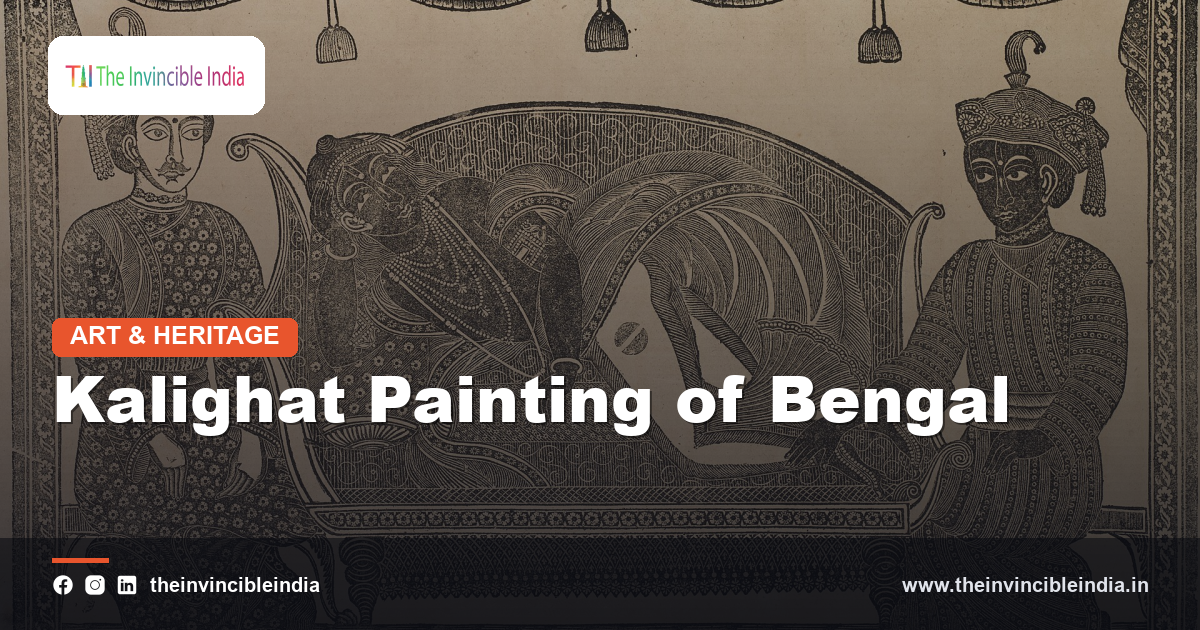
Kalighat painting is a distinctive folk art tradition that emerged in the nineteenth century near the Kalighat temple in Kolkata, developed by scroll painters who adapted their skills to meet the demand of pilgrims and city dwellers for quick, affordable images. Painted with sweeping brushstrokes and flat, vivid colour on paper, Kalighat works range from images of deities to sharp satirical scenes of contemporary Bengali society, making the tradition as notable for its wit as for its style. It grew out of the older Bengali tradition of scroll painting, much as other regional folk styles trace their roots to earlier painting and scroll traditions across the country. This guide explores its origins, style, themes and heritage.
Quick Facts
| Detail | Information |
|---|---|
| Type | A Bengali folk painting tradition |
| Origin | Developed near the Kalighat temple in Kolkata |
| Period | Flourished chiefly in the nineteenth century |
| Style | Bold sweeping brushwork with flat vivid colour |
| Themes | Deities, mythology and satire of urban society |
| Heritage | A pioneering tradition of modern Indian folk art |
Kalighat Painting: An Overview
Kalighat painting is a bold and distinctive folk art tradition that developed in the nineteenth century in the vicinity of the Kalighat temple in Kolkata, where itinerant scroll painters settled to sell devotional images to the many pilgrims visiting the shrine. Working quickly with brush and pigment on paper, these painters produced images of striking simplicity and confidence, using sweeping lines and flat colour to capture both sacred subjects and scenes of everyday city life. This economy of style became the hallmark of the tradition. As a bold folk art born at the meeting point of temple pilgrimage and city life, Kalighat painting occupies a distinctive and influential place in the history of Indian art.
Origins Near the Kalighat Temple
The tradition takes its name and much of its early character from its origin near the Kalighat temple, a major site of pilgrimage in Kolkata where large numbers of devotees sought inexpensive devotional images to carry home as souvenirs of their visit. Painters gathered in the area to meet this demand, producing quick, affordable works on paper rather than the more time-consuming cloth scrolls of earlier tradition. This practical demand shaped the entire character of the style. This origin of Kalighat painting in the commercial life around a great pilgrimage temple explains both its speed of production and its direct, appealing visual style.
Roots in Bengali Scroll Painting
Kalighat painting grew directly out of the older Bengali tradition of patachitra, or scroll painting, in which travelling artists illustrated devotional narratives on long painted scrolls that they unrolled while singing accompanying verses. As these artists moved to the city and adapted to a new urban clientele, they simplified their technique and format, moving from long narrative scrolls to single sheets that could be produced quickly and sold cheaply. This adaptation marked a significant evolution of the older craft. This grounding of Kalighat painting in the patachitra tradition of rural Bengal reveals how folk art could evolve rapidly to meet the changing demands of urban life.
Technique and Materials
Kalighat painters worked rapidly, using a few confident brushstrokes to define the outline and volume of a figure before filling the forms with flat washes of watercolour in a limited but vivid palette. This economical technique allowed painters to produce a large number of works in a short time, meeting the steady demand of pilgrims and buyers without sacrificing visual impact. Shading was often used sparingly to suggest form and dimension. This distinctive technique of swift outline and flat colour gives Kalighat painting its immediately recognisable style and its enduring appeal to later artists and audiences alike.
Deities and Mythological Themes
A large part of Kalighat painting’s output consisted of devotional images depicting Hindu deities and scenes from mythology, produced to meet the needs of pilgrims visiting the Kalighat temple and other shrines of the city. These devotional works, though quickly made, achieved a striking clarity and dignity through their bold composition and confident line, making them effective and appealing objects of everyday worship. Their popularity sustained the painters’ livelihoods. This substantial body of devotional and mythological work forms an important foundation of the Kalighat tradition, even as the style became equally celebrated for its secular and satirical subjects.
Satire and Social Commentary
Alongside devotional imagery, Kalighat painters became known for sharp and often humorous depictions of contemporary Bengali urban society, poking fun at fashionable excess, hypocrisy and the changing manners of a colonial-era city undergoing rapid social change. These satirical works captured public figures and social types with wit and economy, offering a visual commentary on the anxieties and absurdities of the period. This satirical strand gave the tradition unusual social relevance. This tradition of satire and social commentary within Kalighat painting distinguishes it from most other folk painting traditions and gives it lasting interest as social history.
Colour and Palette
Kalighat painters worked with a relatively limited palette of watercolours, favouring strong, saturated hues applied in flat, unmodulated areas that gave their images a bold graphic clarity well suited to quick production and immediate visual impact. This restrained use of colour, combined with confident outline, produced images that read clearly even at a glance, an important quality for works intended for a fast-moving market of pilgrims and city buyers. The resulting style has a striking modern feel. This bold and economical use of colour is one of the most immediately recognisable and admired features of Kalighat painting.
Figures and Composition
The figures of Kalighat painting are typically rendered with rounded, fluid forms and a strong sense of volume achieved through a few sweeping curves rather than detailed modelling, giving even simple compositions a lively sense of presence and movement. Compositions were usually kept simple, focusing attention on one or two figures against a plain background, allowing the subject and its expression to dominate the image. This clarity of composition suited the speed of production required. This distinctive treatment of figure and composition in Kalighat painting anticipated qualities later admired in modern graphic and poster art.
Commercial Production and the Bazaar
Kalighat painting operated within a lively commercial market, produced not for royal or temple patronage in the traditional sense but for sale directly to ordinary pilgrims and city residents in the bazaars surrounding the temple. This commercial basis distinguished the tradition from many earlier Indian painting schools tied to court or monastic patronage, and it encouraged painters to develop styles that were fast to produce, visually striking and immediately appealing to a broad public. This market orientation shaped its entire character. This commercial, popular basis of Kalighat painting marks it as an important early example of art produced for a broad urban public rather than an elite patron.
Kalighat Painting in the Colonial Context
Kalighat painting flourished during the colonial period in Kolkata, a city undergoing rapid change under British administration, and its subjects often reflected the social tensions and cultural encounters of that era, from changing fashions to the mingling of Indian and European customs. Painters observed this changing world with a sharp and often ironic eye, capturing the contradictions of a society caught between tradition and new colonial influences. This historical setting gives the paintings added documentary value. This colonial context of Kalighat painting helps explain both its satirical edge and its role as a visual record of nineteenth-century Bengali urban life.
Influence on Printmaking and Popular Art
The bold, simplified style of Kalighat painting influenced the development of popular printmaking in Bengal, as woodblock and later lithographic prints adapted its compositions and themes for even wider and cheaper circulation among the public. This transition from hand-painted originals to printed multiples extended the reach of Kalighat imagery well beyond what individual painters could achieve by hand. The clarity of the style translated well to print. This influence of Kalighat painting on early Indian printmaking and popular visual culture underscores its importance as a pioneer of accessible, mass-produced art in India.
Decline of the Tradition
By the early twentieth century, the market for Kalighat painting had begun to decline as cheaper printed images produced by mechanical presses increasingly replaced hand-painted works, undercutting the trade that had sustained generations of painters near the temple. Changing tastes and the growing availability of other forms of popular imagery further reduced demand for the traditional hand-painted pat. This shift marked the effective end of Kalighat painting as a living commercial trade. This decline of Kalighat painting in the face of mechanised printing illustrates the broader pressures that transformed many traditional Indian crafts during the early twentieth century.
Rediscovery by Collectors and Scholars
Long after its commercial decline, Kalighat painting was rediscovered by collectors, scholars and museums who recognised its artistic originality and its value as a record of nineteenth-century Bengali life, leading to significant collections being formed both in India and abroad. This renewed appreciation restored the reputation of a tradition once dismissed as mere bazaar art, situating it instead as an important and innovative chapter in the history of Indian painting. Exhibitions have since brought the style to wider audiences. This rediscovery of Kalighat painting by scholars and collectors has secured its place as a genuinely original contribution to modern Indian art history.
Influence on Modern Indian Artists
The bold line and flat colour of Kalighat painting later influenced modern Indian artists seeking a visual language rooted in indigenous tradition rather than imported academic styles, drawing on its economy of means and directness of expression. Painters and designers admired the confidence of Kalighat brushwork, finding in it a model for a distinctly Indian modernism that owed little to Western convention. This legacy extended the tradition’s influence well beyond its original context. This influence of Kalighat painting on later Indian artists demonstrates the lasting creative value of a tradition originally intended for the humble pilgrim trade.
Preservation and Museum Collections
Surviving examples of Kalighat painting are today preserved in museum collections in India and abroad, where they are studied for both their artistic qualities and their historical value as records of nineteenth-century urban Bengali society. Conservation of these fragile paper works, along with continued scholarship and exhibition, ensures that the tradition remains accessible to new generations of viewers and researchers. This institutional care has been vital to its survival. This ongoing preservation of Kalighat painting in museum collections plays an essential role in keeping this pioneering folk tradition visible and appreciated today.
Kalighat Painting Today
Today Kalighat painting is recognised as one of the most original and historically significant folk art traditions of India, admired for its bold technique, its wit and its vivid record of a changing society. A small number of contemporary artists continue to practise and revive Kalighat-style painting, keeping its methods alive even as the original commercial context that produced it has long since passed. Its influence continues to be traced in Indian visual culture. As a bold and inventive tradition born at the meeting point of pilgrimage, city life and satire, Kalighat painting remains a cherished chapter in the story of Indian folk art.
Sources & Further Reading
- Ministry of Culture, Government of India, on the folk and traditional art forms of Bengal (indiaculture.gov.in).
- Sangeet Natak Akademi, on the traditional and folk arts of India.
Frequently Asked Questions
What is Kalighat painting?
Kalighat painting is a folk art tradition that developed in the nineteenth century near the Kalighat temple in Kolkata, known for its bold sweeping brushwork, flat vivid colour and subjects ranging from Hindu deities to satirical scenes of urban Bengali life.
Where did Kalighat painting originate?
Kalighat painting originated in the area surrounding the Kalighat temple in Kolkata, where scroll painters from the Bengali patachitra tradition settled to sell quick, affordable devotional images to pilgrims visiting the shrine.
What subjects did Kalighat painters depict?
Kalighat painters depicted a wide range of subjects, including Hindu deities and mythological scenes as well as sharp satirical images of contemporary urban society, capturing changing fashions and social attitudes in colonial-era Kolkata.
Why did Kalighat painting decline?
Kalighat painting declined in the early twentieth century as cheaper mechanically printed images increasingly replaced hand-painted works, undercutting the commercial trade that had long sustained painters working near the temple.
Why is Kalighat painting important to Indian art history?
Kalighat painting is important for its bold, original style and for later influencing modern Indian artists and printmakers, as well as for its value as a vivid visual record of nineteenth-century Bengali urban society.


