

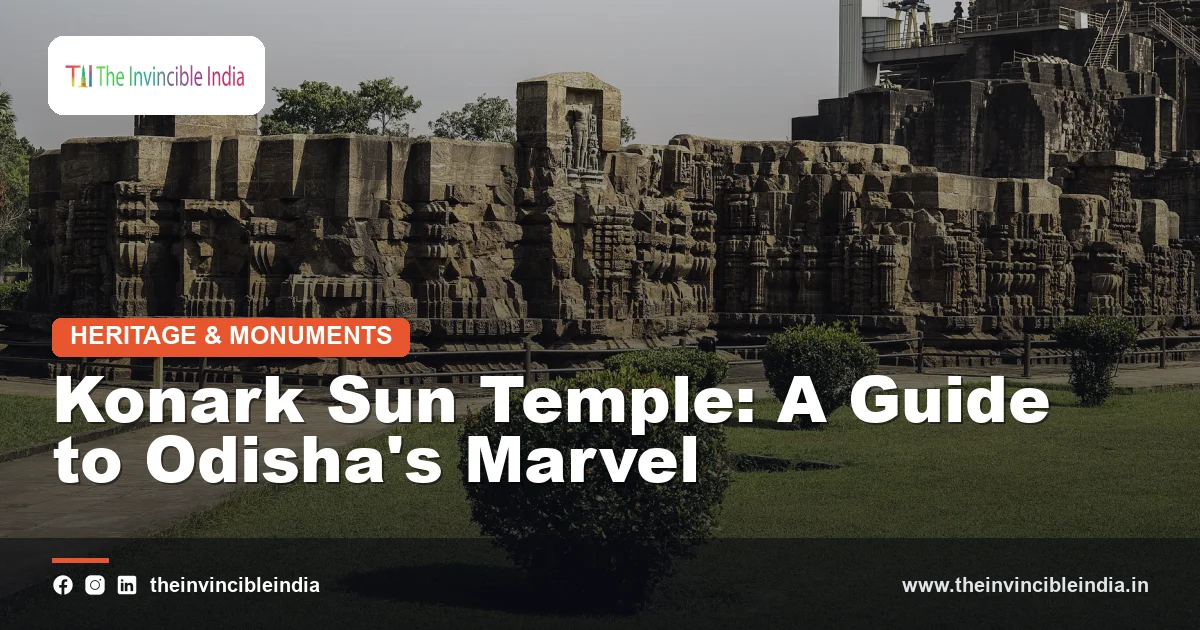
The Konark Sun Temple in Odisha is one of India’s most breathtaking and iconic monuments. Built in the 13th century, this UNESCO World Heritage Site is designed as a colossal stone chariot of Surya, the Sun God, and is a marvel of engineering, astronomy and artistry. So significant is it to India’s heritage that it features on the reverse of the Indian ten-rupee note. This detailed guide explores the history, architecture, symbolism and visiting details of the Konark Sun Temple.
Quick Facts
| Location | Konark, Odisha |
| Built | Around 1250 CE |
| Built by | King Narasimhadeva I (Eastern Ganga dynasty) |
| Dedicated to | Surya, the Sun God |
| UNESCO status | World Heritage Site (1984) |
The Chariot of the Sun
The Konark Sun Temple is conceived as a magnificent chariot of Surya, the Sun God, complete with twelve pairs of intricately carved stone wheels and drawn by seven galloping horses. The design is rich in symbolism: the twenty-four wheels are widely believed to represent the hours of the day (or the fortnights of the year), while the seven horses are said to symbolise the seven days of the week, together evoking the passage of time and the daily journey of the sun across the sky.
History of the Temple
The temple was built around 1250 CE by King Narasimhadeva I of the Eastern Ganga dynasty, reportedly employing thousands of artisans and craftsmen over more than a decade. Its name, “Konark,” derives from “Kona” (corner or angle) and “Arka” (the sun). Over the centuries, parts of the temple, including its towering main sanctuary, fell into ruin, but the surviving structures remain among the greatest achievements of Indian temple architecture.
The Wheels as Sundials
Among the temple’s most astonishing features are its beautifully carved wheels, which are not merely decorative but function as accurate sundials. The precise time of day can be calculated from the shadows cast by the spokes, a feat that reflects the advanced astronomical and mathematical knowledge of its builders. Visitors are often amazed to learn that these medieval stone wheels can still tell the time.
Intricate Carvings
Every surface of the Konark Sun Temple is adorned with exquisite sculptures, making it an open-air gallery of medieval Odishan art. The carvings depict gods and goddesses, celestial dancers and musicians, animals such as elephants and horses, mythological scenes, and vivid depictions of everyday life. The craftsmanship, detail and scale of these sculptures place Konark among the finest examples of Indian temple art.
Decline and Preservation
Like many great monuments, Konark suffered damage over the centuries from natural forces and neglect, and its main tower collapsed. In more recent times, extensive conservation efforts, including by the Archaeological Survey of India, have preserved and stabilised the surviving structures. Today the temple is protected as a UNESCO World Heritage Site and remains one of India’s most visited and admired monuments.
The Konark Dance Festival
Each year, the illuminated temple provides a magnificent backdrop for the Konark Dance Festival, a celebration of India’s classical dance forms, especially Odissi — itself deeply inspired by the sculptures of Odisha’s temples. The festival draws leading artists and audiences and is a wonderful time to experience Konark’s blend of art, architecture and performance.
Nearby Attractions
Konark forms part of Odisha’s “Golden Triangle” of tourism, together with the holy city of Puri, home to the famous Jagannath Temple and its grand Rath Yatra, and the state capital Bhubaneswar, known as the “Temple City” for its hundreds of ancient temples. The nearby Chandrabhaga Beach, a short distance from the temple, is a peaceful spot to watch the sunrise over the Bay of Bengal.
Best Time to Visit and How to Reach
The best time to visit Konark is between October and February, when the weather is pleasant. The temple is easily reached from Bhubaneswar (about 65 kilometres) and Puri (about 35 kilometres) by road, and hiring a knowledgeable guide greatly enriches the experience, bringing the temple’s symbolism and stories to life.
The Legend of the Temple’s Construction
A moving legend surrounds the building of the Konark Sun Temple. It is said that a team of 1,200 artisans, led by the master architect Bisu Maharana, laboured for twelve years but struggled to complete the crowning stone of the temple. According to the tale, the architect’s young son, Dharmapada, who had never met his father, arrived at the site and solved the engineering challenge, completing the temple — but, to save the honour of the artisans who had failed, he is said to have sacrificed his own life in the sea. This poignant story is woven into the temple’s enduring mystique.
The Structure of the Temple
The Konark complex was designed as a grand ensemble. Beyond the main sanctuary (deul) and the audience hall (jagamohana), which survives today, the temple included a dancing hall (Nata Mandir), where temple dancers once performed for the Sun God, and a hall of offerings (Bhoga Mandapa). The alignment of the temple was such that the first rays of the rising sun would once illuminate the deity within, reflecting the profound astronomical thought behind its design.
The Symbolism of Konark
Every element of the Konark Sun Temple carries meaning. As a chariot of the Sun, it celebrates Surya’s daily journey across the heavens and the cycles of time. The wheels represent time itself, the horses the days of the week, and the intricate carvings depict the whole spectrum of life, from the divine to the everyday. The temple is thus not only a place of worship but a cosmic monument, embodying the ancient Indian understanding of the universe, time and the sun’s life-giving power.
The Konark Museum and Conservation
Adjacent to the temple, the ASI’s Konark Museum displays sculptures and architectural fragments recovered from the site, helping visitors appreciate the artistry and scale of the original structure. The Archaeological Survey of India has undertaken extensive work to conserve and stabilise the monument against the effects of sea air, weather and time, ensuring that this masterpiece endures for future generations to admire.
Chandrabhaga Beach and the Golden Triangle of Odisha
A short distance from the temple lies Chandrabhaga Beach, a tranquil stretch of coast famous for its sunrises and associated with the Magha Saptami festival, when pilgrims gather to bathe. Konark itself forms one point of Odisha’s “Golden Triangle” of tourism, together with the sacred city of Puri, home to the Jagannath Temple, and the “Temple City” of Bhubaneswar, making it easy to combine these three remarkable destinations in a single trip.
How to Reach and Visiting Tips
Konark is well connected by road, about 35 kilometres from Puri and 65 kilometres from Bhubaneswar, which has the nearest airport and major railway station. The best time to visit is between October and February, and the annual Konark Dance Festival in early December is a wonderful occasion. Hiring a knowledgeable guide is highly recommended to fully appreciate the temple’s intricate symbolism, and mornings offer the best light for photography and the fewest crowds.
The Konark Wheel: A National Symbol
The Konark wheel has become an enduring symbol of India’s heritage and progress. Its elegant, precise design, representing the wheel of time, has been adopted in various emblems and is instantly recognisable across the country. Its appearance on the ten-rupee note and its use in official iconography reflect the pride India takes in this masterpiece, which stands as a testament to the nation’s ancient achievements in art, astronomy and engineering.
Odissi Dance and the Temple
The Konark Sun Temple has a deep connection with Odissi, one of India’s classical dance forms. The temple’s Nata Mandir (dancing hall) once hosted performances dedicated to the Sun God, and the graceful poses of its sculpted celestial dancers directly influenced the postures and movements of Odissi. Today, the annual Konark Dance Festival celebrates this bond, with performances of Odissi and other classical dances set against the floodlit temple, a magical fusion of architecture and living art.
Nearby Attractions and Beaches
The area around Konark offers more to explore. Chandrabhaga Beach, a short distance away, is a serene spot for sunrise and is significant during the Magha Saptami festival. The Ramachandi Temple, set beside a river and the sea, and the turtle-nesting beaches of the Odisha coast add to the region’s appeal. Combined with Puri and Bhubaneswar, Konark forms part of a rich circuit of temples, beaches and culture along the Bay of Bengal.
The Enduring Wonder of Konark
Even in its partially ruined state, the Konark Sun Temple continues to inspire awe in all who visit. The sheer ambition of its conception — a colossal chariot of the sun rendered in stone, aligned with the heavens and adorned with countless sculptures — speaks of a civilisation of extraordinary vision and skill. Standing before its great wheels, visitors feel a powerful connection to the artisans who, nearly eight centuries ago, sought to capture the majesty of the sun itself in enduring stone.
Planning Your Visit to Konark
A visit to Konark is easy to plan and richly rewarding. Allow two to three hours to explore the temple complex thoroughly, ideally in the morning when the light is soft and the crowds are thinner. Wear comfortable shoes and a hat, carry water, and consider engaging one of the ASI-approved guides at the entrance, whose explanations of the carvings, symbolism and legends transform a simple walk into a fascinating journey through history. The temple pairs perfectly with Puri and Bhubaneswar for a complete Odisha experience.
A Timeless Masterpiece
The Konark Sun Temple stands as one of the crowning achievements of Indian civilisation — a monument where art, science, faith and imagination meet in stone. Its chariot of the sun, frozen mid-journey across the sky, has inspired poets, dancers, scholars and travellers for centuries. To stand before it is to feel the ambition and genius of those who built it, and to understand why this remarkable temple continues to be celebrated as one of the great wonders of India’s architectural heritage.
Konark: A Journey Through Time
Ultimately, a visit to Konark is a journey through time — back to a 13th-century world of master craftsmen, devout kings and profound cosmic vision. The temple reminds us of the heights that human creativity and devotion can reach, and of the importance of preserving such treasures for the future. Whether you come as a pilgrim, a history enthusiast, an art lover or a curious traveller, the great chariot of the sun at Konark will leave you deeply moved and inspired.
Frequently Asked Questions
Who built the Konark Sun Temple?
It was built around 1250 CE by King Narasimhadeva I of the Eastern Ganga dynasty.
Why is the Konark Sun Temple shaped like a chariot?
It is designed as the chariot of Surya, the Sun God, with 24 wheels and seven horses.
Do the temple wheels really tell time?
Yes, the carved wheels function as sundials that can indicate the time of day from their shadows.
Is Konark a UNESCO World Heritage Site?
Yes, the Konark Sun Temple was inscribed as a UNESCO World Heritage Site in 1984.
What is the best time to visit Konark?
October to February offers the most pleasant weather.


