

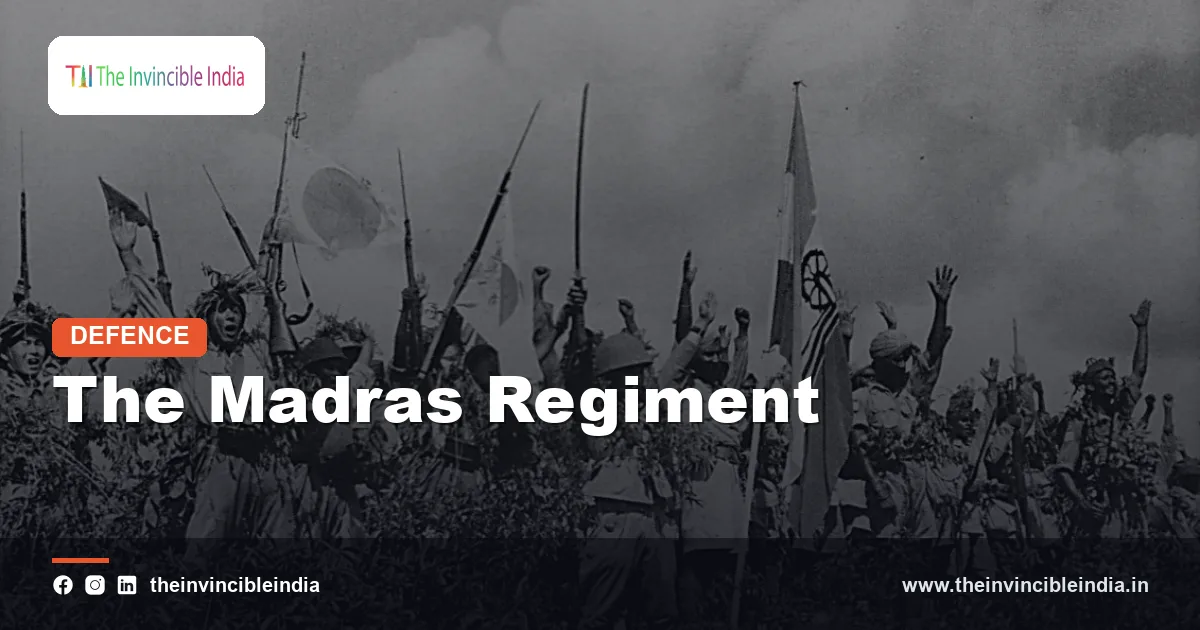
The Madras Regiment is the oldest infantry regiment of the Indian Army, tracing its roots to the sepoy battalions that the East India Company raised on the Coromandel Coast in the eighteenth century and recruiting soldiers from the southern states of India. Its men are affectionately known as “Thambis”, a Tamil and Malayalam word for younger brother, and they fight to the war cry “Veera Madrasi, Adi Kollu, Adi Kollu, Adi Kollu”.
The regiment’s story runs from the Carnatic Wars and the Battle of Assaye in 1803 to the Second World War and the wars fought since 1947, including the 1971 capture of the Siramani post. This explainer covers the history, battle honours, symbols, recruitment and traditions of the Madras Regiment using public, well-established facts.
Quick Facts
| Item | Madras Regiment of the Indian Army |
|---|---|
| Origin | Coast sepoy battalions of the East India Company, formalised by Stringer Lawrence in the 1750s |
| Type | Infantry regiment; the oldest infantry regiment of the Indian Army |
| Name history | Madras Native Infantry; 3rd Madras Regiment (1922); Madras Regiment (1947) |
| War cry | “Veera Madrasi, Adi Kollu, Adi Kollu, Adi Kollu” |
| Motto | “Swadharme Nidhanam Shreyah” (it is glorious to die in the performance of one’s duty), from the Bhagavad Gita |
| Regimental Centre | Wellington, Tamil Nadu (Nilgiris) |
| Symbol | The Assaye elephant over crossed Malabar swords |
| Distinctive dress | Black pom-pom on a green beret, adopted in 1949 |
Key Takeaways
- The Madras Regiment is the oldest infantry regiment of the Indian Army, descending from the Company’s sepoy battalions on the Coromandel Coast.
- The Madras Regiment’s crest is the Assaye elephant over crossed Malabar swords, a symbol that commemorates the Battle of Assaye of 1803.
- The soldiers of the Madras Regiment are called “Thambis”, meaning younger brothers in Tamil and Malayalam, and the regiment’s Centre is at Wellington in the Nilgiri hills of Tamil Nadu.
- The Madras Regiment’s motto, “Swadharme Nidhanam Shreyah”, is taken from chapter 3, verse 35 of the Bhagavad Gita and means that it is glorious to die doing one’s duty.
- The Madras Regiment earned post-Independence battle honours at Tithwal, Punch, Kalidhar, Maharajke, Basantar and Siramani.
- The Madras Regiment recruits from Tamil Nadu, Kerala, Karnataka, Andhra Pradesh and Telangana, and its black pom-pom on the green beret is unique in the Indian Army.
What is the Madras Regiment?
The Madras Regiment is an infantry regiment of the Indian Army that recruits soldiers from the southern states and is regarded as the Army’s oldest infantry regiment. Its battalions serve across the country in all kinds of terrain, from the deserts and plains of the western border to the mountains of Jammu and Kashmir and the jungles of the north-east.
The regiment is composed of a number of regular battalions, each with its own history and nickname, supported by the Madras Regimental Centre. It follows an all-class composition drawn from the southern states rather than a single community.
The regiment should not be confused with the Madras Engineer Group, the Madras Sappers, which is a separate corps of engineers based at Bengaluru. The two share the historic “Madras” name from the old Madras Army but have different roles and traditions.
How old is the Madras Regiment and where did it begin?
The Madras Regiment traces its beginnings to the 1750s, when the East India Company’s Coast sepoys on the Madras side were organised into regular battalions under Major Stringer Lawrence, although some of its units claim lineages that reach back even earlier. Sources give different founding dates, because the sepoy companies of the early eighteenth century were gradually consolidated into formal battalions.
The units were first known as Coast Sepoys. In 1769 they were grouped as Carnatic and Circar battalions, in 1784 they became Madras battalions, and in 1796 they were organised as the Madras Native Infantry, numbered from the 1st to the 50th. The word “Native” was dropped in 1891.
In 1922 the regiment became the 3rd Madras Regiment, and in 1947 the numeral was dropped, leaving the present name. The 9th Battalion, which grew from the Nair units of Travancore, is regarded as its oldest battalion.
Key dates in the regiment’s lineage
| Year | Development |
|---|---|
| 1750s | Coast sepoy units organised into battalions under Stringer Lawrence |
| 1769 | Carnatic and Circar battalions formed |
| 1784 | Battalions renamed as Madras battalions |
| 1796 | Madras Native Infantry numbered 1st to 50th |
| 1803 | Battle of Assaye; the elephant badge sanctioned |
| 1891 | The word “Native” dropped |
| 1922 | 3rd Madras Regiment formed |
| 1942 | Regimental Centre re-raised at Madukkarai |
| 1947 | Centre moved to Wellington; regiment becomes the Madras Regiment |
Why do Madras Regiment soldiers carry the Assaye elephant?
The Assaye elephant appears on the crest of the Madras Regiment because the Battle of Assaye, fought on 23 September 1803, was one of the great victories of the Madras Army, and the elephant was sanctioned as a battle badge after it. At Assaye, in the Second Anglo-Maratha War, a smaller force under Major General Arthur Wellesley, later the Duke of Wellington, defeated a much larger Maratha army.
The badge was authorised for several Madras battalions after the battle. The crest of the present regiment shows the elephant standing over two crossed Malabar swords, with a shield at the crossing, and it is a bi-metallic emblem.
The elephant is a symbol and a battle badge, and not a living mascot. The shoulder title of the regiment is simply “Madras”, and its dress also includes the black pom-pom worn on a green beret, a feature adopted in January 1949 and not used by any other Indian regiment.
What does “Thambi” mean and why is it used for Madras Regiment soldiers?
“Thambi” is a Tamil and Malayalam word meaning younger brother, and it is used as an affectionate and respectful nickname for the soldiers of the Madras Regiment, who are called “Thambis”. The term reflects the closeness of the regiment’s southern community and the family-like bonds of its units.
The name is applied to the whole regiment in popular usage. Individual battalions have their own nicknames as well, and the 8th Battalion, which captured the Siramani post in East Pakistan in 1971, is often remembered as the gallant Thambis of that action.
In modern Army usage, “Thambi” expresses pride in southern identity within a national force.
What is the war cry and motto of the Madras Regiment?
The war cry of the Madras Regiment is “Veera Madrasi, Adi Kollu, Adi Kollu, Adi Kollu”, which can be translated as “Brave Madrasi, strike and kill”. It was adopted formally at a conference of battalion commanders in 1969 and is drawn from the martial tradition of the Nair soldiers of Travancore.
The motto of the regiment is “Swadharme Nidhanam Shreyah”, a phrase from the Bhagavad Gita, chapter 3, verse 35. It means that it is better, or more glorious, to die in the performance of one’s own duty. The motto was adopted on 8 June 1955.
These two expressions reflect the regiment’s character: aggressive in battle, and anchored in the ideal of duty found in Indian philosophy.
What are the major battle honours of the Madras Regiment?
The Madras Regiment carries battle honours that stretch from the Carnatic Wars of the eighteenth century to the wars of 1948, 1965 and 1971. The honours reflect more than 250 years of service by its various battalions.
Before 1947
- Carnatic and Sholinghur: the eighteenth-century wars in south India.
- Seringapatam (1799) and Mysore: the campaigns against Tipu Sultan.
- Assaye (1803): the victory in the Second Anglo-Maratha War, source of the elephant badge.
- Mesopotamia and Kilimanjaro: service in the First World War in Iraq and East Africa.
- Burma and Mount Popa: the Second World War campaign in Burma.
After 1947
- Tithwal and Punch (1948): actions in Jammu and Kashmir.
- Kalidhar and Maharajke (1971): actions in the western theatre.
- Basantar (1971): the battle of the Shakargarh sector.
- Siramani (1971): the capture of a fortified post in East Pakistan by the 8th Battalion.
Commonly quoted gallantry tallies for the regiment include five Maha Vir Chakras, dozens of Vir Chakras, Shaurya Chakras and Kirti Chakras, and hundreds of Sena Medals, but exact numbers vary between sources.
Who are the notable gallantry award winners of the Madras Regiment?
Among the notable award winners of the Madras Regiment lineage are two Victoria Cross winners from the Madras Native Infantry period and a recipient of the Ashoka Chakra, the highest peacetime gallantry award, after Independence. The Victoria Cross winners are Lieutenant Herbert Clogstoun, decorated in 1859, and Lieutenant Charles Grant, decorated in connection with the 1891 Manipur campaign.
After Independence, Lieutenant Ram Prakash Roperia of the 26th Battalion received the Ashoka Chakra. The regiment’s soldiers have also won Maha Vir Chakras and Vir Chakras in the 1948, 1965 and 1971 wars and in counter-insurgency operations.
The record of the 8th Battalion at Siramani is regarded as one of the regiment’s best-known post-Independence achievements, and the action is often discussed in studies of the 1971 war in East Pakistan.
Where is the Madras Regiment Centre and how does it recruit?
The Madras Regimental Centre is located at Wellington in the Nilgiri hills of Tamil Nadu, where it moved in February 1947 after being re-raised at Madukkarai in July 1942. The Centre trains recruits and maintains the regimental records, museum and traditions.
The regiment recruits from the former Madras Presidency and Mysore regions, which today means Tamil Nadu, Kerala, Karnataka, Andhra Pradesh and Telangana. Tamil and Malayalam speakers have traditionally formed the largest groups, and recruitment of Telugu and Kannada speakers has grown since the 1990s.
The historic Nair battalions, which became the 9th and 16th Battalions, drew heavily on the former princely states of Travancore and Cochin. Officers of the regiment can be commissioned from any part of India.
Recruitment rules for the Indian Army change from time to time, so candidates should check current official notices.
How does the Madras Regiment differ from other infantry regiments?
The Madras Regiment differs from many other infantry regiments in being drawn from the southern states and in being the oldest in the Army, with a distinct emblem, dress and war cry. Many other regiments are tied to a single community or region of north or western India, whereas the Madras Regiment draws on several southern languages.
| Feature | Madras Regiment |
|---|---|
| Region | Southern India (Tamil Nadu, Kerala, Karnataka, Andhra Pradesh, Telangana) |
| Seniority | Oldest infantry regiment of the Indian Army |
| Emblem | Assaye elephant over crossed Malabar swords |
| Headdress detail | Black pom-pom on a green beret |
| Nickname for soldiers | Thambis |
| Centre | Wellington, Tamil Nadu |
What was the role of the Madras Regiment in the world wars?
The Madras Regiment, through its forerunner battalions, served in both World Wars, with First World War service in Mesopotamia and East Africa and Second World War service chiefly in Burma. The regiment’s battle honours Kilimanjaro, Mesopotamia, Burma and Mount Popa record this service.
In the First World War, Madras battalions took part in the campaign against German forces in East Africa, including the fighting around Kilimanjaro in 1916, and in operations in Iraq against Ottoman forces. These campaigns were fought in harsh climate and difficult terrain, with disease an ever-present danger.
In the Second World War, the Madras Regimental Centre was re-raised at Madukkarai on 19 July 1942 as the Army expanded rapidly, and the regiment’s battalions served in the Burma theatre, where honours such as Mount Popa were earned in 1945. The move of the Centre to Wellington in February 1947 prepared the regiment for its transition to the Indian Army after Independence.
These wartime experiences shaped the discipline, endurance and regimental pride that the Madras Regiment carried into its post-Independence campaigns in Jammu and Kashmir and on the western and eastern fronts.
Why does the Madras Regiment matter?
The Madras Regiment matters because it represents the contribution of southern India to the Army over more than two and a half centuries and because it keeps alive some of the earliest chapters of modern Indian military history. Its record shows that the Indian infantry tradition is not confined to a single region.
The regiment also stands as an example of continuity, from the Coast sepoys of the Carnatic Wars through the Madras Native Infantry and the 3rd Madras Regiment to a modern force with its own motto from the Bhagavad Gita and a war cry in the southern languages.
Bottom Line
The Madras Regiment is the oldest infantry regiment of the Indian Army, with roots in the Company’s sepoy battalions, the Assaye elephant as its emblem and Thambis as its soldiers. Its record runs from Assaye and Seringapatam to Tithwal, Basantar and Siramani. Last reviewed: 15 October 2026.
Frequently Asked Questions
What is the Madras Regiment?
The Madras Regiment is the oldest infantry regiment of the Indian Army and recruits soldiers from the southern states. It descends from the East India Company’s Coast sepoy battalions of the eighteenth century. Its Regimental Centre is at Wellington in Tamil Nadu.
Why are Madras Regiment soldiers called Thambis?
Madras Regiment soldiers are called Thambis because “thambi” means younger brother in Tamil and Malayalam. The name is used affectionately and with pride for the regiment’s southern soldiers. It is also associated with the 8th Battalion’s well-known action at Siramani in 1971.
What is the war cry of the Madras Regiment?
The war cry of the Madras Regiment is “Veera Madrasi, Adi Kollu, Adi Kollu, Adi Kollu”. It means roughly “Brave Madrasi, strike and kill” and was formally adopted in 1969. Its motto is “Swadharme Nidhanam Shreyah” from the Bhagavad Gita.
What is the symbol of the Madras Regiment?
The symbol of the Madras Regiment is the Assaye elephant standing over crossed Malabar swords. The elephant commemorates the Battle of Assaye of 23 September 1803, and the badge is not a living mascot. The regiment also wears a black pom-pom on its green beret, a feature unique in the Army.
Where is the Madras Regiment Centre?
The Madras Regimental Centre is at Wellington in the Nilgiris district of Tamil Nadu. It was re-raised at Madukkarai in 1942 and moved to Wellington in 1947. The Centre trains recruits and preserves the regiment’s history.
Which states does the Madras Regiment recruit from?
The Madras Regiment recruits from Tamil Nadu, Kerala, Karnataka, Andhra Pradesh and Telangana. Tamil and Malayalam speakers have traditionally been the largest groups, with more Telugu and Kannada recruits since the 1990s. Recruitment rules can change, so official notices should be checked.
{“@context”:”https://schema.org”,”@graph”:[{“@type”:”FAQPage”,”mainEntity”:[{“@type”:”Question”,”name”:”What is the Madras Regiment?”,”acceptedAnswer”:{“@type”:”Answer”,”text”:”The Madras Regiment is the oldest infantry regiment of the Indian Army and recruits soldiers from the southern states. It descends from the East India Company’s Coast sepoy battalions of the eighteenth century. Its Regimental Centre is at Wellington in Tamil Nadu.”}},{“@type”:”Question”,”name”:”Why are Madras Regiment soldiers called Thambis?”,”acceptedAnswer”:{“@type”:”Answer”,”text”:”Madras Regiment soldiers are called Thambis because “thambi” means younger brother in Tamil and Malayalam. The name is used affectionately and with pride for the regiment’s southern soldiers. It is also associated with the 8th Battalion’s well-known action at Siramani in 1971.”}},{“@type”:”Question”,”name”:”What is the war cry of the Madras Regiment?”,”acceptedAnswer”:{“@type”:”Answer”,”text”:”The war cry of the Madras Regiment is “Veera Madrasi, Adi Kollu, Adi Kollu, Adi Kollu”. It means roughly “Brave Madrasi, strike and kill” and was formally adopted in 1969. Its motto is “Swadharme Nidhanam Shreyah” from the Bhagavad Gita.”}},{“@type”:”Question”,”name”:”What is the symbol of the Madras Regiment?”,”acceptedAnswer”:{“@type”:”Answer”,”text”:”The symbol of the Madras Regiment is the Assaye elephant standing over crossed Malabar swords. The elephant commemorates the Battle of Assaye of 23 September 1803, and the badge is not a living mascot. The regiment also wears a black pom-pom on its green beret, a feature unique in the Army.”}},{“@type”:”Question”,”name”:”Where is the Madras Regiment Centre?”,”acceptedAnswer”:{“@type”:”Answer”,”text”:”The Madras Regimental Centre is at Wellington in the Nilgiris district of Tamil Nadu. It was re-raised at Madukkarai in 1942 and moved to Wellington in 1947. The Centre trains recruits and preserves the regiment’s history.”}},{“@type”:”Question”,”name”:”Which states does the Madras Regiment recruit from?”,”acceptedAnswer”:{“@type”:”Answer”,”text”:”The Madras Regiment recruits from Tamil Nadu, Kerala, Karnataka, Andhra Pradesh and Telangana. Tamil and Malayalam speakers have traditionally been the largest groups, with more Telugu and Kannada recruits since the 1990s. Recruitment rules can change, so official notices should be checked.”}}]}]}


