

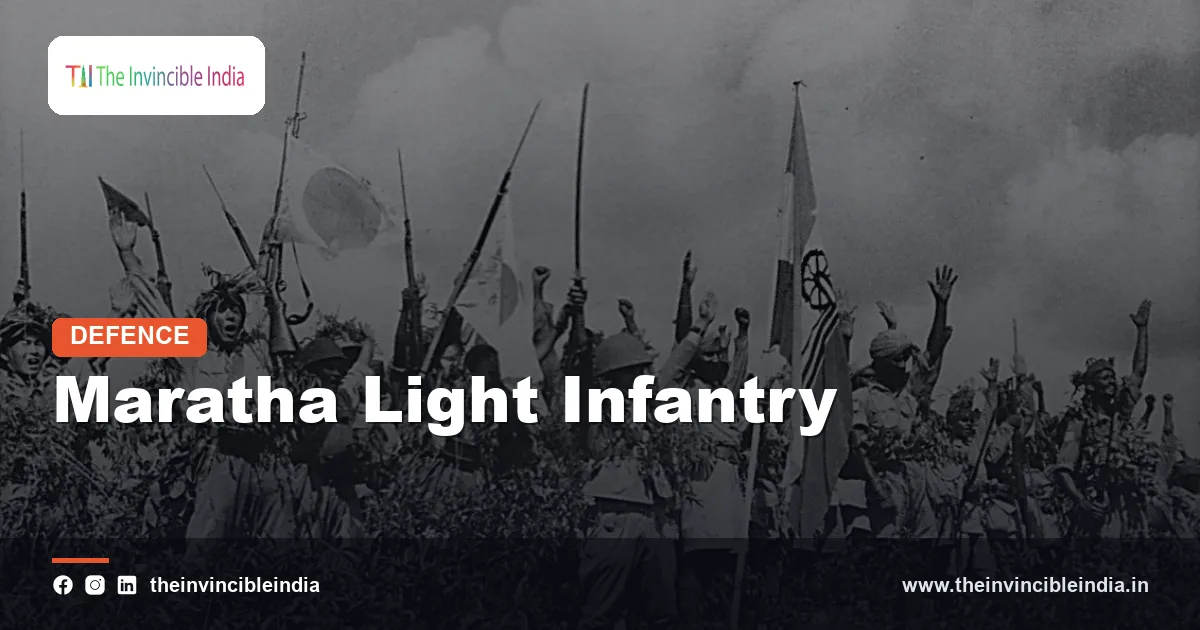
The Maratha Light Infantry is the most senior light infantry regiment of the Indian Army, tracing its lineage to the Bombay Sepoys raised by the East India Company in 1768 and carrying forward the martial heritage of Chhatrapati Shivaji Maharaj. Its soldiers go into battle with the cry “Bola Shri Chhatrapati Shivaji Maharaj Ki Jai” and are trained as light infantry, a role that stresses speed, mobility and initiative.
The regiment is based at Belagavi (Belgaum) in Karnataka and recruits mainly from Maharashtra and the Marathi-speaking areas of the neighbouring region. This explainer sets out the history, battle record, traditions and recruitment of the Maratha Light Infantry, limiting itself to well-established public facts.
Quick Facts
| Item | Maratha Light Infantry (MLI) of the Indian Army |
|---|---|
| Origin | Bombay Sepoys of the East India Company, first battalion raised in 1768 |
| Type | Light infantry regiment (classed as the senior light infantry regiment of the Army) |
| Earlier names | Bombay Native Infantry; 103rd Mahratta Light Infantry (1903); 5th Mahratta Light Infantry (1922); Maratha Light Infantry (after 1947) |
| War cry | “Bola Shri Chhatrapati Shivaji Maharaj Ki Jai” |
| Motto | Duty, Honour, Courage |
| Regimental Centre | Belagavi (Belgaum), Karnataka, since 1922 |
| Insignia | A bugle with cords over crossed swords, symbolising light infantry |
| Victoria Cross winners | Naik Yeshwant Ghadge (1944) and Sepoy Namdeo Jadhav (1945), both in Italy |
Key Takeaways
- The Maratha Light Infantry is the most senior light infantry regiment in the Indian Army and traces its beginnings to the Bombay Sepoys raised in 1768.
- The Maratha Light Infantry draws on the heritage of Chhatrapati Shivaji Maharaj, and its war cry is “Bola Shri Chhatrapati Shivaji Maharaj Ki Jai”.
- The 1st Battalion of the Maratha Light Infantry is known as the Jangi Paltan, meaning the fighting battalion, and the 2nd Battalion is known as the Kali Panchwin.
- Two soldiers of the Maratha Light Infantry, Naik Yeshwant Ghadge and Sepoy Namdeo Jadhav, won the Victoria Cross in Italy during the Second World War.
- The Maratha Light Infantry Regimental Centre has been at Belagavi in Karnataka since 1922, and it trains the regiment’s recruits.
- The Maratha Light Infantry has won battle honours in both World Wars and in the wars of 1947-48, 1965 and 1971, including Naushera, Jhangar, Burki, Hussainiwala and Jamalpur.
What is the Maratha Light Infantry?
The Maratha Light Infantry is an infantry regiment of the Indian Army, trained and organised as light infantry and recruited mainly from the Maratha community and other groups of Maharashtra. Light infantry in the Indian Army tradition are mobile troops, expected to move quickly, operate in difficult terrain and fight with initiative, a role historically linked with skirmishing.
The regiment consists of regular battalions, each of which carries its own history and nickname, supported by the Maratha Light Infantry Regimental Centre. Its battalions have served in plains, mountains and jungles, in conventional wars, internal security operations and international missions.
The regiment is often described as the oldest of its type because its first battalion was raised in 1768, well before the formation of the modern Indian Army. Its identity combines the discipline of the Company-era sepoy battalions with the military memory of the Maratha Empire.
When and how was the Maratha Light Infantry raised?
The Maratha Light Infantry was raised in 1768, when the East India Company formed a battalion of Bombay Sepoys to protect its possessions on the island of Bombay. This unit was initially designated the 2nd Battalion of the Bombay Sepoys and later became the 1st Battalion of the regiment, the Jangi Paltan.
A second battalion was raised in 1769, and as the Bombay Army grew, the units were renumbered several times. They were known as Bombay Native Infantry regiments in the nineteenth century and were converted to light infantry in 1871. Early campaigns included the wars against Mysore, in which the sepoys fought at Seedaseer and Seringapatam in 1799.
In 1903 the battalion was renamed the 103rd Mahratta Light Infantry, and in the 1922 reorganisation it became the 1st Battalion of the 5th Mahratta Light Infantry. After Independence in 1947 the number was dropped and the regiment became the Maratha Light Infantry of the Indian Army, with its centre at Belagavi.
Lineage of the senior battalion
| Year | Designation |
|---|---|
| 1768 | 2nd Battalion, Bombay Sepoys |
| 1796 | Battalion of the Bombay Native Infantry |
| 1824 | 3rd Bombay Native Infantry |
| 1871 | 3rd Bombay (Light) Infantry |
| 1903 | 103rd Mahratta Light Infantry |
| 1922 | 1st Battalion, 5th Mahratta Light Infantry |
| 1947 onwards | 1st Battalion, Maratha Light Infantry |
Why is the Maratha Light Infantry linked to Shivaji Maharaj?
The Maratha Light Infantry is linked to Chhatrapati Shivaji Maharaj (1630-1680) through its recruitment, its identity and its war cry, which invokes his name. Shivaji founded the Maratha state, was crowned at Raigad in 1674, and is remembered for his use of forts, speed and surprise, a style of warfare often called “ganimi kava”.
The regiment is not a direct descendant of Shivaji’s armies, because it was raised by the East India Company in the eighteenth century. The connection is one of heritage: the regiment recruits from the lands of the former Maratha Empire, adopts the symbols of that tradition and teaches its recruits the history of Shivaji and the Maratha warriors.
Shivaji’s emphasis on mobility, local knowledge, discipline and strong leadership matches the doctrine of light infantry, and the regiment draws on that parallel in its training and ethos. Statues, portraits and commemorations of Shivaji Maharaj are an integral part of regimental life.
A note on a common point of confusion: the 1818 Battle of Koregaon Bhima was fought by a battalion of the Bombay Native Infantry and is commemorated mainly through the lineage of other Bombay Army regiments, notably the Mahar Regiment. The Maratha Light Infantry shares the same Bombay Army background but its principal pre-1947 battle honours include Seedaseer, Seringapatam, Kahun and the Mesopotamia campaign.
What is the war cry of the Maratha Light Infantry?
The war cry of the Maratha Light Infantry is “Bola Shri Chhatrapati Shivaji Maharaj Ki Jai”, which means “Say, victory to Chhatrapati Shivaji Maharaj”. The cry is raised by a leader and answered by the troops, and it is used on parade, during ceremonies and in the field.
The regiment also uses the traditional Maratha calls “Har Har Mahadev” and “Jai Bhavani, Jai Shivaji” on ceremonial and historical occasions. The Shivaji cry became the principal battle cry in the Second World War period, replacing the earlier “Har Har Mahadev”.
The regiment’s motto is “Duty, Honour, Courage”. Its insignia is a bugle with cords above crossed swords and a shield, topped by the Lion Capital of Ashoka. The bugle is the traditional symbol of light infantry, which once controlled skirmishers through bugle calls rather than drum beats.
How does light infantry differ from regular infantry?
Light infantry differs from regular line infantry mainly in its history, drill and role: light infantry were originally the fast-moving skirmishers who screened an army, and their drill and marching pace reflect this. Light infantry regiments march at a quicker pace than the ordinary infantry and use the bugle as their characteristic instrument.
In the modern Indian Army, the practical difference in tasks is small, because all infantry battalions are trained for a wide range of operations. The distinction survives as a matter of tradition, ceremonial and identity, and it gives light infantry regiments such as the Maratha Light Infantry a distinctive style on the parade ground.
- Quick march pace faster than standard infantry.
- Bugle rather than drum as the symbolic instrument.
- A cap badge and insignia built around the bugle.
- A tradition of dispersed, rapid movement and individual initiative.
What are the major battle honours of the Maratha Light Infantry?
The Maratha Light Infantry holds a long list of battle honours, running from the Mysore wars of the 1790s to the wars of the 1960s and 1970s. Counts are often quoted at over fifty honours in total, with a substantial group earned before the First World War, but the precise number depends on how battalions and theatre honours are counted.
Before 1947
- Mysore, Seedaseer and Seringapatam (1790s): campaigns against Tipu Sultan, including the capture of Seringapatam in 1799.
- Kahun (1840): an action in what is now Balochistan during the first Afghan war period.
- Mesopotamia (First World War): including the action at Sharqat in 1918, where the 114th Mahrattas won an exceptional number of gallantry awards for a single action.
- Italy and other theatres (Second World War): service in the Italian campaign, where two Victoria Crosses were won.
After 1947
- Naushera and Jhangar (1948): actions in Jammu and Kashmir during the first war with Pakistan.
- Burki and Hussainiwala (1965): actions on the Punjab front in the 1965 war.
- Jamalpur, Burj and Suadih (1971): actions during the 1971 war and the liberation of Bangladesh.
The 117th Mahrattas, an earlier battalion of the regiment’s lineage, was granted the title “Royal” for its service in Mesopotamia, which was a rare distinction for an Indian Army unit.
Who are the gallantry award winners of the Maratha Light Infantry?
The best-known gallantry award winners of the Maratha Light Infantry are Naik Yeshwant Ghadge and Sepoy Namdeo Jadhav, who both won the Victoria Cross in Italy during the Second World War. Naik Yeshwant Ghadge earned the Victoria Cross posthumously in July 1944 for attacking German positions under heavy fire, and Sepoy Namdeo Jadhav earned it for crossing the Senio River in April 1945 and destroying enemy positions.
After Independence, the regiment has won several Maha Vir Chakras, Vir Chakras, Ashoka Chakras and other awards in the wars of 1947-48, 1965 and 1971 and in counter-insurgency operations. Commonly quoted tallies include five Maha Vir Chakras and four Ashoka Chakras, although these numbers should be treated as approximate.
The regiment has also produced senior officers who rose to senior command appointments in the Army.
Where is the Maratha Light Infantry based and who does it recruit?
The Maratha Light Infantry Regimental Centre is at Belagavi (Belgaum) in Karnataka, where it has been located since 1922. The Centre trains new recruits, preserves regimental history and runs the regimental museum and welfare activities.
The regiment recruits mainly Marathas from across Maharashtra, with some recruitment from Marathi-speaking districts of Karnataka. At the end of the twentieth century, Marathas formed the large majority of recruits, with smaller numbers of other communities, and the trades and support posts in the regiment are open to people of all classes.
Recruitment policies for the Indian Army are revised from time to time, so aspirants should consult official Army recruitment notices for the latest rules, age limits and physical standards.
What traditions does the Maratha Light Infantry observe?
The Maratha Light Infantry observes traditions that honour Shivaji Maharaj, the sepoy battalions of the Bombay Army and the soldiers who fell in its campaigns. The regimental band, drill and ceremonial are well known, and the regiment has twice won the best marching contingent award at the Republic Day parade in New Delhi.
In July 2009 a contingent of the Maratha Light Infantry led the Bastille Day parade on the Champs-Elysees in Paris, a rare honour for an Indian Army unit. The regiment’s band is known for its repertoire of martial and patriotic tunes.
- Jangi Paltan: the nickname of the 1st Battalion, meaning the fighting battalion.
- Kali Panchwin: the nickname of the 2nd Battalion, meaning the black fifth.
- Regimental museum: at the Belagavi centre, preserving colours, weapons and photographs.
- Remembrance: observances for the fallen, with special parades on battle anniversaries.
Why does the Maratha Light Infantry matter?
The Maratha Light Infantry matters because it links the military history of the Bombay Presidency, the Maratha tradition and the modern Indian Army in one regiment with a continuous record from 1768. Its battle honours show participation in almost every major campaign of the Company, the British Indian Army and independent India.
The regiment also illustrates how identity works in the Indian Army: a regiment is not only a fighting unit but also a community of memory, with its cry, symbols, customs and local roots. For the people of Maharashtra and northern Karnataka, the Maratha Light Infantry is a visible link between local pride and national service.
Bottom Line
The Maratha Light Infantry is the Indian Army’s senior light infantry regiment, with roots in 1768 and a heritage tied to Shivaji Maharaj. Its record runs from Seringapatam and Mesopotamia to Italy, Naushera and the wars of 1965 and 1971. Last reviewed: 15 October 2026.
Frequently Asked Questions
What is the Maratha Light Infantry?
The Maratha Light Infantry is a light infantry regiment of the Indian Army, recruited mainly from Maharashtra. It traces its origin to the Bombay Sepoys raised in 1768 and has its Regimental Centre at Belagavi in Karnataka. It is regarded as the senior light infantry regiment of the Army.
What is the war cry of the Maratha Light Infantry?
The war cry of the Maratha Light Infantry is “Bola Shri Chhatrapati Shivaji Maharaj Ki Jai”, meaning “Say, victory to Chhatrapati Shivaji Maharaj”. The regiment also uses “Har Har Mahadev” and “Jai Bhavani, Jai Shivaji” on traditional occasions. Its motto is “Duty, Honour, Courage”.
When was the Maratha Light Infantry raised?
The first battalion of the Maratha Light Infantry was raised in 1768 as a battalion of Bombay Sepoys. It became the 103rd Mahratta Light Infantry in 1903 and the 5th Mahratta Light Infantry in 1922. After Independence it was renamed the Maratha Light Infantry.
What does Jangi Paltan mean?
Jangi Paltan means “fighting battalion” and is the nickname of the 1st Battalion of the Maratha Light Infantry. The nickname reflects the battalion’s long record in combat from the eighteenth century onwards. The 2nd Battalion is similarly known as the Kali Panchwin.
Which Maratha Light Infantry soldiers won the Victoria Cross?
Naik Yeshwant Ghadge and Sepoy Namdeo Jadhav of the Maratha Light Infantry won the Victoria Cross in Italy during the Second World War. Ghadge was decorated in July 1944 and Jadhav in April 1945 for the crossing of the Senio River. Both are remembered as heroes of the regiment.
Where is the Maratha Light Infantry Regimental Centre?
The Maratha Light Infantry Regimental Centre is located at Belagavi (Belgaum) in Karnataka. It has been there since 1922. The Centre trains recruits and preserves the regiment’s history and traditions.
{“@context”:”https://schema.org”,”@graph”:[{“@type”:”FAQPage”,”mainEntity”:[{“@type”:”Question”,”name”:”What is the Maratha Light Infantry?”,”acceptedAnswer”:{“@type”:”Answer”,”text”:”The Maratha Light Infantry is a light infantry regiment of the Indian Army, recruited mainly from Maharashtra. It traces its origin to the Bombay Sepoys raised in 1768 and has its Regimental Centre at Belagavi in Karnataka. It is regarded as the senior light infantry regiment of the Army.”}},{“@type”:”Question”,”name”:”What is the war cry of the Maratha Light Infantry?”,”acceptedAnswer”:{“@type”:”Answer”,”text”:”The war cry of the Maratha Light Infantry is “Bola Shri Chhatrapati Shivaji Maharaj Ki Jai”, meaning “Say, victory to Chhatrapati Shivaji Maharaj”. The regiment also uses “Har Har Mahadev” and “Jai Bhavani, Jai Shivaji” on traditional occasions. Its motto is “Duty, Honour, Courage”.”}},{“@type”:”Question”,”name”:”When was the Maratha Light Infantry raised?”,”acceptedAnswer”:{“@type”:”Answer”,”text”:”The first battalion of the Maratha Light Infantry was raised in 1768 as a battalion of Bombay Sepoys. It became the 103rd Mahratta Light Infantry in 1903 and the 5th Mahratta Light Infantry in 1922. After Independence it was renamed the Maratha Light Infantry.”}},{“@type”:”Question”,”name”:”What does Jangi Paltan mean?”,”acceptedAnswer”:{“@type”:”Answer”,”text”:”Jangi Paltan means “fighting battalion” and is the nickname of the 1st Battalion of the Maratha Light Infantry. The nickname reflects the battalion’s long record in combat from the eighteenth century onwards. The 2nd Battalion is similarly known as the Kali Panchwin.”}},{“@type”:”Question”,”name”:”Which Maratha Light Infantry soldiers won the Victoria Cross?”,”acceptedAnswer”:{“@type”:”Answer”,”text”:”Naik Yeshwant Ghadge and Sepoy Namdeo Jadhav of the Maratha Light Infantry won the Victoria Cross in Italy during the Second World War. Ghadge was decorated in July 1944 and Jadhav in April 1945 for the crossing of the Senio River. Both are remembered as heroes of the regiment.”}},{“@type”:”Question”,”name”:”Where is the Maratha Light Infantry Regimental Centre?”,”acceptedAnswer”:{“@type”:”Answer”,”text”:”The Maratha Light Infantry Regimental Centre is located at Belagavi (Belgaum) in Karnataka. It has been there since 1922. The Centre trains recruits and preserves the regiment’s history and traditions.”}}]}]}


