

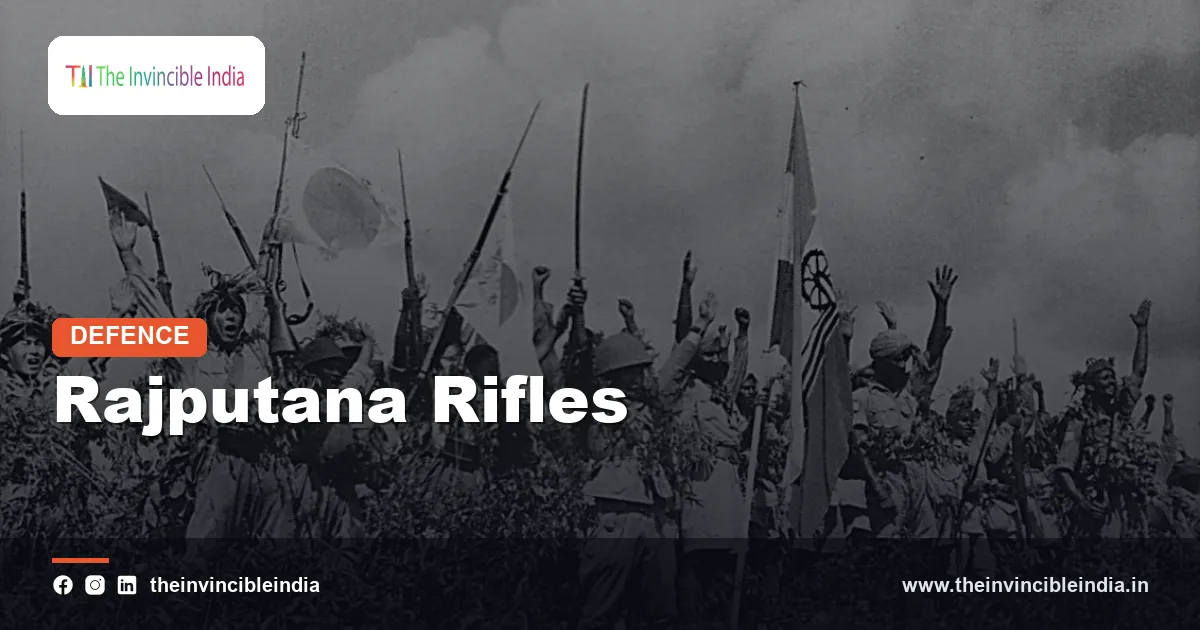
The Rajputana Rifles is the senior-most rifle regiment of the Indian Army, raised in 1775 as a battalion of Bombay Sepoys and known for its war cry “Raja Ramchandra Ki Jai”. Its record includes four Victoria Crosses won before Independence and the Param Vir Chakra awarded to Company Havildar Major Piru Singh in the 1947-48 war in Jammu and Kashmir.
The regiment, whose Regimental Centre is at Delhi Cantonment, has fought in the Persian expedition of 1856, both World Wars, and every major conflict since 1947, including the 1999 Kargil operations. This explainer covers its origins, battle honours, awards, traditions and recruitment, using public and well-established facts only.
Quick Facts
| Item | Rajputana Rifles of the Indian Army |
|---|---|
| Origin | Raised in January 1775 as the 5th Battalion, Bombay Sepoys, of the East India Company |
| Type | Rifle regiment; the senior-most (oldest) rifle regiment of the Indian Army |
| Name history | 4th Bombay Rifles; 104th Wellesley’s Rifles (1903); 6th Rajputana Rifles (1921); Rajputana Rifles (1945) |
| War cry | “Raja Ramchandra Ki Jai” |
| Motto | “Veer Bhogya Vasundhara” (the brave shall inherit the earth) |
| Regimental Centre | Delhi Cantonment |
| Param Vir Chakra | Company Havildar Major Piru Singh, 6th Battalion (1948) |
| Victoria Cross winners | Four, including Captain John Augustus Wood (1856) |
Key Takeaways
- The Rajputana Rifles is the senior-most rifle regiment of the Indian Army, raised in January 1775 as the 5th Battalion of the Bombay Sepoys.
- The Rajputana Rifles’ war cry is “Raja Ramchandra Ki Jai”, and its motto is “Veer Bhogya Vasundhara”, meaning that the brave shall inherit the earth.
- Company Havildar Major Piru Singh of the 6th Battalion, Rajputana Rifles, was awarded the Param Vir Chakra for his gallantry in the Tithwal sector of Jammu and Kashmir in July 1948.
- The Rajputana Rifles lineage includes four Victoria Cross winners, and Captain John Augustus Wood’s Victoria Cross at Bushire in 1856 was the first won in an Indian unit.
- The Rajputana Rifles Regimental Centre is located in Delhi Cantonment, and the regiment has traditionally recruited Rajputs and Jats in equal proportions.
- The Rajputana Rifles earned post-Independence battle honours including Punch, Asal Uttar, Hajipir, Basantar, Tololing and Drass.
What is the Rajputana Rifles?
The Rajputana Rifles is an infantry regiment of the Indian Army, classed as a rifle regiment and regarded as the senior-most of the Army’s rifle regiments. Its soldiers have traditionally come from the Rajput and Jat communities, mainly from Rajasthan, Haryana and neighbouring areas, which explains the name taken from the historic region of Rajputana.
The regiment consists of a number of regular battalions together with the Rajputana Rifles Regimental Centre. Like other rifle regiments, it carries the tradition of skirmishing infantry that fought in open order using accurate rifle fire, although today its battalions are trained for the full range of infantry tasks.
Among Indian regiments with the word “Rifles” in the name, the best known are the Gorkha Rifles, the Garhwal Rifles and the Rajputana Rifles. The Rajputana Rifles is the oldest of the three in terms of seniority.
When and how was the Rajputana Rifles raised?
The Rajputana Rifles was raised in January 1775 by the East India Company as the 5th Battalion of the Bombay Sepoys. It was renumbered as the 9th Battalion in 1778 and as part of the Bombay Native Infantry in 1796, and in 1824 it became the 4th Regiment of Bombay Native Infantry.
In 1881 the unit became a rifle corps, reflecting the specialist skills of fast-moving riflemen. It became the 4th Bombay Rifles in 1901 and the 104th Wellesley’s Rifles in 1903. In the army reorganisation after the First World War, several Bombay Army rifle units were grouped into the 6th Rajputana Rifles, with six battalions, in 1921.
The numeral was dropped in 1945 and the regiment became the Rajputana Rifles. It was transferred to the Indian Army after Independence in 1947. In 1949, its 1st Battalion, Wellesley’s Rifles, was converted to become the 3rd Battalion of the Brigade of the Guards.
Name changes at a glance
| Year | Designation |
|---|---|
| 1775 | 5th Battalion, Bombay Sepoys |
| 1796 | Battalion of the Bombay Native Infantry |
| 1824 | 4th Regiment, Bombay Native Infantry |
| 1881 | 4th Regiment, Native Infantry (Rifle Corps) |
| 1901 | 4th Bombay Rifles |
| 1903 | 104th Wellesley’s Rifles |
| 1921 | 6th Rajputana Rifles |
| 1945 | Rajputana Rifles |
What is the war cry of the Rajputana Rifles?
The war cry of the Rajputana Rifles is “Raja Ramchandra Ki Jai”, which means “Victory to King Rama”. The cry invokes Lord Rama, the king of Ayodhya, a figure widely revered in the regiment’s home regions as the model of duty and kingship.
The regimental motto is “Veer Bhogya Vasundhara”, a Sanskrit phrase which means that the earth is enjoyed by the brave. The insignia is the bugle horn, which is also the symbol of the light infantry and rifle tradition, and the regimental colours are dark green, black and red.
In a difference from British rifle regiments, which traditionally march at a very fast pace, the Rajputana Rifles marches at the standard pace of the Indian Army.
Who are the Param Vir Chakra and Victoria Cross winners of the Rajputana Rifles?
The Rajputana Rifles has one Param Vir Chakra winner and four Victoria Cross winners in its lineage. The Param Vir Chakra was awarded to Company Havildar Major Piru Singh of the 6th Battalion for his actions in the Tithwal sector of Jammu and Kashmir in July 1948.
Piru Singh led his men in an assault on strongly held enemy positions, continuing to attack even after he was wounded repeatedly and after most of his section had fallen. He was killed while attempting to reach the last enemy position and was decorated posthumously.
Victoria Cross winners
- Captain John Augustus Wood (1856): decorated for storming the fort at Bushire during the Anglo-Persian War. This was the first Victoria Cross earned in an Indian unit.
- Lieutenant William Francis Frederick Waller: decorated in the nineteenth century while serving with a Bombay Native Infantry battalion that is part of the regiment’s lineage.
- Subedar Richhpal Ram (1941): decorated for his conduct in the Eritrean campaign in the Second World War.
- Company Havildar Major Chhelu Ram (1943): decorated posthumously for gallantry in the Tunisian campaign in the Second World War.
When Wood won his Victoria Cross, Indian soldiers were not yet eligible for the award. Two Indian officers recommended for the Bushire action, Subedar Major Mohammed Sharief and Subedar Peer Bhatt, could not be decorated for that reason, a fact that is remembered in the regiment’s history.
What are the major battle honours of the Rajputana Rifles?
The Rajputana Rifles has dozens of battle honours spanning the Company era, both World Wars and the wars fought since 1947. The honours are carried on regimental colours and reflect service in Asia, Africa and Europe.
Before 1947
- Kirkee (1817): an action in the Third Anglo-Maratha War.
- Bushire (1856): the capture of the fort in the Anglo-Persian War.
- Kut al Amara (1915) and Mesopotamia: actions in the First World War in Iraq.
- Jerusalem and Megiddo (1917-1918): actions in the Palestine campaign.
- Burma (1942-1945): the Second World War campaign in Burma.
After 1947
- Punch (1947-48): operations in Jammu and Kashmir.
- Asal Uttar and Hajipir (1965): actions in the Punjab and Kashmir fronts.
- Charwa, Basantar and Mynamati (1971): actions in the western and eastern theatres.
- Tololing and Drass (1999): actions in the Kargil conflict.
The capture of Tololing in June 1999 by the 2nd Battalion, Rajputana Rifles, is regarded as a turning point in the Kargil conflict, since it was the first major success in dislodging intruders from the heights above Drass. Major Vivek Gupta of the battalion was awarded the Maha Vir Chakra posthumously for his actions there.
How does the Rajputana Rifles recruit and who serves in it?
The Rajputana Rifles has traditionally recruited Rajputs and Jats in equal proportions, making it a fixed-class regiment drawn mainly from Rajasthan, Haryana, Uttar Pradesh and nearby areas. Recruits are trained at the Regimental Centre in Delhi Cantonment, which also holds the regiment’s records, museum and welfare organisation.
In recent years the Army’s recruitment rules have changed, and newer schemes allow wider recruitment across classes. For the latest eligibility rules, readers should check official Army recruitment notices.
The regiment’s officers, like those of all regiments, are commissioned from across India through the National Defence Academy, the Indian Military Academy and the Officers Training Academy.
What traditions and symbols define the Rajputana Rifles?
The traditions of the Rajputana Rifles revolve around its seniority among rifle regiments, the memory of Bushire and Tithwal, and the culture of Rajput and Jat soldiers. The regiment has its own museum at Delhi Cantonment, which houses relics, photographs, medals and weapons from more than two centuries of service.
- War cry: “Raja Ramchandra Ki Jai”.
- Motto: “Veer Bhogya Vasundhara”.
- Insignia: bugle horn, the traditional symbol of rifle and light infantry units.
- Colours: dark green, black and red.
- Seniority: first among the rifle regiments of the Indian Army.
- Regimental museum: a collection inside Delhi Cantonment documenting the regiment’s history.
The regiment also commemorates the Victoria Cross and Param Vir Chakra winners in portraits, memorials and the names of buildings and roads at the Centre.
How does the Rajputana Rifles compare with other rifle regiments?
The Rajputana Rifles compares with other rifle regiments as the oldest and with a distinct recruitment base, since the Gorkha Rifles recruit from Nepal and the hill areas and the Garhwal Rifles from Uttarakhand. The three share the rifle designation but have different origins, class compositions and customs.
| Regiment | Principal recruiting base | Notes |
|---|---|---|
| Rajputana Rifles | Rajputs and Jats (Rajasthan, Haryana and neighbouring areas) | Senior-most rifle regiment; raised 1775 |
| Garhwal Rifles | Garhwal region of Uttarakhand | Raised in the late nineteenth century; Centre at Lansdowne |
| Gorkha Rifles | Gorkha communities of Nepal and the Indian hills | Several regiments, with their own Centres |
What role did the Rajputana Rifles play in the world wars?
The Rajputana Rifles, through its predecessor battalions, served in both World Wars, in the Middle East and Burma in the First World War and in Eritrea, Tunisia and Burma in the Second. The honours Kut al Amara, Jerusalem, Megiddo and Burma are among those that record this service.
In the First World War, battalions of Wellesley’s Rifles and other Bombay Army rifle units fought in Mesopotamia, where Kut al Amara in 1915 became a byword for hardship, and in the Palestine campaign that ended with the capture of Jerusalem in 1917 and the victory at Megiddo in 1918.
In the Second World War, the 6th Rajputana Rifles fought in the East African campaign, where Subedar Richhpal Ram earned his Victoria Cross in Eritrea, and in North Africa, where Company Havildar Major Chhelu Ram earned his in Tunisia. The regiment’s battalions also served in the Burma campaign of 1942-1945.
The wartime record explains why the Rajputana Rifles entered the Indian Army in 1947 with a large set of battle honours and a reputation for steady, disciplined infantry.
Why does the Rajputana Rifles matter?
The Rajputana Rifles matters because its history connects the Company army, the British Indian Army and the Indian Army in one unbroken line, and because its record includes some of the best-known acts of gallantry in India’s military history. Bushire, Keren, Tunisia, Tithwal and Tololing are all part of the story of the regiment.
The regiment is also a reminder of how regional identity shapes the Army. Rajasthan and the surrounding areas have long supplied soldiers whose service is honoured in villages, museums and war memorials, and the regiment gives that tradition a formal home.
Bottom Line
The Rajputana Rifles is the senior-most rifle regiment of the Indian Army, with a lineage reaching back to 1775 and a record that includes four Victoria Crosses and a Param Vir Chakra. Its war cry, “Raja Ramchandra Ki Jai”, and its home at Delhi Cantonment keep that heritage alive. Last reviewed: 15 October 2026.
Frequently Asked Questions
What is the Rajputana Rifles?
The Rajputana Rifles is the senior-most rifle regiment of the Indian Army, raised in January 1775 as a Bombay Sepoy battalion. It has its Regimental Centre at Delhi Cantonment. Its soldiers have traditionally been Rajputs and Jats.
What is the war cry of the Rajputana Rifles?
The war cry of the Rajputana Rifles is “Raja Ramchandra Ki Jai”, meaning “Victory to King Rama”. The regiment’s motto is “Veer Bhogya Vasundhara”, which means that the brave shall inherit the earth. Both are used on parade and ceremonial occasions.
Who won the Param Vir Chakra from the Rajputana Rifles?
Company Havildar Major Piru Singh of the 6th Battalion won the Param Vir Chakra for the Rajputana Rifles. He was decorated for his gallantry in the Tithwal sector of Jammu and Kashmir in July 1948. The award was given posthumously.
How many Victoria Crosses has the Rajputana Rifles won?
The Rajputana Rifles lineage includes four Victoria Cross winners. They are Captain John Augustus Wood (1856), Lieutenant William Waller, Subedar Richhpal Ram (1941) and Company Havildar Major Chhelu Ram (1943). Wood’s award was the first Victoria Cross won in an Indian unit.
Where is the Rajputana Rifles Regimental Centre?
The Rajputana Rifles Regimental Centre is in Delhi Cantonment. The Centre trains recruits and houses the regiment’s museum and records. It is the home of the regiment’s traditions.
Who can join the Rajputana Rifles?
The Rajputana Rifles has traditionally recruited Rajputs and Jats in equal proportions, mainly from Rajasthan, Haryana and nearby areas. Army recruitment rules have changed in recent years and now allow wider recruitment. Candidates should always check the latest official Army notifications.
{“@context”:”https://schema.org”,”@graph”:[{“@type”:”FAQPage”,”mainEntity”:[{“@type”:”Question”,”name”:”What is the Rajputana Rifles?”,”acceptedAnswer”:{“@type”:”Answer”,”text”:”The Rajputana Rifles is the senior-most rifle regiment of the Indian Army, raised in January 1775 as a Bombay Sepoy battalion. It has its Regimental Centre at Delhi Cantonment. Its soldiers have traditionally been Rajputs and Jats.”}},{“@type”:”Question”,”name”:”What is the war cry of the Rajputana Rifles?”,”acceptedAnswer”:{“@type”:”Answer”,”text”:”The war cry of the Rajputana Rifles is “Raja Ramchandra Ki Jai”, meaning “Victory to King Rama”. The regiment’s motto is “Veer Bhogya Vasundhara”, which means that the brave shall inherit the earth. Both are used on parade and ceremonial occasions.”}},{“@type”:”Question”,”name”:”Who won the Param Vir Chakra from the Rajputana Rifles?”,”acceptedAnswer”:{“@type”:”Answer”,”text”:”Company Havildar Major Piru Singh of the 6th Battalion won the Param Vir Chakra for the Rajputana Rifles. He was decorated for his gallantry in the Tithwal sector of Jammu and Kashmir in July 1948. The award was given posthumously.”}},{“@type”:”Question”,”name”:”How many Victoria Crosses has the Rajputana Rifles won?”,”acceptedAnswer”:{“@type”:”Answer”,”text”:”The Rajputana Rifles lineage includes four Victoria Cross winners. They are Captain John Augustus Wood (1856), Lieutenant William Waller, Subedar Richhpal Ram (1941) and Company Havildar Major Chhelu Ram (1943). Wood’s award was the first Victoria Cross won in an Indian unit.”}},{“@type”:”Question”,”name”:”Where is the Rajputana Rifles Regimental Centre?”,”acceptedAnswer”:{“@type”:”Answer”,”text”:”The Rajputana Rifles Regimental Centre is in Delhi Cantonment. The Centre trains recruits and houses the regiment’s museum and records. It is the home of the regiment’s traditions.”}},{“@type”:”Question”,”name”:”Who can join the Rajputana Rifles?”,”acceptedAnswer”:{“@type”:”Answer”,”text”:”The Rajputana Rifles has traditionally recruited Rajputs and Jats in equal proportions, mainly from Rajasthan, Haryana and nearby areas. Army recruitment rules have changed in recent years and now allow wider recruitment. Candidates should always check the latest official Army notifications.”}}]}]}


