

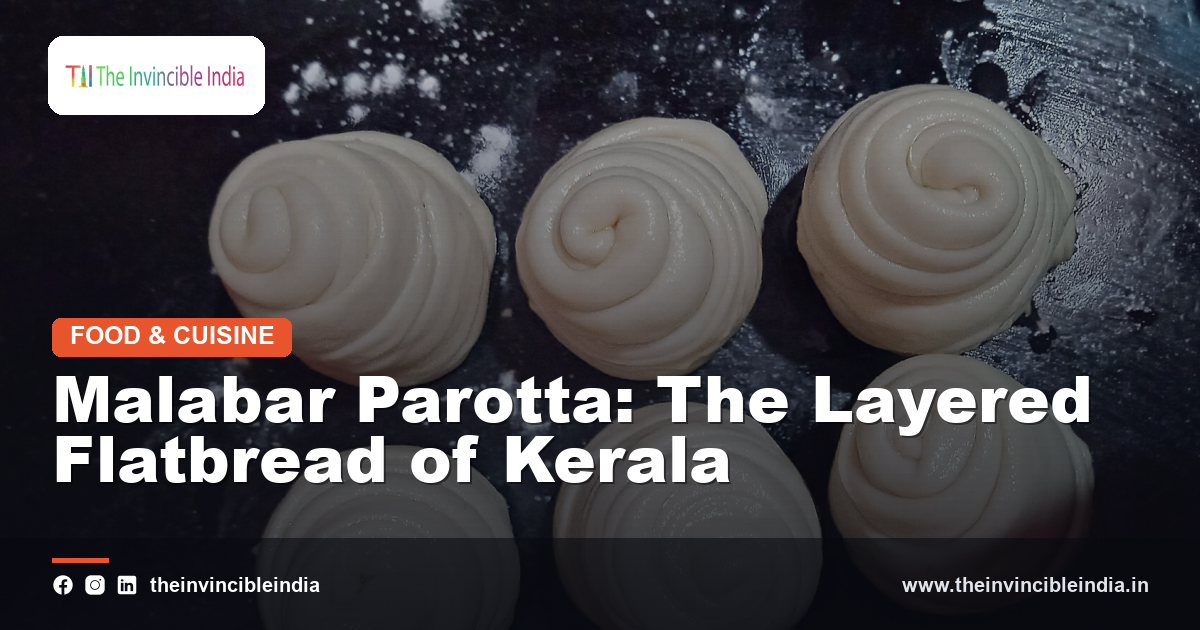
Malabar parotta, also called Kerala parotta, porotta, or Malabar paratha, is a flaky, layered flatbread made from refined wheat flour that has become one of the best-loved foods of Kerala. Unlike the soft idli and dosa described in our guide to South Indian breakfast, the parotta is rich, crisp at the edges, and built from many thin sheets of dough. It takes its name from the Malabar coast of northern Kerala, although it is now eaten across the state and well beyond it. The bread is a fixture of roadside eateries, home kitchens, and festive meals alike. This guide explains what it is, how it is made, and why it holds such a firm place in Kerala food culture.
Quick answer: Malabar parotta is a layered, flaky flatbread from Kerala, made from refined wheat flour dough that is stretched thin, folded or coiled into a spiral, rested, and cooked on a flat griddle. It is named after the Malabar region of northern Kerala and is typically eaten with curries such as beef fry, chicken curry, or vegetable kurma. It is one of the most popular breads of Kerala cuisine.
Key Takeaways
- Malabar parotta is a flaky, layered flatbread of Kerala, made mainly from refined wheat flour, water, salt, and oil or ghee.
- The bread is named for the Malabar region of northern Kerala, and it is also spelled porotta or paratha in different places.
- Its layers come from stretching the dough thin, oiling it, and coiling it before it is rolled out and griddled.
- Cooks often clap the hot parotta between their hands to separate the layers and give it a fluffy, shredded texture.
- Common companions include beef fry, Kerala chicken curry, vegetable kurma, and salna.
- The parotta is eaten across Kerala and neighbouring regions, and is a staple of street food, restaurants, and family meals.
Read on for the ingredients, method, serving customs, and cultural role in detail.
Quick Facts
| Detail | Information |
|---|---|
| Dish | Malabar parotta (Kerala parotta, porotta) |
| Type | Layered flatbread |
| Origin | Malabar region, northern Kerala |
| State | Kerala |
| Main ingredient | Refined wheat flour (maida) |
| Typical accompaniment | Beef fry, chicken curry, kurma, or salna |
What is Malabar parotta?
Malabar parotta is a layered flatbread of Kerala, cooked on a griddle until golden and flaky. It is made from a soft dough of refined wheat flour that is stretched, oiled, and coiled so that each cooked bread contains many thin, separate layers. The texture is a mix of crisp outer edges and a soft, slightly chewy interior that peels apart in ribbons. Unlike plain chapati, which is thin and simple, the parotta is rich and substantial, and it is almost always eaten with a flavourful curry. The bread is available in restaurants, tea shops, and homes across Kerala, and it is considered one of the state’s defining foods. Its combination of flakiness and softness makes it unlike most other Indian flatbreads.
Where does Malabar parotta come from?
Malabar parotta comes from the Malabar coast in northern Kerala, a region long known for its trading ports and varied culinary traditions. The cities of Kozhikode and Thalassery, together with the wider Malabar area, are closely associated with the bread, and the name reflects that link. Layered flatbreads of the paratha family are found across South Asia, and the Kerala parotta is generally understood as a regional expression of that wider tradition, shaped by local tastes and the use of refined flour. The exact history of its arrival and adaptation in Kerala is not firmly documented, so it is best described as a food that developed within the region’s cooking over time. Today it is regarded as a signature item of the state.
What are the ingredients of Malabar parotta?
The ingredients of Malabar parotta are refined wheat flour, water, salt, oil or ghee, and in many recipes a small amount of sugar. Refined flour, known locally as maida, gives the bread its soft, elastic dough and pale colour. Sugar helps with browning and a slight sweetness, and some cooks add milk or egg to enrich the dough. Oil or ghee is used generously, both in the dough and between the layers, because the fat is what separates the sheets and creates the flaky texture. Nothing else is required, which makes the bread seem simple on paper. Its character comes entirely from technique, since the same few ingredients can produce either an ordinary flatbread or a pastry-like parotta depending on how they are handled.
How is Malabar parotta made?
Malabar parotta is made by kneading a soft dough, resting it, dividing it into balls, stretching each ball thin, and coiling it into a spiral before griddling. The dough is mixed with water, salt, sugar, and oil until it becomes smooth and elastic, then rested so the gluten relaxes. Each portion is flattened with oil, stretched as thinly as possible, and pleated or folded into a long rope. The rope is coiled into a round and rested again. The coil is rolled out gently and cooked on a hot flat griddle with oil until golden brown on both sides. Finally the cooked bread is struck between the palms to loosen the layers. The sequence of stretching, coiling, and resting is what creates the signature flakiness.
Why is the dough stretched and coiled?
The dough is stretched and coiled because the thin sheets, separated by fat, form the many layers of the finished bread. When the dough is pulled very thin, it becomes almost translucent, and brushing it with oil prevents the sheets from sticking together. Pleating the sheet into a rope and coiling it stacks those thin sheets in a spiral, so a single ball holds dozens of fine layers. During cooking, the heat and fat puff the layers apart and make them crisp. Skilled cooks make this look effortless, flipping and swirling the dough in the air, and the skill is often admired by customers who watch it prepared at the counter. Without stretching and coiling, the result would be a thick, plain flatbread rather than a parotta.
Why is the parotta clapped after cooking?
The parotta is clapped after cooking to separate the layers and make the bread light and shredded. When the hot bread is lifted from the griddle, the cook pushes the edges toward the centre and strikes it between the palms, which loosens the compacted coils into soft, airy ribbons. The sound of this clapping is a familiar feature of Kerala eateries and signals that fresh parotta is ready. The action also lets steam escape, keeping the crisp surface from turning soggy. Parotta that is not clapped tends to remain dense and flat, while clapped parotta has a feathery interior that absorbs curry well. The step is therefore not merely theatrical but a functional part of the technique that gives the bread its distinctive texture.
What does Malabar parotta taste like?
Malabar parotta tastes mildly rich, slightly buttery, and gently sweet, with a crisp exterior and a soft, flaky interior. Its flavour is deliberately neutral so that it can carry the bold gravies it is served with. The outer layers brown into a crunchy shell, while the inner sheets stay tender and almost pastry-like. When broken apart, the bread peels into thin strips that soak up curry without losing all of their structure. The fat used in cooking adds richness, and a hint of sugar in the dough adds a subtle caramelised note. Eaten fresh from the griddle, it is warm and aromatic, and as it cools the layers become chewier. The texture, more than any flavour, is what people most often remember.
What is Malabar parotta served with?
Malabar parotta is served with spicy, gravy-rich curries, the most famous pairing being beef fry, a dry-style Kerala dish of beef with coconut slivers and black pepper. Other classic companions include Kerala chicken curry, egg roast, vegetable kurma, and salna, a thin spiced gravy often prepared in eateries to accompany parotta. The bread’s richness balances the heat and acidity of these dishes, and the layers act like a spoon for the gravy. Vegetarian diners commonly choose kurma, dal curry, or potato stew. A side of sliced onions, lime, and sometimes green chillies is usual in simple eateries. The ease with which the parotta pairs with so many dishes is one reason it appears on nearly every Kerala restaurant menu.
Why is beef fry the classic partner?
Beef fry is the classic partner of Malabar parotta because its dark, peppery, coconut-studded masala contrasts well with the mild, flaky bread. In Kerala, beef is widely eaten across communities, and the combination of parotta and beef fry is a familiar order at roadside restaurants and tea shops. The meat is slow cooked with onions, ginger, garlic, black pepper, and spices, then fried with coconut pieces and curry leaves until deeply flavoured. Tearing a piece of parotta and wrapping it around a morsel of meat is a common way to eat the two together. The pairing has become shorthand for casual Kerala dining. It is, however, one of many options, and vegetarian combinations are just as common in households and eateries.
How does Malabar parotta differ from other parathas?
Malabar parotta differs from north Indian parathas because it is made from refined flour, is more layered, and is usually served with curry rather than eaten as a stuffed breakfast bread. A typical paratha of the north is made with whole wheat flour, folded into triangles or squares, and often stuffed with potato, paneer, or radish. The Kerala parotta is thinner in its layers, richer in fat, and pulled apart after cooking. It is also larger in the number of coils and has a more pastry-like texture. Both belong to the broad family of layered South Asian flatbreads, but their flavours and uses differ. The parotta is eaten as a main item for lunch or dinner, while the north Indian paratha often appears at breakfast.
Where else is Kerala-style parotta eaten?
Kerala-style parotta is eaten across the state and in neighbouring southern regions, especially in Tamil Nadu and Karnataka. In Tamil Nadu, a closely related layered bread is popular in many towns, and the shredded dish known as kothu parotta, in which the bread is chopped and stir fried with egg, meat, or vegetables on a griddle, is a well-known street food. Keralite communities in the Gulf and other parts of the world have carried the bread with them, so it appears in restaurants overseas that serve Kerala dishes. The dish travels well because its ingredients are simple and its technique can be taught. Each region adjusts the size, thickness, and pairings to local tastes. Even so, the Malabar style remains the reference point for many cooks.
What is the place of parotta in Kerala street food?
Parotta holds a central place in Kerala street food, where tea shops and small restaurants serve it fresh through the day and late into the night. A typical eatery has a counter where the cook stretches, coils, and griddles the dough in view of customers, and the rhythmic clapping is part of the atmosphere. The bread is affordable, filling, and quick to serve, which suits workers, students, travellers, and families. Late-night parotta stalls are a familiar part of many towns. The practice of ordering parotta with a curry and a glass of tea or sweet lime soda is widely recognised as an everyday ritual. In this way the bread functions as both daily nourishment and a social food that brings people together.
Is Malabar parotta healthy?
Malabar parotta is a rich, calorie-dense bread, so it is generally regarded as an indulgence rather than a light everyday staple. It is made with refined flour and a generous amount of oil or ghee, which gives the texture but also adds refined carbohydrates and fat. Nutritionists commonly advise moderation, particularly for people who eat the bread frequently or in large portions. Some households prepare versions with whole wheat flour, which are denser and have more fibre, though they lose some of the flakiness. Pairing the bread with vegetables, lentils, or a lighter curry can make a meal more balanced. As with many beloved regional foods, enjoying it occasionally and in sensible amounts is the usual recommendation.
What are common variations of Malabar parotta?
Common variations of Malabar parotta include whole wheat versions, stuffed versions, smaller or thicker rounds, and dishes made by shredding the bread. Wheat parotta replaces some or all of the refined flour with whole wheat atta. Egg parotta is cooked with a beaten egg layer, and stuffed parottas may contain spiced potato or minced meat. Kothu parotta chops the cooked bread and stir fries it with spices, eggs, vegetables, or meat. Some restaurants offer mini parottas for convenience or to serve with several curries at once. Frozen and ready-made parottas are now widely sold, which has extended the bread to households without a skilled cook. These variations keep the bread flexible while retaining its identity as a layered, griddle-cooked flatbread.
What tips help in making good parotta?
Good parotta depends on a soft, well-rested dough, enough fat between the layers, and a hot, evenly heated griddle. The dough should be kneaded until smooth and elastic, then allowed to rest so it can be stretched thin without tearing. Generous oiling of each sheet keeps the layers from sticking, and coiling them loosely allows steam to open them during cooking. The griddle should be hot enough to brown the bread quickly without drying it. Clapping the bread immediately after cooking helps release the layers, and keeping the finished parottas covered in a cloth preserves their softness. Beginners often find stretching the dough the hardest part, and practice usually improves the result. Patience with resting and technique matters more than any special ingredient.
Malabar Parotta Today
Malabar parotta today remains one of the most recognisable foods of Kerala, found in restaurants, tea shops, supermarkets, and home kitchens across the state and in the Kerala diaspora. Its flaky layers, easy pairing with curries, and affordable price have given it near-universal appeal, and it continues to inspire variations such as kothu parotta and stuffed forms. Chefs and food writers frequently highlight the bread as a symbol of Kerala’s street food and its skill with flour, fat, and fire. At the same time, discussions about health have led some cooks to experiment with wheat versions and lighter accompaniments. The parotta endures because it combines a simple set of ingredients with a technique that produces something remarkable, and it remains a daily pleasure for many people.
Sources & Further Reading
- Ministry of Culture, Government of India (indiaculture.gov.in).
- Ministry of Tourism, Government of India (tourism.gov.in).
Frequently Asked Questions
What is Malabar parotta?
Malabar parotta is a flaky, layered flatbread from Kerala, made from refined wheat flour, water, salt, and oil. The dough is stretched thin, coiled, and griddled, and the cooked bread is clapped to separate its layers.
Why is it called Malabar parotta?
It is called Malabar parotta because it is associated with the Malabar region of northern Kerala. Cities such as Kozhikode and Thalassery are closely linked with the bread, though it is now eaten throughout the state.
What is Malabar parotta made of?
Malabar parotta is made of refined wheat flour (maida), water, salt, oil or ghee, and often a little sugar. Some cooks also add milk or egg to the dough for extra softness.
What is Malabar parotta eaten with?
Malabar parotta is eaten with curries such as beef fry, Kerala chicken curry, egg roast, vegetable kurma, and salna. The mild, flaky bread balances the strong spices of these dishes.
What is the difference between parotta and paratha?
Parotta is a thin-layered, refined-flour bread of Kerala, while paratha is a general name for flatbreads of the wider region, often made with whole wheat and sometimes stuffed. The Kerala parotta is richer, flakier, and usually served with curry.
What is kothu parotta?
Kothu parotta is a dish in which cooked parotta is chopped into small pieces and stir fried on a griddle with egg, vegetables, or meat and spices. It is a popular street food in Tamil Nadu and Kerala.


