

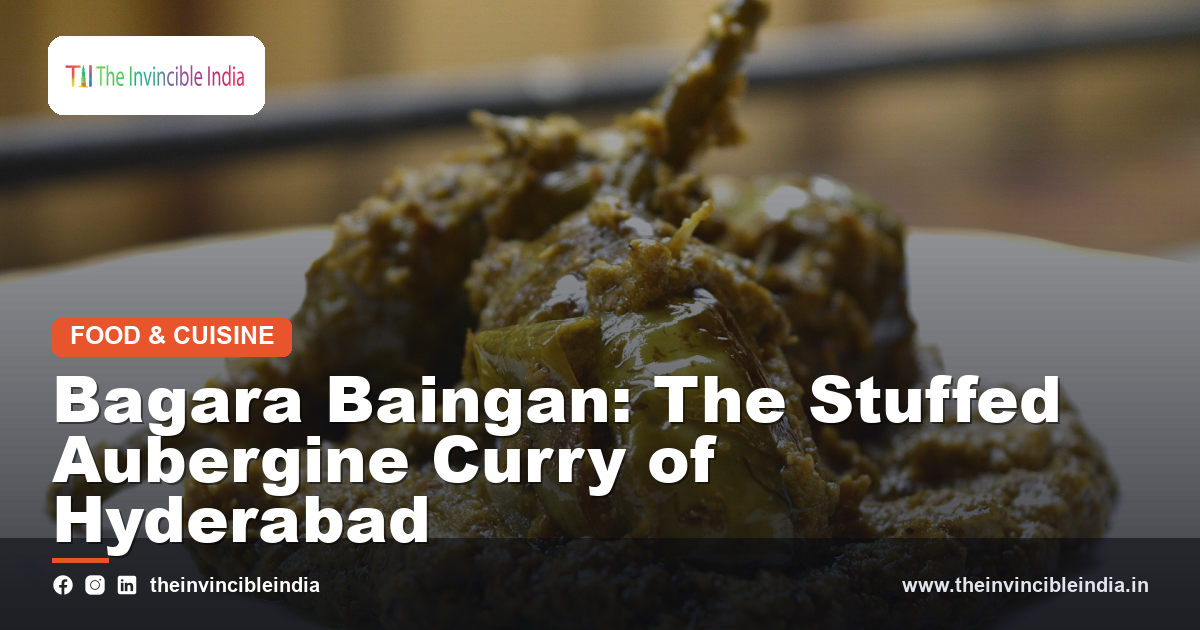
Bagara baingan, also written baghare baingan or bagara baigan, is a classic Hyderabadi curry in which small aubergines, known as brinjals or baingan, are simmered in a thick gravy of roasted peanuts, sesame, coconut, tamarind, and spices. The word bagara refers to the tempering or finishing of a dish in hot oil with whole spices, which gives the curry much of its aroma. Like the many dishes mapped in our guide to Indian spices, it depends on careful layering of flavours rather than on a single dominant spice. It is most often served alongside biryani, where its tangy richness balances the rice. This guide explains what the dish is, how it is made, and why it holds a central place in Hyderabadi feasts.
Quick answer: Bagara baingan is a traditional curry of Hyderabad in Telangana, made by cooking small whole aubergines in a gravy of ground roasted peanuts, sesame seeds, dry coconut, tamarind, onion, and spices. The name comes from bagara, meaning a spiced tempering, and baingan, meaning aubergine. It is typically served with biryani, bagara rice, or flatbreads at festive meals.
Key Takeaways
- Bagara baingan is a Hyderabadi curry of small aubergines cooked in a thick peanut, sesame, and coconut gravy.
- The name joins bagara, a spiced tempering in hot oil, with baingan, the Hindi and Urdu word for aubergine.
- Tamarind gives the gravy its characteristic tang, balancing the richness of the nuts and seeds.
- The dish is a standard companion to Hyderabadi biryani and is also served with bagara khana and rotis.
- The aubergines are usually slit or quartered but left joined at the stem so they hold the gravy while keeping their shape.
- The curry reflects the blend of Deccani, Mughal, and South Indian flavours that defines Hyderabadi cuisine.
Read on for the ingredients, method, serving customs, and cultural role in detail.
Quick Facts
| Detail | Information |
|---|---|
| Dish | Bagara baingan (baghare baingan) |
| Type | Vegetarian curry |
| Origin | Hyderabad, Deccan region |
| State | Telangana |
| Main ingredient | Small round aubergines (brinjals) |
| Typical accompaniment | Biryani, bagara rice, or roti |
What is Bagara baingan?
Bagara baingan is a Hyderabadi vegetarian curry made from small aubergines in a rich, nutty, tangy gravy. The aubergines are cooked whole or nearly whole, which allows the sauce to seep into the flesh, and they are finished with a tempering that adds fragrance. The gravy is thick, glossy, and dark, with a texture that comes from ground roasted peanuts, sesame seeds, and coconut. Its taste combines the earthiness of the nuts, the sourness of tamarind, and the warmth of chilli and ground spices. In Hyderabad the dish is considered one of the key side dishes of a festive meal, usually appearing next to biryani. It is therefore regarded as both a home favourite and a restaurant staple.
Where does Bagara baingan come from?
Bagara baingan comes from Hyderabad, where the cooking of the Nizam-era households and the wider Deccan produced a distinctive regional style. Hyderabadi cuisine took inspiration from Mughal, Persian, and Turkish traditions, but it also drew on local ingredients such as tamarind, peanuts, sesame, and dry coconut that are central to South Indian cooking. Bagara baingan sits at the meeting point of these influences, since its nut-and-seed gravy recalls courtly richness while its tamarind and curry leaves belong to the Deccan. The precise origin of the recipe is not documented in a way that names a date or an individual, so it is best described as a dish that developed within the city’s kitchens over time. It is now treated as a quintessential Hyderabadi preparation.
What does bagara mean in this dish?
Bagara means a tempering, in which whole spices are heated in oil or ghee and poured over or stirred into a dish to release their aroma. In Hyderabadi cooking the word is used in several preparations, including bagara khana, which is spiced rice, and bagara baingan, the aubergine curry. The tempering typically includes mustard seeds, cumin, curry leaves, and sometimes fenugreek or dried red chillies. When the hot spices meet the gravy, they perfume the whole pot with a fragrant sizzle. The technique is common across India under names such as tadka, chaunk, and vaghar, but the Hyderabadi term has given the dish its title. Understanding the word helps explain why aroma is such an important part of the curry’s identity.
What are the main ingredients?
The main ingredients of Bagara baingan are small aubergines, roasted peanuts, sesame seeds, dry coconut, tamarind, onion, and a blend of spices. The aubergines are usually the small, round, purple or green variety that holds its shape in a gravy. Peanuts and sesame are dry roasted and ground to a paste, which becomes the body of the sauce. Dry coconut adds sweetness and thickness, and tamarind pulp supplies the sourness that defines the dish. Coriander, cumin, turmeric, and red chilli are the usual spices, and curry leaves and mustard seeds are used in the tempering. Ginger and garlic paste is common, and some cooks add a little jaggery to soften the tang. Together these ingredients create a layered gravy that is richer than its simple parts suggest.
How is Bagara baingan made?
Bagara baingan is made by preparing the aubergines, grinding a roasted nut-and-seed paste, and simmering both with tamarind and spices before finishing with a tempering. The aubergines are slit crosswise from the base and left joined at the stem, then shallow fried until lightly browned. Peanuts, sesame, and coconut are dry roasted and ground with a little water into a smooth paste. Onions, ginger, and garlic are cooked in oil, the spice powders and the paste are added, and tamarind water is poured in. The fried aubergines go into the gravy and simmer gently until they are tender and the oil begins to separate. A final tempering of mustard seeds and curry leaves completes the dish. The result is a thick, aromatic curry with the aubergines fully infused.
Why are the aubergines slit instead of cut up?
The aubergines are slit rather than chopped because the cut lets the gravy enter the vegetable while the intact stem keeps each piece whole. A crossed slit opens the flesh like a small flower, so the sauce seeps inside during simmering. Keeping the stem attached holds the quarters together, which gives the finished curry an attractive and traditional appearance. Frying the aubergines briefly before they go into the gravy firms the skin and prevents them from collapsing into a mush. The technique is also practical, since it shortens the cooking time compared to using a whole uncut vegetable. This method of stuffing or slitting small vegetables is common in many Indian curries, and in Bagara baingan it is why the dish is sometimes described as a stuffed aubergine curry.
What gives the gravy its flavour?
The gravy gets its flavour from the combination of roasted nuts and seeds, tamarind, and a spice base. Roasting the peanuts, sesame, and coconut before grinding develops a deep, toasty taste that is the backbone of the sauce. Tamarind adds a sharp sourness that prevents the rich paste from becoming heavy. Onions cooked slowly to a golden colour bring sweetness, while ginger and garlic give sharpness. The ground spices add warmth, and the final tempering contributes the fresh aroma of mustard seeds and curry leaves. Many cooks adjust the sourness and spice according to taste, and some add a little jaggery for balance. The overall effect is a gravy that is nutty, tangy, mildly sweet, and moderately spicy all at once.
How is Bagara baingan served?
Bagara baingan is served hot as a side dish, most often with Hyderabadi biryani, bagara khana, or flatbreads such as roti and naan. In a biryani meal it sits alongside a cooling raita, and its tangy gravy is spooned over or beside the rice. Many households also serve it with plain steamed rice or with khichdi. The dish is usually presented in a deep bowl so the thick gravy and aubergines remain warm, and a garnish of fresh coriander is common. Because it is rich, a small portion is generally enough for each person. Its role is to provide a tangy, savoury counterpoint to the spiced rice, and the pairing is so established that a biryani meal feels incomplete without it.
Why does Bagara baingan go with biryani?
Bagara baingan goes with biryani because the sourness and nuttiness of the curry offset the richness and spice of the rice. Biryani is layered with meat or vegetables, ghee, and whole spices, which makes it fragrant and heavy. A tamarind-based gravy cuts through that heaviness and refreshes the palate between mouthfuls. The curry is vegetarian, so it also gives guests who do not eat meat a satisfying dish at a biryani-centred feast. In Hyderabad, it is usually paired with its relatives, such as mirchi ka salan, which has a similar peanut-and-sesame base. The result is a table in which rice, curry, raita, and dessert each play a defined role. The pairing is a clear example of how Hyderabadi menus are built around contrast.
How does it compare with Mirchi ka salan?
Bagara baingan and mirchi ka salan are close cousins, since both use a gravy of roasted peanuts, sesame, coconut, and tamarind, but they feature different vegetables. In bagara baingan the star is the small aubergine, which gives the dish a soft, creamy interior. In mirchi ka salan, large mild green chillies are cooked in the same style of gravy and give a gentle heat. Both are usually served with biryani, and either can be offered depending on the host or the season. The shared base shows how a single sauce can be adapted to different vegetables, a common practice across Indian cuisines. Together they form a pair of signature Hyderabadi side dishes that are often mentioned in the same breath.
What other dishes use the same gravy base?
The nut-and-seed gravy of Bagara baingan appears in several other Hyderabadi dishes, including mirchi ka salan and some versions of vegetable and egg curries. The combination of peanuts, sesame, coconut, and tamarind is sometimes called a salan base, and cooks can adjust it for different main ingredients. Hard-boiled eggs, small potatoes, or baby okra may be cooked in the same gravy, and the tempering is adjusted accordingly. The shared base makes it easy for a household to prepare more than one side dish from the same spice paste. It also gives the Hyderabadi table a unified flavour even when the dishes differ. This family of salans shows how regional cooking often relies on a few versatile preparations rather than a long list of unrelated recipes.
Which regional influences shaped the dish?
The dish was shaped by Deccani, Mughal, and South Indian influences, which together define Hyderabadi cooking. Mughal and Persian traditions contributed the idea of rich, slow-cooked gravies and the use of nuts and dried fruit. The Deccan and neighbouring Andhra and Karnataka regions contributed tamarind, curry leaves, sesame, peanuts, and a generous hand with chilli. Over time local cooks fused these strands into new preparations rather than copying any single source. Bagara baingan is one of the clearest examples because its gravy uses both courtly richness and the sour, nutty notes of the south. Food historians often point to this blend when explaining why Hyderabadi cuisine tastes different from both north Indian and south Indian cooking. The dish thus serves as a compact summary of the city’s culinary identity.
What are common variations of Bagara baingan?
Common variations of Bagara baingan change the type of aubergine, the thickness of the gravy, and the balance of sour and sweet flavours. Some cooks use long thin aubergines cut into pieces, while traditionalists prefer the small round kind. A few add a spoonful of poppy seeds or chironji for extra richness, and others increase the tamarind for a sharper taste. Jaggery may be added to round off the sourness, and the amount of chilli is adjusted for heat. Restaurants sometimes thin the gravy, while home kitchens often keep it thick and clinging. Despite these differences, the defining features remain the roasted nut-and-seed base, the tamarind, and the final tempering. These small adjustments make the dish adaptable without altering its recognisable character.
What role does the dish play in celebrations?
Bagara baingan plays the role of a festive side dish at Hyderabadi weddings, family gatherings, and holiday meals. A celebration feast in the city typically includes biryani, a meat dish, a vegetable salan, raita, and a dessert such as qubani ka meetha. Bagara baingan is a common choice for the vegetable salan, and in many households it is considered an essential part of the spread. Its rich, deeply seasoned character fits the abundance of such occasions. Guests who do not eat meat often find it the centrepiece of their meal. The dish also appears in restaurants and catering menus, which has helped carry it beyond Hyderabad. Its place at the table signals hospitality and the care given to a complete meal.
What are tips for cooking it well?
Good Bagara baingan depends on fresh small aubergines, patient roasting of the nuts and seeds, and slow simmering of the gravy. Roasting the peanuts, sesame, and coconut on a gentle flame brings out their flavour without burning, which would make the paste bitter. Frying the aubergines until the skin is lightly browned keeps them intact in the sauce. The gravy should be simmered until the oil begins to rise to the surface, a traditional sign that the paste and spices are fully cooked. Tamarind should be added gradually, tasting as the sourness builds. Resting the curry for a short time before serving lets the flavours settle, and many cooks find that the dish tastes even better the next day. Careful technique, more than elaborate ingredients, makes the difference.
Bagara Baingan Today
Bagara baingan today remains a staple of Hyderabadi cooking, appearing on restaurant menus, in catering spreads, and in family kitchens across India and abroad. Home cooks continue to make it with the traditional nut-and-seed paste, while chefs sometimes present it in lighter or plated forms. The dish is a favourite with vegetarian diners and an indispensable part of biryani meals, which keeps it in constant demand. Food writers frequently cite it as one of the best examples of how Hyderabadi cuisine combines courtly richness with Deccan tang. Its popularity has also encouraged cooks in other regions to try the gravy with their own local vegetables. The curry endures because it balances nuts, seeds, sourness, and spice in a way that is both comforting and distinctive.
Sources & Further Reading
- Ministry of Culture, Government of India (indiaculture.gov.in).
- Ministry of Tourism, Government of India (tourism.gov.in).
Frequently Asked Questions
What is Bagara baingan?
Bagara baingan is a Hyderabadi curry of small aubergines cooked in a thick gravy of roasted peanuts, sesame, dry coconut, tamarind, and spices. It is finished with a tempering and is usually served with biryani.
What does Bagara baingan mean?
Bagara baingan means tempered aubergine. Bagara refers to a tempering of whole spices in hot oil, and baingan is the Hindi and Urdu word for aubergine or brinjal. It is also spelled baghare baingan.
What is Bagara baingan served with?
Bagara baingan is served with Hyderabadi biryani, bagara rice, plain rice, or flatbreads such as roti and naan. It is a standard side dish at biryani-centred feasts and is often accompanied by raita.
Is Bagara baingan vegetarian?
Yes, Bagara baingan is a vegetarian dish. Its gravy is made from aubergines, roasted peanuts, sesame seeds, coconut, tamarind, and spices, with no meat or fish, so it suits vegetarian diners at a biryani meal.
Which state is Bagara baingan from?
Bagara baingan is from Hyderabad, the capital of Telangana. It belongs to Hyderabadi cuisine, which developed from Mughal, Persian, and Deccan influences.
What is the difference between Bagara baingan and Mirchi ka salan?
Bagara baingan features small aubergines, while mirchi ka salan features large mild green chillies. Both are Hyderabadi curries made in a similar gravy of peanuts, sesame, coconut, and tamarind.


