

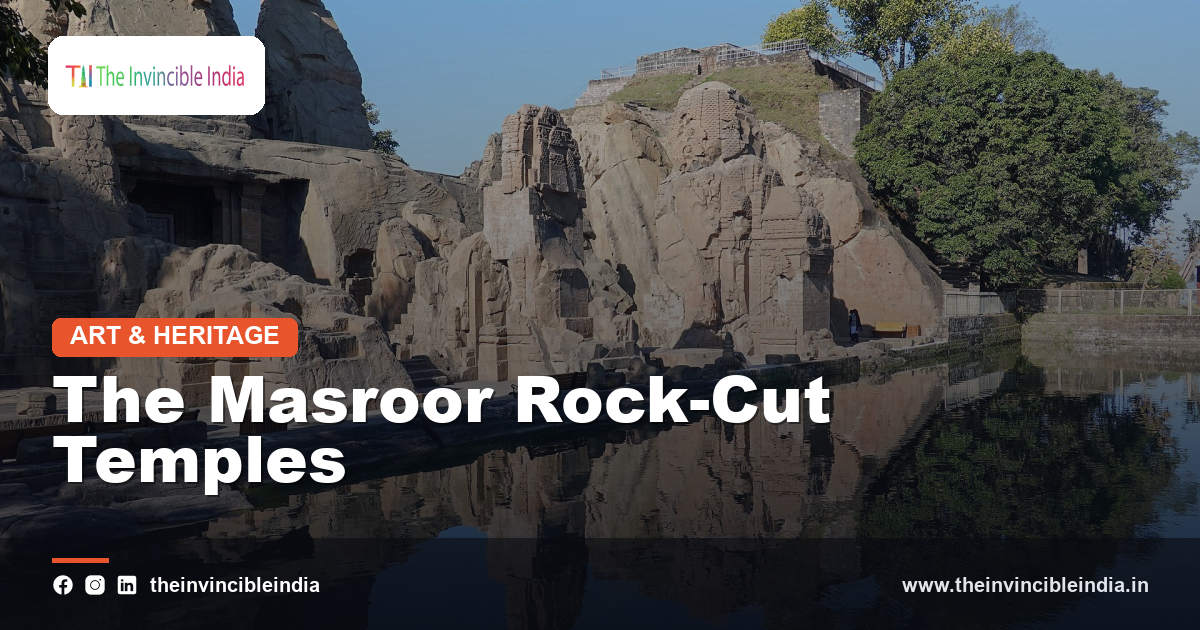
High in the Kangra valley of Himachal Pradesh, a long sandstone ridge has been transformed into one of the most unusual temple complexes in the Indian subcontinent. The Masroor rock-cut temples are a cluster of shrines carved directly out of the living rock, their curved towers and sculpted walls emerging from a single outcrop rather than being assembled block by block. Set against the snow-capped Dhauladhar range, the complex has long drawn comparison with the great excavated sanctuaries of the Deccan, and it offers a rare northern counterpart to the tradition explored in the guide to rock-cut architecture in India. This guide examines its setting, design, sculpture, and continuing importance.
Quick Facts
| Detail | Information |
|---|---|
| Location | Kangra district, Himachal Pradesh |
| Type | Monolithic rock-cut temple complex |
| Architectural Style | Nagara (Indo-Aryan) |
| Material | Sandstone ridge |
| Period | Early medieval |
| Protection | Archaeological Survey of India |
An Introduction to the Masroor Temples
The Masroor temples stand near the village of Masroor in the Kangra region of Himachal Pradesh, where a rugged sandstone ridge rises above the surrounding terraced fields. Here, rather than building with quarried blocks, early medieval craftsmen carved an entire temple group from the hill itself, removing rock from above and around to leave finished forms standing in place. The result is a complex of monolithic shrines whose towers, porches, and doorways share the same unbroken stone as the ridge beneath them. Because so few comparable monuments survive in the northern hills, Masroor holds a special place in the study of Indian sacred architecture. It shows that the rock-cutting tradition, so often associated with the caves of western and central India, reached far into the Himalayan foothills, and it remains among the most remarkable ancient monuments of the region.
Location and Setting in the Kangra Valley
The complex occupies a ridge in the Kangra valley, a fertile and historically important region of the western Himalayan foothills. Visitors approach across open country, with the long white wall of the Dhauladhar mountains dominating the northern horizon. The temples face this range, and the alignment gives the site a striking natural backdrop that appears to have been part of its original conception. A large rectangular tank lies in front of the main group, and on still days it mirrors the carved facades and the distant peaks together. This union of architecture, water, and mountain is deliberate in feeling if not documented in detail, and it reflects a broad Indian tradition of placing sanctuaries where landscape itself carries spiritual meaning. The setting therefore forms an inseparable part of the monument, shaping how every visitor first encounters and understands it.
A Monolithic Temple Complex
The term monolithic describes a structure carved from a single mass of stone, and Masroor is celebrated as one of the finest examples of the method in northern India. The complex consists of a group of around fifteen temples, arranged along the ridge and cut from the same continuous outcrop. Some are complete, while others remain partial or simplified, which allows careful observers to read the sequence of the work. Each temple appears as a freestanding building, yet none was ever separate from the hill. This gives the group a sculptural unity unusual among Indian temples, where the joining of individual stones normally produces visible seams. The monolithic approach demanded exceptional planning, since any error could not be corrected once stone had been removed, and it makes the surviving complex a lasting testament to the precision and confidence of its builders.
The Rock-Cutting Tradition in India
Rock-cut architecture has a long history in India, beginning with Buddhist and Jain monastic caves and continuing through the great Hindu excavations of the Deccan. Most of these monuments are hollowed interiors, chambers dug inward from a cliff face. A smaller and more demanding category consists of temples cut from the top downward and shaped on the outside as complete buildings, and Masroor belongs to this group. Such monuments require the removal of enormous quantities of rock and a clear mental image of the finished form before work begins. Placed within this wider story, Masroor shows how a technique matured in western India was adapted to a northern Himalayan landscape, and it provides a valuable link between two great regional traditions of building in stone and the artistic ideas that travelled between them.
Nagara Architecture in Stone
The Masroor temples follow the Nagara style, the northern Indian tradition marked by a curving tower, known as a shikhara, rising above a square sanctum. At Masroor the shikhara forms are carved from the ridge with a confident rounded profile, and the walls below them are divided into projecting and recessed planes that create rhythmic bands of light and shadow. These features connect the complex to the broader design language described in the guide to Nagara temple architecture. What distinguishes Masroor is that the familiar vocabulary is translated into rock-cut form, so that every projection and moulding must be shaped from the mass. The complex thus demonstrates how flexible the Nagara idiom was, capable of expression in assembled masonry or in living rock, while keeping the proportions and symbolism that define the style.
The Central Shrine and Its Layout
The most elaborate temple in the group stands at the centre of the complex and serves as its principal focus. It is carved with a sanctum, an entrance porch, and a surrounding arrangement of smaller shrines, giving the impression of a complete temple precinct cut from one block. Around it, other temples stand at slightly varying scales, some with independent porches and some connected to their neighbours by shared platforms. This organization suggests a planned ensemble rather than a random collection, with the principal shrine anchoring a hierarchy of subsidiary structures. The arrangement echoes the logic of built temples in which a main sanctuary is accompanied by attendant shrines. In stone that could never be rearranged, the plan had to be settled at the outset, and the resulting layout remains a clear expression of ritual order, symmetry, and the careful vision guiding the entire project.
Sculptural Decoration and Carved Details
Although weathering has softened many surfaces, the temples still preserve a rich programme of carved decoration. Doorways are framed by layered mouldings, and pillars, pilasters, and cornices carry patterned ornament. Niches in the walls contain figures, and repeated motifs such as the chaitya arch, a horseshoe-shaped window form inherited from early Buddhist architecture, appear across the towers. Sculpted faces, floral scrolls, and geometric bands animate the stone without overwhelming the strong architectural outlines. The quality of carving varies from one shrine to another, which is understandable in a project that likely continued over a long period and involved many hands. Taken together, these details show that Masroor was conceived not merely as a technical feat but as a fully decorated sacred environment, where sculpture and architecture worked together to express devotion, order, and beauty in a mountain setting.
Iconography and Sacred Dedication
Temples of this kind usually express devotion through a combination of a central image and a wider programme of carved figures, and Masroor follows this pattern. The complex is generally associated with Shaiva worship, and Shiva imagery is prominent in the carving, yet the site also contains figures connected with other traditions of Hindu devotion. This mixture is characteristic of early medieval India, when temple builders often presented several strands of belief within a single complex without any sense of contradiction. The sanctum of the main shrine holds an important sculpted group that continues to draw attention from scholars and visitors alike. The range of iconography at Masroor reflects a flexible and inclusive religious culture, one in which patrons and craftsmen could honour multiple deities together, and it adds to the significance of the site as a document of belief as well as of architectural skill.
Dating and Historical Context
Scholars generally place the Masroor temples in the early medieval period, and stylistic comparison with other Nagara monuments supports this broad attribution. Precise dating and patronage remain matters of scholarly discussion, because the site preserves little that names its founders with certainty. What is clear is that the complex belongs to an era of intense temple building across the subcontinent, when regional kingdoms competed in erecting durable and impressive religious monuments. The Kangra region, sitting along important routes between the plains and the hills, was well placed to receive artistic influences from several directions. Masroor therefore represents a moment in which northern hill culture engaged confidently with larger currents of Indian art. Because dating rests on style rather than inscription, it is wise to treat any single date with caution and to appreciate the site instead through its broader historical and artistic setting.
The Unfinished Character of the Complex
One of the most intriguing features of Masroor is that parts of the complex appear unfinished or only partly carved. Some shrines lack completed interiors or sculptural detail, and certain areas of the ridge show rock that was shaped but never fully refined. Explanations offered by scholars include interruptions in patronage, changing circumstances, or the sheer scale of the task. Whatever the cause, the incomplete portions have an unexpected value, since they reveal the working method by which such temples were produced. Observers can see how the outline came first, how surfaces were then defined, and how decoration was added last. In this sense the unfinished areas act as an open workshop, letting modern visitors understand the stages of construction that finished monuments normally conceal, and giving the complex a distinctive educational importance among the great temple sites of the Himalayan region.
The Temple Tank and Water Symbolism
In front of the main temples lies a broad rectangular tank, an important part of the overall composition. Water occupies a central place in Indian sacred geography, and tanks are commonly built beside temples for ritual bathing, purification, and contemplation. At Masroor the tank performs both a symbolic and an aesthetic function, since its still surface duplicates the carved facades and the peaks beyond. Steps and edges define the water body and connect it to the platform on which the temples stand. The association of a shrine complex with water reflects a wider pattern seen in sites across the country, including the great stepped wells described in the guide to stepwells of India. Together, temple and tank form a single sacred landscape, in which stone, water, and mountain combine to create a setting of remarkable calm and dignity.
Comparison with Ellora and Other Rock-Cut Sites
Masroor is often described as the Ellora of the Himalayas, a phrase that points to its kinship with the great monolithic temple at Ellora in Maharashtra, where a whole temple was cut from a hillside. The comparison is useful but should be applied with care. Ellora is far larger and belongs to a different regional tradition, whereas Masroor is more compact and expresses the northern Nagara idiom. Still, both share the extraordinary method of carving a complete building from a mass of rock. Placed alongside the other sites discussed in the guide to rock-cut architecture, Masroor stands as a northern outpost of a shared engineering and artistic ambition. The comparison highlights both the wide reach of the tradition and the individuality of each place where it took root.
Earthquake Damage and Conservation
The Kangra region lies in a seismically active zone, and the Masroor temples have suffered from earthquakes over the centuries. A major tremor in the early twentieth century is widely recorded as having caused significant damage to the complex, bringing down portions of the carved structures and leaving some shrines in a fragmentary condition. Additional wear has come from weathering, moisture, and the natural softness of sandstone. Today the monument is protected by the Archaeological Survey of India, which undertakes conservation measures to stabilize the rock, control water seepage, and preserve carved surfaces. Conservation of a monolithic site presents unusual challenges, since the temples cannot be dismantled and reassembled as built structures can. Careful, minimal intervention is therefore the guiding principle, protecting the surviving stone while respecting the authenticity of a complex that has endured long centuries in a demanding landscape.
Religious Practice and Local Traditions
Although the temples are protected as an archaeological monument, they remain part of the cultural life of the surrounding region. Local communities associate the site with older stories and traditions, and visitors from nearby villages and further afield come to pay respects at the sanctuaries. Folk accounts attach the complex to legendary figures and epic themes, and these narratives are transmitted orally alongside scholarly interpretations. Such traditions matter because they show that the monument has never been a mere relic but has continued to carry meaning for the people living around it. The living memory that surrounds Masroor complements the evidence of archaeology, offering another way of understanding how the temples were experienced. In treating both the scholarly record and the local narrative with respect, visitors gain a fuller picture of how the site has been valued across generations.
Planning a Visit to Masroor
Masroor is located within reach of the Kangra valley towns and can be combined with visits to other heritage and natural attractions in the region. The complex is best explored slowly, allowing time to walk around the main group, view the temples from the tank side, and climb to viewpoints that reveal the relationship between the ridge and the mountains. Morning and late afternoon light bring out the texture of the carved stone and the outline of the Dhauladhar peaks. Visitors should respect the protected status of the monument by avoiding climbing on fragile sections, touching delicate carvings, or leaving litter. Modest clothing and quiet behaviour are appropriate, since the site retains a sacred character. Approached with patience and care, a visit rewards travellers with an unhurried encounter with one of the most distinctive and atmospheric monuments in the Indian Himalaya.
Place in India's Architectural Heritage
The importance of Masroor lies in its combination of rarity, ambition, and beauty. Very few surviving monuments in northern India were carved as complete monolithic temples, and none surpasses Masroor in scale in the Himalayan foothills. Its study enriches understanding of how architectural traditions travelled, adapted, and flourished in different landscapes. The monument also connects to broader themes of national heritage, appearing among the sites that reflect India’s remarkable range of building achievements, a subject introduced in the guide to UNESCO World Heritage Sites in India. By showing how a community could turn a hillside into a devotional masterpiece, Masroor stands as a reminder that heritage is created through vision, skill, and perseverance, and that the mountains of the north hold cultural treasures equal to those of any other region.
Masroor Today
Today the Masroor rock-cut temples survive as a protected monument and a treasured landmark of Himachal Pradesh. Scholars continue to study the carvings, the layout, and the unfinished passages for clues about the people who conceived the complex and the methods they used. Conservation work seeks to slow the effects of weather and seismic movement, so that future generations may still see the shrines emerging from their sandstone ridge. For visitors, the site offers a quiet and contemplative experience, far from the crowds of better-known destinations, with the great Himalayan wall rising in the distance. As a monument that unites architecture, sculpture, water, and landscape, Masroor remains a vivid demonstration of India’s rock-cut heritage and a lasting inspiration for anyone interested in the history of sacred building in the mountains.
Sources & Further Reading
- Archaeological Survey of India (asi.nic.in).
- Ministry of Culture, Government of India (indiaculture.gov.in).
Frequently Asked Questions
Where are the Masroor rock-cut temples located?
The Masroor rock-cut temples are located in the Kangra district of Himachal Pradesh, on a sandstone ridge in the Kangra valley. They face the Dhauladhar mountain range, which forms a dramatic backdrop to the complex.
What makes the Masroor temples special?
They are a rare group of monolithic temples in northern India, carved from a single mass of rock rather than assembled from separate stones. This gives the complex a sculptural unity and links it to the wider tradition of rock-cut architecture.
Which architectural style do the Masroor temples follow?
The temples follow the Nagara style, the northern Indian tradition characterized by curved towers called shikharas. At Masroor this familiar style is expressed through carving directly into the ridge.
Why is Masroor called the Ellora of the Himalayas?
The nickname refers to the shared technique of carving a complete temple from living rock, as seen at Ellora. Masroor is smaller and stylistically distinct, but the comparison highlights its importance as a northern rock-cut monument.
Who protects the Masroor temples today?
The Archaeological Survey of India protects and conserves the monument. Conservation efforts focus on stabilizing the sandstone and reducing damage from weather and seismic activity.


