

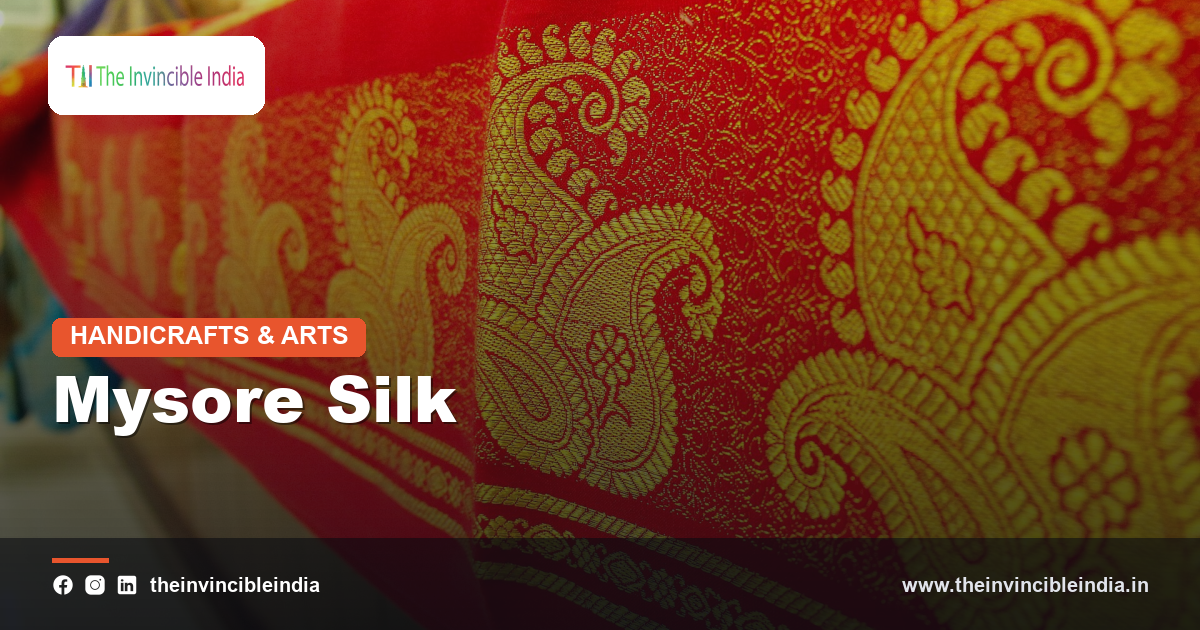
Mysore silk is among the most recognised silk saree traditions of South India, woven in and around the city of Mysore in the southern state of Karnataka. Produced primarily from pure mulberry silk, it is prized for its smooth texture, natural sheen and the fine gold zari that traces its borders and pallu. The tradition grew alongside Karnataka’s long association with sericulture, which made the state one of the country’s principal silk-producing regions. Much like the Kanjeevaram silk of Tamil Nadu, Mysore silk sarees are closely tied to festive and ceremonial wear, forming an important part of South Indian textile heritage. This guide explores the material, technique, motifs and continuing legacy of the craft.
Quick Facts
| Detail | Information |
|---|---|
| Region | Mysore, Karnataka |
| Material | Pure mulberry silk |
| Known For | Lustrous texture and gold zari borders |
| Weave Type | Plain weave silk with woven zari border |
| Recognition | Geographical Indication (GI) tag |
| Typical Use | Wedding and festive wear |
Origins and Regional Roots
The story of Mysore silk is closely tied to the growth of organised sericulture in the region once ruled as the princely state of Mysore. Local rulers and administrators encouraged silk cultivation and weaving as an important economic activity, supporting mulberry plantations and silk reeling units across the surrounding countryside. Karnataka’s climate proved well suited to mulberry cultivation, allowing silk production to flourish and turning the area into one of India’s principal centres for high quality silk yarn. Over generations, weavers in and around Mysore refined techniques suited to the fine, lustrous silk grown locally, gradually developing a saree tradition distinct from those found elsewhere in the country. Steady patronage and institutional support strengthened this ecosystem over time. This regional foundation gave Mysore silk its distinct identity, rooted in Karnataka’s soil, climate and generations of inherited weaving skill passed down within local communities of artisans.
The Silk Fibre and Its Qualities
Mysore silk is made almost entirely from pure mulberry silk, considered among the finest categories of silk produced in India. The fibre is valued for its softness, even texture and a natural lustre that catches light gently rather than appearing overly glossy. Because mulberry silkworms are reared on a controlled diet of mulberry leaves, the resulting filament tends to be more uniform than silk obtained from wild or semi-wild varieties, giving finished fabric a smoother hand-feel. This consistency makes the yarn easier to weave into fine, closely set fabric without excessive slubbing or irregularity. Weavers and buyers alike associate Mysore silk with a particular softness that drapes well against the body, an important quality for a saree meant to be worn through long ceremonial occasions. These inherent qualities of the fibre form the foundation on which the saree’s reputation for elegance and comfort ultimately rests.
From Cocoon to Yarn
Before it reaches the loom, mulberry silk passes through a sequence of careful processing steps that begins with the rearing of silkworms and the harvesting of their cocoons. The cocoons are reeled to draw out the continuous silk filament, which is then twisted and combined into yarn of the required thickness for weaving. This reeling stage demands close attention, since uneven tension or breakage can weaken the resulting thread and affect the quality of the finished cloth. Karnataka’s sericulture network, supported by dedicated research and extension institutions, has long focused on improving cocoon quality and reeling techniques to keep pace with the exacting standards required for fine saree weaving. Only yarn that meets consistent strength and smoothness standards is considered suitable for the closely woven, lightweight fabric associated with Mysore silk. This preparatory stage, though largely unseen by the eventual wearer, is essential to the saree’s characteristic softness and sheen.
The Weaving Process
Mysore silk sarees are traditionally woven on looms set up for fine, closely packed silk fabric, with the body of the saree typically kept in a single restrained colour to let the silk’s natural sheen stand out. Skilled weavers manage the interplay between the silk warp and weft, working at a measured pace to avoid snags or irregular tension that would compromise the smooth finish the fabric is known for. The border and pallu, where decorative zari is introduced, require particular concentration, since the weaver must coordinate additional threads without disturbing the plain weave of the body. Many workshops combine traditional handloom techniques with modern powerloom production for different price segments, though handwoven pieces continue to be valued for their subtlety and craftsmanship. The rhythm of the loom, passed down through apprenticeship, remains central to how the fabric acquires its characteristic drape. This process, patient and exacting, is what ultimately transforms raw silk yarn into a finished saree of lasting quality.
Distinctive Motifs and Border Designs
Mysore silk sarees are generally recognised by their comparatively understated body, often woven in a single solid shade, paired with a broad, richly worked zari border and pallu. This contrast between a plain field and an ornate border is one of the saree’s most identifiable visual traits, allowing the gold work to stand out clearly against the silk. Traditional motifs found along the border and pallu draw on temple architecture, floral forms and geometric patterns that have long featured in South Indian textile design. The restraint shown in the body of the saree reflects a design philosophy that favours quiet elegance over dense ornamentation, letting the quality of the silk itself speak for the garment. Such motifs are not merely decorative; they situate the saree within a broader regional visual language shared across South Indian textile traditions. This balance of simplicity and rich detailing continues to define the aesthetic appeal of Mysore silk today.
The Zari Work
The gold-toned zari used in Mysore silk sarees is one of the fabric’s most celebrated features, traditionally associated with fine metallic thread woven into the border and pallu. Historically, zari involved fine metal wire wrapped around a silk core, though contemporary production commonly uses metal-coated yarn to achieve a similar visual effect at a more accessible cost. The quality of zari is judged by its lustre, durability and the way it catches light without appearing gaudy, qualities that skilled weavers take into account when selecting materials for a given saree. Because zari work is concentrated at the border and pallu rather than spread across the entire body, it can be woven with a level of detail that would be impractical if applied throughout the fabric. This concentrated ornamentation has become closely associated with Mysore silk’s identity, distinguishing it at a glance from more heavily patterned regional silks. The care given to this zari work reflects the broader emphasis on craftsmanship that runs through the entire tradition.
Colour Palette and Dyeing Traditions
Mysore silk sarees are traditionally associated with rich, saturated colours such as deep reds, purples, greens and golds, chosen for their suitability to festive and ceremonial occasions. The dyeing process aims for even, fade-resistant colour across the length of the fabric, an important consideration given the smooth, reflective surface of pure silk that can reveal any unevenness in dye application. While natural dyes were historically used across many Indian handloom traditions, contemporary production more often relies on synthetic dyes that offer greater colour consistency and a wider range of shades. Colour choices are often linked to occasion and regional preference, with certain shades considered particularly auspicious for weddings and festivals. The saturated palette also complements the gold zari border, creating a visual contrast that has become closely associated with the saree’s festive character. This attention to colour, alongside the fabric’s natural sheen, contributes significantly to the saree’s enduring popularity for special occasions.
Karnataka's Sericulture Ecosystem
Karnataka has long held a prominent position within India’s sericulture sector, supported by a network of mulberry farms, cocoon markets and reeling units that feed into the state’s weaving industry. State institutions have historically played a role in research, quality standards and training, helping to sustain the supply chain that Mysore silk weaving depends upon. This ecosystem connects farmers who cultivate mulberry and rear silkworms with reelers who convert cocoons into yarn, and finally with weavers who transform that yarn into finished sarees. Such an integrated structure has allowed the region to maintain a relatively steady supply of quality silk, even as demand and market conditions have shifted over time. Public sector involvement in silk production and marketing has also helped maintain consumer confidence in the authenticity of Mysore silk products. This broader agricultural and industrial foundation underpins the visibility that the finished saree enjoys in markets across India.
The Saree's Drape and Wearability
Beyond its visual appeal, Mysore silk is valued for the way it drapes on the body, falling in soft, even folds rather than stiff pleats. This quality stems directly from the fine mulberry silk yarn and close plain weave used for the body of the saree, which together produce a fabric with a supple hand-feel. Wearers often note that the saree remains comfortable even through long ceremonies, an important practical consideration for garments associated with weddings and extended festive events. The moderate weight of the fabric, neither too heavy nor too light, allows it to hold its shape through the day without feeling burdensome. This combination of comfort and elegance has helped the saree remain a preferred choice across generations, even as fashion trends in Indian textiles have continued to evolve. The drape, subtle yet distinctive, is often cited by long-time wearers as one of the saree’s most appreciated qualities.
Occasions and Cultural Significance
Mysore silk sarees occupy an important place in the wardrobe of many South Indian households, particularly for weddings, religious festivals and other significant family occasions. The saree is often associated with formality and respect, making it a common choice for ceremonies where traditional attire is expected. In many families, a Mysore silk saree may be gifted or passed down as part of wedding trousseaus, reflecting the value placed on the fabric as both an aesthetic and sentimental object. Its association with Karnataka’s cultural identity also makes it a popular choice during regional festivals and civic celebrations. Beyond personal wear, the saree has come to represent a broader sense of South Indian textile heritage recognised well beyond the state’s borders. This cultural weight, built up over generations of use in significant life events, adds meaning to the saree beyond its material qualities alone.
Weaving Clusters and Craft Communities
Silk weaving in the Mysore region is sustained by communities of artisans whose skills are typically passed down within families and local weaving clusters. These communities have historically organised themselves around cooperative structures and workshops, allowing knowledge of weaving techniques, motif design and finishing to be shared and refined over generations. Such clusters often specialise in particular aspects of production, from reeling and dyeing to the more specialised zari border work, reflecting a broader division of skilled labour within the craft. The continuity of these communities depends heavily on younger members choosing to continue in the trade, a pattern shared with many traditional Indian handicrafts facing competition from other livelihoods. Support from state agencies and cooperative societies has, at various points, helped sustain these clusters through training programmes and market access initiatives. The resilience of these weaving communities remains central to the survival of Mysore silk as a living craft rather than a purely historical reference.
Comparisons with Other South Indian Silks
Mysore silk is often discussed alongside other major South Indian silk traditions, each of which has developed its own distinct character shaped by regional materials and weaving practices. Where some traditions favour dense, heavily patterned bodies with elaborate motifs throughout, Mysore silk is generally recognised for its comparatively restrained body paired with a concentrated, richly worked border. This distinction reflects differing regional aesthetics rather than any difference in the underlying quality of craftsmanship, with each tradition prized for its own particular strengths. Buyers familiar with South Indian textiles often learn to distinguish these traditions by border width, motif style and the overall balance between plain and patterned areas of the fabric. Such comparisons help highlight the diversity of India’s silk weaving heritage, in which Mysore silk represents one distinctive strand among several closely related but visually different traditions. Understanding these differences deepens appreciation for the specific choices that define the Mysore silk aesthetic.
Modern Adaptations and Fashion
In recent decades, Mysore silk has found its way into contemporary fashion through designer collaborations, ready-to-wear adaptations and lighter-weight variants aimed at younger consumers. Designers have experimented with new colour combinations, contemporary motifs and alternative garment forms such as stoles, dupattas and fusion wear, while still drawing on the traditional weaving techniques that define the fabric. These adaptations have helped introduce the textile to audiences who may not otherwise encounter it through conventional saree retail. At the same time, many buyers continue to seek out classic, traditionally woven pieces for weddings and formal occasions, sustaining demand for the fabric in its established form. Online retail has also expanded the reach of Mysore silk beyond Karnataka, connecting weaving clusters with buyers across India and abroad. This blend of continuity and innovation has helped keep the craft commercially relevant without diluting its core identity.
Challenges Facing the Craft
Like many traditional Indian textile crafts, Mysore silk weaving faces a set of ongoing challenges tied to changing economic conditions and shifting consumer habits. Rising costs of raw silk, competition from machine-made and imported fabrics, and the gradual movement of younger generations away from traditional weaving occupations have all placed pressure on the craft’s continuity. Maintaining consistent quality across a fragmented network of small workshops and individual weavers can also be difficult without strong coordination and quality control mechanisms. Fluctuations in silk yarn prices, linked to broader agricultural and market conditions, add further uncertainty for weavers who often operate on thin margins. Addressing these challenges requires sustained investment in training, fair pricing structures and market access that allows weavers to benefit directly from the value their skill creates. Recognising these pressures is an important step toward ensuring the craft’s long-term survival.
GI Tag and Preservation Efforts
Mysore silk has received formal recognition through a Geographical Indication tag, a designation intended to protect the name and reputation associated with silk produced in the region against misuse elsewhere. This recognition helps distinguish authentic Mysore silk from imitations and supports efforts to maintain quality standards associated with the name. Alongside this legal protection, various institutional and cooperative efforts have focused on documenting traditional techniques, supporting weaver welfare and promoting the fabric through exhibitions and trade fairs. Such preservation initiatives aim to balance the practical economic needs of weaving communities with the broader goal of safeguarding a distinctive regional craft. Government schemes related to handloom and sericulture development have periodically extended support to weavers working within this tradition. Together, these efforts represent an ongoing commitment to ensuring that Mysore silk remains both economically viable and culturally intact for future generations.
Mysore Silk Today
Today, Mysore silk continues to be recognised as one of India’s notable silk saree traditions, valued for its pure silk content, subtle elegance and distinctive gold zari borders. It remains closely associated with Karnataka’s cultural identity, worn during weddings, festivals and other significant occasions across South India and beyond. The craft has adapted to changing markets through a combination of traditional handloom production, cooperative marketing structures and contemporary design collaborations, allowing it to reach new audiences while retaining its essential character. Continued institutional support, GI recognition and the resilience of weaving communities have helped the tradition endure amid broader shifts in the textile industry. As with many handloom crafts, its future will likely depend on sustained efforts to support artisans, maintain quality and connect the tradition with new generations of buyers. Mysore silk stands today as a living testament to Karnataka’s long-standing relationship with silk cultivation and weaving craftsmanship.
Sources & Further Reading
- Ministry of Textiles, Government of India (texmin.nic.in).
- Karnataka Silk Industries Corporation Limited (ksicsilk.com).
Frequently Asked Questions
What makes Mysore silk different from other Indian silks?
Mysore silk is known for its pure mulberry silk content, smooth texture and characteristic combination of a plain, softly coloured body with a rich gold zari border, giving it a more understated look compared to some other heavily patterned silk traditions.
Is Mysore silk always handwoven?
Both handloom and powerloom production exist within the tradition, with handwoven pieces generally considered more valuable due to the skill and time involved, while powerloom versions offer a more accessible price point.
What occasions are Mysore silk sarees typically worn for?
They are most commonly worn for weddings, religious festivals and other formal or ceremonial occasions, reflecting their long-standing association with significant family and cultural events in South India.
Does Mysore silk have official recognition?
Yes, silk produced in the region has been granted a Geographical Indication tag, which helps protect the name and supports quality assurance for genuine Mysore silk products.
How should a Mysore silk saree be cared for?
As with most fine silk textiles, careful dry cleaning, storage away from direct sunlight and moisture, and gentle folding are generally recommended to preserve the fabric’s colour and sheen over time.


