

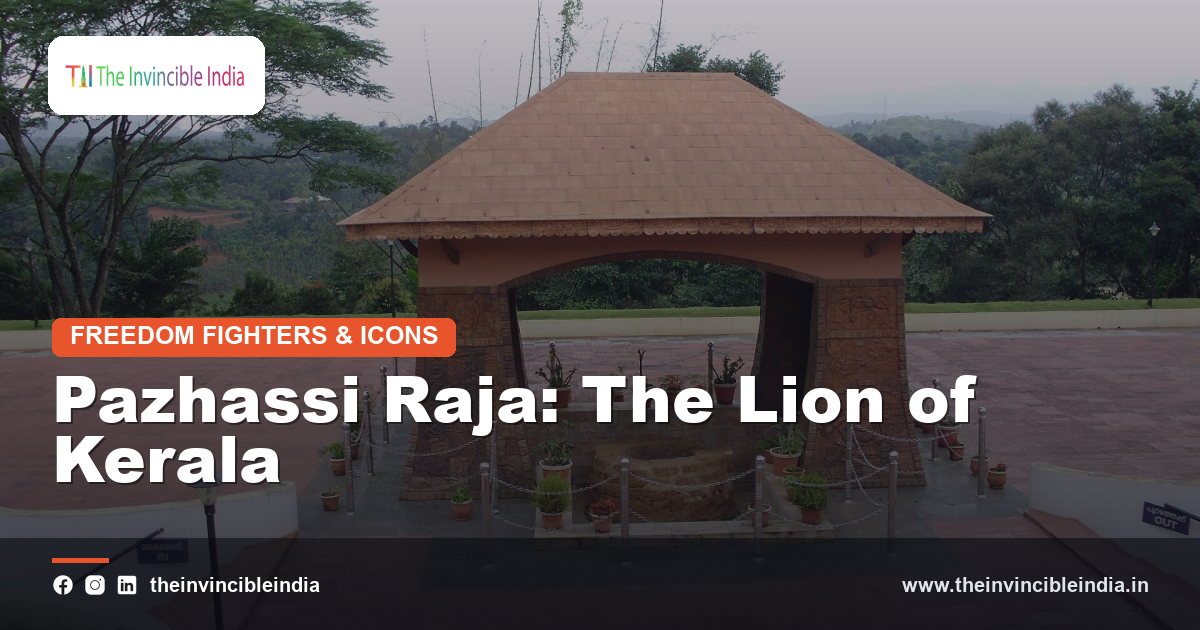
Pazhassi Raja, remembered in Kerala as the Lion of Kerala and as Kerala Varma, was a prince of the Kottayam royal house in northern Malabar who refused to bow before foreign power. Over many years he resisted first the pressures of Mysore and then the expanding authority of the East India Company, drawing on the dense forests and hills of Wayanad, the loyalty of local communities and a remarkable gift for guerrilla warfare. His struggle belongs to the earliest chapter of organised resistance to colonial rule in southern India, long before the more widely known movements of the nineteenth and twentieth centuries. Like Velu Nachiyar in the Tamil country, he stands as proof that opposition to colonial domination began early and took many forms. This guide explores his life, methods and enduring legacy.
Quick Facts
| Detail | Information |
|---|---|
| Known as | Pazhassi Raja, Kerala Varma, the Lion of Kerala |
| Royal house | Kottayam (Cotiote) royal family of Malabar |
| Region | Northern Kerala, especially the Wayanad hills |
| Opponents | Mysore incursions and the East India Company |
| Method of resistance | Forest-based guerrilla warfare |
| Legacy | Museums, memorials, folk memory and cinema in Kerala |
Malabar Before the Rebellion
The Malabar coast of northern Kerala was, before the colonial era, a landscape of small principalities, each ruled by a local royal house and bound together by trade, custom and shared devotion to regional traditions. The pepper and spice trade drew merchants from distant lands, and the coastal ports connected the region to the wider Indian Ocean world. Behind the coast, the hills and forests of the Western Ghats sheltered communities with their own ways of life.
This political fabric was gradually strained by outside powers seeking control of Malabar’s wealth. Understanding the world into which Pazhassi Raja was born helps explain why his resistance mattered so deeply to ordinary people. It was not merely a quarrel between rulers but a struggle to preserve the customs, revenue arrangements and independence of a region that had long governed itself in its own manner.
The Kottayam Royal House
Pazhassi Raja belonged to the Kottayam royal house, a ruling family of northern Malabar whose territories lay in the hilly country that stretched toward Wayanad. The family was associated with the region of Pazhassi, a place name that gave the prince the name by which history remembers him. The house exercised authority over lands and communities in the interior as well as stretches closer to the coast.
The Kottayam rulers maintained relationships with neighbouring chiefs, with local temples and with the communities who farmed or lived in the forested hills. This standing among the people proved crucial in later years, when the prince needed shelter, supplies and dependable allies. His belonging to a respected ruling family, and his closeness to the people of the hill country, shaped both his legitimacy and his ability to sustain a long resistance.
Early Life and Princely Responsibility
Pazhassi Raja grew up within the courtly world of Malabar, where princes were expected to learn statecraft, the management of land and revenue, and the martial skills needed to defend their territory. He took on a leading role in the affairs of his house at a time when the region faced mounting pressure from powerful neighbours.
Accounts agree that he combined diplomatic caution with personal courage, qualities that served him well during decades of turbulence. Specific details of his childhood are sparsely recorded, and it is wiser to speak of his formation in general terms than to assert precise events. What history preserves with confidence is the character of the adult leader, one who understood the land, respected local customs and showed an unusual capacity to command loyalty in difficult conditions.
Mysorean Pressure on Malabar
In the later eighteenth century the rulers of Mysore extended their power into Malabar, seeking control over its ports, its pepper and its strategic position. These incursions disrupted the existing order, and many local chiefs were forced to choose between submission, resistance and exile. The Kottayam house and its neighbours faced difficult decisions as the new authority pressed its demands.
Pazhassi Raja and his family experienced this period as one of disruption, and the prince is remembered as having resisted the incursions rather than accepting them without protest. The experience taught him the value of the forested hills as a refuge and the importance of alliances with local communities. These early lessons in survival and resistance prepared him for the far longer struggle that was to come against a different and more enduring power.
The Company Enters Malabar
The decline of Mysore’s hold over the region and the rise of the East India Company brought a fresh set of rulers to Malabar. After the conflicts of the late eighteenth century, the Company took charge of the territory and began organising it according to its own administrative and financial priorities. Local rulers who had hoped for the restoration of their traditional rights found themselves treated as subordinates rather than sovereigns.
The Company’s chief interest lay in revenue and in control of the lucrative spice trade, and its officials were unfamiliar with, or indifferent to, the customary arrangements that had governed Malabar for generations. This clash between a distant commercial power and an old regional order created the conditions for rebellion. Pazhassi Raja emerged as the most determined voice of that resistance.
Revenue, Rights and the Roots of Revolt
The immediate causes of the uprising lay in disputes over revenue collection and the rights of the local ruling families. Under the new arrangements, the Company sought to collect taxes directly and to place arrangements in the hands of favoured intermediaries, disregarding the claims of established royal houses. The burden on cultivators grew heavier, and resentment spread across the countryside.
For Pazhassi Raja, the issue was both personal and political. His family’s rights were set aside, and the people of his territory were subjected to demands they regarded as unjust. He therefore became a champion of those who felt wronged by the new system. The revolt that followed was rooted in a sense of justice and in the defence of a way of life, not simply in the ambitions of one prince.
Wayanad as a Natural Fortress
The hills and forests of Wayanad became the heart of Pazhassi Raja’s resistance. This plateau region of the Western Ghats is covered by dense woodland, cut by streams and steep ravines, and sparsely populated by settled communities. For an army accustomed to open ground and fixed positions, such terrain was a formidable obstacle.
The prince and his followers knew every path, ridge and hiding place, and they used this knowledge to move quickly, strike unexpectedly and vanish before pursuit could organise. The monsoon rains, the thick undergrowth and the tangle of narrow tracks all favoured the defenders. Wayanad thus served as a natural fortress, and its landscape became inseparable from the story of the resistance. To this day the region carries the memory of the Lion of Kerala in its hills and valleys.
The Art of Guerrilla Warfare
Pazhassi Raja is widely remembered as a master of guerrilla warfare, adapting his tactics to the strengths of his people and the realities of the land. Rather than meeting a better-equipped force in open battle, he preferred ambushes, sudden raids on supply lines and rapid withdrawals into the forest. These methods wore down his opponents and denied them the decisive engagement they sought.
Success in such warfare depended on information, mobility and the goodwill of local communities, all of which he cultivated. His forces knew how to strike at vulnerable points and how to disappear into terrain that outsiders found bewildering. The prolonged and frustrating campaign that resulted showed that determination and local knowledge could challenge a far stronger military machine, a lesson that later movements in India would also come to appreciate.
Allies from the Hills and Villages
No resistance of this length could have survived without broad support, and Pazhassi Raja drew strength from many communities. Among his most valued followers were the Kurichya people of Wayanad, skilled in archery and intimately familiar with the forest, who stood beside him through years of hardship. Other supporters came from among the local warriors and villagers who shared his sense of grievance.
This coalition reflected the prince’s ability to look beyond rank and community and to unite people around a common cause. The loyalty he inspired was a measure of the trust he had earned. In the memory of Kerala, the story of Pazhassi Raja is therefore also the story of the forest communities and fighters who stood with him, and whose courage deserves to be remembered alongside his own.
Edachena Kunkan and Thalakkal Chandu
Two names are especially linked with Pazhassi Raja’s cause: Edachena Kunkan and Thalakkal Chandu. Both are remembered as loyal and capable commanders who fought at his side and contributed greatly to the resistance. Their courage and dedication have become part of Kerala’s regional heritage, and they appear prominently in local retellings of the struggle.
Edachena Kunkan is associated with the fighters drawn from the villages of the hill country, while Thalakkal Chandu is remembered for his leadership among the forest communities of Wayanad. Their roles illustrate how the movement relied on trusted lieutenants as well as on its royal leader. Honouring them alongside the prince recognises the collective nature of the resistance, in which many individuals risked everything for a cause they believed was just.
Two Phases of a Long Struggle
The conflict between Pazhassi Raja and the Company is generally described as unfolding in two broad phases, separated by a period of uneasy settlement. In the first, the prince resisted the new revenue system and the claims imposed on his territory, and fighting continued until negotiations brought a temporary calm. The peace did not resolve the underlying grievances, however.
When tensions rose again, he returned to the forests and resumed the struggle with renewed determination. The second phase was marked by more concentrated efforts on the part of the Company to capture him, and by increasing hardship for his followers. Taken together, the two phases show a leader who was willing to negotiate when possible but who never abandoned his principles when the terms offered were unacceptable.
Final Years and Death in the Forest
In the closing years of his struggle, Pazhassi Raja lived the harsh life of a fugitive in the Wayanad forests, moving constantly to avoid capture while remaining the focus of local loyalty. The Company pressed hard to end the resistance, deploying considerable forces and seeking to cut him off from his supporters.
He died in the early nineteenth century during an encounter with Company forces in the forest region of Wayanad, remaining unconquered to the end. Accounts record that his remains were treated with respect, a gesture that reflected the standing he had earned even among his adversaries. His death ended the active resistance, but it did not end the memory of his defiance, which passed into the living tradition of Kerala as a symbol of courage and honour.
Character and Leadership
Those who describe Pazhassi Raja consistently emphasise his steadiness, patience and capacity to inspire. He combined the dignity of a royal prince with a willingness to share the privations of life in the forest, and this closeness to his followers strengthened their devotion. His leadership rested on trust rather than coercion.
He is also remembered as a strategist who understood the limits of his resources and used them with care. Rather than seeking dramatic but costly victories, he pursued a patient campaign of attrition that exploited his opponents’ weaknesses. These qualities of resolve, adaptability and respect for his people explain why his reputation has endured so strongly. He remains a model of principled leadership under pressure, valued as much for his character as for his military skill.
Memorials, Museums and Places of Remembrance
Kerala honours Pazhassi Raja through memorials, museums and place names that keep his story visible. A memorial in the Wayanad region stands as a place of remembrance near the area associated with his last days, and visitors come to pay respects and learn about the resistance. A museum in Kozhikode that bears his name preserves artefacts and displays connected with the history and heritage of the region.
Educational institutions, public spaces and works of regional infrastructure have also been named in his honour. Such commemorations make the past a part of daily life, reminding successive generations of what earlier Keralites endured and achieved. They also connect the physical landscape of Malabar with its history, turning forests, hills and towns into carriers of collective memory.
Pazhassi Raja in Art, Folk Memory and Cinema
The Lion of Kerala lives on in the cultural imagination of the state through stories, songs, plays and films. Folk tradition in Malabar has long celebrated the exploits of the prince and his companions, and local retellings keep alive details of the hill country struggle that formal histories sometimes overlook. Writers and dramatists have drawn on his life for inspiration.
Malayalam cinema has also brought his story to a wide audience, presenting the resistance as a drama of loyalty, sacrifice and defiance against overwhelming odds. While artistic treatments inevitably shape the story for the stage or screen, they reflect the genuine affection the people of Kerala feel for him. Through these cultural forms the memory of Pazhassi Raja continues to reach new generations beyond the pages of history books.
A Place in India's Wider Freedom Story
Pazhassi Raja belongs to the earlier chapters of resistance that preceded the organised national movement. Alongside figures such as Tantia Tope, Velu Nachiyar and Rani Chennamma, he is part of a long tradition of local leaders who opposed colonial expansion with whatever means they had. Their struggles were regional in character but national in significance.
Recognising such figures corrects the impression that the freedom struggle began only in the nineteenth or twentieth century. In truth, resistance arose wherever colonial power met local pride and local rights, and the forests of Wayanad were among its earliest battlegrounds. The story of the Lion of Kerala therefore deserves a secure place in any account of India’s long journey toward freedom and self-rule.
Pazhassi Raja Today
Today, Pazhassi Raja is honoured across Kerala as a symbol of courage, loyalty to land and refusal to submit to injustice. His name appears in schools, museums and public spaces, and his story is told to children as part of the heritage of the state. Visitors to Wayanad encounter the landscape that sheltered him and the memorials that commemorate his sacrifice.
The enduring relevance of his story lies in its human qualities rather than in any single battle. It speaks of a leader who stood with his people, used the land with wisdom and held to his principles despite great hardship. In remembering Pazhassi Raja, India honours a regional hero whose resistance helped shape the long tradition of freedom that lives on in the nation’s collective memory.
Sources & Further Reading
- Ministry of Culture, Government of India (indiaculture.gov.in).
- Archaeological Survey of India (asi.nic.in).
Frequently Asked Questions
Who was Pazhassi Raja?
Pazhassi Raja, also known as Kerala Varma, was a prince of the Kottayam royal house in northern Malabar. He led a long resistance against the East India Company, using the forests of Wayanad as his base, and is remembered in Kerala as the Lion of Kerala.
Why is Pazhassi Raja called the Lion of Kerala?
The title reflects his courage and his refusal to submit to colonial authority despite years of hardship. It is a popular honorific used in Kerala to express the respect and affection people feel for his steadfast resistance.
What kind of warfare did Pazhassi Raja use?
He relied on guerrilla tactics suited to the dense forests and hills of Wayanad, including ambushes, raids on supply lines and swift withdrawals. His knowledge of the terrain and the support of local communities made these methods highly effective.
Who were his main companions in the struggle?
Edachena Kunkan and Thalakkal Chandu are among the best-known commanders associated with him, and the Kurichya archers of Wayanad were important allies. Their loyalty and courage are remembered as an essential part of the resistance.
How is Pazhassi Raja remembered today?
He is honoured through memorials in Wayanad, a museum in Kozhikode that bears his name, folk traditions and Malayalam cinema. He is widely regarded in Kerala as an early symbol of resistance to colonial rule and of loyalty to one’s land and people.


