

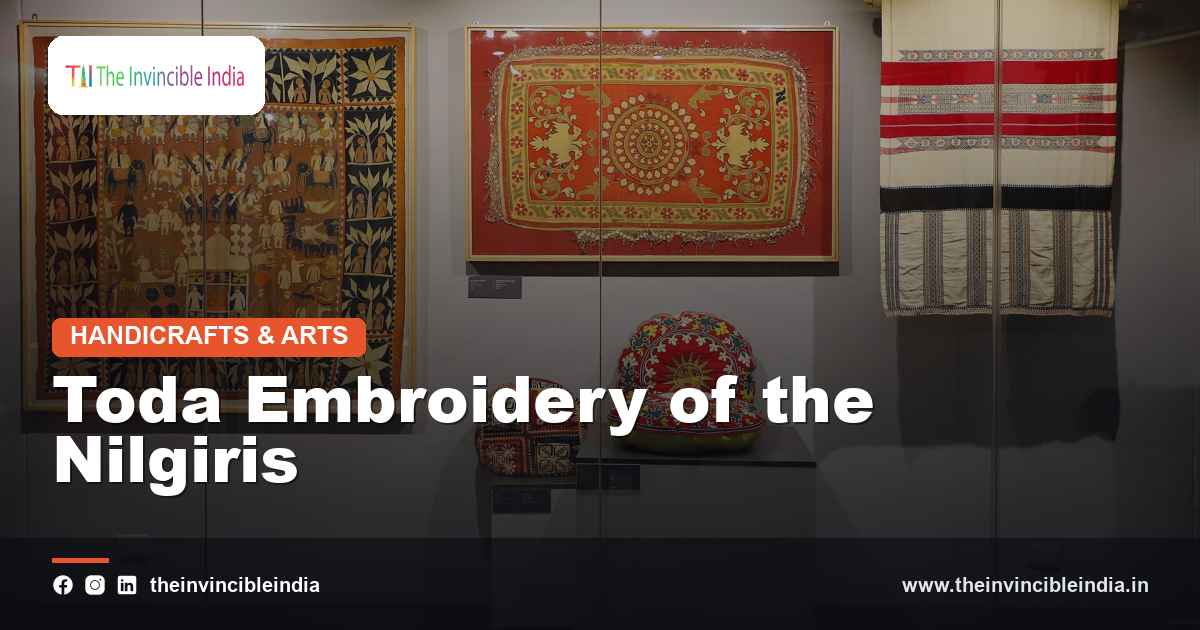
Toda embroidery is among the most distinctive needlework traditions of southern India, created by the women of the Toda community who live on the high grasslands of the Nilgiri hills in Tamil Nadu. Worked in bold red and black thread on a white cotton ground, the embroidery forms bands of crisp geometric patterns that appear almost woven rather than stitched. Unlike the flowing floral designs of Kasuti embroidery from neighbouring Karnataka, Toda work is strictly geometric, rhythmic and highly disciplined. Traditionally made for the community’s own shawls, it has also gained recognition beyond the hills as a celebrated heritage craft. This guide explores its origins, materials, technique, symbolism and present-day revival.
Quick Facts
| Detail | Information |
|---|---|
| Type | Geometric counted-thread hand embroidery |
| Community | Toda people of the Nilgiri hills |
| Region | Nilgiris, Tamil Nadu |
| Signature garment | The Poukhoor shawl |
| Colours | Red and black thread on white cloth |
| Recognition | Protected as a Geographical Indication craft |
What Is Toda Embroidery
Toda embroidery is a form of hand needlework practised by the women of the Toda community, a small pastoral people native to the Nilgiri hills of Tamil Nadu. Its most recognisable feature is the use of red and black thread on a white cotton ground, arranged in neat horizontal bands of geometric motifs. The stitches are worked so precisely that the finished pattern looks like part of the fabric itself, which is why first-time viewers often mistake it for woven cloth. The craft is closely tied to Toda identity, appearing on the community’s ceremonial and everyday shawls. Toda embroidery therefore stands as both a refined textile art and a living marker of a distinctive highland culture.
The Toda People and the Nilgiris
The Todas are one of the small indigenous communities of the Nilgiri hills, a region of rolling grasslands, shola forests and misty plateaus in the Western Ghats of southern India. For generations they have lived in scattered settlements known as munds, following a pastoral way of life centred on buffalo herding. Their language, architecture, religion and clothing set them apart from neighbouring communities, and their culture has long attracted scholarly and public attention. Embroidery is one of the strands that holds this heritage together, passed down quietly within families. The craft cannot be understood without the landscape and community that produced it, since both shape its character, its patterns and its purpose.
The Poukhoor Shawl
The garment most closely associated with Toda embroidery is the shawl, traditionally called the Poukhoor or Pukhoor in the Toda language. It is a large rectangular piece of thick white cotton cloth, worn draped around the body by both men and women. The embroidered bands are placed across the width of the shawl, usually near the borders and in the central field, leaving generous areas of plain white around them. This careful balance between ornament and empty space gives the shawl its calm, dignified appearance. Worn for daily use, important gatherings and ceremonies alike, the Poukhoor remains the central object through which Toda embroidery is seen, admired and remembered.
Origins and Heritage
The exact beginnings of Toda embroidery are not firmly documented, and it is best understood as a tradition that grew slowly within the community over many generations. What is clear is that the craft has long been a woman’s art, learned by watching and practising rather than from written instruction. Patterns, proportions and colour habits were preserved through repetition and memory, giving the embroidery a remarkable consistency across households. Visitors and scholars who encountered the Todas in earlier eras often noted their distinctive shawls, which helped carry the reputation of the craft beyond the hills. This unbroken, community-held transmission is the most important part of its heritage, because the skill itself resides in people rather than in manuals.
Materials and Threads
Toda embroidery relies on simple materials chosen for durability and clarity of pattern. The base is a thick, closely woven white cotton cloth, which provides a bright, stable surface against which the coloured thread stands out sharply. The embroidery thread, traditionally of red and black, is worked in soft, firmly twisted strands that sit crisply on the surface. Today embroiderers may use commercially available cotton and wool threads, though the visual language of the red and black palette remains unchanged. A plain needle, scissors and patient hands complete the toolkit, since no frame or printed outline is needed. The modest nature of these materials underlines how much the craft depends on skill, counting and memory rather than equipment.
The Red, Black and White Palette
The restricted palette of red, black and white is one of the defining features of Toda embroidery and gives the work its strong visual identity. White cloth forms the open ground, while red and black thread build the patterns in alternating bands that create a lively rhythm across the shawl. Because only a few colours are used, the interest of the design lies in proportion, repetition and the interplay of light and dark rather than in variety of hue. This disciplined approach lends the shawls a formal, almost architectural quality. The enduring use of this three-colour scheme shows how a limited palette, handled with confidence, can produce a design language that is instantly and unmistakably recognisable.
The Technique of Working from the Reverse
The technique behind Toda embroidery is as remarkable as its appearance. The embroiderer typically works from the reverse side of the cloth, counting the threads of the weave and passing the needle in a regular sequence so that the pattern forms on the front face. Because no pattern is drawn on the fabric, the design is held in the mind and guided by the weave itself. The resulting stitches are even, tight and raised slightly like a woven texture, which explains why the embroidery resembles loom-made brocade. Mastering this method demands concentration and steady practice, since a miscount can disturb an entire band. The technique is the real signature of the craft, setting it apart from most other Indian embroidery traditions.
Motifs and Geometric Patterns
Toda embroidery is built from geometric motifs rather than naturalistic scenes. Common elements include stepped forms, zigzags, diamonds, triangles and repeating bands that run across the cloth in measured sequence. Each band is made from small, balanced units repeated until the desired length is reached, with narrow lines of contrasting colour framing the main pattern. Artisans may combine several such bands on a single shawl, varying their width and arrangement to suit the piece. Although the vocabulary of shapes is limited, the possible combinations are numerous, allowing each embroiderer to express individual taste within tradition. The geometric language of the motifs gives Toda work its crisp, orderly beauty and links it to textile traditions found in many parts of the world.
Symbolism and Cultural Meaning
Toda embroidery carries meaning beyond decoration, since the shawl forms part of how the community presents itself on important occasions. The patterns are generally understood as an expression of community identity, order and continuity, and the wearing of the Poukhoor signals belonging. Specific interpretations of individual motifs vary and are best described in general terms, as they have been passed on orally rather than recorded in any fixed code. What is certain is that the embroidery is treated with respect and associated with dignity, particularly when worn at gatherings and ceremonies. In this way the craft functions as a quiet visual language, linking daily life, tradition and shared memory without needing words to explain it.
The Role of Toda Women
Embroidery is traditionally the work of Toda women, who learn the craft within the household from mothers, aunts and elders. Girls begin by observing, then practise simple bands before attempting more complex arrangements, gradually developing the steady counting and fine control the technique requires. The work is often carried out in the quieter hours of the day, alongside other domestic and community responsibilities. Over time, embroidery has become one of the few craft traditions through which Toda women have gained recognition and, in some cases, a modest independent income. Their role is therefore central rather than supplementary, since without these women the craft, its standards and its continuity would not exist at all.
Buffalo, Pastures and Pastoral Life
The Toda way of life has long revolved around the buffalo, which holds a special place in the community’s economy, rituals and imagination. Their dairy-centred pastoral culture shaped the settlements, the sacred dairies and the rhythm of the year, and it also shaped how the community saw itself. Embroidery sits comfortably within this world, produced by women whose lives are intertwined with the same grasslands and herds. While the patterns themselves are geometric rather than pictorial, the craft belongs to the same pastoral culture and shares its values of patience, order and attachment to place. Understanding this setting helps explain why Toda embroidery feels so closely connected to its homeland.
Ceremonial and Everyday Use
The embroidered shawl serves both everyday and ceremonial purposes within the Toda community. In daily life it works as a practical wrap against the cool, often misty climate of the Nilgiri highlands, its thick cotton providing warmth and comfort. On special occasions, finer and more elaborately embroidered shawls are worn with pride, and they may also be offered as respectful gifts. The same garment can thus move between ordinary and formal settings, which is part of its cultural value. Its continued use by the community, rather than only as a souvenir, helps keep the tradition authentic. This dual role ensures that the craft stays rooted in lived experience and not merely in display.
How a Toda Shawl Is Made
The making of a Toda shawl begins with selecting a suitable length of white cotton cloth, which is prepared and laid out for work. The embroiderer then plans the arrangement of bands in her mind, deciding their position, width and sequence of colours. Working steadily, she builds each band stitch by stitch, counting the weave and keeping tension even so the pattern stays straight. Several bands may be completed over days or weeks, depending on the complexity of the design and the time available. Once the embroidery is finished, the shawl is trimmed and finished with attention to the edges. Every step relies on patience, which is why a completed shawl represents a considerable investment of skilled time.
Recognition and Geographical Indication Status
In recent decades, Toda embroidery has received formal recognition as a distinctive regional craft of the Nilgiris, including protection under India’s Geographical Indication framework. Such recognition helps establish that the work belongs to a specific community and place, and it can discourage imitation and mislabelling in the wider market. It also draws public attention to the craft and to the artisans who keep it alive, encouraging institutions and buyers to value authenticity. While recognition alone cannot guarantee economic security, it provides a useful foundation for promotion, training and fair marketing. Toda embroidery’s formal status therefore supports both its protection as intangible heritage and the livelihoods of the women who practise it.
Challenges Facing the Craft
Like many community-based crafts, Toda embroidery faces challenges in a changing world. The work is slow and demanding, which makes it hard to compete with machine-made imitations that copy its look at a fraction of the effort. Younger members of the community have wider educational and career choices, and fewer may have the time or incentive to master a technique that takes years to perfect. Changes in lifestyle also reduce everyday demand for traditional shawls. Dependence on intermediaries can limit the fair return that artisans receive. These pressures do not erase the craft’s value, but they make deliberate support for training, fair trade and market access important to its long-term survival.
Caring for Toda Embroidery
A well-made Toda shawl can last for many years when it is handled with care. Because the cloth is cotton, it can generally be cleaned gently with mild soap and cool water, avoiding harsh scrubbing that might disturb the stitches. The red and black threads should be dried in shade rather than strong sunlight to protect the colour. Folding the shawl loosely and storing it in a dry, ventilated place helps prevent dampness and mould. Owners are wise to avoid aggressive ironing directly on the embroidered bands, which can flatten their texture. Thoughtful care preserves the crispness of the pattern and ensures that the shawl continues to reflect the skill invested in its making.
Toda Embroidery Today
Today, Toda embroidery continues as a living craft, supported by artisan groups, cooperatives and organisations that help Toda women bring their work to wider audiences. Beyond traditional shawls, the embroidery now appears on stoles, bags, cushion covers and other contemporary items that keep the patterns relevant while respecting their character. Growing interest in authentic, handmade textiles has helped new buyers appreciate the effort behind each piece. The craft remains a proud expression of Toda identity and of the cultural richness of the Nilgiri hills. By valuing its authenticity and supporting the women who make it, admirers help ensure that this precise and quietly powerful needlework tradition has a lasting future.
Sources & Further Reading
- Ministry of Culture, Government of India (indiaculture.gov.in).
- Development Commissioner (Handicrafts), Ministry of Textiles, Government of India (handicrafts.nic.in).
Frequently Asked Questions
What is Toda embroidery?
Toda embroidery is a geometric hand embroidery practised by Toda women of the Nilgiri hills in Tamil Nadu. It uses red and black thread on white cotton cloth and is best known for decorating the traditional Poukhoor shawl.
Why does Toda embroidery look like weaving?
The embroiderer works from the reverse side of the cloth, counting the weave threads so that the pattern forms evenly on the front. The stitches sit tightly and in regular sequence, giving a textured, loom-like appearance.
What colours are used in Toda embroidery?
The traditional palette consists of red and black thread on a white cotton ground. This limited colour scheme is a defining feature of the craft and gives it a bold, instantly recognisable look.
Who makes Toda embroidery?
The craft is traditionally practised by women of the Toda community, who learn it within the family from elders. It has remained a community-held skill passed down through observation and practice.
Where can Toda embroidery be found?
Authentic pieces are associated with the Nilgiris region of Tamil Nadu and are available through artisan cooperatives and government-supported handicraft outlets. Buyers can look for authenticity markers linked to its Geographical Indication status.


