

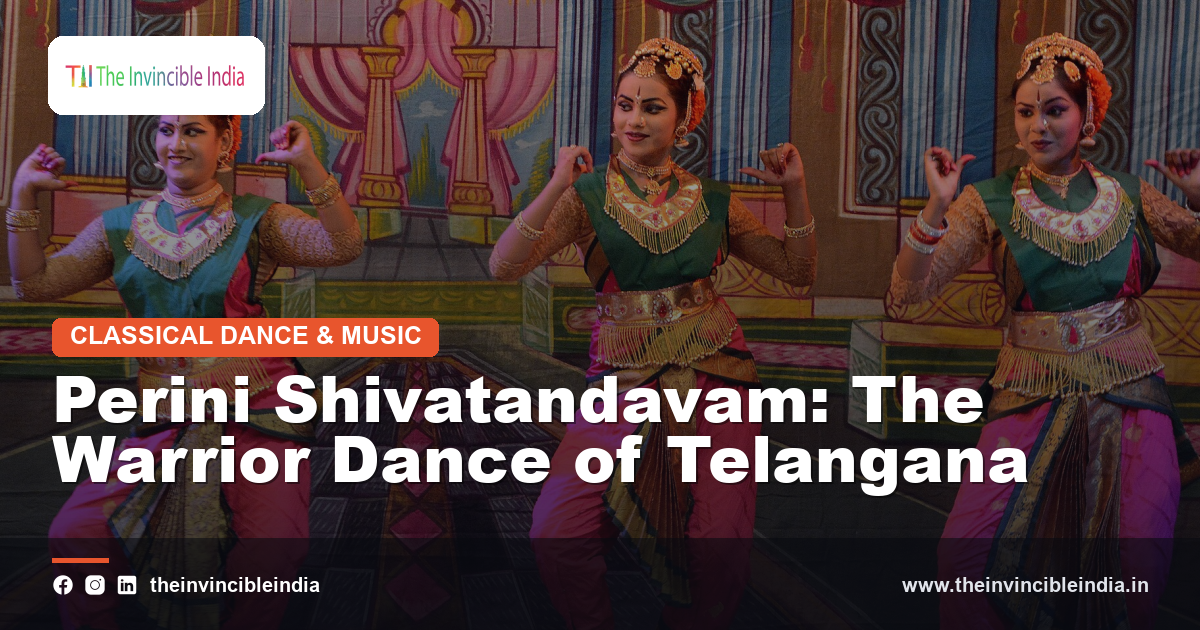
Among the many dance traditions of the Deccan, few carry the raw energy and martial pride of Perini Shivatandavam, the vigorous dance of Telangana offered in worship of Lord Shiva. Traditionally performed by men, it is remembered as a dance of warriors who invoked the god’s power before going into battle, and its forceful steps recall the cosmic dance of Shiva himself. Long associated with the Kakatiya period and with the great temples of the region, it nearly faded from view before artists and scholars restored it to the stage. Although it is not counted among the eight recognised classical dance forms of India, its refined structure and ancient lineage give it a strong claim to classical dignity.
Quick Facts
| Detail | Information |
|---|---|
| Type | A vigorous devotional dance in honour of Lord Shiva |
| Region | Telangana, in the Deccan |
| Performers | Traditionally male dancers |
| Historical link | Associated with the Kakatiya period and its temples |
| Spirit | Martial energy joined with worship |
| Revival | Restored to the stage in the twentieth century |
What Is Perini Shivatandavam
Perini Shivatandavam is a forceful dance form of Telangana in which male dancers offer their art to Lord Shiva through strong, rhythmic movement. The name combines two ideas: Perini, usually understood as referring to the tradition of the dance itself, and Shivatandavam, the energetic cosmic dance of Shiva. Performed to the pounding of drums, the dance expresses both devotion and heroic strength, and it has long been remembered as a dance of warriors. Its postures are bold and its rhythms commanding, setting it apart from gentler lyrical forms. Revived in recent generations, it now represents a proud strand of Telangana’s cultural heritage and is presented on stages, at festivals and before temples as a living link with the region’s martial and spiritual past.
Origins in the Kakatiya Age
The dance is closely identified with the Kakatiya period, when the kingdom centred on the Telugu country flourished as a patron of temple building, sculpture, literature and the performing arts. Within this setting, devotion to Shiva was strong, and the royal court and its temples encouraged the cultivation of dance as part of worship and state ceremony. Warriors of the kingdom are traditionally believed to have performed the dance before battle as an act of invocation. While detailed historical records of performance practice are limited, the tradition’s association with the Kakatiya age is widely accepted in cultural memory and scholarship. The link to a celebrated royal era lends the dance a sense of historical grandeur and explains why it is regarded as a symbol of Telangana’s heritage.
The Dance of Warriors
Perini is often called a dance of warriors because tradition holds that soldiers performed it before going to war. The idea was to channel the fearsome energy of Shiva, the destroyer of evil in Hindu belief, so that the fighters might enter battle strengthened in spirit and resolve. In this reading, the dance functioned as both ritual and rehearsal, uniting prayer, physical conditioning and martial confidence. The powerful stamping, sweeping arm movements and fierce expressions reflect this purpose. Whether or not every detail of the older practice can be verified, the martial character remains central to the identity of the dance and to how it is understood by dancers and audiences. It stands as a reminder that Indian dance has served many roles beyond entertainment.
Devotion to Lord Shiva
At its core, Perini Shivatandavam is an act of worship. Shiva, as Nataraja, the lord of dance, is central to Indian understanding of cosmic movement, creation and dissolution, and the dance invokes this aspect of the deity through vigorous, rhythmic motion. Performers traditionally begin with an offering and prayer, treating the stage as a sacred space where the god is honoured. The fierce moods of the dance are not aggression for its own sake but expressions of divine power directed toward the protection of the righteous. This devotional framework gives the dance its seriousness and focus, and it ties Perini to the broader family of Shaiva traditions in which dance, music and ritual are inseparable parts of religious life.
The Nritta Ratnavali of Jayapa Senani
A key literary source for Perini is the Sanskrit treatise Nritta Ratnavali, written by Jayapa Senani, a military commander in the service of the Kakatiya ruler Ganapati Deva. This work on dance describes various types of movement and the styles of the Deccan, and it is widely regarded as an important record of the dance culture of the age. That the author was both a general and a theorist of dance reflects the close relationship between martial skill and artistic discipline in the period. The treatise has become the foundation on which modern scholars and practitioners have based efforts to understand and reconstruct the older dance. Its importance shows how seriously the tradition was studied and how much scholarly attention the dance enjoyed in its heyday.
Sculptures and Temple Evidence
The temples of the Kakatiya era preserve some of the most evocative visual evidence for the dance. At Ramappa and other sites, carved figures show dancers in poised and energetic postures, with sculpted musicians and drummers in attendance, offering a frozen glimpse of how performance may have looked. The Ramappa Temple, a masterpiece of Kakatiya craft, is recognised as a UNESCO World Heritage Site, and its figures have drawn the attention of dancers seeking to understand the old movement vocabulary. Such sculptures cannot give a full picture of choreography, but they offer valuable clues about stance, gesture and costume. The dialogue between stone and stage has been central to the revival of Perini, with living dancers reading the carvings as a guide to the past.
Why the Dance Faded
With the decline of the old kingdoms and the changing patterns of patronage, Perini gradually lost its place in temple and court life. Without royal support and without the martial purpose that had once sustained it, the dance receded, and the continuous chain of teachers and students was weakened. By the modern period it had nearly vanished as a living art, surviving only in fragments of memory and in the stone carvings of the old temples. This kind of loss is a familiar story in the history of Indian performing traditions, many of which depended on the fortunes of particular courts and institutions. Yet the dance was not forgotten entirely, and its rediscovery in later years shows how cultural memory can endure even when practice lapses.
The Revival of Perini
The restoration of Perini to the stage is widely credited to the dancer and scholar Nataraja Ramakrishna, who studied the textual and sculptural sources and worked with artists to reconstruct and teach the dance in the twentieth century. His efforts drew on the Nritta Ratnavali, the temple carvings and the memories of older performers, and they gave the form a new generation of practitioners. The revival is a good example of how research and creative practice can work together to bring an endangered art back into public life. Since then, dancers and teachers in Telangana have continued to refine and promote the form, ensuring that it is performed in festivals and on formal stages. The revival rescued Perini from near oblivion and secured its place in modern cultural life.
Movements and Technique
The technique of Perini Shivatandavam is marked by strength, speed and precision. Dancers use firm footwork, deep postures, expansive arm movements and sharp turns, often keeping a grounded and powerful stance that conveys martial authority. Rhythm is central, and the movements are closely tied to the beats of the drums, with complex patterns that build intensity through the performance. Facial expression conveys the fierce and heroic moods, while the body maintains a controlled energy that never loses balance or form. The result is a dance that looks both ferocious and disciplined, requiring considerable stamina and training. Mastering it means developing the physical conditioning of an athlete along with the sensitivity and devotional focus of a temple dancer.
Music and Percussion
Percussion is the soul of Perini. The dance is performed to the beat of drums, whose booming rhythms set the pace and carry the martial spirit of the performance. Vocal chanting and verses in praise of Shiva may accompany the dance, and the music is shaped to match the changing moods from invocation to full-blooded display. The interplay between dancers and drummers is intense, with each responding to the other as the rhythm rises. This strong percussion base links the form with other vigorous folk and ritual traditions of the region, while the structure of its rhythms reflects a more formal, classical sensibility. The sound of the drums remains one of the most memorable aspects of the experience for audiences.
Costume and Ornaments
The costume of the Perini dancer is designed to convey strength and devotion without restricting movement. Dancers traditionally appear with the upper body largely uncovered, wearing a draped lower garment tied firmly at the waist, together with ornaments such as garlands, bracelets and other adornments linked to the worship of Shiva. Anklets and bells sound with each step, adding to the rhythm. Sacred marks on the forehead and body signify the religious nature of the performance. The overall look recalls the sculpted figures of the old temples and gives the dance a stately, ancient air. Costume here supports the character of the dance as a physical offering, allowing the strength and sculpted form of the dancer to be seen in full.
Performance Settings
Perini Shivatandavam was originally performed in temples and at royal and military gatherings, and its modern revival has returned it to many of these settings while adding new ones. Today the dance is presented on cultural stages, at festivals celebrating the heritage of Telangana, and in programmes organised by academies and government bodies. Its sense of occasion makes it suited to open-air spaces, where the sound of drums carries and a large audience can gather. Performances may be given by solo dancers, but group presentations are also popular, as the sight of many dancers moving in unison heightens the dramatic effect. Wherever it is staged, the dance retains its ceremonial quality and its connection to the sacred.
Perini and the Classical Tradition
Perini is often discussed as a candidate for classical status because of its textual foundations, formal technique and devotional purpose, though it is not among the eight forms formally recognised at the national level. It shares with the classical arts a basis in treatises, a codified movement vocabulary and a spiritual orientation. At the same time, its martial energy, male performers and strong percussive character distinguish it from forms such as Bharatanatyam, which tend toward lyrical grace. This difference enriches the national dance heritage by showing that India’s classical thinking embraced strength as well as sweetness. The study of Perini therefore broadens understanding of what Indian classical dance has been and can be.
Place in Telangana Identity
For the people of Telangana, Perini carries a special emotional charge. It is celebrated as a distinctive cultural emblem, evoking a proud history, the artistry of the Kakatiya temples and the strength of the region’s traditions. Cultural festivals and public events often feature the dance as a symbol of regional heritage, and its imagery appears in official celebrations and artistic displays. The recovery of the dance has also fed a wider interest in the arts and history of the region, encouraging the study of folk and classical traditions side by side. As such, Perini serves not only as an art form but also as a marker of identity, linking present-day communities with a celebrated past and offering them a shared source of pride.
Training and Practitioners
Learning Perini requires physical conditioning, rhythmic mastery and an understanding of its devotional context. Students study under teachers who trace their knowledge to the revival and to older sources, working on footwork, posture, stamina and the intricate rhythmic patterns that define the form. The training builds endurance and balance, since the dance demands sustained, intense effort. Alongside technique, students learn about the stories, prayers and symbolism of Shiva that give the dance its meaning. Institutions and cultural bodies in the region have supported teaching programmes, and a growing group of young dancers is carrying the art forward. Although the number of practitioners remains modest compared with that of mainstream forms, the commitment of those who study it is strong.
Challenges and Preservation
Like many revived traditions, Perini faces challenges of continuity. Because the older lineage was broken, the present form rests partly on reconstruction, and questions naturally arise about how closely it matches the practice of the past. There is also the practical task of finding students, performance opportunities and sustained support for a dance that is not as widely known as other forms. Documentation, teaching and public performance are all essential to preservation, and cultural institutions have a role in encouraging each. Scholars continue to study the treatises and sculptures, while artists keep refining their technique. The balance between faithful reconstruction and living creativity is delicate, but careful work in both directions offers the best hope for keeping the dance healthy and meaningful.
Perini Shivatandavam Today
Today Perini Shivatandavam stands as a powerful reminder of the diversity of Indian dance. Revived from near disappearance, it is now performed in festivals, taught in dance schools and celebrated as part of the heritage of Telangana. Its forceful rhythms, devotional spirit and martial grace continue to impress audiences who encounter it for the first time. The dance connects the living stage with the carved figures of the old temples and with a historical age of artistic flowering. Its future depends on continued teaching, scholarship and public appreciation, all of which are growing. As a dance that joins strength with worship, Perini Shivatandavam holds a distinctive and honoured place in the cultural life of the region and of the nation.
Sources & Further Reading
- Sangeet Natak Akademi, Government of India (sangeetnatak.gov.in).
- Archaeological Survey of India (asi.nic.in).
Frequently Asked Questions
What is Perini Shivatandavam?
Perini Shivatandavam is a vigorous dance of Telangana, traditionally performed by men in honour of Lord Shiva. It is remembered as a warrior dance associated with the Kakatiya period.
Who revived Perini Shivatandavam?
The dancer and scholar Nataraja Ramakrishna is widely credited with reviving the dance in the twentieth century. He drew on the Nritta Ratnavali, temple sculptures and the memories of older performers.
What is the Nritta Ratnavali?
The Nritta Ratnavali is a Sanskrit treatise on dance by Jayapa Senani, a commander under the Kakatiya ruler Ganapati Deva. It is an important source for understanding the dance culture of the Deccan in that age.
Why is Perini called a warrior dance?
Tradition holds that warriors performed it before battle to invoke the strength of Shiva and steel their spirit. The forceful movements and martial character of the dance reflect this origin.
Is Perini Shivatandavam a classical dance?
It is not one of the eight forms formally recognised at the national level, but it has textual foundations, a formal technique and a devotional purpose that resemble those of classical arts. It is often described as a classical-style tradition of Telangana.


