

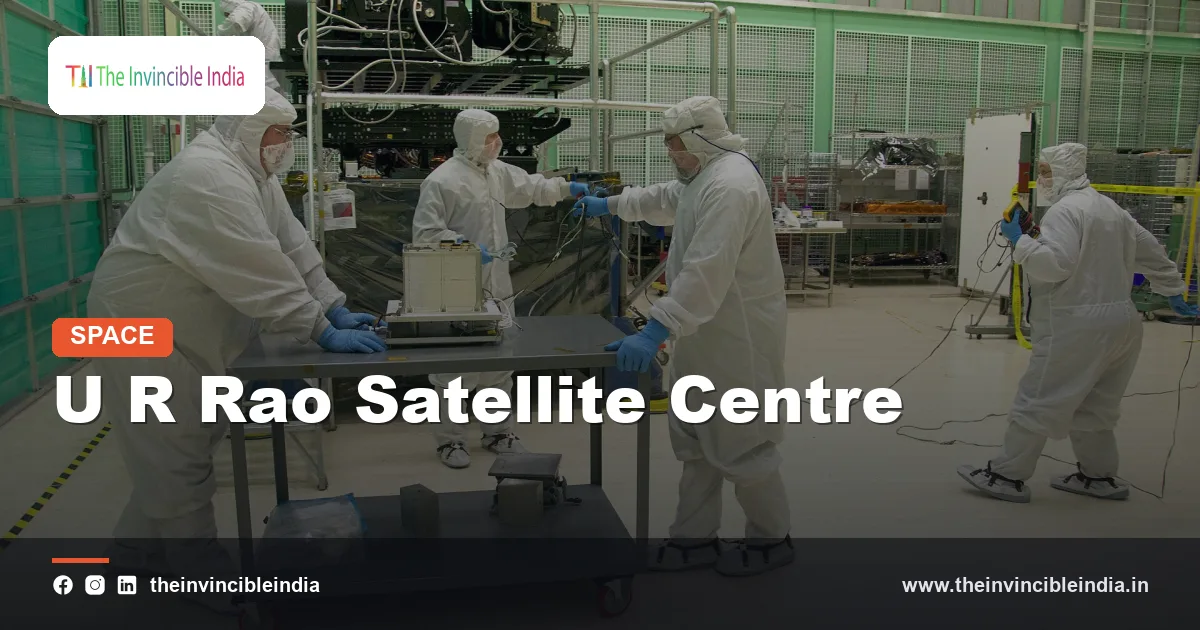
The U R Rao Satellite Centre (URSC) is the lead centre of the Indian Space Research Organisation (ISRO) for designing, building, integrating and testing satellites, and it is based in Bengaluru, Karnataka. Until 2017 it was known as the ISRO Satellite Centre (ISAC), and it was renamed in honour of Professor Udupi Ramachandra Rao, the space scientist who led ISRO for a decade and guided the building of many of India’s satellites.
From the Aryabhata satellite of 1975 to the INSAT communication series, the IRS Earth-observation fleet, the NavIC navigation constellation, Chandrayaan and the Mars Orbiter Mission, the U R Rao Satellite Centre has built the spacecraft that carry Indian science, services and ambition into orbit. This explainer describes its history, its work, its facilities and its place in the Indian space ecosystem.
Quick Facts
| Attribute | Detail |
|---|---|
| Full name | U R Rao Satellite Centre (URSC), formerly ISRO Satellite Centre (ISAC) |
| Parent organisation | Indian Space Research Organisation (ISRO), Department of Space, Government of India |
| Headquarters | Bengaluru, Karnataka |
| Origin | Indian Scientific Satellite Project, set up in 1972 and later developed into ISAC |
| Renamed | 2017, after the death of Professor U. R. Rao |
| First satellite | Aryabhata, launched on 19 April 1975 |
| Principal mandate | Design, development, integration and testing of satellites and spacecraft |
| Notable spacecraft | Aryabhata, APPLE, INSAT and GSAT series, IRS series, NavIC (IRNSS), Chandrayaan-1, Mars Orbiter Mission, Chandrayaan-3 |
Key Takeaways
- The U R Rao Satellite Centre is ISRO’s lead centre for satellite design, integration and testing and is located in Bengaluru.
- The U R Rao Satellite Centre was called the ISRO Satellite Centre (ISAC) until it was renamed in 2017 to honour the space scientist Professor Udupi Ramachandra Rao.
- India’s first satellite, Aryabhata, launched on 19 April 1975, was built by the team that later became the U R Rao Satellite Centre.
- The U R Rao Satellite Centre builds communication, Earth-observation, navigation, scientific and planetary spacecraft, including the NavIC regional navigation satellites.
- The U R Rao Satellite Centre built the Chandrayaan-1 and Mars Orbiter Mission spacecraft, and it was a major contributor to the Chandrayaan-3 mission that landed near the lunar south pole in 2023.
- The U R Rao Satellite Centre depends on partner centres of ISRO, including the Space Applications Centre for payloads and the Vikram Sarabhai Space Centre for launch vehicles.
What is the U R Rao Satellite Centre?
The U R Rao Satellite Centre is the satellite-building establishment of ISRO, where spacecraft are conceived, designed, assembled and tested before they are shipped to the launch site at Sriharikota. Its campus in Bengaluru contains design laboratories, clean rooms for assembly, and large environmental test facilities that reproduce the vibration, noise, heat and vacuum of space.
The centre handles the spacecraft bus, which is the platform that provides structure, power, thermal control, attitude control, propulsion and communication for a satellite. It also integrates the payloads, such as cameras, transponders or scientific instruments, that are often developed by other ISRO centres. A satellite is only ready for launch once it has passed a full programme of tests at this centre.
Besides building satellites, the centre carries out research in space technology, develops new subsystems such as lithium-ion batteries and electric propulsion, and trains the engineers who work on national space missions.
How did the U R Rao Satellite Centre begin?
The U R Rao Satellite Centre began as the Indian Scientific Satellite Project (ISSP), set up in 1972 in Bengaluru to build India’s first satellite. The ISSP team started work in temporary sheds in an industrial area of the city and, within three years, built Aryabhata.
The group grew steadily as India took up more satellite projects. In 1976 the project was brought into a more permanent form as the ISRO Satellite Centre, usually written ISAC. Over the following decades, ISAC built experimental satellites, the INSAT communication satellites, the Indian Remote Sensing series and scientific spacecraft.
The centre was renamed the U R Rao Satellite Centre in 2017, after the death of Professor U. R. Rao in July of that year. The change recognised the role he played in setting up the ISSP, building the first satellites and leading the Indian space programme.
Who was U. R. Rao?
Udupi Ramachandra Rao (1932-2017) was an Indian space scientist who served as Chairman of ISRO and Secretary of the Department of Space from 1984 to 1994, after earlier leading satellite development in Bengaluru. He was born in Adamaru, near Udupi, in Karnataka, and trained as a cosmic-ray physicist.
Rao worked with Vikram Sarabhai at the Physical Research Laboratory in Ahmedabad and then spent time at institutions in the United States, where he took part in studies of cosmic rays and the solar wind. After returning to India, he took charge of the satellite project at Bengaluru and helped plan the Indian National Satellite (INSAT) and Indian Remote Sensing (IRS) programmes.
During his term as ISRO Chairman, the PSLV programme was advanced, the development of the GSLV and cryogenic technology was pushed forward, and the foundation was laid for the later Chandrayaan lunar missions. He was awarded the Padma Bhushan in 1976 and the Padma Vibhushan in 2017.
Which satellites has the U R Rao Satellite Centre built?
The U R Rao Satellite Centre has built a large number of spacecraft over five decades, spread across experimental, communication, Earth-observation, navigation, scientific and planetary categories. The table below lists some of the best-known milestones.
| Satellite or series | Period | Significance |
|---|---|---|
| Aryabhata | 1975 | India’s first satellite, launched on a Soviet rocket for X-ray astronomy, aeronomy and solar physics experiments |
| Bhaskara-I and II | 1979 and 1981 | Experimental Earth-observation satellites, launched on Soviet rockets |
| Rohini series | 1979 onwards | Technology satellites flown on the SLV-3 and ASLV, including the satellite of the first successful Indian orbital launch in 1980 |
| APPLE | 1981 | Experimental geostationary communication satellite that demonstrated three-axis stabilisation |
| INSAT and GSAT series | 1980s onwards | Multipurpose communication, broadcasting and meteorological satellites |
| IRS series | 1988 onwards | Operational Earth-observation satellites for resources and mapping |
| Chandrayaan-1 | 2008 | India’s first lunar orbiter |
| Mars Orbiter Mission (Mangalyaan) | 2013 | India’s first interplanetary spacecraft; entered Mars orbit in September 2014 |
| IRNSS or NavIC satellites | 2013 onwards | Regional navigation constellation |
| AstroSat | 2015 | India’s first dedicated multi-wavelength space observatory |
| Chandrayaan-3 | 2023 | Lunar lander and rover mission that landed near the Moon’s south pole |
What was Aryabhata and why does it matter?
Aryabhata was India’s first satellite, launched on 19 April 1975 from the Soviet Union’s Kapustin Yar site on a Soviet Cosmos-3M rocket under an agreement between the two countries. It was named after the ancient Indian mathematician and astronomer Aryabhata, who worked in the fifth century CE.
The satellite weighed about 360 kilograms and carried instruments for X-ray astronomy, the study of the upper atmosphere and the study of solar neutrons and gamma rays. It was built in Bengaluru by a young team working in improvised facilities. Although some of its systems stopped working within days, it gave the team experience in satellite design, ground control and project management, and it gave India confidence to move ahead with more complex missions.
Aryabhata is also widely remembered because an image of the satellite appeared on the Indian two-rupee note for several years, which made it familiar to the general public.
What types of satellites does the U R Rao Satellite Centre build?
The U R Rao Satellite Centre builds five broad types of satellites: communication, Earth-observation, navigation, scientific and planetary missions, plus technology demonstrators. Each type has different requirements for orbit, power and pointing.
- Communication satellites: The INSAT and GSAT satellites sit in geostationary orbit about 36,000 kilometres above the equator and carry transponders for telephone links, television broadcasting, internet services and weather observation.
- Earth-observation satellites: The Indian Remote Sensing and Cartosat families fly in low Earth orbit and observe land, water, agriculture, forests, urban areas and the coast. The cameras and sensors are usually supplied by the Space Applications Centre, while the spacecraft platform comes from the U R Rao Satellite Centre.
- Navigation satellites: The NavIC constellation, formerly the Indian Regional Navigation Satellite System, provides position and timing services over India and the region around it.
- Scientific satellites: AstroSat and similar missions study stars, galaxies and the Sun. The Aditya-L1 spacecraft, launched in 2023, studies the Sun from a point near the Sun-Earth Lagrange point L1.
- Planetary missions: Chandrayaan-1, Chandrayaan-2, Chandrayaan-3 and the Mars Orbiter Mission are spacecraft built for the Moon and Mars.
How does the U R Rao Satellite Centre build a satellite?
The U R Rao Satellite Centre builds a satellite through a sequence of design, fabrication, integration, testing and delivery, with each step checked against strict quality standards. The work usually takes several years for a major spacecraft.
Typical stages
- Requirement and configuration: The mission, orbit, life span, payload and launch vehicle are fixed, and engineers choose a suitable platform.
- Subsystem design: Teams design structure, thermal control, power with solar panels and batteries, attitude and orbit control, propulsion, communication and onboard computing.
- Fabrication and assembly: Components are made, qualified and assembled in clean rooms where dust and contamination are controlled.
- Payload integration: Instruments from other centres are mounted and tested with the platform.
- Environmental testing: The complete satellite is shaken, exposed to acoustic noise, subjected to heat and cold in a vacuum chamber and checked for electromagnetic compatibility.
- Launch campaign: The satellite is moved to Sriharikota, fuelled, mated to the launch vehicle and monitored until separation in orbit.
The centre also uses standard bus families, commonly described by their approximate mass class, such as the I-1K, I-2K, I-3K and I-6K buses. Reusing proven platforms lowers cost and reduces risk.
What facilities does the U R Rao Satellite Centre have?
The U R Rao Satellite Centre has clean rooms, vibration and acoustic test facilities, thermal vacuum chambers, antenna test ranges and electromagnetic compatibility laboratories that together can qualify a complete spacecraft before launch. These facilities make Bengaluru the testing base for Indian satellites.
- Clean rooms: Satellites are assembled in controlled-air environments to keep dust from damaging optics and electronics.
- Vibration and shock testing: Large shakers simulate the stresses of lift-off and stage separation.
- Acoustic testing: Powerful sound chambers reproduce the noise of a rocket launch, which can damage fragile structures.
- Thermal vacuum chambers: Spacecraft are exposed to the temperature extremes and vacuum of orbit.
- Antenna and communication testing: Compact test ranges check how the satellite antennas radiate and receive signals.
- Electromagnetic compatibility testing: Engineers confirm that electronics do not interfere with one another.
Some testing of large structures and propulsion elements is also done at other ISRO locations, but the final integrated tests of most satellites are performed in Bengaluru.
What role did the U R Rao Satellite Centre play in Chandrayaan and Mangalyaan?
The U R Rao Satellite Centre built the spacecraft for India’s lunar and Mars missions and led the work on the Chandrayaan-3 landing mission. These projects extended the centre’s expertise from Earth orbit to deep space.
Chandrayaan-1, launched in October 2008, orbited the Moon and carried instruments from India and other countries; one of them found evidence of water molecules on the lunar surface. The Mars Orbiter Mission, launched on 5 November 2013, reached Mars orbit on 24 September 2014 and made India the first country to reach Mars orbit on its first attempt.
Chandrayaan-2, launched in July 2019, consisted of an orbiter, a lander and a rover; the orbiter is still in service, while the lander crashed during descent. Chandrayaan-3 followed and landed on 23 August 2023 near the Moon’s south polar region, making India the fourth country to land on the Moon and the first to land so close to the pole. The U R Rao Satellite Centre contributed to the design of the propulsion module, the lander and the rover, working with other ISRO centres.
How does the U R Rao Satellite Centre work with other ISRO centres?
The U R Rao Satellite Centre works with other ISRO centres through a division of labour in which each handles a different part of a space mission. No single centre builds a complete mission alone.
| Centre | Contribution to a satellite mission |
|---|---|
| U R Rao Satellite Centre (URSC) | Satellite platform, integration and testing |
| Space Applications Centre (SAC) | Communication and remote-sensing payloads, such as transponders and cameras |
| Vikram Sarabhai Space Centre (VSSC) | Launch vehicles that place the satellite in orbit |
| Liquid Propulsion Systems Centre (LPSC) | Thrusters and propulsion systems for satellites and rockets |
| Satish Dhawan Space Centre SHAR | Launch complex and range operations |
| ISRO Telemetry, Tracking and Command Network (ISTRAC) | Tracking, telemetry and command after launch |
| Master Control Facility (MCF) | Control of geostationary satellites in orbit |
The centre also works with Indian industry, which supplies electronics, structures, solar panels and batteries. In recent years the government has encouraged private companies to build satellites and subsystems, and the U R Rao Satellite Centre supports this by sharing know-how and test facilities.
Why does the U R Rao Satellite Centre matter for India?
The U R Rao Satellite Centre matters because satellites built in India provide the country with independent communication, broadcasting, weather, mapping, navigation and scientific capabilities. These services support farmers, fishers, disaster managers, defence forces, broadcasters and students across the country.
The centre has made India one of the few nations able to build satellites from start to finish, and it has helped Indian industry develop a supply chain for space-grade components. NavIC, in particular, gives India a navigation system under its own control. The centre’s work in planetary missions has also increased the visibility of Indian science worldwide.
Bottom Line
The U R Rao Satellite Centre is the engine room of the Indian satellite programme, where spacecraft are built and tested before they leave for Sriharikota. Its journey from the Aryabhata sheds of 1972 to Chandrayaan-3 shows how steady engineering can build a national capability.
Frequently Asked Questions
What is the U R Rao Satellite Centre known for?
The U R Rao Satellite Centre is known for building India’s satellites, from Aryabhata to Chandrayaan. It designs, integrates and tests communication, Earth-observation, navigation and scientific spacecraft. It is based in Bengaluru and belongs to ISRO.
Why was ISAC renamed the U R Rao Satellite Centre?
The ISRO Satellite Centre was renamed in 2017 to honour Professor U. R. Rao, who died that year. He led ISRO from 1984 to 1994 and played a central role in building India’s early satellites.
Where is the U R Rao Satellite Centre located?
The U R Rao Satellite Centre is located in Bengaluru, Karnataka. The city is also home to ISRO’s headquarters and to several other space-related establishments. The satellite centre has its own campus with clean rooms and test facilities.
What was the first satellite built by the centre?
The first satellite built by the centre was Aryabhata, launched on 19 April 1975. It was India’s first satellite and was launched on a Soviet rocket. The team that built it later became the ISRO Satellite Centre.
What is the difference between URSC and the Space Applications Centre?
The U R Rao Satellite Centre builds the satellite platform and integrates the spacecraft, while the Space Applications Centre in Ahmedabad develops many of the payloads and the applications that use satellite data. The two centres work closely on communication and Earth-observation satellites.
Did the U R Rao Satellite Centre build NavIC?
Yes, the U R Rao Satellite Centre built the NavIC navigation satellites, formerly called IRNSS. NavIC provides position and timing services over India and the surrounding region, and the first satellite of the constellation was launched in 2013.
{“@context”:”https://schema.org”,”@graph”:[{“@type”:”FAQPage”,”mainEntity”:[{“@type”:”Question”,”name”:”What is the U R Rao Satellite Centre known for?”,”acceptedAnswer”:{“@type”:”Answer”,”text”:”The U R Rao Satellite Centre is known for building India’s satellites, from Aryabhata to Chandrayaan. It designs, integrates and tests communication, Earth-observation, navigation and scientific spacecraft. It is based in Bengaluru and belongs to ISRO.”}},{“@type”:”Question”,”name”:”Why was ISAC renamed the U R Rao Satellite Centre?”,”acceptedAnswer”:{“@type”:”Answer”,”text”:”The ISRO Satellite Centre was renamed in 2017 to honour Professor U. R. Rao, who died that year. He led ISRO from 1984 to 1994 and played a central role in building India’s early satellites.”}},{“@type”:”Question”,”name”:”Where is the U R Rao Satellite Centre located?”,”acceptedAnswer”:{“@type”:”Answer”,”text”:”The U R Rao Satellite Centre is located in Bengaluru, Karnataka. The city is also home to ISRO’s headquarters and to several other space-related establishments. The satellite centre has its own campus with clean rooms and test facilities.”}},{“@type”:”Question”,”name”:”What was the first satellite built by the centre?”,”acceptedAnswer”:{“@type”:”Answer”,”text”:”The first satellite built by the centre was Aryabhata, launched on 19 April 1975. It was India’s first satellite and was launched on a Soviet rocket. The team that built it later became the ISRO Satellite Centre.”}},{“@type”:”Question”,”name”:”What is the difference between URSC and the Space Applications Centre?”,”acceptedAnswer”:{“@type”:”Answer”,”text”:”The U R Rao Satellite Centre builds the satellite platform and integrates the spacecraft, while the Space Applications Centre in Ahmedabad develops many of the payloads and the applications that use satellite data. The two centres work closely on communication and Earth-observation satellites.”}},{“@type”:”Question”,”name”:”Did the U R Rao Satellite Centre build NavIC?”,”acceptedAnswer”:{“@type”:”Answer”,”text”:”Yes, the U R Rao Satellite Centre built the NavIC navigation satellites, formerly called IRNSS. NavIC provides position and timing services over India and the surrounding region, and the first satellite of the constellation was launched in 2013.”}}]}]}


