

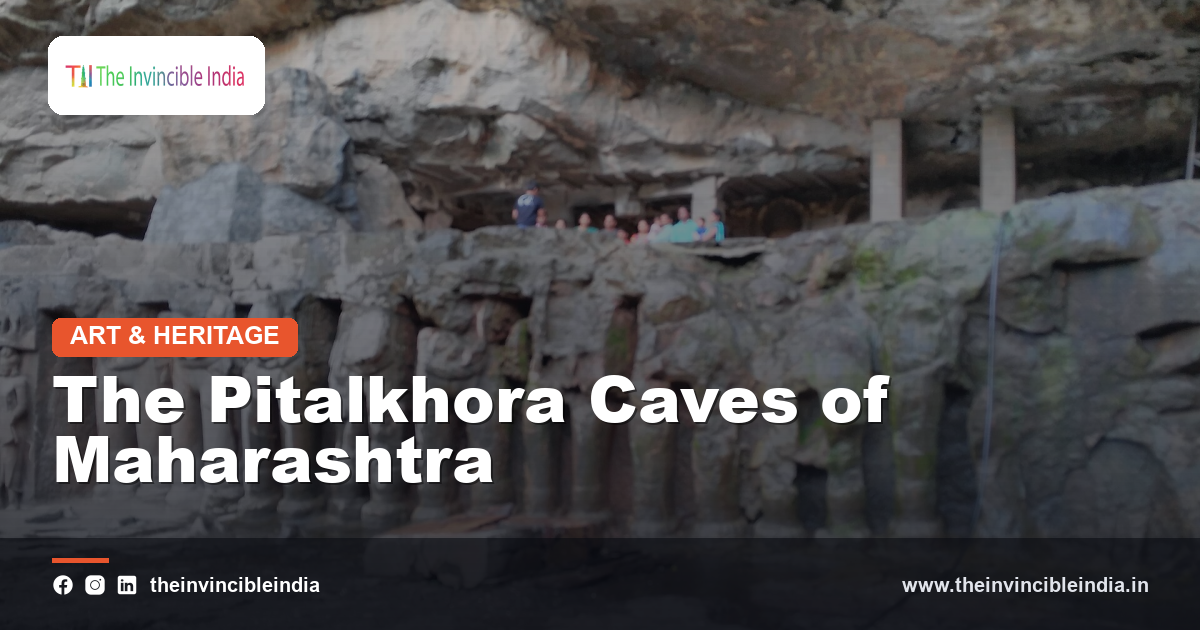
The Pitalkhora Caves, also spelled Pitalkhora Leni and sometimes called the Pitalkhora Buddhist caves, are a group of ancient rock-cut monuments in the Satmala range of Maharashtra, in the Kannad area near the city of Chhatrapati Sambhajinagar, formerly Aurangabad. Carved into the basalt wall of a quiet gorge, they are counted among the oldest cave excavations in western India and include a chaitya hall, several monastic residences and some remarkable sculpture. Their early stone-cutting traditions form part of the wider story told in the guide to Indian sculpture. This article explains their history, design and significance.
Quick answer: The Pitalkhora Caves (also spelled Pitalkhora Leni) are a group of ancient Buddhist rock-cut caves in the Satmala hills of Maharashtra, India, near Kannad in the Chhatrapati Sambhajinagar region. They are among the oldest rock-cut sites in the country, with an early phase generally placed in the last centuries before the Common Era. The site is known for its chaitya hall, its viharas, its carved yaksha figures and traces of early painting.
Key Takeaways
- The Pitalkhora Caves are a group of Buddhist rock-cut caves in the Satmala hills of Maharashtra, near Kannad.
- They are counted among the oldest rock-cut caves in India, with an early phase generally dated to the last centuries before the Common Era.
- The site includes a chaitya hall with a stupa, viharas for monks and a number of cisterns carved in the rock.
- Its famous sculptures include yaksha figures and a carved elephant, which show early Indian sculptural skill.
- Inscriptions and later paintings and carvings show that the site was used and renewed over many centuries.
- The caves lie in a gorge on an ancient trade route and are within reach of the more famous caves of Ellora and Ajanta.
The sections below describe the setting, the phases of development and the principal features of the site.
Quick Facts
| Detail | Information |
|---|---|
| Location | Satmala hills, near Kannad, Chhatrapati Sambhajinagar region, Maharashtra |
| Also known as | Pitalkhora Leni, Pitalkhora Buddhist Caves |
| Type | Buddhist rock-cut caves with chaitya hall and viharas |
| Approximate era | Early phase in the last centuries BCE, with later additions |
| Number of caves | About a dozen excavations |
| Notable features | Yaksha sculptures, carved elephant, stupa and early painting remains |
| Setting | Cliff face of a basalt gorge with a seasonal waterfall |
| Protection | Protected monument of the Archaeological Survey of India |
What Are the Pitalkhora Caves?
The Pitalkhora Caves are a group of Buddhist rock-cut caves carved into the face of a basalt cliff in the Satmala hills of Maharashtra. They consist of a chaitya hall, which is a prayer hall centred on a stupa, and a series of viharas, which are residences for monks. Some of the caves are plain and functional, while others carry remarkable sculpture and traces of painted decoration. The site belongs to the earliest wave of Buddhist cave excavation in the Deccan, when builders translated the forms of timber architecture into solid rock. It is less visited than Ajanta or Ellora, yet it holds crucial evidence for the beginnings of the cave tradition. The Pitalkhora Caves therefore offer a rare window into the early development of Indian rock-cut art.
Where Are the Pitalkhora Caves Located?
The Pitalkhora Caves are located in the Satmala range, in the Kannad area of Maharashtra, within reach of the city of Chhatrapati Sambhajinagar. They are cut into the cliffs of a wooded gorge, where a seasonal stream creates a waterfall during the rains. The site lies not far from the town of Chalisgaon and is reached by a road that ends near a flight of steps leading to the caves. The surroundings are quiet and green, and the sound of water and birdsong adds to the atmosphere. The caves are also within travelling distance of Ellora and Ajanta, which are among the best known cave sites in the world. This position makes Pitalkhora a rewarding addition to any journey through the cave heritage of the Deccan.
What Does the Name Pitalkhora Mean?
The name Pitalkhora is generally explained as combining the Marathi words pital, meaning brass, and khora, meaning a ravine or gorge, giving the sense of a brass ravine. Several explanations are offered for the name, and local tradition connects it with the colour of the rock or with a past use of the area, although none is certain. In older records the site appears under a variety of spellings, and the older name may have been different. Names of places often preserve stories that historians cannot fully verify, and Pitalkhora is a good example. The word has come to refer to the cave group and to its gorge together. The name Pitalkhora thus gives a poetic and local flavour to an ancient monument.
How Old Are the Pitalkhora Caves?
The Pitalkhora Caves are among the oldest rock-cut sites in India, and the earliest excavations are generally placed in the last centuries before the Common Era. Scholars base this dating on the architecture, the style of the sculpture and the early script of the inscriptions, and the exact range remains a subject of discussion. Later additions and renovations continued for several centuries, including a phase usually linked to the Satavahana period and a later phase with Mahayana features. The long span of use shows that the site remained important for a considerable time. It also makes Pitalkhora valuable as a reference point for the development of cave architecture. The age of the Pitalkhora Caves places them among the foundational monuments of Indian rock-cut art.
What Is the Layout of the Caves?
The caves are arranged in a long line along the cliff face, and there are about a dozen excavations of varying size. They are usually described as falling into two main groups along the cliff. The main chaitya hall stands among them, and the viharas are placed on either side, each with a central space surrounded by small cells. Steps and ledges once linked the caves, though many are damaged and worn by time. The pattern reflects the practical needs of a monastic community, with places for prayer, living and storing water. The layout of Pitalkhora presents a clear and early example of how a Buddhist monastery was organised in rock.
What Is the Chaitya Hall at Pitalkhora?
The chaitya hall at Pitalkhora is a prayer hall with a rounded rear end, within which stands a stupa, the central symbol of early Buddhist worship. The hall was meant for circumambulation, with space for devotees to walk around the stupa in a ritual manner. Its plan and the shape of its roof recall wooden prototypes, and the cave interior imitates the beams and ribs of a timber building. Some of the pillars and surfaces have been damaged, but enough remains to show the original design. The hall is modest in scale compared with later giants such as Karla, yet it is valuable for its antiquity. The chaitya at Pitalkhora shows the early form of the Buddhist prayer hall in western India.
What Are the Viharas Like?
The viharas at Pitalkhora are monastic residences consisting of a central hall surrounded by small cells for individual monks. Some of the cells have benches cut from the rock, and doors and windows are shaped to suggest wooden originals. The viharas vary in size and condition, and some have been reworked in later phases with additional pillars or sculpture. They served as places for sleeping, study and meditation, and they were designed with the simplicity prescribed by monastic discipline. Together the viharas show how the Buddhist community lived and worked in the hills. The residential caves of Pitalkhora therefore give an intimate view of the practical side of early monastic life.
Which Sculptures Make Pitalkhora Famous?
The sculptures of Pitalkhora are among its greatest treasures, and they include yaksha figures, elephants and decorative reliefs carved with striking vitality. Yakshas are nature spirits associated with fertility and protection, and they were widely used as guardians in early Indian art. At Pitalkhora, several of these figures stand near the entrances to the caves, and some are portrayed as sturdy, almost playful beings. A large carved elephant near the site is also well known, and the animal is shown with a sense of weight and movement. These carvings show the skill of the early sculptors and their ability to give life to stone. The sculpture of Pitalkhora forms an important chapter in the early history of Indian figure art.
What Do the Yaksha Figures Represent?
The yaksha figures represent protective spirits who were honoured long before the formal imagery of the Buddha appeared in Indian art. In early Buddhism, yakshas were drawn into the tradition as guardians and attendants, so they were naturally placed near sacred spaces. At Pitalkhora these figures are shown with rounded bodies, lively faces and ornaments, and their presence suggests the blending of popular belief with Buddhist practice. They also highlight how early Buddhist art borrowed from the broader religious life of the countryside. Studying these figures helps scholars understand how Buddhism absorbed local traditions. The yakshas of Pitalkhora therefore reveal the meeting of folk devotion and monastic religion in early India.
What Do the Inscriptions and Paintings Show?
The caves preserve inscriptions in early Brahmi script that record gifts made by donors, who included members of the lay community and craftspeople. These records show that the caves were supported by ordinary people as well as by wealthy patrons. Traces of painting also survive, and they belong to different periods, including a later phase related to the Mahayana form of Buddhism. The paintings are fragmentary but valuable, since they provide rare examples of early Indian wall painting in the Deccan. Together the inscriptions and paintings add social and artistic detail to the story of the monuments. The surviving records of Pitalkhora thus show a community that supported, used and renewed its sacred space.
How Did Pitalkhora Change Over Time?
Pitalkhora developed in several phases, beginning with the early excavation of the chaitya and viharas and continuing with later additions and decoration. In the later phase, some caves were adapted to include figures of the Buddha, which reflects a change in Buddhist practice from symbolic to more direct representation. Other changes include the reworking of surfaces, the addition of pillars and the placing of new paintings over older ones. These layers can be read like pages in a book, showing how the needs of the community changed. They also reflect wider religious and artistic shifts across the Deccan. The changes seen at Pitalkhora illustrate how a sacred site can evolve while remaining in use for centuries.
Why Was Pitalkhora Placed on an Ancient Trade Route?
Pitalkhora was placed on an ancient trade route because Buddhist monasteries in the Deccan often grew up near the paths used by merchants and travellers. The caves provided shelter, water and a place of worship for people on the move, and traders in turn supported the monks with gifts. The Satmala hills lay on a corridor linking the northern plains with the plateau and the western coast, so the location was convenient. This relationship between commerce and religion helped to spread both goods and ideas across the region. It also explains why donors from different walks of life are recorded in inscriptions. The trade setting of Pitalkhora shows how closely early Buddhism was tied to the economy of the Deccan.
How Does Pitalkhora Compare With Ajanta and Ellora?
Pitalkhora is much earlier than the great sites of Ajanta and Ellora in its first phase, and it is smaller and more modest in scale. Ajanta is celebrated for its paintings and sculpture of the fully developed Buddhist tradition, while Ellora combines Buddhist, Hindu and Jain monuments of great size. Pitalkhora offers instead an insight into the beginnings of the cave tradition, when forms were simpler and the Buddha was honoured through symbols. It stands alongside early sites such as Bhaja, Karla and Bedse, which also belong to the formative period. Seeing Pitalkhora before or after the larger sites helps visitors grasp how far the tradition travelled. The comparison shows that Pitalkhora is a valuable foundation for understanding the later cave masterpieces of Maharashtra.
What Is the Conservation Status of the Caves?
The Pitalkhora Caves are protected as a monument of national importance and are looked after by the Archaeological Survey of India. Conservation faces special challenges because the basalt cliff is subject to erosion, water seepage and falling rock, and several parts of the site have suffered damage over the centuries. Work includes cleaning, structural stabilisation and attention to drainage, along with documentation of the sculpture and inscriptions. Careful management of visitors helps protect the fragile surfaces. Because the site is relatively remote, it needs regular monitoring and local involvement. The care of Pitalkhora is an important example of how ancient rock-cut heritage can be preserved in a challenging natural environment.
Pitalkhora Caves Today
The Pitalkhora Caves today are a peaceful heritage site visited by historians, art lovers, photographers and travellers interested in the earliest phase of Indian cave art. The quiet gorge, the carved yakshas and the ancient chaitya make it a memorable stop on a route through the Deccan caves. Research continues to refine knowledge of the site’s chronology, inscriptions and sculpture, adding detail to its early history. Conservation efforts aim to keep the caves safe from natural and human threats. For visitors, the site rewards patience and attention, since much of its charm lies in small details and its natural setting. The caves remain a significant reminder of the antiquity and creativity of Indian rock-cut architecture.
Sources & Further Reading
- Archaeological Survey of India (asi.nic.in).
- Maharashtra Tourism, Government of Maharashtra (maharashtratourism.gov.in).
Frequently Asked Questions
What are the Pitalkhora Caves?
The Pitalkhora Caves are a group of ancient Buddhist rock-cut caves in the Satmala hills of Maharashtra. They include a chaitya hall, viharas and fine sculpture. They are among the oldest rock-cut sites in India.
Where are the Pitalkhora Caves located?
The Pitalkhora Caves are located in the Satmala hills near Kannad in Maharashtra, within reach of Chhatrapati Sambhajinagar. They lie in a wooded gorge near the town of Chalisgaon. They can be combined with a visit to Ellora and Ajanta.
How old are the Pitalkhora Caves?
The earliest excavations at Pitalkhora are generally dated to the last centuries before the Common Era. Later phases continued for several centuries. Exact dates are still discussed by scholars.
What does Pitalkhora mean?
Pitalkhora is generally understood to mean a brass ravine, from the Marathi words pital and khora. Several local explanations exist for the name. The word now refers to the cave group and its gorge.
What is Pitalkhora famous for?
Pitalkhora is famous for being one of the oldest rock-cut cave sites in India, and for its yaksha sculptures, its carved elephant and its early chaitya hall. It also preserves inscriptions and traces of early painting. These features make it important for the study of early Buddhist art.
How is Pitalkhora different from Ajanta and Ellora?
Pitalkhora is older, smaller and simpler than Ajanta and Ellora, and it represents the early phase of Buddhist cave art. Ajanta is renowned for its paintings and Ellora for its range of Buddhist, Hindu and Jain caves. Pitalkhora shows the beginnings of the tradition that those sites later developed.


