

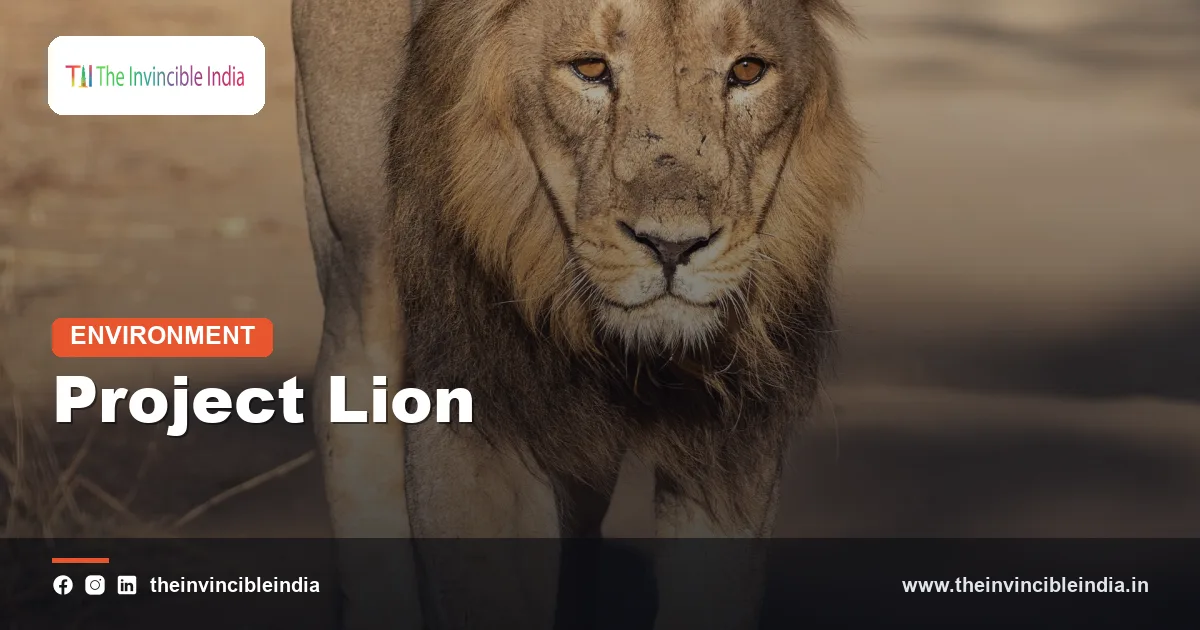
Project Lion is India’s dedicated conservation programme for the Asiatic lion, the big cat that survives in the wild nowhere else in the world except in and around the Gir forest of Gujarat. Announced in 2020 and modelled on the thinking behind Project Tiger and Project Elephant, it aims to move lion conservation beyond a single protected forest and towards a broader, better-managed landscape.
The story behind it is one of the most remarkable recoveries in Indian wildlife history. From a handful of animals protected by a princely ruler more than a century ago, the Asiatic lion (Panthera leo persica) has grown to several hundred individuals. Yet that success carries its own risk, because nearly the whole wild population still lives in one region. This explainer covers the animal, its history, how conservation works on the ground, and what the programme hopes to achieve.
Quick Facts
| Item | Details |
|---|---|
| Programme | Project Lion, a conservation programme for the Asiatic lion |
| Announced | 2020, with funding approved at a later date |
| Species | Asiatic lion (Panthera leo persica) |
| Only wild home | Gir forest and surrounding Saurashtra landscape, Gujarat |
| Core protected area | Gir National Park and Wildlife Sanctuary (sanctuary declared 1965, national park 1975) |
| Conservation status | Endangered on the IUCN Red List; Schedule I of the Wildlife (Protection) Act, 1972 |
| Population (dated) | Over 600-700 in the 2020 population estimation; counts have risen steadily since the early 1900s |
| Main concern | All wild lions live in one region, so disease or disaster could affect the whole population |
What Is Project Lion?
Project Lion was announced by the Prime Minister in the Independence Day address of 2020 as a programme to safeguard the Asiatic lion and its habitat. Later, the Union government approved a multi-year financial outlay so that the idea could be turned into a funded, structured effort. It is implemented mainly through the Gujarat Forest Department, with support from the Ministry of Environment, Forest and Climate Change and scientific institutions such as the Wildlife Institute of India.
The naming deliberately recalls India’s earlier flagship species programmes. Project Tiger began in 1973 and Project Elephant in 1992, and both gave a single charismatic species a dedicated administrative and funding framework. Project Lion applies a similar idea to a species that is far more geographically restricted. Its stated focus areas include:
- Securing and improving habitat across the lion landscape.
- Establishing a second, independent population.
- Strengthening disease surveillance, veterinary care and rescue facilities.
- Reducing conflict through eco-development and community participation.
- Supporting long-term research, monitoring and technology.
Meet the Asiatic Lion
Physical features
The Asiatic lion is slightly smaller than its African cousin, though still a powerful predator. Adult males are heavy-bodied, with a mane that is generally less full than that of an African male, which leaves the ears visible. The most reliable identifying mark is a longitudinal fold of skin running along the belly, which is far more prominent in Asiatic lions than in African ones. The tuft at the tip of the tail is also well developed.
Social life and diet
Like all lions, Asiatic lions are social, but their groups differ in structure. Females and cubs form prides, while adult males tend to live apart or in small coalitions, joining prides to mate. In Gir, lions hunt chital, sambar, nilgai and wild boar, and they also take domestic livestock, especially around the edges of the forest. A healthy prey base of wild herbivores is therefore central to keeping lions inside forest areas.
Why it matters to India
Because this is the only place on Earth where wild Asiatic lions survive, the animal is a matter of national pride and a major responsibility. India is the sole custodian of this subspecies in the wild, and any decline here would be a global loss rather than a local one.
A History of Collapse and Recovery
Asiatic lions once ranged from parts of Greece and West Asia through Persia and the Indian subcontinent, reaching deep into northern and central India. Hunting, the clearing of forests for farming and the loss of prey drove them out of one region after another. By the late nineteenth century they had vanished from most of their former Indian range, and the last strongholds were the dry forests of Kathiawar in Gujarat.
By the early twentieth century only a few dozen lions were believed to survive. The Nawab of Junagadh, whose state included Gir, introduced protection measures that helped the survivors, and lion hunting was restricted. This ruler-led protection, combined with the lion’s own resilience, is widely credited with preventing extinction.
After Independence
Following Independence, protection shifted to the state. The Gir Sanctuary was declared in 1965 and the core area became a national park in 1975. The Wildlife (Protection) Act, 1972 gave the lion the highest legal protection by listing it in Schedule I. Over the decades the numbers climbed, slowly at first and then more quickly, as habitat improved and poaching was controlled.
Population Growth Across the Censuses
Lion numbers are tracked through periodic population estimations conducted by the Gujarat Forest Department, historically at roughly five-year intervals. Teams of forest staff and volunteers survey a vast area, and the results show a steady upward trend. The figures below are approximate, drawn from widely reported estimates, and should be read as indicative rather than exact.
| Period | Approximate lion count |
|---|---|
| Early 1900s | A few dozen animals |
| 1936 | About 290 |
| 1990 | About 280 |
| 2001 | About 330 |
| 2010 | About 410 |
| 2015 | About 520 |
| 2020 | Over 600, commonly cited as about 674 |
The sharp rise since 2000 reflects both real growth and the lions’ spread beyond the sanctuary into surrounding districts. Later estimates have reported further increases, but readers should check the latest official release for current figures, since these numbers change with every count.
How Conservation Works in Gir
The protected core
The Gir National Park and Wildlife Sanctuary in the Saurashtra region forms the heart of the effort. The wider area includes the Pania and Mitiyala sanctuaries and the Girnar sanctuary, among other protected patches. Forest staff patrol on foot, by vehicle and increasingly with the help of radio collars, camera traps and digital monitoring.
Habitat and prey management
Managers maintain grasslands and water sources, remove invasive weeds where they harm native grazing, and keep an eye on populations of chital, sambar and other prey. In dry summers, artificial waterholes help wildlife cope. A strong natural prey base reduces the temptation for lions to attack livestock.
Protection and anti-poaching
Anti-poaching camps, intelligence networks and legal action under wildlife law guard against hunting and the illegal wildlife trade. Rescue teams respond to injured, sick or stranded animals, and dedicated veterinary centres treat them.
The Maldharis and Living with Lions
Gir has long been home to the Maldharis, pastoral communities who graze cattle and buffalo in the forest. For generations they have shared the landscape with lions and are known for a relatively tolerant attitude towards the predators. From the 1970s, a rehabilitation programme resettled many Maldhari families from inside the core area to villages outside, giving vegetation and wild prey more room to recover.
Today, a notable feature of lion conservation is that a large share of the animals live outside formal protected areas, in a patchwork of farmland, scrub, coastal belts, riverbanks and village outskirts. This makes Gujarat unusual: large carnivores live close to dense human settlements with relatively few serious attacks, supported by local tolerance and compensation for livestock losses.
- Compensation: payments for cattle killed by lions and for human injury help maintain goodwill.
- Cultural attitudes: many communities regard the lion with respect, and temples and traditions are associated with the forest.
- Eco-tourism: visitor income in places such as Sasan Gir creates local livelihoods linked to the animal’s survival.
Threats Facing the Asiatic Lion
Success has brought new pressures. As lions spread into human-dominated areas, the challenges change from classical poaching to a mixture of accidents, conflict and disease.
| Threat | Why it matters |
|---|---|
| Open wells | Unfenced wells on farms can trap lions, especially young animals, and have been a long-standing cause of accidental deaths; parapet walls are being built to reduce them |
| Railway lines | Tracks passing near the forest and the coast have caused collision deaths, leading to speed limits, fencing and patrols |
| Road traffic | Highways through lion areas add risk, particularly at night |
| Disease outbreaks | Contagious infections can spread quickly through a concentrated population |
| Habitat fragmentation | Mining, development and farm expansion can isolate lion patches |
| Human-lion conflict | Livestock attacks and occasional injuries can erode local tolerance |
| Electrocution and snares | Illegal fences, traps and power lines can kill wildlife, including lions |
The Single-Population Risk
The biggest strategic worry is that nearly all wild Asiatic lions share one landscape. Conservation biologists call this putting all the eggs in one basket. A single epidemic, a severe fire, a cyclone or an unexpected genetic problem could cause a serious decline, and no other wild population exists to act as a back-up.
The danger became concrete in 2018, when an outbreak of canine distemper virus, along with a parasitic infection, killed a significant number of lions in the eastern part of Gir. Some animals were moved to rescue centres for treatment and vaccination, and the episode showed how quickly disease can move through a dense population. Experts have also noted that populations descended from a very small founder group carry limited genetic diversity, which can reduce resilience.
For this reason, disease management is a core part of Project Lion. It includes surveillance of carnivores and domestic animals in the area, vaccination of dogs and livestock, and an advanced diagnostics and veterinary facility.
The Second Home Debate
The idea of creating a second wild population has been discussed since the 1980s. Wildlife scientists identified the Kuno area in Madhya Pradesh as a suitable site, with adequate prey and habitat, and the plan was to establish a new group of lions there. In 2013 the Supreme Court of India directed that Asiatic lions be translocated to Kuno within a stated period.
The order has remained unimplemented. Gujarat has resisted the transfer, arguing that the lions are a symbol of the state’s heritage and that the Gir landscape can support them. Meanwhile, Kuno was prepared and later received African cheetahs, introduced there in 2022 under a separate reintroduction programme. The legal and administrative question of a lion translocation continues to feature in debates on conservation policy.
Alternatives under discussion
Gujarat has pointed to sites within the state, such as Barda Wildlife Sanctuary, as potential additional homes. Supporters argue that this keeps lions in a familiar climate and ecosystem, while critics note that a site in the same state does not fully remove the risk from regional disasters. Either way, an independent second population remains an accepted long-term goal.
Project Lion’s Plan of Action
The programme brings several strands together, aiming for a landscape-scale approach rather than a forest-only one.
- Habitat management: restoring grasslands, building water sources, and strengthening corridors between lion patches.
- Technology: using GPS and radio collars, camera traps, drones and monitoring software for tracking and early warning.
- Veterinary and rescue capacity: modern hospitals, quarantine areas and trained response teams.
- Community and eco-development: livelihood support, awareness drives and participation of local people in monitoring and tourism.
- Research: studies on lion ecology, genetics, disease and behaviour to guide decisions.
- Conflict reduction: safer infrastructure, covered wells, alert systems and quick response to wandering animals.
The long-term intention is to secure a landscape of tens of thousands of square kilometres across Saurashtra where lions can live alongside people with minimal conflict.
The Lion in India’s Culture and Symbols
The lion has been a symbol of strength and sovereignty in India for thousands of years. The Lion Capital of Ashoka from Sarnath, with four lions standing back to back, was adopted as the national emblem on 26 January 1950, and the lions of the capital are often linked in popular imagination with the Asiatic lion. The lion appears in temple sculpture, royal insignia and folklore across the country, and the name Singh, meaning lion, is widely used.
In Gujarat, the lion is a strong emblem of regional identity, and Gir is a significant tourist destination. World Lion Day, observed on 10 August, is also marked by awareness events, schools and local communities in lion country.
Conclusion
Project Lion builds on a century of conservation success while acknowledging that success is not the same as security. The Asiatic lion has rebounded from the brink of extinction thanks to royal protection, legal safeguards, habitat management and the unusual tolerance of local communities. The next phase is about resilience: a bigger, better-connected landscape, strong disease preparedness, and ideally a second home. How these goals are met, and how long the wait for a second population lasts, will shape the future of one of India’s most treasured animals. This article was last reviewed on 1 October 2026.
Frequently Asked Questions
What is Project Lion?
Project Lion is India’s conservation programme for the Asiatic lion, announced in 2020 and later backed with a funded plan. It focuses on habitat, disease management, community participation, research and the creation of a second lion population.
Where are Asiatic lions found in the wild?
Wild Asiatic lions live only in India, in and around the Gir forest and the wider Saurashtra region of Gujarat. No other wild population exists anywhere else in the world.
How is the Asiatic lion different from the African lion?
The Asiatic lion is slightly smaller, has a thinner mane that leaves the ears visible and has a prominent fold of skin along its belly. It also differs in social structure, with males often living apart from the prides.
Why is a second home for lions needed?
Because nearly all wild Asiatic lions live in one area, a disease outbreak or natural disaster could seriously harm the whole population. The 2018 canine distemper deaths in Gir highlighted this risk, and a separate population would act as insurance.
Why did the Kuno translocation not happen?
The Supreme Court ordered the shifting of lions to Kuno in Madhya Pradesh in 2013, but Gujarat has resisted the move and the order has not been carried out. Kuno later received African cheetahs under a different programme.
How is the lion population counted?
The Gujarat Forest Department conducts periodic population estimations, historically about every five years, using trained staff and volunteers across the lion landscape. The 2020 estimate was commonly cited as over 600, and the numbers have trended upward since the early twentieth century.
{“@context”:”https://schema.org”,”@graph”:[{“@type”:”FAQPage”,”mainEntity”:[{“@type”:”Question”,”name”:”What is Project Lion?”,”acceptedAnswer”:{“@type”:”Answer”,”text”:”Project Lion is India’s conservation programme for the Asiatic lion, announced in 2020 and later backed with a funded plan. It focuses on habitat, disease management, community participation, research and the creation of a second lion population.”}},{“@type”:”Question”,”name”:”Where are Asiatic lions found in the wild?”,”acceptedAnswer”:{“@type”:”Answer”,”text”:”Wild Asiatic lions live only in India, in and around the Gir forest and the wider Saurashtra region of Gujarat. No other wild population exists anywhere else in the world.”}},{“@type”:”Question”,”name”:”How is the Asiatic lion different from the African lion?”,”acceptedAnswer”:{“@type”:”Answer”,”text”:”The Asiatic lion is slightly smaller, has a thinner mane that leaves the ears visible and has a prominent fold of skin along its belly. It also differs in social structure, with males often living apart from the prides.”}},{“@type”:”Question”,”name”:”Why is a second home for lions needed?”,”acceptedAnswer”:{“@type”:”Answer”,”text”:”Because nearly all wild Asiatic lions live in one area, a disease outbreak or natural disaster could seriously harm the whole population. The 2018 canine distemper deaths in Gir highlighted this risk, and a separate population would act as insurance.”}},{“@type”:”Question”,”name”:”Why did the Kuno translocation not happen?”,”acceptedAnswer”:{“@type”:”Answer”,”text”:”The Supreme Court ordered the shifting of lions to Kuno in Madhya Pradesh in 2013, but Gujarat has resisted the move and the order has not been carried out. Kuno later received African cheetahs under a different programme.”}},{“@type”:”Question”,”name”:”How is the lion population counted?”,”acceptedAnswer”:{“@type”:”Answer”,”text”:”The Gujarat Forest Department conducts periodic population estimations, historically about every five years, using trained staff and volunteers across the lion landscape. The 2020 estimate was commonly cited as over 600, and the numbers have trended upward since the early twentieth century.”}}]}]}


