

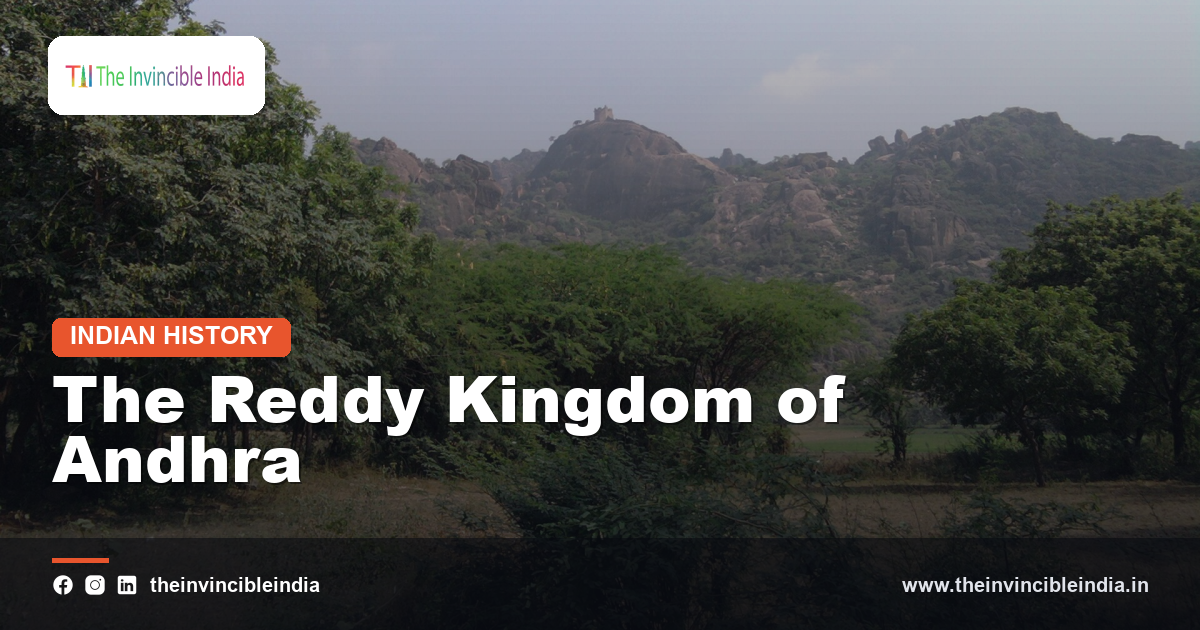
The Reddy kingdom was a regional power that emerged in the eastern Deccan during the fourteenth century, in the political vacuum left by the weakening of the Kakatiya realm. Ruling from hill forts and river cities across the Krishna and Godavari regions, the Reddy chiefs built a state that combined military strength, temple patronage and generous support for Telugu literature. They competed for influence with the Bahmani sultans, the Recherla chiefs and the rising power of the Vijayanagara Empire, and their story reveals how regional kingdoms shaped the political and cultural life of medieval Andhra.
Quick Facts
| Detail | Information |
|---|---|
| Region | Coastal and central Andhra, Krishna-Godavari region |
| Founder | Prolaya Vema Reddy |
| Main centres | Addanki, Kondaveedu and Rajahmundry |
| Famous fort | Kondaveedu hill fort |
| Cultural legacy | Telugu literature, temples and irrigation works |
| Main rivals | Recherla Velamas, Bahmanis, Vijayanagara, Gajapatis |
Who Were the Reddys
The Reddys were a landholding and warrior community of the Telugu country who rose to political prominence during the medieval period. Many of them had served as local chiefs and military commanders under the Kakatiyas, and this experience gave them the administrative and martial skills needed to build a state of their own when central authority faded.
The Reddy kingdom therefore was not created from nothing. It grew from established local leadership in the villages and forts of coastal Andhra, where families with military followings had long acted as intermediaries between the ruler and the countryside. The dynasty stands as a good example of how regional elites transformed themselves into royal houses in the changing political world of the fourteenth century.
The Kakatiya Background
The Kakatiyas of Warangal had built one of the most successful medieval states in the Telugu country, with a strong army, a sophisticated tank irrigation system and a great tradition of temple building. Their power was based on a network of local chiefs, called nayakas, who held forts and lands in return for service.
When the Kakatiya kingdom was overwhelmed by the armies of the Delhi Sultanate, this network of chiefs was left without a central authority. Many of them turned to resistance and to the creation of new local states. The Reddy chiefs were among those who filled the gap, and their kingdom drew directly on the institutions and traditions that the Kakatiyas had established over the previous centuries.
Prolaya Vema Reddy and the Founding of the State
The founder of the Reddy kingdom is generally identified as Prolaya Vema Reddy, a chieftain who took part in the resistance to the sultanate’s authority and gradually consolidated his own power in the coastal Andhra region. He established his base at Addanki and began to rule as an independent king.
Prolaya Vema Reddy is remembered for combining military leadership with concern for the welfare of his subjects. Inscriptions and later tradition credit him with restoring temples, supporting Brahmin scholars and encouraging agriculture. His achievement was to turn a scattered group of local chiefdoms into a functioning kingdom, and the dynasty he founded carried his memory as a model of the ideal ruler.
Addanki as the Early Capital
Addanki, in the region of the lower Krishna basin, served as the first capital of the Reddy kingdom. It lay in a strategically useful position, near fertile agricultural land and within reach of the coast and the routes leading inland. From here the early Reddy rulers extended their influence over neighbouring districts.
The choice of Addanki reflected the practical needs of a young state. It offered access to resources while remaining defensible, and it allowed the new dynasty to maintain contact with the temple centres and local chiefs on whom its authority depended. Later rulers moved the centre of power elsewhere as the kingdom grew, but Addanki retained its place as the cradle of Reddy rule.
Kondaveedu Fort and the Shift of Power
Kondaveedu became the most famous stronghold of the Reddy kingdom and gave its name to one of the dynasty’s most recognisable phases. The fortress stands on a range of hills in the Guntur region and controls the surrounding plains. Its natural defences were reinforced by walls, gateways and bastions built by the Reddy rulers and later by other dynasties.
The hill fort served both as a military base and as a symbol of royal power. Water tanks, temples and storehouses within the complex supported a garrison and a court. Kondaveedu changed hands many times after the Reddy period, but its ruins still show the sophistication of medieval Deccan military architecture, and they remain an important heritage site in Andhra today.
The Rajahmundry Branch
As the kingdom expanded, the Reddy family developed a second centre of power in the Godavari region, with Rajahmundry as its seat. This branch of the family ruled the eastern part of the realm and maintained a degree of independence while acknowledging its links to the main line.
The Rajahmundry rulers governed a fertile delta region famed for its rice cultivation and river trade. Their courts became centres of learning and religious activity, and some of the most celebrated Telugu poets of the age were associated with them. The division into two branches allowed the Reddys to administer a large territory, though it also exposed the kingdom to internal rivalry that neighbouring powers were quick to exploit.
Government, Nayakas and Local Administration
The Reddy state was governed through a mix of royal authority and local power. The king controlled the main forts and the treasury, while a network of nayakas and local officials managed villages, collected revenue and provided troops. This system was inherited from the Kakatiyas and adapted to the needs of a smaller kingdom.
Inscriptions show a concern for regular administration, including the recording of land grants, taxes and temple endowments. Ministers advised the king on matters of state, and military commanders held territorial responsibilities. The combination of central leadership and local autonomy allowed the kingdom to respond flexibly to threats, though it also meant that loyalty depended on the continuing strength of the ruler.
Rivalry with the Recherla Velamas
One of the main political struggles of the Reddy period was the rivalry with the Recherla Velama chiefs, who had their own power base in the Telangana region and claimed the Kakatiya legacy. The two Telugu dynasties competed for territory, forts and influence, and their conflict continued for a long period.
The rivalry shaped alliances across the Deccan. The Recherla chiefs often sought support from the Bahmani sultans, while the Reddys drew on other allies, including at times the rulers of Vijayanagara. Because the two dynasties were culturally close, the conflict was not one between different peoples but between competing regional ambitions, and it weakened both states at a time when larger powers were expanding.
Relations with the Bahmani Sultanate
The Bahmani sultanate, established to the northwest, was a major neighbour of the Reddy kingdom and often a threat. Its armies campaigned in the eastern Deccan, and the Reddy rulers had to combine resistance, diplomacy and occasional alliance in dealing with it.
Relations shifted with circumstances. At times the Reddys fought the sultanate directly, while at other times they cooperated against common rivals. The pressure of Bahmani expansion, together with the demands of local wars, gradually drained the resources of the Reddy kingdom. The interplay of these forces shows how medieval Deccan politics were shaped by shifting alliances rather than fixed loyalties or simple lines of religious or ethnic difference.
Vijayanagara and the Gajapatis
The other great powers surrounding the Reddy kingdom were the Vijayanagara Empire to the south and the Gajapatis of Odisha to the northeast. Vijayanagara rulers sometimes appeared as allies and sometimes as rivals, and disputes over the Krishna-Godavari region were a recurring source of conflict.
The Gajapatis eventually became the most dangerous adversary. Their campaigns into coastal Andhra put heavy pressure on the Reddy territories, and in the end the Gajapati kings brought the region under their control. The Reddy kingdom thus survived as an independent power for only a limited period, squeezed between larger empires whose resources it could not match over the long term.
Telugu Literature and the Poets
The Reddy period was a distinguished era in the history of Telugu literature. The courts of the kingdom supported poets, scholars and translators who enriched the language with new works and refined its literary style. The tradition of translating the great Sanskrit epics into Telugu, begun earlier, continued to flourish under Reddy patronage.
Among the poets associated with the age, Srinatha is especially celebrated, and the work of Errana, who completed part of the Telugu Mahabharata, is also remembered. Their compositions combined learning with elegance and became models for later writers. The patronage of the Reddy kings helped establish Telugu as a language of high culture, and the literary achievements of the period form one of the kingdom’s most enduring legacies.
Temples, Steps and Religious Patronage
Religious patronage was an important part of Reddy kingship. The rulers supported temples dedicated to Shiva and Vishnu, granted villages and revenues for worship, and repaired shrines that had suffered during the turbulent decades of the previous century. The great pilgrimage centres of the region, such as Srisailam, received attention from Reddy donors.
Tradition credits Prolaya Vema Reddy with improving access to important sacred sites, and inscriptions record many gifts made by later rulers and their officers. Such patronage strengthened the legitimacy of the dynasty by presenting the kings as protectors of dharma and sustainers of sacred institutions. It also created a network of temples that served as centres of learning, charity and community life in the countryside.
Irrigation, Agriculture and the Economy
The economy of the Reddy kingdom was based mainly on agriculture, supported by irrigation from tanks, channels and rivers. The fertile deltas of the Krishna and Godavari produced abundant rice, and the rulers encouraged the clearing of land and the building of water works to expand the area under cultivation.
Trade also mattered. Ports on the eastern coast connected the kingdom with overseas markets, and inland routes carried textiles, grain and other goods between towns. Merchant guilds and temple institutions took part in commerce and banking. A prosperous rural economy supplied the revenue on which the kings depended, and the concern shown for irrigation and agriculture reflects the practical priorities of a state rooted in the land.
Architecture and Military Heritage
The Reddy rulers left a material legacy of forts, temples and public buildings across coastal Andhra. Their hill forts, of which Kondaveedu is the finest example, combined natural strength with stone fortifications, gateways and water storage systems designed to withstand long sieges.
Temples built or expanded under the Reddys followed the traditions of the region, with carved pillars, mandapas and sculpted gateways. Some of these structures were later modified by other dynasties, which makes it harder to identify exactly what belongs to the Reddy period. Even so, the surviving remains testify to a confident building tradition, and they are valued today as important elements of the architectural heritage of the Telugu country.
Decline and Absorption into Larger Kingdoms
The Reddy kingdom declined as a result of both internal and external pressures. Division within the ruling family, wars with neighbouring states and the growing strength of larger empires steadily reduced its power. The rivalry between different branches allowed enemies to play one side against the other.
Eventually the Gajapati rulers of Odisha overran the Reddy territories and brought coastal Andhra under their control, and parts of the region later passed to other powers, including Vijayanagara. Although the political independence of the Reddys came to an end, the culture they had fostered continued. Their poets, temples and forts remained part of the landscape, ensuring that the memory of the kingdom did not disappear with its rulers.
The Reddy Kingdom Today
The Reddy kingdom is remembered today as a formative chapter in the history of Andhra. It shows how regional powers rose from the ruins of a fallen empire, defended their independence for a time and left behind a rich cultural inheritance. The story of the dynasty is part of the wider history of the Telugu country and of the Deccan as a whole.
Visitors to Kondaveedu and other heritage sites can still trace the outlines of forts and temples that belonged to this age, and Telugu literature preserves the voices of the poets who flourished under royal patronage. The Reddy kingdom reminds readers that the political map of medieval India was crowded and dynamic, with many regional states contributing to its creativity.
Sources & Further Reading
- Archaeological Survey of India (asi.nic.in).
- Ministry of Culture, Government of India (indiaculture.gov.in).
Frequently Asked Questions
Who founded the Reddy kingdom?
The Reddy kingdom is generally traced to Prolaya Vema Reddy, a chieftain who rose after the decline of the Kakatiyas. He established his authority at Addanki and built the foundations of a regional state in coastal Andhra.
What is Kondaveedu fort known for?
Kondaveedu is a hill fort in the Guntur region that became the most famous stronghold of the Reddy kingdom. Its walls, gateways and water tanks make it an important example of medieval Deccan military architecture.
Which powers rivalled the Reddy kingdom?
The Reddys competed with the Recherla Velamas, the Bahmani sultans, the Vijayanagara Empire and the Gajapatis of Odisha. Shifting alliances among these powers shaped the politics of the eastern Deccan.
How did the Reddy rulers support literature?
They patronised Telugu poets and scholars and supported the translation of Sanskrit epics into Telugu. Srinatha and Errana are among the poets associated with the age.
How did the Reddy kingdom end?
It declined through internal division and pressure from larger neighbours, and the Gajapati rulers of Odisha eventually took control of the coastal Andhra territories. The cultural legacy of the dynasty survived its political end.


