

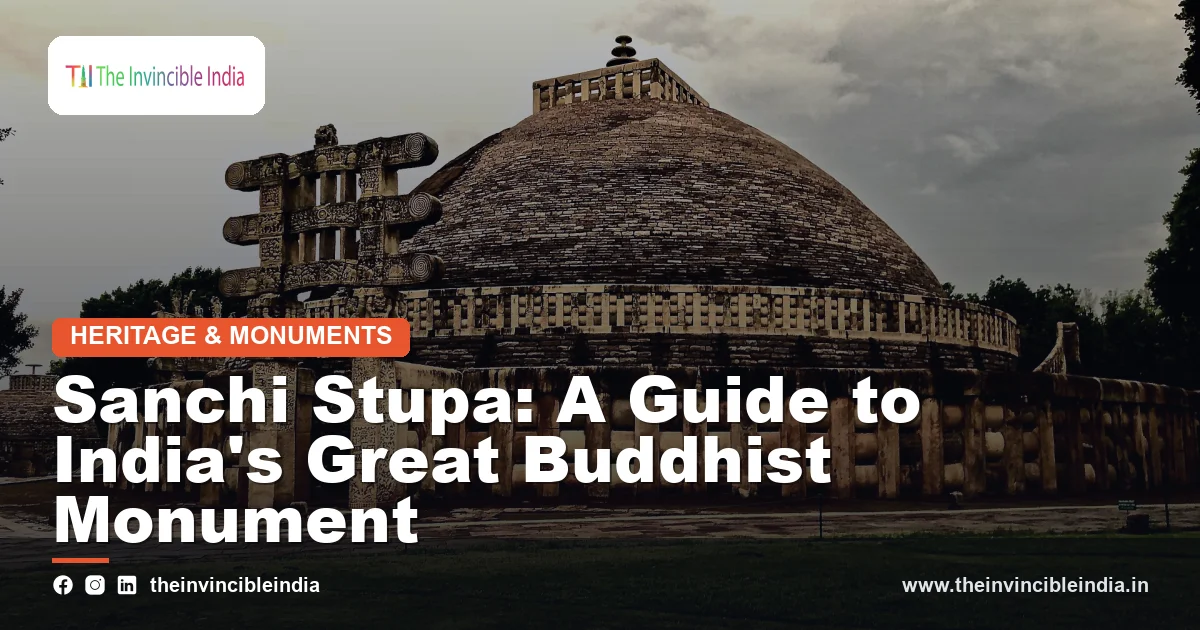
Rising serenely atop a hill in Madhya Pradesh, the Great Stupa at Sanchi is one of the oldest stone structures in India and among the most important Buddhist monuments in the world. Commissioned in the 3rd century BCE by the great Mauryan emperor Ashoka, this magnificent dome and its intricately carved gateways have stood for over two thousand years as a testament to India’s ancient Buddhist heritage. A UNESCO World Heritage Site, Sanchi offers a profound journey into the history, art and spirituality of early Buddhism. This guide explores the story, architecture and significance of this timeless monument.
Quick Facts: Sanchi Stupa
| Detail | Information |
|---|---|
| Location | Sanchi, Madhya Pradesh (near Bhopal) |
| Commissioned by | Emperor Ashoka, 3rd century BCE |
| Type | Buddhist stupa (relic monument) |
| Famous for | The four carved toranas (gateways) |
| UNESCO status | World Heritage Site (1989) |
| Nearest city | Bhopal, about 46 km away |
The Origins of Sanchi
The story of Sanchi begins with Emperor Ashoka, who, after embracing Buddhism following the bloody Kalinga war, became one of history’s greatest patrons of the faith. In the 3rd century BCE, Ashoka commissioned the original Great Stupa at Sanchi, a simple hemispherical brick dome built to enshrine relics of the Buddha. Over the following centuries, under the Shunga and Satavahana dynasties, the stupa was enlarged, encased in stone, and adorned with the magnificent gateways and railings that make it so famous today. Remarkably, Sanchi is not associated with any specific event in the Buddha’s life, yet it became one of the greatest centres of Buddhist worship and learning.
The Great Stupa
The centrepiece of Sanchi is the Great Stupa, or Stupa No. 1, a massive solid dome built over the relics of the Buddha. The dome, known as the anda, represents the cosmos and the dome of heaven, and is topped by a square railing (harmika) enclosing a triple umbrella (chhatra) that symbolises the Buddha, his teaching and the monastic community. A raised terrace and a ground-level path allow devotees to perform pradakshina, the ritual of walking clockwise around the stupa in reverence. The sheer scale and simplicity of the dome convey a profound sense of peace and permanence.
The Magnificent Toranas
The crowning glory of Sanchi is its four elaborately carved gateways, or toranas, positioned at the cardinal points around the Great Stupa. Added in the 1st century BCE, these gateways are covered from top to bottom in exquisite relief carvings depicting scenes from the life of the Buddha, the Jataka tales of his previous births, and various symbolic and decorative motifs. What makes them especially fascinating is that, in keeping with early Buddhist tradition, the Buddha himself is never shown in human form, but is represented instead by symbols such as a footprint, an empty throne, a wheel or the Bodhi tree.
The Art and Symbolism of the Gateways
The carvings on the toranas are a treasure trove of early Indian art and Buddhist symbolism. Recurring symbols include the wheel (dharmachakra), representing the Buddha’s teaching; the lotus, symbolising purity; the elephant, associated with his conception; and the Bodhi tree, marking his enlightenment. The gateways also teem with lively depictions of everyday life, animals, guardian figures and celestial beings, offering a vivid window into the world of ancient India. The artistry of these carvings, at once devotional and richly detailed, marks a high point in the development of Indian sculpture.
The Ashokan Pillar
Near the southern gateway of the Great Stupa stand the remains of a famous pillar erected by Emperor Ashoka, one of the many such pillars he raised across his empire. Made of polished sandstone, the pillar once bore an inscription and was crowned by a capital of four lions standing back to back. This design, the Lion Capital, later became the national emblem of India. The Sanchi pillar reflects the extraordinary craftsmanship of the Mauryan period, with its characteristic mirror-like polish, and connects the site directly to one of the greatest rulers in Indian history.
The Wider Complex
Sanchi is not a single monument but an extensive complex of stupas, temples, pillars and monasteries that developed over more than a thousand years, from the 3rd century BCE to the 12th century CE. Alongside the Great Stupa are several smaller stupas, including ones believed to contain the relics of important Buddhist teachers, as well as the ruins of ancient monasteries where monks once lived and studied, and later temples reflecting the site’s long history. Exploring the whole hilltop reveals the evolution of Buddhist architecture across many centuries.
Rediscovery and Preservation
After the decline of Buddhism in India, Sanchi was gradually abandoned and forgotten, lying overgrown and neglected for centuries until it was rediscovered by a British officer in 1818. In the following decades it suffered from amateur excavations and treasure hunting before careful restoration work, largely carried out in the early 20th century, returned the monuments to something of their former glory. Today Sanchi is protected as a UNESCO World Heritage Site, and its excellent state of preservation makes it one of the finest places in the world to appreciate early Buddhist art and architecture.
Planning Your Visit
Sanchi is located about 46 kilometres from Bhopal, the capital of Madhya Pradesh, and is easily reached by road or rail. The site is set on a peaceful hill and can be explored in a few hours, ideally in the cooler morning or late afternoon light. The best time to visit is during the pleasant winter months from October to March. An on-site museum displays artefacts recovered from the area, and hiring a guide or carrying a good reference helps in understanding the rich symbolism of the carvings. Sanchi pairs well with a visit to the nearby historic town of Vidisha and the Udayagiri caves.
Buddhism in Ancient India
To understand Sanchi is to glimpse the world of ancient Indian Buddhism at its height. Following the enlightenment of the Buddha in the 6th century BCE and the later patronage of Emperor Ashoka, Buddhism spread rapidly across the subcontinent and beyond, becoming one of the great religions of Asia. Great monastic centres, stupas and universities flourished, and Buddhist art and philosophy reached extraordinary heights. Sanchi was one of the most important of these centres, a thriving hub of worship, learning and pilgrimage for well over a thousand years. Its monuments allow visitors to trace not only the art but the living history of a faith that profoundly shaped India and the wider world.
The Other Stupas and Monuments
While the Great Stupa is the star attraction, the hill at Sanchi is dotted with numerous other monuments that reward exploration. Stupa No. 2 and Stupa No. 3 are important in their own right, with Stupa No. 3 believed to have once held the relics of two of the Buddha’s chief disciples, Sariputta and Mahamoggallana. Scattered across the site are the ruins of ancient monasteries (viharas) where monks once lived and studied, the remains of temples built in later centuries, and several pillars. Together, these structures reveal how Sanchi developed and evolved over more than a millennium, offering a layered picture of changing architectural styles and religious practice.
The Sanchi Archaeological Museum
At the foot of the hill lies the Sanchi Archaeological Museum, which houses a valuable collection of artefacts recovered from the site during excavations. Among its highlights are sculptures, railings and the celebrated lion capital that once crowned Ashoka’s pillar, echoing the design that became India’s national emblem. Visiting the museum before ascending the hill helps put the monuments in context and deepens appreciation of the artistry on display. The exhibits illustrate the skill of ancient craftsmen and the rich symbolism of Buddhist art, making the museum an essential complement to a tour of the stupas and temples above.
The Enduring Legacy of Sanchi
Sanchi stands as one of the most precious windows into ancient India, a place where art, faith and history come together in remarkable harmony. As one of the oldest stone structures in the country and among the finest surviving monuments of early Buddhism, it offers an irreplaceable record of a formative era in Indian civilisation. Its serene hilltop setting, its magnificent gateways and its deep spiritual significance continue to move and inspire the pilgrims, scholars and travellers who visit from around the world. More than two thousand years after Ashoka first raised its dome, Sanchi endures as a timeless symbol of peace, devotion and the enduring power of India’s Buddhist heritage.
How to Reach Sanchi
Sanchi is conveniently located about 46 kilometres from Bhopal, the capital of Madhya Pradesh, which is well connected by air, rail and road to the rest of India. Sanchi has its own small railway station, and regular buses and taxis run from Bhopal and the nearby town of Vidisha, making the site easy to reach as a day trip. The monuments are set on a peaceful hill a short distance from the town and can be comfortably explored on foot over a few hours.
Combining Sanchi with Nearby Sites
A visit to Sanchi pairs beautifully with several other historic and natural attractions in the region. The ancient town of Vidisha, the rock-cut Udayagiri Caves with their remarkable Gupta-era sculptures, and the striking Heliodorus Pillar are all close by and rich in history. Bhopal itself offers lakes, museums and the nearby prehistoric rock shelters of Bhimbetka, a UNESCO World Heritage Site. Together, these destinations make the Sanchi region a rewarding stop for anyone interested in India’s deep and layered past.
Best Time to Visit Sanchi
The ideal time to visit Sanchi is during the cool, dry winter months from October to March, when the weather is pleasant for exploring the hilltop monuments on foot. The early morning and late afternoon offer the softest light for appreciating the carvings and photographing the Great Stupa against the sky. Summers in Madhya Pradesh can be very hot, while the monsoon brings lush greenery but occasional rain, so the winter season remains the most comfortable and rewarding time to experience this magnificent site.
What to Know Before You Go
Sanchi is an open-air heritage site set on a hill, so comfortable walking shoes, sun protection and drinking water are advisable, especially in the warmer months. There is a modest entry fee, and the on-site museum is well worth the additional visit for the context it provides. Allow two to three unhurried hours to explore the stupas, gateways and monastery ruins, and take time simply to sit and absorb the extraordinary sense of history and peace that pervades this ancient hilltop, one of the great spiritual and artistic treasures of India.
Frequently Asked Questions
Who built the Sanchi Stupa?
The original Great Stupa at Sanchi was commissioned by the Mauryan emperor Ashoka in the 3rd century BCE, and it was later enlarged and adorned with gateways under subsequent dynasties.
Why is the Sanchi Stupa famous?
Sanchi is famous as one of the oldest and best-preserved Buddhist monuments in India, especially for its four magnificently carved gateways (toranas) and its status as a UNESCO World Heritage Site.
Why is the Buddha not shown in the Sanchi carvings?
In keeping with early Buddhist tradition, the Buddha is represented through symbols such as a footprint, an empty throne, a wheel or the Bodhi tree, rather than in human form.
What is the best time to visit Sanchi?
The best time is during the cool, dry season from October to March, when the weather is pleasant for exploring the hilltop complex.


