

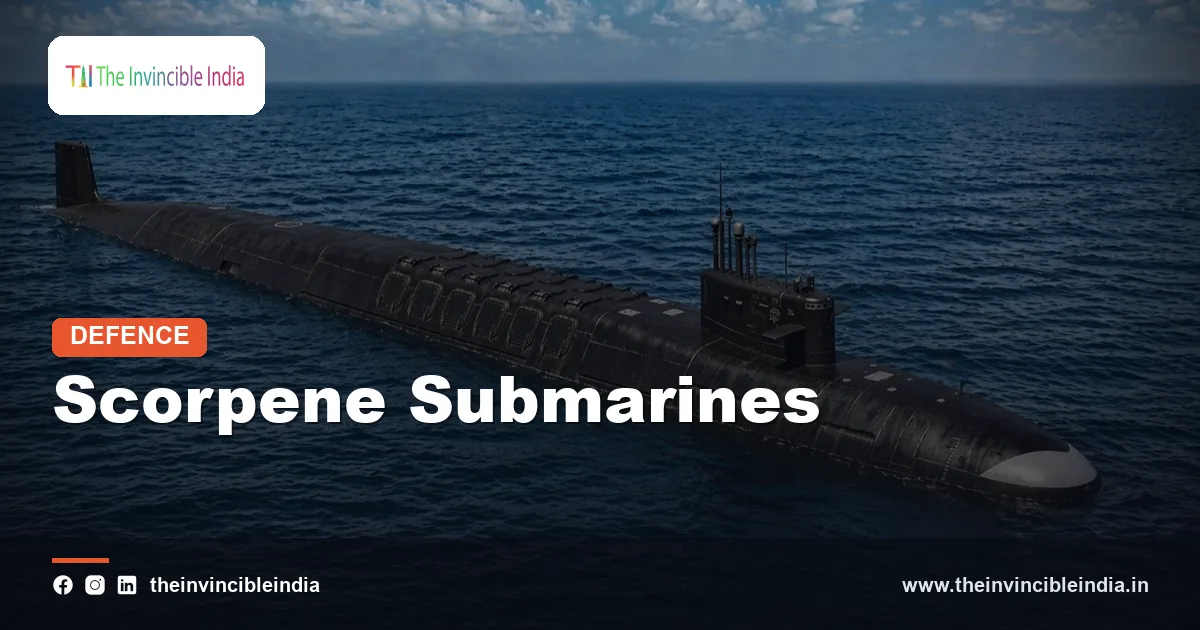
The Scorpene submarines of the Indian Navy, formally known as the Kalvari class, are six diesel-electric attack submarines built at Mazagon Dock Shipbuilders Limited (MDL) in Mumbai under a programme called Project 75. The design comes from the French naval group, then known as DCNS and today called Naval Group, and the boats were built in India under a transfer-of-technology arrangement. Together they represent the Indian Navy’s first major submarine construction effort in decades and a significant step in building a domestic underwater warfare industry.
Submarines are among the most complex machines a navy can operate. They need advanced acoustics, precision engineering, safe handling of batteries and weapons, and well-trained crews. India’s submarine fleet had been ageing, and the Navy’s plan to maintain a credible underwater force required new boats. Project 75 was meant to fill part of this gap while teaching Indian industry how to build modern conventional submarines. This explainer covers how the programme started, the six boats, their capabilities, the planned air-independent propulsion upgrade and the follow-on Project 75I.
| Feature | Details |
|---|---|
| Class name | Kalvari class (Scorpene design) |
| Programme | Project 75 |
| Builder | Mazagon Dock Shipbuilders Limited, Mumbai |
| Design partner | Naval Group, France (formerly DCNS) |
| Contract signed | 2005 |
| Number of boats | Six |
| First boat | INS Kalvari, commissioned on 14 December 2017 |
| Type | Diesel-electric attack submarine |
| Key weapons | Torpedoes, SM39 Exocet anti-ship missiles and mines |
Why India Needed Project 75
The Indian Navy’s submarine arm began on 8 December 1967 with the commissioning of the first INS Kalvari, a Soviet-built Foxtrot-class boat. Over the decades the fleet grew to include Soviet and Russian Kilo-class submarines, known in India as the Sindhughosh class, and German-designed Type 209 submarines, called the Shishumar class, two of which were built at Mazagon Dock in the 1980s and 1990s. By the late 1990s, these boats were ageing and the Navy faced a shortfall in numbers.
The 30-year submarine plan
In 1999 the Government approved a long-term plan to build a fleet of submarines in India over thirty years. It envisioned two production lines, one of which was Project 75 and the other Project 75I, designed to replace older boats with modern ones and to encourage indigenous construction. Project 75 was the first of these lines, and it was intended to build six boats with a foreign design partner and technology transfer.
Choice of the Scorpene
The Scorpene design, developed jointly by the French company DCNS and the Spanish shipbuilder Navantia, was selected for the programme. The contract was signed in 2005 with MDL and the French partner, covering the construction of six boats in Mumbai with design support and technology transfer from France. The design is also used by other navies, including those of Chile, Malaysia and Brazil, in versions adapted to their requirements.
The Six Kalvari-Class Boats
The six boats of the class carry names from earlier Indian submarines and from marine species and places. The names themselves are a link to the earlier generation of the Navy’s submarine arm.
| Boat | Pennant | Commissioned |
|---|---|---|
| INS Kalvari | S21 | December 2017 |
| INS Khanderi | S22 | September 2019 |
| INS Karanj | S23 | March 2021 |
| INS Vela | S24 | November 2021 |
| INS Vagir | S25 | January 2023 |
| INS Vagsheer | S26 | January 2025 |
Meaning of the names
- Kalvari: named after the tiger shark of the Indian Ocean, and also the name of India’s first submarine.
- Khanderi: named after an island fort near Mumbai associated with the Maratha naval tradition.
- Karanj: named after an island near Mumbai, and recalls an earlier submarine of the same name.
- Vela: carries forward the name of an earlier Foxtrot-class boat.
- Vagir: named after the sand shark, again reviving an earlier submarine’s name.
- Vagsheer: named after the sand fish, a creature of the deep sea.
Design and Stealth Features
The Scorpene is a medium-sized submarine, around 67 metres long and in the region of 1,500 to 1,800 tonnes in displacement, depending on whether it is surfaced or submerged. Its principal virtue is stealth. The hull is designed to be hydrodynamically efficient, with a shape that minimises flow noise, and it is made of special high-tensile steel capable of withstanding the pressure at operating depths.
Quiet running
Submarines are detected mainly by sound. The Scorpene uses a range of noise-reduction measures: vibration-damped machinery, a carefully designed propeller, and an electric propulsion motor that runs more quietly than a mechanical drive. When running on battery power, a conventional submarine is among the quietest underwater vessels. This allows it to lurk close to enemy ships and approach without detection.
Crew and endurance
The boat is operated by a compact crew of about three dozen sailors and officers. As a diesel-electric submarine, it must periodically come to or near the surface to run its diesel engines and recharge its batteries, using a snorkel mast. It is capable of patrols lasting several weeks, with endurance limited by fuel, food, battery cycles and crew stamina, rather than by a nuclear reactor.
How a Diesel-Electric Submarine Works
To appreciate the Scorpene, it helps to understand the basic cycle of a conventional submarine. It has diesel engines, a large battery bank and an electric motor that turns the propeller.
- On the surface or at snorkel depth: the diesel engines run generators that charge the batteries and supply power.
- Submerged: the boat runs on battery power alone, silently, driving the electric motor.
- Indiscretion ratio: the fraction of time spent near the surface to run diesels, which is when the boat is most vulnerable to detection.
The weakness of this arrangement is that batteries have a limited stored charge. A Scorpene can stay submerged for days at slow speed, but must eventually return to snorkel depth. This is why air-independent propulsion is of such interest: it extends submerged endurance without surfacing or snorkelling.
Weapons and Combat Systems
The Scorpene’s weapons are launched from six torpedo tubes in the bow. The boat can carry a total load of around eighteen weapons, a mix of torpedoes and missiles, and can also be configured for laying mines.
Torpedoes and missiles
The principal anti-submarine and anti-ship weapon is the heavyweight torpedo, a long-range self-guided weapon that can home on a target using sonar. In addition, the boats can carry the SM39 Exocet, a French sub-surface-launched anti-ship missile. The missile is fired from a torpedo tube inside a capsule, rises to the surface and then flies at low altitude to the target. This gives the submarine a capability to attack surface ships from stand-off distance while remaining submerged.
Sonar and combat management
A submarine’s eyes and ears are its sonars. The Scorpene is fitted with a suite of sensors, including a bow-mounted sonar, flank arrays and a towed array, with a combat management system that integrates sensor data and helps the crew to track targets and fire weapons. The boats also carry electronic support measures and periscopes, and are designed for intelligence gathering and special operations in addition to attack missions.
Building the Boats at Mazagon Dock
Mazagon Dock Shipbuilders in Mumbai is a major defence shipyard, with experience in building destroyers, frigates and earlier submarines of the Shishumar class. Under Project 75, it worked with the French design partner to master the techniques of constructing and integrating a modern submarine, including precision hull fabrication, pressure testing, installation of machinery and combat systems, and trials at sea.
Transfer of technology
The arrangement allowed Indian engineers to learn from the French partner, while the programme employed Indian suppliers for several sub-systems and materials. The technology transfer is regarded as an important legacy of the project because the skills built here can be used for future submarine programmes.
Delays and controversies
Project 75 faced significant delays. The first boat was originally expected years earlier than its eventual induction, owing to difficulties in absorbing technology, supply issues and contractual complexities. In 2016, a leak of documents related to the Scorpene design drew media attention and led to an official examination. Despite such setbacks, the programme eventually delivered all six boats, with progress improving as the production line matured.
Operational Role in the Indian Navy
The Kalvari-class boats operate primarily in the Indian Ocean Region and are based at Mumbai on the western seaboard, forming part of the Navy’s Western Naval Command. Their missions include anti-ship warfare, anti-submarine warfare, intelligence gathering, area surveillance, mine laying and special forces insertion.
Importance in the Indian Ocean
The Indian Ocean is a critical sea route for trade and energy supplies, and its waters are increasingly active with the presence of different navies. Submarines offer a powerful deterrent and sea-denial capability, since an adversary can never be sure where they are. The presence of quiet conventional boats on patrol complicates the planning of any potential opponent and supports India’s broader maritime strategy.
Complementing other platforms
The Scorpene fleet does not stand alone. It works alongside the older Kilo and Type 209 boats, the nuclear-powered ballistic missile submarines such as INS Arihant, aircraft carriers, surface combatants and maritime patrol aircraft. Each plays a role in a layered naval force, with conventional attack submarines specialising in covert, close-range operations.
The Air-Independent Propulsion Plan
The Kalvari-class boats were originally built without air-independent propulsion (AIP), a technology that lets a conventional submarine stay submerged for much longer without surfacing. The Navy has planned to add AIP to the boats, typically during their scheduled refits.
MESMA and indigenous options
The French design offers an AIP module called MESMA, which uses a steam cycle with ethanol and oxygen. India’s DRDO has also developed its own AIP system based on fuel cells, through its Naval Materials Research Laboratory. The plan involves inserting an additional hull section containing the AIP plug into the submarine, an operation that requires cutting the hull and reintegrating it, and therefore needs to be done in a refit period.
What AIP offers
- Longer submerged endurance: up to a few weeks, rather than days, at low speed.
- Lower detection risk: less need to come to snorkel depth to charge batteries.
- Greater tactical flexibility: better ability to remain on station in contested waters.
The retrofit is subject to technical, schedule and cost considerations, and the pace at which it is implemented can vary with decisions on the final choice of AIP technology.
Project 75 India (Project 75I): The Follow-On Programme
Project 75I, with the “I” standing for India, is the next stage of the 30-year plan. It is intended to build six advanced conventional submarines equipped with AIP, with greater capability than the Scorpene boats, in Indian shipyards through partnership with a foreign designer. It is being run under the Strategic Partnership model, which allows selected Indian private and public shipyards to team with a foreign original equipment manufacturer to build major platforms in India.
Competing teams
The programme shortlisted Indian shipyards, including Mazagon Dock Shipbuilders and Larsen and Toubro, each paired with a foreign partner. The selection involved evaluating technical proposals, trials and cost. The process has been long and complex, as is common with large defence acquisitions, and reports have indicated that negotiations and approvals follow a stepwise path through the Defence Acquisition Council and the Cabinet Committee on Security.
Related programmes
Alongside Project 75I, discussion has covered additional Scorpene-type boats and a separate nuclear-powered attack submarine effort, sometimes referred to as Project 75 Alpha. These are in addition to the ballistic missile submarine programme under which INS Arihant and its successors were built. Together they illustrate the Navy’s goal of a balanced undersea force with both conventional and nuclear-powered boats.
Strategic Significance and Challenges
The Scorpene programme matters for several reasons. It brought modern conventional submarines into the Navy, kept alive the capability to build submarines in India and provided a foundation of skills, supply chains and experience that future programmes can build on.
Challenges to keep in view
- Schedule and cost management: a recurring challenge for complex shipbuilding programmes.
- Supply chains and indigenisation: increasing the share of components made in India.
- Training and maintenance: maintaining skilled crews and shore support facilities.
- Technology upgrades: integrating AIP and updated weapons and sensors.
- Numbers: sustaining a sufficient number of submarines in a large ocean region requires continued construction and replacement.
Conclusion
The Scorpene submarines and Project 75 mark a critical phase in the story of the Indian Navy’s undersea arm. From the commissioning of INS Kalvari in 2017 to the induction of the sixth boat, the programme demonstrated that India could construct modern submarines at home with foreign design support. Despite delays, the Kalvari class has given the Navy quiet, well-armed boats and given Indian industry valuable experience. With the AIP retrofit and the follow-on Project 75I, the next generation of Indian conventional submarines will build on the foundation laid by the Scorpene.
Frequently Asked Questions
What are the Scorpene submarines?
The Scorpene submarines, officially the Kalvari class, are six diesel-electric attack submarines of the Indian Navy. They were built at Mazagon Dock Shipbuilders in Mumbai under Project 75 using a design and technology transfer from France’s Naval Group.
Which are the six Kalvari-class submarines?
The six boats are INS Kalvari, INS Khanderi, INS Karanj, INS Vela, INS Vagir and INS Vagsheer. INS Kalvari was the first, commissioned in December 2017, and the series was completed with INS Vagsheer in 2025.
What weapons do the Scorpene submarines carry?
They carry heavyweight torpedoes and SM39 Exocet anti-ship missiles launched from six bow torpedo tubes, and can also lay mines. The total weapon load is in the region of eighteen weapons.
What is Project 75?
Project 75 is the Indian Navy’s programme, conceived in the late 1990s as part of a 30-year submarine-building plan, to build six modern conventional submarines in India with foreign design assistance. The contract was signed in 2005 for the Scorpene design.
What is air-independent propulsion and will the Scorpenes get it?
Air-independent propulsion (AIP) lets a conventional submarine remain submerged for much longer without surfacing or snorkelling. The Navy plans to add AIP to the Kalvari-class boats during refits, using either a French system called MESMA or an indigenous DRDO fuel-cell design.
What is Project 75I?
Project 75I is the follow-on programme to build six more advanced AIP-equipped conventional submarines in India through the Strategic Partnership model, with Indian shipyards teaming up with foreign designers. It is a more capable successor to the Scorpene boats of Project 75.


