

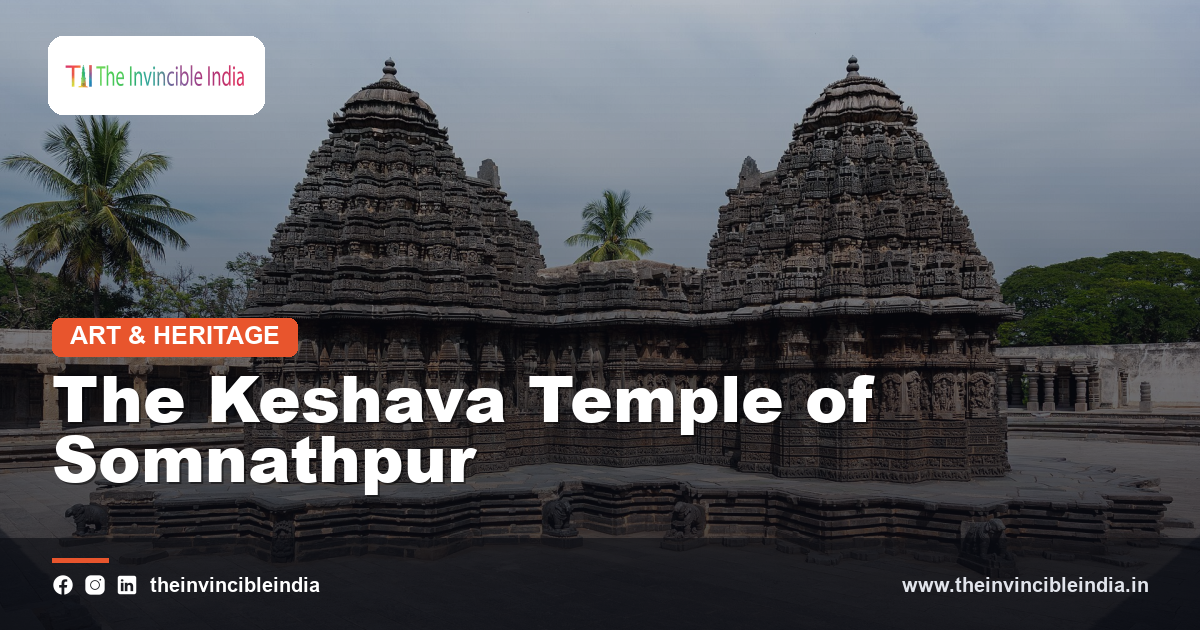
The Keshava Temple of Somnathpur, also spelled Somanathapura and often called the Chennakesava Temple of Somanathapura, is one of the finest surviving temples of the Hoysala dynasty in southern Karnataka. It stands on the banks of the Kaveri river in Mysuru district and was raised in the thirteenth century as a shrine to Vishnu. Its three towers, star-shaped platform and walls covered in miniature sculpture make it a landmark of South Indian art, and it belongs to the same living tradition surveyed in the guide to Indian temple architecture. This article explains its history, design and meaning.
Quick answer: The Keshava Temple of Somnathpur (also spelled Somanathapura) is a thirteenth-century Hoysala temple dedicated to Vishnu in Mysuru district, Karnataka, India. It has three shrines arranged around a pillared hall, a star-shaped plan and outer walls carved in soapstone with elephants, scrolls and scenes from the epics. It is regarded as one of the most complete and polished examples of Hoysala temple architecture.
Key Takeaways
- The Keshava Temple is a Hoysala temple of the thirteenth century at Somnathpur, also called Somanathapura, in Mysuru district, Karnataka.
- It is a trikuta temple, meaning it has three shrines, dedicated to Vishnu in the forms of Keshava, Janardhana and Venugopala.
- The temple stands on a raised, star-shaped platform that lets sculpture and sunlight play across its many angled walls.
- Its walls are carved from fine-grained soapstone with horizontal bands of elephants, horses, scrolls and epic scenes.
- The temple is enclosed by a pillared cloister with many small cells, and the whole complex is protected by the Archaeological Survey of India.
- It forms part of the Sacred Ensembles of the Hoysalas, a UNESCO World Heritage listing that also includes Belur and Halebidu.
The sections below describe who built the temple, how it is arranged and why it is admired so widely.
Quick Facts
| Detail | Information |
|---|---|
| Location | Somanathapura (Somnathpur), Mysuru district, Karnataka |
| Also known as | Chennakesava Temple, Keshava Temple, Somanathapura Temple |
| Dynasty | Hoysala |
| Approximate era | Thirteenth century CE |
| Deity | Vishnu as Keshava, Janardhana and Venugopala |
| Plan | Trikuta (three shrines) on a star-shaped platform |
| Material | Fine-grained soapstone (chloritic schist) |
| Heritage status | Protected monument; part of the UNESCO listing for the Sacred Ensembles of the Hoysalas |
What Is the Keshava Temple of Somnathpur?
The Keshava Temple of Somnathpur is a Hoysala temple of Vishnu built in the thirteenth century on the banks of the Kaveri river in southern Karnataka. It is a trikuta temple, which means that three shrines open from one shared hall, and each shrine is crowned by a pyramidal tower. The temple is built almost entirely of soapstone, a soft stone that hardens after quarrying and allows extremely fine detail. Visitors often describe it as a jewel box in stone because every surface, from the platform to the eaves, carries ornament. It is also one of the most complete Hoysala temples, since its plan, towers and surrounding cloister have survived with relatively little alteration. The Keshava Temple therefore offers a clear picture of the Hoysala ideal of a fully sculpted temple.
Where Is Somnathpur Located?
Somnathpur is a small village in Mysuru district of Karnataka, set on the southern bank of the Kaveri river within the old Mysore plateau. The place is officially known as Somanathapura, a name that recalls Somanatha, the patron who founded the settlement and its temple. It lies a short drive from the city of Mysuru and is easily combined with other sites of the region, including the riverside town of Srirangapatna and the pilgrimage centre of Talakad. The surrounding landscape is one of fields, coconut groves and quiet lanes, which gives the temple a calm and open setting. Unlike many monuments hemmed in by modern streets, the Keshava Temple stands in its own lawned enclosure. The village location helps preserve the sense of a sacred precinct set apart from daily bustle.
Who Built the Keshava Temple and When?
The Keshava Temple was built in the thirteenth century under the Hoysala kings, and tradition credits its foundation to Somanatha, a high official or commander in the service of the Hoysala ruler Narasimha III. Inscriptions associated with the temple record the founding of the agrahara, a settlement granted to scholars and priests, together with the consecration of the Vishnu shrines. The village itself took its name from the founder, which shows how a patron could shape a place as well as a monument. Precise details of the construction years are best taken from the inscriptions and the work of historians rather than repeated loosely. What is clear is that the temple belongs to the late Hoysala period, when the style had matured. The Keshava Temple thus stands as a product of a confident dynasty and a devoted patron working together.
Why Is the Temple Star-Shaped?
The temple is star-shaped because Hoysala architects designed the platform and walls on a stellate plan, with many projecting angles instead of a plain rectangle. Each projection catches light and shadow differently, so the surface seems to change as the sun moves across the sky. The star plan also multiplies the area available for sculpture, giving the carvers many more panels to fill. Each of the three shrines is built on this plan, and their towers repeat the stepped, star-like outline in miniature as they rise. The arrangement is not merely decorative, because it organises the entire temple into a rhythm of corners, recesses and bands. This geometric thinking makes the Keshava Temple a striking example of how mathematics and devotion were combined in medieval Indian architecture.
What Is a Trikuta Temple?
A trikuta temple is a temple with three shrines, each with its own sanctum and tower, grouped around a common hall. At Somnathpur the three sanctums are dedicated to forms of Vishnu named Keshava, Janardhana and Venugopala, and they face a shared pillared mandapa. The shrines are placed at the west, north and south sides of the hall, so that the plan resembles a three-armed cross. This layout allows a rich variety of worship within a single building, and it creates a sense of grandeur without the need for a very high tower. The Hoysalas used the trikuta form in several temples, and Somnathpur is its best preserved and most balanced example. The trikuta design thus shows how Hoysala planners enlarged the temple into a complex, harmonious whole.
What Is Carved on the Outer Walls?
The outer walls carry horizontal bands of sculpture that run around the whole platform, and these bands are one of the temple’s most famous features. The lowest friezes show rows of elephants, followed by horsemen, scrolls of foliage, scenes from the epics and the mythical sea creature known as the makara. Above them stand larger figures of deities and attendants set in niches and panels. The sequence of bands is repeated with great discipline, so that the walls read almost like a woven textile of stone. The scenes draw on stories from the Ramayana, the Mahabharata and the Bhagavata Purana, and they invite the viewer to walk slowly around the temple in the traditional manner of circumambulation. The outer walls of Somnathpur thus function as a carved book that visitors can follow from one panel to the next.
What Is Special About the Interior Pillars?
The interior of the temple is notable for its pillars, which were shaped on a lathe-like process and have rounded, bell-like or beaded profiles. Hoysala craftsmen were known for this technique, and the polished finish of the pillars gives the hall a refined and gleaming appearance. The ceilings above are divided into square bays, and each bay carries a deep, lotus-like dome richly carved with concentric rings and hanging forms. The pillars and ceilings together create a rhythmic interior that feels both solid and delicate. Light enters through the open sides and falls on the carved surfaces, adding to the effect. The craftsmanship here shows that the Hoysala sculptors cared as much about the inner spaces as about the outer walls. The mandapa at Somnathpur therefore reveals the full technical and artistic skill of the Hoysala workshop.
Who Are Keshava, Janardhana and Venugopala?
Keshava, Janardhana and Venugopala are three names and forms of Vishnu, the preserving deity of the Hindu trinity. Keshava is a widely used epithet of Vishnu and is the name from which the temple takes its title. Janardhana is another epithet, often explained as the one who is worshipped by people, while Venugopala refers to Krishna as the cowherd who plays the flute. Each form gave the temple a distinct devotional mood, one majestic, one protective and one tender and playful. Over time some of the original images have been lost or damaged, which is a common fate for medieval temples, so the present state of the shrines is not the same as in the original design. Even so, the three names show how the temple was conceived as a complete expression of Vaishnava devotion.
How Is the Temple Complex Arranged?
The Keshava Temple stands in a rectangular courtyard enclosed by a pillared cloister lined with small cells. The cloister once sheltered images and provided a sheltered path around the sanctuary, and its pillars echo the style of the main hall. A gateway leads into the courtyard, and the main temple rises from its platform near the centre. The enclosure gives the monument a clear boundary and a sense of order, setting the sacred space apart from the village outside. Movement through the complex follows a deliberate sequence from the gate to the platform and then around the walls. The cloister and courtyard thus make the temple a complete architectural precinct rather than a single isolated building.
What Material and Technique Did the Hoysalas Use?
The Hoysala builders used soapstone, a fine-grained chloritic schist that is soft when freshly quarried and hardens over time. This quality allowed sculptors to carve very fine details such as jewellery, hair, folds of cloth and tiny architectural models. The stone also takes a high polish, which is why many Hoysala surfaces seem smooth and gleaming. Workshops of masons, sculptors and designers collaborated on each temple, and inscriptions elsewhere sometimes record the names of individual artists. The method involved careful planning of the plan and proportions, followed by detailed carving of each block before or after placement. Because soapstone could be shaped so precisely, Hoysala temples achieved a density of ornament that is rare in other regional styles. The choice of material was therefore central to the unique look and feel of Somnathpur.
How Does Somnathpur Compare With Belur and Halebidu?
Somnathpur is often grouped with the Hoysala temples of Belur and Halebidu, but it differs from them in several ways. The temples at Belur and Halebidu are earlier and larger in some respects, while Somnathpur is later, more compact and more unified in its design. Its trikuta plan and fully preserved star-shaped layout make it a particularly clear example of the mature Hoysala style. Belur is known for its elaborate bracket figures and an active place of worship, whereas Halebidu is known for its dense carving on a very large scale. Together the three sites present the dynasty’s art at different moments and in different moods. The Chennakeshava Temple of Belur is a useful companion to this temple for anyone who wants to see the range of Hoysala achievement.
Why Is Somnathpur Important in the History of Indian Art?
Somnathpur is important because it shows a regional temple style reaching a mature and highly refined stage of development. The Hoysalas created a distinct architectural language, with star-shaped plans, lathe-turned pillars and densely carved soapstone surfaces, and the Keshava Temple preserves this language in nearly complete form. The temple also demonstrates how royal and official patronage supported large groups of skilled artists. For students of art history, it provides evidence about iconography, narrative sculpture and the relation between architecture and ornament. It also illustrates how South Indian temple traditions developed in conversation with both the earlier Chalukyan and the wider Deccan styles. The temple therefore holds a secure place in any account of medieval Indian art and architecture, and it is regularly cited in studies of sculpture of Indian sculpture.
What Is the Heritage Status of the Temple?
The Keshava Temple is a protected monument under the care of the Archaeological Survey of India, which maintains the building, the lawns and the surrounding enclosure. It is also part of the Sacred Ensembles of the Hoysalas, a serial listing on the UNESCO World Heritage List that groups it with the temples at Belur and Halebidu. This recognition highlights the outstanding value of Hoysala architecture and brings greater international attention to its conservation. Protection involves regular cleaning, structural monitoring and the management of visitors so that the delicate soapstone surfaces are not damaged. The status also encourages careful research and documentation of the temple’s sculpture. In this way the heritage framework helps ensure that the Keshava Temple will remain available to future generations.
How Can Visitors Experience the Temple?
Visitors can experience the temple best by walking slowly around the platform in a clockwise direction, studying one band of sculpture at a time before entering the hall. Morning and late afternoon light bring out the carving most clearly, and these hours are also less crowded and cooler. The site is a protected monument, so visitors are expected to respect the rules about footwear, photography and touching the stone. A guide or a printed note can help identify the epic scenes and the many small figures, since the details are easy to miss at first glance. Somnathpur is often visited on a day trip from Mysuru, together with nearby historic places. Allowing generous time at the temple rewards visitors with a deeper appreciation of the artistry, and patient observation is the best way to see it.
Somnathpur Keshava Temple Today
The Keshava Temple of Somnathpur today stands as a quiet but powerful reminder of the artistic ambition of the Hoysala dynasty. It is cared for as a protected monument, studied by historians and architects, and visited by students, pilgrims and travellers from India and abroad. Its star-shaped plan, three towers and richly carved walls continue to inspire discussion about how stone can be turned into a language of devotion and story. The temple also contributes to local life, since the village and the surrounding region benefit from cultural tourism and interest in heritage. Conservation work ensures that the soapstone surfaces are monitored and the setting is kept clean and open. The temple remains one of the finest achievements of medieval Karnataka and a lasting symbol of the region’s rich cultural heritage.
Sources & Further Reading
- Archaeological Survey of India (asi.nic.in).
- UNESCO World Heritage Centre, Sacred Ensembles of the Hoysalas (whc.unesco.org).
Frequently Asked Questions
What is the Keshava Temple at Somnathpur?
The Keshava Temple at Somnathpur is a thirteenth-century Hoysala temple of Vishnu in Mysuru district, Karnataka. It has three shrines around a shared hall and stands on a star-shaped platform. It is famous for its finely carved soapstone walls.
Where is Somnathpur located?
Somnathpur, officially Somanathapura, is a village in Mysuru district of Karnataka on the bank of the Kaveri river. It lies a short distance from the city of Mysuru. It is usually visited as a day trip from Mysuru.
Who built the Keshava Temple of Somnathpur?
The temple was built under the Hoysala dynasty in the thirteenth century, and tradition credits Somanatha, an official of the Hoysala king Narasimha III, as its founder. The village is named after him. Inscriptions record the founding of the settlement and the temple.
Why is the Somnathpur temple star-shaped?
The temple is star-shaped because Hoysala architects designed its platform and walls with many projecting angles. This increases the surface available for sculpture and creates dramatic play of light and shadow. The plan is a hallmark of the mature Hoysala style.
What is the Keshava Temple at Somnathpur famous for?
The Keshava Temple is famous for its three-shrine trikuta plan, its star-shaped platform, its lathe-turned pillars and its richly carved soapstone friezes. The walls show elephants, horsemen, scrolls and scenes from the epics. It is considered one of the best preserved Hoysala temples.
Is the Somnathpur temple a UNESCO World Heritage Site?
Yes, the Keshava Temple at Somnathpur is part of the Sacred Ensembles of the Hoysalas, a UNESCO World Heritage listing that also includes the temples of Belur and Halebidu. The temple is also a protected monument of the Archaeological Survey of India. This status supports its conservation.


