

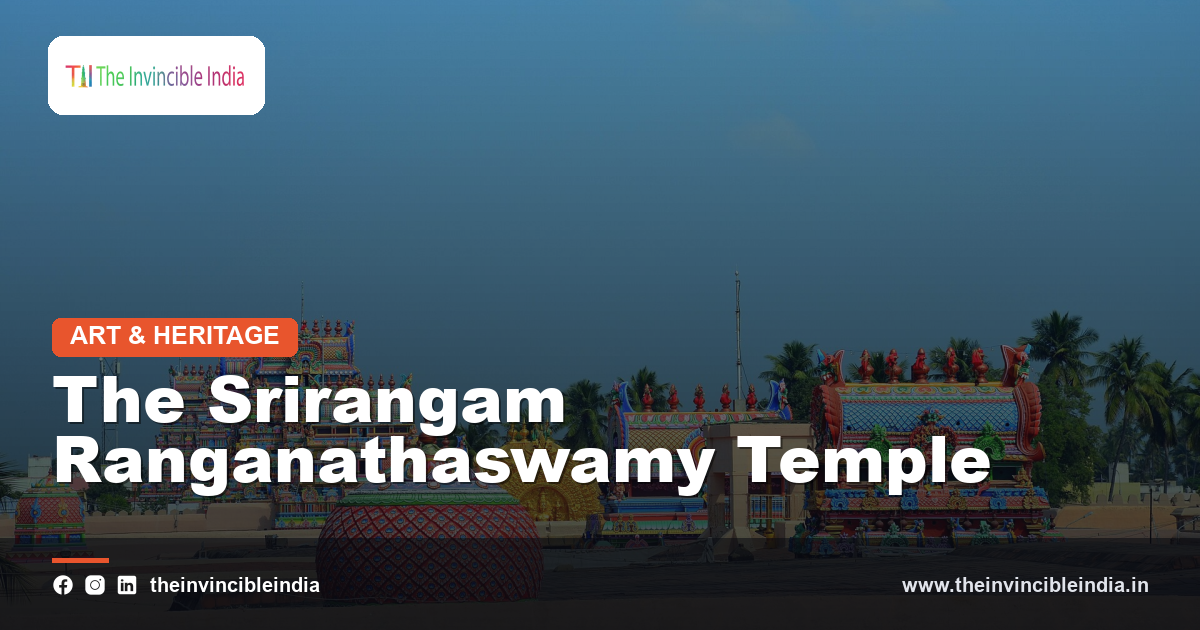
The Srirangam Ranganathaswamy temple rises on an island formed by the Kaveri and its branch river near Tiruchirappalli in Tamil Nadu, a vast sacred city in which a temple is the organising centre of an entire settlement. Dedicated to Vishnu in his reclining form as Ranganatha, it is regarded as the foremost of the Vaishnava shrines of the south and is counted among the largest functioning temple complexes in the world. Its seven concentric enclosures, soaring gateway towers, and pillared halls make it a defining example of the Dravidian tradition surveyed in the guide to Dravidian temple architecture, while its living worship links it directly to a devotional movement that has lasted more than a thousand years.
Quick Facts
| Detail | Information |
|---|---|
| Location | Srirangam island, near Tiruchirappalli, Tamil Nadu |
| Deity | Vishnu as Ranganatha, reclining on Adisesha |
| Layout | Seven concentric enclosures |
| Tradition | Sri Vaishnava; foremost Divya Desam |
| Style | Dravidian, with Chola to Nayaka additions |
| Best known for | Towering gopurams and Vaikuntha Ekadashi festival |
An Island Temple on the Kaveri
Srirangam occupies a long river island between the Kaveri and the Kollidam, and the setting is an essential part of the temple’s identity. The surrounding waters give the island a sense of separateness, as though the sanctuary stands apart from the ordinary world. Fertile fields, groves, and river ghats lie around the temple, and pilgrims have long approached it along causeways and across the river. The temple is not an isolated monument but the heart of a living town whose streets are arranged in concentric rectangles around the shrine. Homes, markets, and monasteries line these streets, so that the daily life of the community unfolds within the sacred precinct itself. This integration of religion and settlement is one of the most striking features of Srirangam, and it explains why the complex is often described as a temple town rather than a single building.
Ranganatha, the Reclining Vishnu
The principal deity of the temple is Ranganatha, a form of Vishnu shown reclining on the serpent Adisesha, who forms his couch. The image rests with the head toward the south and the face turned in that direction, a feature that distinguishes the shrine in the Vaishnava world. The posture expresses the idea of the divine at rest, yet watchful over the universe, and it is a favourite theme in Vaishnava devotion and art. According to tradition, the image has a very ancient lineage and was worshipped long before the present temple took shape. The sanctum is crowned by a gilded vimana that glows in the sunlight and marks the spiritual centre of the complex. For devotees, the sight of the reclining deity is the culmination of a pilgrimage, and the calm grandeur of the image conveys the sense of repose and compassion that the tradition attributes to Vishnu.
The Alvars and Sri Vaishnava Tradition
Srirangam holds a unique place in the history of Tamil Vaishnava devotion. The Alvars, the saint-poets of South India, composed hymns in praise of Vishnu, and several of them sang especially of Ranganatha. These verses, gathered in a famed collection, became a central scripture of the Sri Vaishnava community, and Srirangam is celebrated as the first and foremost of the holy places they praised. The temple became the headquarters of the tradition, with its priests, scholars, and teachers shaping doctrine and ritual. The recitation of the hymns remains an important part of temple worship, and their language links the present congregation to the early devotional poets. This deep association with the Alvars gives the temple a significance that goes beyond architecture, making it a living archive of literature, music, and theology as well as a work of stone.
Ramanuja and the Organisation of the Temple
The great Vaishnava teacher Ramanuja is closely associated with Srirangam, and tradition credits him with organising the administration and ritual life of the temple. His philosophy of qualified non-dualism, which emphasises devotion and the personal relationship between the soul and God, shaped the religious identity of the shrine. He is said to have established systems of worship, management, and service that provided stability for the temple over the centuries. Shrines and memorials within the complex honour his memory, and his teachings continue to inspire the community of devotees. The link between a great philosopher and a great temple illustrates how Indian religious institutions combined intellectual leadership with ritual practice. Through Ramanuja’s influence, Srirangam became not only a place of worship but also a centre of learning and spiritual guidance for the wider Vaishnava world.
The Seven Concentric Enclosures
The layout of the Srirangam temple is one of the most remarkable in India. The sanctum lies at the centre of seven concentric rectangular enclosures, each separated by a high wall and entered through gateway towers. The innermost courts are reserved for the most sacred rituals, while the outer enclosures merge with the streets of the town and are shared with residents and shopkeepers. Moving from the outer entrance toward the sanctum thus becomes a gradual journey from the everyday world into deeper levels of sanctity. The scale of the complex is immense, and the walls enclose a vast area that contains shrines, halls, tanks, and gardens in addition to the central temple. This planning principle, in which the temple grows outward in successive layers, reflects the way the complex expanded over time as successive rulers added new enclosures and gateways.
The Gopurams of Srirangam
The gateway towers, or gopurams, of Srirangam are among the most impressive in India. They rise in successive tiers above the openings in the great walls, and their surfaces are covered with sculpted and painted figures of deities, guardians, and mythological scenes. The outermost gateway, known as the Rajagopuram, is one of the tallest temple gateways in the country and dominates the horizon for many miles around. Smaller towers punctuate the inner walls, each one decreasing in size as the visitor approaches the centre, a deliberate arrangement that builds a sense of progression. The towers were added over many centuries, and their styles reflect the tastes of different periods. Seen from a high vantage point, the gopurams form a rhythmic skyline of ascending shapes that gives the temple town a unique silhouette.
Halls of a Thousand Pillars
Among the most admired structures within the complex are its great pillared halls, or mandapas, supported by forests of carved columns. The most famous is the hall of a thousand pillars, a vast space in which row upon row of sculpted shafts create a dramatic effect of depth and rhythm. Many of the pillars end in carved figures of rearing horses and fierce mythical beasts, the hallmark of the later Dravidian style. These halls served practical purposes, providing space for festival assemblies, performances, and the display of the deity during special occasions. They also gave sculptors an opportunity to display their virtuosity, since each column could be carved with its own figures and patterns. Walking through these halls, visitors experience the scale and craftsmanship that characterise the best of South Indian temple building, as well as the cultural life that once filled such spaces.
Dynasties That Shaped the Temple
The Srirangam temple was built up over many centuries, and several dynasties contributed to its growth. Chola rulers were notable patrons, and later the Pandyas, the Hoysalas, the Vijayanagara kings, and the Nayakas all made donations, repairs, and additions. Each ruling house left its mark on the architecture, whether through a new enclosure, a gateway, or a hall. The temple also endured periods of conflict and disruption, and tradition describes episodes in which the sacred image was protected and carried to safety until peace returned. These stories add to the sense of the temple as a sanctuary that survived across the changing fortunes of the region. The long record of royal support reflects the importance of Srirangam as a religious centre, and the accumulated layers of building make the complex a unique historical document.
Vaikuntha Ekadashi and the Festival Cycle
Srirangam is famous for its festivals, which occupy a large part of the year. The most celebrated is the Vaikuntha Ekadashi festival, held in the winter month, which draws very large crowds of devotees. During this observance a special gateway, known as the gate of heaven, is opened, and worshippers pass through it in the belief that doing so brings spiritual benefit. The festival includes a long series of recitations of the Tamil hymns of the Alvars, performed in the presence of the deity with great ceremony. Other festivals involve processions of the deity through the streets, boat rituals, and chariot festivals. These events turn the temple town into a stage of devotion and spectacle, and they are accompanied by music, dance, and displays of traditional craft. Through them, the temple renews its role as the centre of Vaishnava life in Tamil Nadu.
Daily Ritual and Temple Service
The temple follows a precise daily routine of worship, in which the deity is awakened, bathed, dressed, offered food, and finally put to rest at night. Priests, musicians, cooks, garland-makers, and many other temple servants carry out their duties according to long-established custom, and many of these roles are passed down within families. Sacred hymns are sung and the chanting of scriptural texts accompanies key moments of worship. The offering of food is especially important, and temple kitchens prepare large quantities of food that are later distributed to devotees. The rhythm of the day gives the complex a steady, reassuring pulse, and it ties together the many people whose work sustains the shrine. This organised system of service is one reason why the temple has retained its character through so many centuries of historical change.
Sculpture and Painted Ornament
Throughout the complex, sculpture and painted decoration enrich the architecture. Gopurams carry hundreds of stucco figures, the pillared halls bear carved horses and riders, and the corridors contain reliefs and panels illustrating sacred stories. Ceilings in some halls preserve painted decoration that shows flowers, deities, and scenes from legend. The sculptural vocabulary draws heavily on Vaishnava themes, particularly the incarnations of Vishnu and episodes from the epics. The style varies across the different periods of construction, from the restrained forms of earlier phases to the vigorous, ornate figures of the later centuries. Together, these works demonstrate the creative energy of generations of artists who worked for the temple. They also show how religious imagery was woven into everyday architecture, so that every doorway and column becomes a surface for storytelling and devotion.
The Temple Tanks and Sacred Waters
Water plays an important role in the sacred life of Srirangam. The island is surrounded by two rivers, and the temple complex includes several tanks and wells used for ritual purposes. The rivers themselves are regarded as holy, and pilgrims take ritual baths in them before entering the temple. The waters of the Kaveri are especially revered in the Tamil tradition, sometimes described as the Ganga of the south. Ceremonial processions often include a journey to the river bank, where the deity is received with special rites. The close relationship between the temple and flowing water ties the shrine to the fertile landscape of the Kaveri delta, which has supported rich agricultural life and sustained a strong tradition of temple patronage. The sacred waters thus form an essential part of the identity of Srirangam, linking the temple to its natural environment.
A Living Temple Town
Unlike many historic monuments, Srirangam is not a site apart from daily life but a town in which thousands of people live within the temple’s concentric streets. Residents include priests, scholars, merchants, and artisans, and the rhythm of the town follows the calendar of the temple. Traditional houses, shops selling flowers and offerings, and monasteries line the avenues, and the sounds of chanting and temple music are a constant presence. This blending of the sacred and the domestic is one of the defining characteristics of South Indian temple towns. It also means that the heritage of Srirangam is carried not only by its stones but also by its people, whose customs and skills keep the traditions alive. Visitors who spend time in the streets encounter a way of life that connects the present directly with the long history of the shrine.
The Srirangam Temple Today
Today the Srirangam Ranganathaswamy temple remains one of the most important pilgrimage destinations in India and a defining monument of Tamil Nadu. Its great gateways still dominate the horizon, its halls still echo with the recitation of ancient hymns, and its festivals still draw devotees from across the country. Caring for a complex this large is a continuing task, involving the repair of stonework, the renewal of painted towers, and large consecration ceremonies. For students of art and architecture, it offers an unrivalled view of how the Dravidian tradition grew over many centuries by accumulation. For worshippers, it is a place where devotion is practised with a continuity that stretches back to the earliest Vaishnava poets. The temple’s enduring vitality confirms the place of Srirangam among the greatest sacred sites of the subcontinent.
Sources & Further Reading
- Ministry of Culture, Government of India (indiaculture.gov.in).
- Archaeological Survey of India (asi.nic.in).
Frequently Asked Questions
Who is the main deity at Srirangam?
The main deity is Ranganatha, a form of Vishnu shown reclining on the serpent Adisesha. The image is the focus of devotion for the Sri Vaishnava tradition.
Why is the Srirangam temple so large?
The complex grew over many centuries as successive dynasties added enclosures, gateways, and halls. It now consists of seven concentric enclosures that merge with the streets of the surrounding town.
What is Vaikuntha Ekadashi?
It is the temple’s most celebrated festival, held in winter, during which a special gateway known as the gate of heaven is opened. Devotees pass through it and the hymns of the Alvars are recited.
Who was Ramanuja and what is his link to Srirangam?
Ramanuja was a great Vaishnava philosopher and teacher. Tradition credits him with organising the worship and administration of the Srirangam temple.
Can visitors enter the Srirangam temple?
Many parts of the complex are open to visitors, though access to the innermost sanctum follows traditional rules. Modest dress and respectful conduct are expected.


