

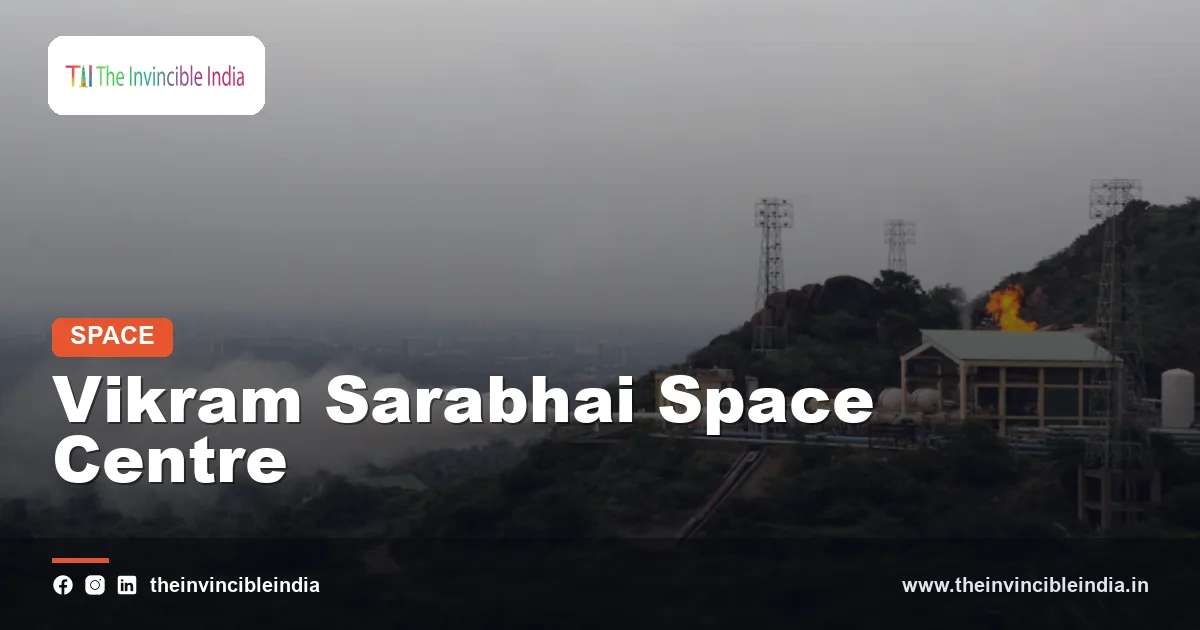
The Vikram Sarabhai Space Centre (VSSC) is the lead centre of the Indian Space Research Organisation (ISRO) for the design and development of launch vehicles and related technologies, located at Thiruvananthapuram in Kerala. The centre grew out of the Thumba Equatorial Rocket Launching Station of 1963 and was named after Dr Vikram Sarabhai, the physicist who is regarded as the father of the Indian space programme.
Almost every rocket that carries an Indian satellite into orbit was conceived, designed or qualified at this campus, from the early Satellite Launch Vehicle to the Polar Satellite Launch Vehicle (PSLV), the Geosynchronous Satellite Launch Vehicle (GSLV) and the heavy-lift LVM3. This explainer covers the history, the work, the facilities and the people behind the Vikram Sarabhai Space Centre.
Quick Facts
| Attribute | Detail |
|---|---|
| Full name | Vikram Sarabhai Space Centre (VSSC) |
| Parent organisation | Indian Space Research Organisation (ISRO), under the Department of Space, Government of India |
| Location | Thumba, Thiruvananthapuram, Kerala |
| Origin | Thumba Equatorial Rocket Launching Station (TERLS), established in 1963 |
| Named in its present form | 1972, after the death of Vikram Sarabhai in December 1971 |
| Principal mandate | Design, development and realisation of launch vehicles, solid propulsion, avionics and structures |
| Launch vehicles associated | Sounding rockets, SLV, ASLV, PSLV, GSLV, LVM3 and SSLV |
| Namesake | Dr Vikram Ambalal Sarabhai (1919-1971) |
Key Takeaways
- The Vikram Sarabhai Space Centre is ISRO’s lead centre for launch-vehicle technology and is headquartered at Thiruvananthapuram, Kerala.
- The Thumba Equatorial Rocket Launching Station, set up in 1963 near the magnetic equator, was the seed from which the Vikram Sarabhai Space Centre developed.
- The Vikram Sarabhai Space Centre took its present name in 1972 to honour Vikram Sarabhai, who founded the Physical Research Laboratory in 1947 and guided ISRO’s early growth.
- The Vikram Sarabhai Space Centre designs the structures, solid motors, avionics and flight software of the SLV, ASLV, PSLV, GSLV and LVM3 families of launch vehicles.
- India’s first successful satellite launch with an indigenous rocket, the SLV-3 flight carrying Rohini in July 1980, came out of the engineering effort that is now centred at the Vikram Sarabhai Space Centre.
- The Vikram Sarabhai Space Centre works alongside the Liquid Propulsion Systems Centre and the Satish Dhawan Space Centre SHAR, which handle liquid engines and launch operations respectively.
What is the Vikram Sarabhai Space Centre?
The Vikram Sarabhai Space Centre is the largest and most technically diverse establishment of ISRO, responsible for turning ideas for rockets into flight-qualified launch vehicles. Its campus at Thiruvananthapuram houses design offices, laboratories, propellant and materials facilities, wind tunnels, avionics workshops and test stands.
The centre does not operate a launch site of its own for orbital missions. Instead, it designs and builds the rocket and its subsystems, and the vehicle is then assembled and launched from the Satish Dhawan Space Centre (SDSC SHAR) at Sriharikota in Andhra Pradesh. Sounding rockets for atmospheric research can still be launched from Thumba, and the Vikram Sarabhai Space Centre remains the intellectual home of those programmes.
Alongside launch vehicles, the Vikram Sarabhai Space Centre carries out research in space science, aerospace materials, mission design and trajectory analysis, reliability engineering and, in recent years, systems linked to human spaceflight and reusable launch technology.
How did the Vikram Sarabhai Space Centre begin?
The Vikram Sarabhai Space Centre began with the establishment of the Thumba Equatorial Rocket Launching Station (TERLS) in 1963, after the Indian National Committee for Space Research (INCOSPAR) chose a coastal site near Thiruvananthapuram because of its position close to the Earth’s magnetic equator. Scientists wanted such a location to study the equatorial electrojet and the upper atmosphere.
The first sounding rocket, a small American-made Nike-Apache, was launched from Thumba on 21 November 1963. In the early days, the station was improvised: a local church building and its adjoining premises were used as offices and workshops, and rocket parts were reportedly moved to the launch pad on bicycles and by hand. This modest start is remembered as one of the defining stories of Indian science.
In 1965 the Space Science and Technology Centre (SSTC) was set up at Thumba to expand rocket and payload development. After the death of Vikram Sarabhai in December 1971, the SSTC was renamed the Vikram Sarabhai Space Centre in 1972. The Government of India had created the Department of Space and the Space Commission the same year, and ISRO, formed in 1969, was placed under the new department.
Why was Thumba chosen for rocket launches?
Thumba was chosen because it lies very close to the magnetic equator, which makes it an exceptionally good place to study the ionosphere, the equatorial electrojet and the behaviour of charged particles in the upper atmosphere. Sounding rockets launched from such a site can carry instruments through layers of air that are difficult to study from other latitudes.
Several practical reasons also supported the choice. The site was near the sea, so spent stages could fall safely into the Arabian Sea. It was close to an airport and to a university and research ecosystem in Thiruvananthapuram. The Government of Kerala and local residents also supported the acquisition of land, which was a complex task in a densely populated state.
In 1968, TERLS was formally dedicated to the United Nations as an international facility, and scientists from several countries used it for atmospheric research with rockets from India, the United States, France and the Soviet Union.
What is the link between Thumba and the sounding-rocket era?
Sounding rockets are small suborbital rockets that carry scientific instruments to altitudes of tens to hundreds of kilometres and return data by telemetry before falling back to Earth. They formed the first phase of Indian rocketry and trained the first generation of engineers who later built orbital launch vehicles.
Early launches at Thumba used imported rockets such as the Nike-Apache and the French Centaure. India then began building its own. The Rohini series, with the RH-75 launched in 1967, was the first family of Indian-made sounding rockets, and larger variants such as the RH-200, RH-300 and RH-560 followed. Over time, the Rohini programme grew into one of the most regularly flown sounding-rocket series in the world.
The sounding-rocket phase taught three lessons that later shaped the Vikram Sarabhai Space Centre: how to manufacture solid propellant motors, how to build reliable telemetry and tracking, and how to run a launch range as a disciplined team operation. Those skills are still the foundation of the centre’s work.
How does the Vikram Sarabhai Space Centre develop launch vehicles?
The Vikram Sarabhai Space Centre develops launch vehicles through a staged engineering process that moves from mission requirements to configuration design, subsystem development, ground testing, integrated testing and flight. Each phase involves several divisions that specialise in aerodynamics, structures, propulsion, avionics, control and guidance, and flight safety.
Main stages of development
- Mission definition: Payload mass, target orbit, launch-site constraints and cost define the size and type of rocket.
- Configuration and trajectory design: Engineers choose the number of stages, the propellant types and the flight profile, and simulate thousands of possible flights on computers.
- Subsystem realisation: Structures, motor casings, nozzles, avionics packages, sensors, actuators and onboard computers are built and tested individually.
- Ground testing: Static motor firings, vibration tests, thermal tests and wind-tunnel experiments verify the design under realistic loads.
- Integration and launch campaign: The stages are assembled at Sriharikota, checked as a complete vehicle and launched under a range-safety framework.
- Post-flight analysis: Telemetry from every flight is studied in detail, and lessons are fed back into the next vehicle.
The Vikram Sarabhai Space Centre shares this work with other ISRO units. The Liquid Propulsion Systems Centre (LPSC) develops liquid and cryogenic engines, while the Satish Dhawan Space Centre SHAR provides the launch complex, solid motor casting for large boosters and range operations. ISRO Inertial Systems Unit (IISU), also based in Thiruvananthapuram, supplies inertial navigation systems. The Vikram Sarabhai Space Centre acts as the systems integrator of the launch vehicle.
Which launch vehicles has the Vikram Sarabhai Space Centre built?
The Vikram Sarabhai Space Centre has led the development of six major families of Indian launch vehicle: the SLV, the ASLV, the PSLV, the GSLV, the LVM3 and the SSLV. Each family marked a step up in payload capacity or a response to a specific need.
| Vehicle | Full name | Role and significance |
|---|---|---|
| SLV-3 | Satellite Launch Vehicle | First Indian orbital launcher; successfully placed the Rohini satellite in low Earth orbit on 18 July 1980 |
| ASLV | Augmented Satellite Launch Vehicle | Developmental vehicle with strap-on boosters, flown in the late 1980s and early 1990s to test new technologies |
| PSLV | Polar Satellite Launch Vehicle | Workhorse four-stage launcher for polar and sun-synchronous orbits; first launched in 1993, with its first success in 1994 |
| GSLV | Geosynchronous Satellite Launch Vehicle | Launcher for communication satellites to geosynchronous transfer orbit; first flew in 2001 and uses a cryogenic upper stage |
| LVM3 | Launch Vehicle Mark 3 (formerly GSLV Mk III) | Heavy-lift launcher used for Chandrayaan-2, Chandrayaan-3 and commercial missions |
| SSLV | Small Satellite Launch Vehicle | Compact, low-cost launcher for small satellites on demand |
What was the SLV-3 and why was it important?
The SLV-3 was India’s first indigenous satellite launch vehicle, a four-stage, all-solid rocket that placed the 35-kilogram Rohini RS-1 satellite into low Earth orbit on 18 July 1980. This made India the sixth country to launch a satellite on its own rocket. The programme was led by A. P. J. Abdul Kalam as project director, working within the Vikram Sarabhai Space Centre.
The first SLV-3 experimental flight in August 1979 did not reach orbit, but it yielded enough data to correct the faults. The 1980 success proved that India could design guidance, control, solid propulsion and staging together, and it provided the technical basis for the ASLV, the PSLV and later systems. The Vikram Sarabhai Space Centre also developed the Rohini satellite series flown on these rockets for technology demonstration.
How did the PSLV, GSLV and LVM3 shape the centre’s role?
The PSLV, GSLV and LVM3 define the modern role of the Vikram Sarabhai Space Centre because they cover the full range of Indian launch needs, from small Earth-observation satellites to heavy communication satellites and interplanetary spacecraft.
PSLV
The PSLV uses alternating solid and liquid stages and can fly with different numbers of strap-on boosters. It has launched Indian remote-sensing satellites, the Chandrayaan-1 lunar orbiter in 2008, the Mars Orbiter Mission in 2013 and many foreign satellites. Its record of repeated success made it a trusted vehicle for commercial customers.
GSLV
The GSLV added a cryogenic upper stage so that heavier communication satellites could be sent to geosynchronous transfer orbit. India first relied on a Russian cryogenic stage and later flew an indigenous cryogenic engine developed by the Liquid Propulsion Systems Centre. The Vikram Sarabhai Space Centre handles the vehicle design and integration around that stage.
LVM3
The LVM3 is the heaviest operational Indian launcher, combining two large solid boosters, a liquid core stage and a cryogenic upper stage. It has launched India’s lunar landers and the OneWeb satellite constellation. Its human-rated variant is being prepared for the Gaganyaan crewed mission.
What technologies does the Vikram Sarabhai Space Centre specialise in?
The Vikram Sarabhai Space Centre specialises in solid propulsion, launch-vehicle structures and materials, avionics, guidance and control, and mission and trajectory design. These disciplines together make a rocket work as a single machine.
- Solid propulsion: The centre develops large solid motors that use composite propellant based on ammonium perchlorate, aluminium powder and a rubber binder. Casting and processing of the largest motors takes place at Sriharikota.
- Structures and materials: Engineers design light, strong rocket bodies using high-strength steel, aluminium and titanium alloys and carbon composites, and test them in wind tunnels and structural test rigs.
- Avionics: The onboard computers, navigation units, sensors, telemetry transmitters and power systems that guide a rocket are designed and tested in dedicated laboratories.
- Guidance, navigation and control: Flight software and control systems steer the rocket along its planned path and correct for winds and disturbances.
- Aerodynamics and thermal design: Wind-tunnel tests and computer simulations ensure that the vehicle survives the pressure and heat of ascent.
- Reliability and safety: Failure analysis, redundancy planning and quality assurance are built into every project.
The centre also works on advanced concepts such as reusable launch vehicle technology demonstrators, air-breathing propulsion experiments, and systems linked to crew safety for human spaceflight. A reusable launch vehicle technology demonstrator was flown from Sriharikota in 2016 as part of this effort.
Who was Vikram Sarabhai, the namesake of the centre?
Vikram Ambalal Sarabhai (1919-1971) was an Indian physicist and industrialist from Ahmedabad who founded the Physical Research Laboratory in 1947 and led the creation of the Indian space programme. He studied at Cambridge, worked on cosmic rays, and returned to India to build institutions in science and management.
Sarabhai was closely associated with the founding of the Indian Institute of Management Ahmedabad and other institutions. He persuaded the Government of India to establish INCOSPAR in 1962 and became its chair. He argued that a developing country should use space technology for communication, weather forecasting, education and resource mapping rather than prestige alone. This view remains the guiding idea behind ISRO’s work.
Sarabhai died on 30 December 1971 at Kovalam, near Thiruvananthapuram, while on a visit to the Thumba facilities. The centre was renamed in his memory the following year, and the Government of India honoured him with the Padma Bhushan in 1966 and a posthumous Padma Vibhushan in 1972.
How is the Vikram Sarabhai Space Centre organised and where does it fit in ISRO?
The Vikram Sarabhai Space Centre is organised into entities led by a Director who reports to the ISRO Chairman, and it works within a network of ISRO centres, each with a specific function. The Department of Space, headed by the Chairman of ISRO, oversees the overall programme.
| ISRO centre | Location | Main role |
|---|---|---|
| Vikram Sarabhai Space Centre (VSSC) | Thiruvananthapuram | Launch-vehicle design and development |
| U R Rao Satellite Centre (URSC) | Bengaluru | Satellite design and integration |
| Liquid Propulsion Systems Centre (LPSC) | Valiamala and Bengaluru | Liquid and cryogenic engines |
| Satish Dhawan Space Centre SHAR | Sriharikota | Launch complexes and large solid motors |
| Space Applications Centre (SAC) | Ahmedabad | Satellite payloads and applications |
| ISRO Telemetry, Tracking and Command Network (ISTRAC) | Bengaluru | Tracking and mission operations |
This division of labour lets each centre build deep expertise while remaining part of one programme. A rocket flight is the combined result of all of these centres.
What is the role of the Vikram Sarabhai Space Centre in human spaceflight?
The Vikram Sarabhai Space Centre contributes to India’s human spaceflight programme, Gaganyaan, by preparing the human-rated version of the LVM3 launch vehicle and by developing technologies for crew safety, such as abort systems and structures. The Human Space Flight Centre (HSFC) in Bengaluru coordinates the overall programme.
Human rating requires higher reliability than satellite launches. This means redundant systems, stricter quality control, and an escape system that can pull the crew module away from a failing rocket. The Vikram Sarabhai Space Centre conducted work on the crew escape system, parachute-based recovery and the structural integration needed for this mission. An earlier experiment in 2014 tested the re-entry of a crew module on an LVM3 test flight, and the 2007 Space Capsule Recovery Experiment showed that a capsule could be returned from orbit.
Why does the Vikram Sarabhai Space Centre matter for India?
The Vikram Sarabhai Space Centre matters because launch capability gives India independent access to space for national communication, navigation, weather, defence and science satellites. Without this capability, the country would depend on foreign launchers and their schedules.
The centre has also supported a growing commercial ecosystem. Indian industries supply materials, machined parts, electronics and propellant ingredients, and the government’s space-sector reforms now allow private companies to work with ISRO facilities. The centre also trains engineers, provides research opportunities for students, and has helped establish Thiruvananthapuram as a hub for aerospace work.
Bottom Line
The Vikram Sarabhai Space Centre is where India’s rockets are designed. From the small launches at Thumba in 1963 to the heavy LVM3 and the preparations for Gaganyaan, the centre carries forward the vision of Vikram Sarabhai that space technology should serve national development.
Frequently Asked Questions
What does the Vikram Sarabhai Space Centre do?
The Vikram Sarabhai Space Centre designs and develops launch vehicles for ISRO. It works on rocket structures, solid propulsion, avionics, guidance and control, and mission design. The finished rockets are assembled and launched from Sriharikota.
Where is the Vikram Sarabhai Space Centre located?
The Vikram Sarabhai Space Centre is located at Thumba in Thiruvananthapuram, the capital of Kerala. The site was chosen in the early 1960s because it lies close to the Earth’s magnetic equator. The campus also hosts the Thumba sounding-rocket facility.
Why is it named after Vikram Sarabhai?
The centre is named after Vikram Sarabhai because he founded the Indian space programme and the Thumba launching station. He died in December 1971, and the Space Science and Technology Centre was renamed the Vikram Sarabhai Space Centre in 1972 in his honour.
What is the difference between VSSC and ISRO?
ISRO is the national space agency, and the Vikram Sarabhai Space Centre is one of its constituent centres. VSSC focuses on launch vehicles, while other ISRO centres handle satellites, liquid engines, launch operations, tracking and applications.
Which rockets were developed at the Vikram Sarabhai Space Centre?
The Vikram Sarabhai Space Centre led the development of the SLV, ASLV, PSLV, GSLV, LVM3 and SSLV launch vehicles, along with the Rohini family of sounding rockets. Liquid and cryogenic engines for some of these rockets come from the Liquid Propulsion Systems Centre.
Does the Vikram Sarabhai Space Centre launch rockets?
The Vikram Sarabhai Space Centre builds and qualifies rockets but orbital launches take place from the Satish Dhawan Space Centre SHAR at Sriharikota. The Thumba site is used mainly for sounding rockets and research.
{“@context”:”https://schema.org”,”@graph”:[{“@type”:”FAQPage”,”mainEntity”:[{“@type”:”Question”,”name”:”What does the Vikram Sarabhai Space Centre do?”,”acceptedAnswer”:{“@type”:”Answer”,”text”:”The Vikram Sarabhai Space Centre designs and develops launch vehicles for ISRO. It works on rocket structures, solid propulsion, avionics, guidance and control, and mission design. The finished rockets are assembled and launched from Sriharikota.”}},{“@type”:”Question”,”name”:”Where is the Vikram Sarabhai Space Centre located?”,”acceptedAnswer”:{“@type”:”Answer”,”text”:”The Vikram Sarabhai Space Centre is located at Thumba in Thiruvananthapuram, the capital of Kerala. The site was chosen in the early 1960s because it lies close to the Earth’s magnetic equator. The campus also hosts the Thumba sounding-rocket facility.”}},{“@type”:”Question”,”name”:”Why is it named after Vikram Sarabhai?”,”acceptedAnswer”:{“@type”:”Answer”,”text”:”The centre is named after Vikram Sarabhai because he founded the Indian space programme and the Thumba launching station. He died in December 1971, and the Space Science and Technology Centre was renamed the Vikram Sarabhai Space Centre in 1972 in his honour.”}},{“@type”:”Question”,”name”:”What is the difference between VSSC and ISRO?”,”acceptedAnswer”:{“@type”:”Answer”,”text”:”ISRO is the national space agency, and the Vikram Sarabhai Space Centre is one of its constituent centres. VSSC focuses on launch vehicles, while other ISRO centres handle satellites, liquid engines, launch operations, tracking and applications.”}},{“@type”:”Question”,”name”:”Which rockets were developed at the Vikram Sarabhai Space Centre?”,”acceptedAnswer”:{“@type”:”Answer”,”text”:”The Vikram Sarabhai Space Centre led the development of the SLV, ASLV, PSLV, GSLV, LVM3 and SSLV launch vehicles, along with the Rohini family of sounding rockets. Liquid and cryogenic engines for some of these rockets come from the Liquid Propulsion Systems Centre.”}},{“@type”:”Question”,”name”:”Does the Vikram Sarabhai Space Centre launch rockets?”,”acceptedAnswer”:{“@type”:”Answer”,”text”:”The Vikram Sarabhai Space Centre builds and qualifies rockets but orbital launches take place from the Satish Dhawan Space Centre SHAR at Sriharikota. The Thumba site is used mainly for sounding rockets and research.”}}]}]}


