

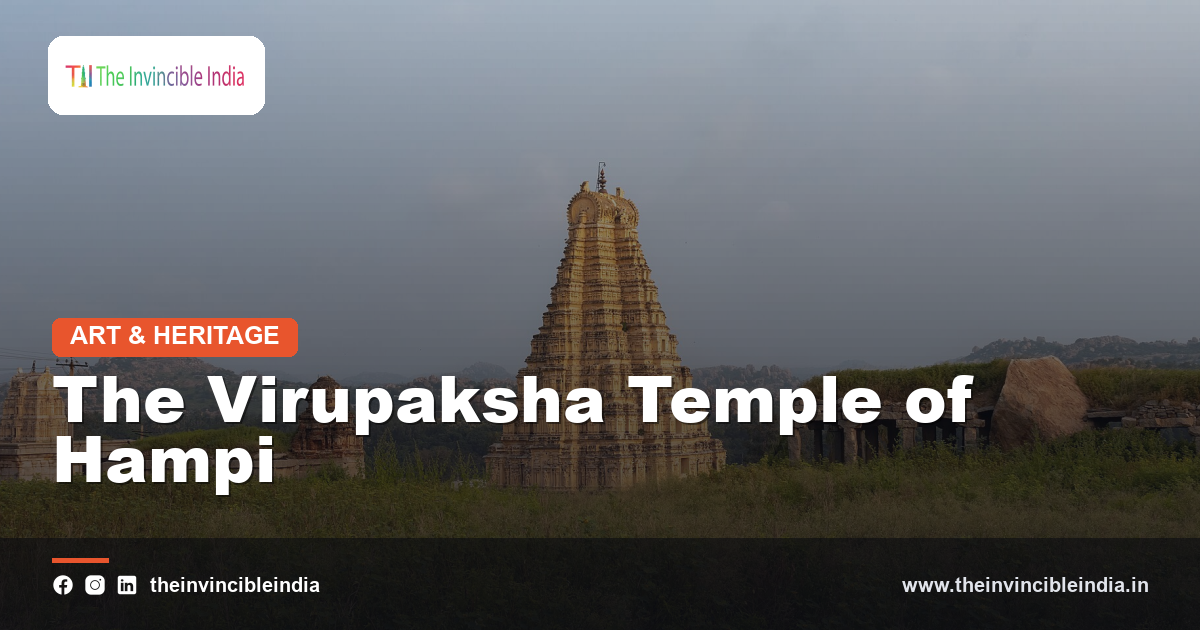
Among the boulder-strewn hills and ruined palaces of Hampi, one temple has never fallen silent. The Virupaksha Temple, dedicated to Shiva in the form of Virupaksha, has been a place of worship for many centuries, and it survived the collapse of the great imperial capital around it. Its tall gateway tower rises above the banks of the Tungabhadra river and acts as the visual anchor of the entire site. The temple is closely tied to the story of the Vijayanagara empire, whose rulers expanded and honoured it as the spiritual heart of their city. This guide explores the temple’s origins, its architecture, its sacred geography, and the living traditions that keep it vibrant today.
Quick Facts
| Detail | Information |
|---|---|
| Temple | Virupaksha Temple (Pampapathi Temple) |
| Location | Hampi, Karnataka |
| Dedicated To | Shiva as Virupaksha, with Pampa Devi |
| Style | Dravidian, Vijayanagara period |
| Setting | Banks of the Tungabhadra river |
| Heritage Status | Part of a UNESCO World Heritage Site |
Hampi and Its Oldest Living Temple
The Virupaksha Temple stands at the western end of Hampi, in a landscape of granite boulders, riverbanks, and ruined monuments that once formed the capital of a great empire. Unlike most of the surrounding structures, which are now silent ruins, the temple has remained an active centre of worship, drawing devotees, priests, and pilgrims throughout the year. This continuity makes it the most alive of Hampi’s monuments and a vital link between the medieval city and the present. The temple faces east toward a long bazaar street, with the river flowing nearby and the hills of the sacred landscape rising behind it. Its tall tower is visible from many points in the valley, orienting visitors as they explore the site. The Virupaksha Temple therefore functions as both a historical monument and a working shrine, bringing the past into direct contact with the living religious life of the region.
Roots Before the Vijayanagara Capital
Worship at this site is generally understood to be older than the Vijayanagara empire itself, with early shrines dedicated to Shiva and to the local goddess Pampa existing in the area before the imperial city took shape. Inscriptions and traditions point to a long history of devotion in the region, and the sacred character of the landscape along the river was recognized well before the capital was founded. When the Vijayanagara rulers established their city in the fourteenth century, they chose to build around an already holy place rather than start afresh. This decision lent legitimacy to their rule by connecting it with an ancient sacred tradition. The temple’s early history is not fully documented, and many details remain a matter of scholarly discussion. What is clear is that the Virupaksha Temple grew from an older devotional base and was later transformed into a magnificent imperial monument.
Virupaksha and Pampa, the Presiding Deities
The temple is dedicated to Virupaksha, a form of Shiva, and to Pampa Devi, a goddess associated with the Tungabhadra river, which was anciently known as Pampa. According to tradition, Pampa performed austerities to win Shiva as her husband, and their union is a central theme of the temple’s religious life. This story links the river, the goddess, and the deity into a single sacred geography, and it gives Hampi its very name, which is derived from Pampa. The temple complex therefore contains shrines for both deities, along with subsidiary shrines to other gods. The worship of Shiva together with a local goddess reflects a widespread pattern in Indian religion, in which regional goddess traditions are woven into the wider framework of Hindu devotion. This pairing is the foundation of the temple’s identity and explains the importance of its annual celebrations.
Imperial Patronage under Vijayanagara
Under the Vijayanagara rulers the temple was enlarged and enriched, becoming one of the most important religious establishments of the empire. Kings and nobles made gifts of land, wealth, and buildings, and the temple’s economy supported priests, musicians, dancers, and artisans. Rulers treated Virupaksha as a patron deity of the kingdom, and royal inscriptions often began with invocations to him. Among the monarchs associated with major additions is Krishnadevaraya, the most celebrated emperor of the dynasty, who is traditionally credited with significant construction at the temple. The patronage was both devotional and political, binding the empire’s ruling house to a central sacred centre. As a result the temple grew in scale and splendour, acquiring gateways, halls, and courtyards that reflected the grandeur of the capital. This imperial support is the main reason the temple achieved its present monumental form.
The Great Eastern Gopuram
The most striking feature of the temple is its towering eastern gateway, a multi-storeyed gopuram that dominates the skyline of Hampi. Its lower levels are built of stone and its upper tiers are finished in brick and plaster, a method typical of Dravidian gateway towers. The tiers narrow as they rise, creating a pyramidal profile that culminates in a barrel-vaulted roof topped with finials. Each level is adorned with sculpted figures of deities, mythical beings, and scenes from sacred stories, giving the tower a lively, richly populated surface. The gopuram serves as a landmark for pilgrims approaching from the bazaar and marks the threshold between the everyday world and the sacred precinct. Its height and decoration announce the importance of the temple from a distance. As the principal gateway, it remains the most recognizable image of Hampi and a masterpiece of Vijayanagara architectural ambition.
Courtyards and the Layout of the Complex
Beyond the great gateway, the temple is organized as a sequence of courtyards, each leading deeper toward the sanctum. A smaller, inner gateway opens onto a second courtyard, where subsidiary shrines, a pillared hall, and various ritual structures are arranged around the central temple. The enclosing walls are lined with cloisters and pillared corridors that offer shelter and shade, and a sacred tank and kitchen buildings serve the practical needs of worship. This progression from outer to inner spaces is characteristic of Dravidian temple planning, which stages a gradual movement from the public street into an increasingly sacred interior. The layout accommodates large crowds during festivals while preserving quiet areas for private devotion. In its clarity and order, the plan demonstrates how medieval architects organized complex religious functions into a coherent and navigable spatial experience.
The Main Shrine and Sanctum
At the heart of the complex stands the main shrine, containing the sanctum where Virupaksha is worshipped in the form of a lingam. The sanctum is a dim, enclosed chamber, entered through a succession of halls that prepare the worshipper for the encounter with the deity. Above it rises a tower in the Dravidian manner, and surrounding it is a passage allowing devotees to circumambulate the shrine. A neighbouring shrine is devoted to Pampa Devi, and another to the goddess Bhuvaneshwari, whose small chamber is noted for its ceiling decoration. Daily rituals, including offerings, lamps, and chanting, continue much as they have for generations, and the atmosphere inside is one of intimacy and reverence. The main shrine reveals the religious core of the monument, reminding us that behind the architectural splendour lies a living practice that gives the entire complex its purpose.
Pillared Halls and Mandapas
The temple contains several pillared halls, or mandapas, that provide space for ritual gatherings, music, and ceremonial performances. One of the best known is the hall in front of the main shrine, supported by pillars carved with fine sculptural detail. Rearing animals, mythical creatures, and elegantly dressed figures decorate the columns, which are cut with remarkable precision from hard stone. The ceilings of some halls bear painted panels depicting episodes from Hindu mythology and scenes associated with the temple’s traditions, executed in a distinctive regional style. Such halls were the setting for dance, recitation, and the great assemblies that marked festival days. They also illustrate the Vijayanagara love of monumental pillared spaces, a feature that became a signature of the dynasty’s architecture. The mandapas of the Virupaksha Temple are therefore among the most expressive and instructive examples of the period’s craftsmanship.
Sculpture and Decorative Carving
Sculpture covers almost every surface of the temple, from the base of the walls to the summit of the gateway. Carved figures of gods, goddesses, and guardian beings appear on doorways and pillars, while narrative reliefs depict stories from epic and Puranic traditions. The carvers worked in granite, a demanding material, and achieved clear outlines and expressive faces despite its hardness. In the gateway towers, stucco figures add colour and movement to the upper levels. The decoration is not merely ornamental, since each image has religious meaning and helps communicate the sacred narrative of the temple to worshippers. The style reflects the broader Dravidian sculptural tradition, adapted by Vijayanagara artists with their own taste for energy and elaboration. As in other great monuments of the south, the temple’s carving turns architecture into a visual scripture that can be read by anyone who walks through its halls.
The Inverted Image in the Dark Chamber
A well-known curiosity of the temple is the inverted image of the gopuram that appears inside a dark pillared hall. Light passing through a small opening projects an upside-down picture of the tower onto a wall or surface within the chamber, in the manner of a pinhole camera. The effect is a natural result of optical principles, and it is often pointed out to visitors by guides and local residents. Whether the arrangement was designed deliberately or arose as a happy accident is not something that can be asserted with certainty, but the phenomenon adds a sense of wonder to the visit. It also invites reflection on the way traditional builders, working with simple materials, created spaces that interact with light in surprising ways. For many people the inverted tower is a memorable highlight, a small piece of magic that complements the more formal splendour of the temple’s architecture.
Hampi Bazaar and the Processional Street
Stretching eastward from the main gateway is a broad, straight street known as Hampi Bazaar or Virupaksha Bazaar, lined on both sides by long colonnaded halls. In the days of the empire it was a thriving market where traders sold jewels, cloth, spices, and other goods, and visitors from many lands are said to have marvelled at its activity. The street also served as the route for temple processions, allowing the festival chariot to travel from the temple toward the far end. Today the old pillared arcades still stand, many of them in a ruined state, framing a vista that ends with a monolithic shrine on a hill in the distance. The bazaar demonstrates that the temple was not an isolated religious building but the centre of an urban, commercial, and ceremonial district. Its long perspective is one of the most evocative sights in Hampi.
The River, the Hills and the Sacred Landscape
The Virupaksha Temple is embedded in a sacred landscape defined by the Tungabhadra river and the surrounding hills. Hemakuta Hill, rising just beside the temple, is dotted with early shrines and gateways that predate the great imperial phase, while Matanga Hill offers a vantage point over the whole valley. A broad stretch of the river nearby is associated with ritual bathing and with the legend of the goddess Pampa. This arrangement of temple, river, and hill follows an old pattern in Indian sacred geography, where natural features are considered holy and architecture is placed in conversation with them. For pilgrims, the journey to the temple has always involved moving through this landscape, which enriches the meaning of the visit. The monument and its setting are inseparable, each deepening the significance of the other.
Festivals and Temple Rituals
The temple’s calendar is marked by festivals that draw large numbers of worshippers to Hampi. One of the most prominent is the annual chariot festival, in which the image of the deity is taken out in a great wooden chariot along the bazaar street to the sound of music and the cheers of the crowd. Another important celebration commemorates the marriage of Virupaksha and Pampa, reflecting the central story of the temple’s tradition. During these occasions the temple is decorated, special offerings are made, and communities from the surrounding region take part. Daily worship, with its rhythm of morning and evening rites, continues throughout the year. These practices keep the temple socially and spiritually relevant, tying it to the life of local villages and to a wider pilgrimage network. The festivals show that the monument is not a relic but a shared cultural institution still animated by communal devotion.
Survival After the Fall of Vijayanagara
In the middle of the sixteenth century the Vijayanagara capital was defeated and its palaces, markets, and many temples were abandoned or damaged. Hampi gradually became a landscape of ruins, yet the Virupaksha Temple continued to be used for worship, protected perhaps by its sacred reputation and the dedication of its priests. Over the following centuries it was cared for by local communities and received periodic repairs and additions, preserving its role as an active shrine. This unbroken continuity is rare among major ruined capitals, where most temples fell silent when their patrons disappeared. It means that the Virupaksha Temple offers a living thread running from the imperial age to the present day. The temple’s endurance is a testament to the strength of devotion and demonstrates how religious tradition can outlast political upheaval and keep a place alive when everything around it has changed.
World Heritage Status and Conservation
The temple is part of the Group of Monuments at Hampi, a site recognized as a UNESCO World Heritage property, as described in the wider story of World Heritage sites in India. This recognition has drawn international attention to the need to protect the monuments and their landscape. Conservation of the temple involves repairing stonework, maintaining the gateway, controlling vegetation, and managing the flow of visitors, particularly during festivals. Because the temple is also a place of active worship, care must be taken to balance conservation with religious use. The Archaeological Survey of India and local authorities cooperate in this work, together with the temple’s own community. Protecting the Virupaksha Temple means safeguarding both a building and a tradition, ensuring that its architecture and its rituals remain intact for generations to come.
The Virupaksha Temple Today
Today the Virupaksha Temple remains the spiritual and visual centre of Hampi, welcoming pilgrims, scholars, and travellers from around the world. Its great gateway still catches the first light of morning, and the sounds of bells and chanting continue to fill its courtyards. For visitors, it provides an unusual opportunity to see a medieval imperial monument in active use rather than as a silent ruin. The temple connects the history of the Vijayanagara empire with the devotional life of the present, and it offers a clear introduction to the glories of Dravidian architecture in the south. Those who walk its halls, stroll the bazaar, and watch the river nearby encounter a place where history, religion, and landscape remain closely joined. The Virupaksha Temple endures as one of the most meaningful and beautiful living monuments in India.
Sources & Further Reading
- Archaeological Survey of India (asi.nic.in).
- UNESCO World Heritage Centre (whc.unesco.org).
Frequently Asked Questions
Who is worshipped at the Virupaksha Temple?
The temple is dedicated to Shiva in the form of Virupaksha, along with his consort Pampa Devi, a goddess linked with the Tungabhadra river. Subsidiary shrines honour other deities within the complex.
Is the Virupaksha Temple still an active place of worship?
Yes. Unlike many monuments at Hampi, it has remained in continuous use and hosts daily rituals and major festivals, including the chariot festival and the celebration of the divine marriage.
What is the inverted image seen at the temple?
Light entering a small opening in a dark hall projects an upside-down picture of the gopuram onto a surface inside, in the manner of a pinhole camera. It is a popular curiosity for visitors.
How is the temple connected to the Vijayanagara empire?
The Vijayanagara rulers enlarged and patronized the temple as the spiritual centre of their capital. Emperors such as Krishnadevaraya are associated with major additions to the complex.
What is Hampi Bazaar?
Hampi Bazaar is the long, colonnaded street running east from the temple gateway. It was once a busy market and is still the route taken by the temple’s festival procession.


