

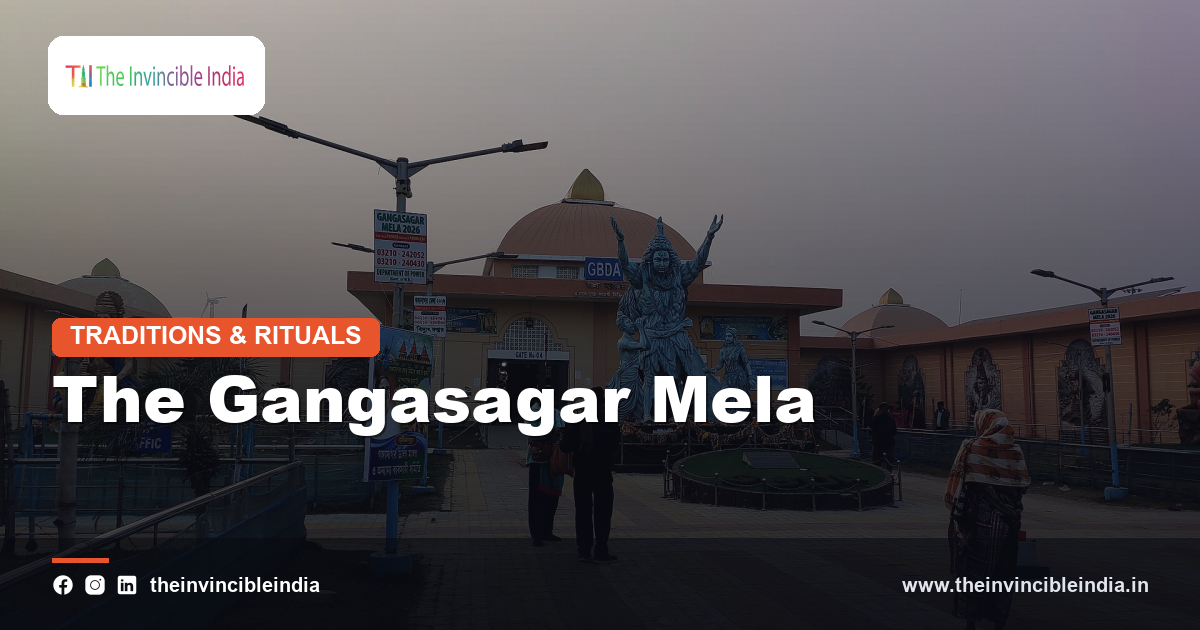
The Gangasagar Mela is one of the largest annual pilgrimage gatherings in India, held on Sagar Island in the Indian state of West Bengal, where the sacred Ganga flows into the Bay of Bengal. Each year around the festival of Makar Sankranti, devotees travel from many regions to take a ritual dip in the waters and offer prayers at the nearby shrine associated with the sage Kapila. Much like the great gatherings described in our guide to the Kumbh Mela, it shows how rivers, faith and community meet in Indian tradition. This article explores the legend, rituals, journey and meaning of the fair.
Quick Facts
| Detail | Information |
|---|---|
| Festival | Gangasagar Mela |
| Location | Sagar Island, West Bengal |
| Occasion | Makar Sankranti (mid-January) |
| Central Ritual | Holy dip at the river-sea confluence |
| Associated Shrine | Kapil Muni Ashram |
| Character | Annual pilgrimage fair |
What Is the Gangasagar Mela?
The Gangasagar Mela is an annual pilgrimage fair held at the southern tip of Sagar Island, in the delta region of West Bengal where the Ganga meets the Bay of Bengal. Its name combines Ganga, the sacred river, and Sagar, meaning sea, and it refers both to the place and to the festival that takes place there each year.
The central act of the fair is a holy bath in the waters at the confluence, followed by worship and offerings. Pilgrims come in very large numbers, and temporary camps, markets and services spring up along the shore to receive them. In essence, the Gangasagar Mela is a devotional gathering that celebrates the union of river and ocean and expresses a deep belief in purification and renewal.
The Legend of King Sagara and Bhagiratha
The sacredness of the place is rooted in an ancient story told in the Ramayana and the Puranas. According to the legend, the sons of King Sagara were reduced to ashes after disturbing the meditation of the sage Kapila. Their souls could find release only through the waters of the Ganga, which then flowed in the heavens.
Many generations later, the king Bhagiratha undertook severe penance to bring the river down to earth, and Lord Shiva is said to have received her descent in his hair so that the earth would not be overwhelmed. The river then followed Bhagiratha to the sea, touching the ashes and liberating the souls. Sagar Island is remembered as the place where this journey ended, which is why pilgrims regard it with such reverence.
Sagar Island and Its Landscape
Sagar Island lies in the Sundarbans delta region of West Bengal, a low-lying landscape of rivers, creeks, mudflats and mangrove forests. It is separated from the mainland by a wide tidal channel, and its southern shore faces the open Bay of Bengal. The island has a rural character, with farmland, villages and long sandy beaches.
For most of the year it is a quiet place of fishing and agriculture, but for a few days around Makar Sankranti its population swells with pilgrims. The contrast between the island’s everyday calm and the festival’s bustle is striking. Understanding this setting helps explain why the fair demands careful organisation and why the delta’s tides, weather and geography shape the experience of every visitor.
Makar Sankranti and the Timing of the Fair
The Gangasagar Mela is held around Makar Sankranti, the day on which the sun is traditionally said to begin its northward journey and enter the zodiac sign of Makara, or Capricorn. This transition usually falls in mid-January and is celebrated across India under different names, such as Pongal, Uttarayan and Magh Bihu.
In Hindu tradition, bathing in sacred waters on this day is regarded as especially meritorious, and charity and prayers are also encouraged. The fair is therefore timed to the solar calendar rather than the lunar one, which gives it a fairly consistent place in the winter season. The alignment with Makar Sankranti links the pilgrimage to a wider national festival of harvest, gratitude and the turning of the year.
The Holy Dip at the Confluence
The most important ritual of the Gangasagar Mela is the holy dip, taken at the point where the river merges with the sea. Pilgrims enter the water in the early morning, often at dawn, offering prayers and sometimes performing symbolic offerings to ancestors. Many wear simple clothing and carry small items of worship.
The bath is understood as an act of cleansing, a way of washing away accumulated faults and seeking blessings for oneself and one’s family. Because the sea is tidal and the shoreline can be powerful, organisers station lifeguards, boats and volunteers along the beach to help ensure safety. The dip, performed in a spirit of faith and humility, is the emotional heart of the entire pilgrimage.
Kapil Muni Ashram
Near the shore stands the Kapil Muni Ashram, a temple dedicated to the sage Kapila, whose name is closely tied to the legend of the place. The shrine houses an image of the sage and is the focus of worship during the fair. Pilgrims usually visit the temple after bathing, offering flowers, coconuts and prayers.
Over time the temple has been rebuilt and maintained as the sea has reshaped the coastline, and it continues to be cared for by its priests and by the local administration. The ashram gives the pilgrimage a clear devotional destination, anchoring the abstract idea of the river meeting the sea in a concrete place of worship where visitors can express their reverence in a quiet and personal way.
A Saying Among Pilgrims
A well-known popular saying, often repeated in Hindi, holds that all other pilgrimages may be made many times, but Gangasagar is to be visited once. The phrase reflects the reputation of the journey as demanding and unique, and it has long encouraged devotees to regard the trip as a special milestone in a lifetime.
In earlier generations, reaching the island required long travel through rivers and difficult terrain, and some pilgrims set out with a sense of great commitment. Although transport has improved, the saying continues to shape how people speak about the fair. It reminds visitors that the value of a pilgrimage lies not only in the destination but also in the effort, devotion and patience that go into the journey itself.
The Pilgrim Journey and Access
Because Sagar Island is separated from the mainland, reaching it involves crossing a tidal channel by ferry or boat. Pilgrims usually travel first to the Kolkata region and then proceed by road to a ferry terminal in the delta, before continuing across the water and by road along the island to the southern shore.
The crossing can be crowded during the fair, and the authorities arrange additional services, queuing systems and staffing to manage the flow of visitors. Travellers are advised to plan carefully, carry only essential belongings and follow official instructions. A bridge link has long been discussed in public conversation as a way to ease the journey. Whatever the mode of travel, the passage across the water forms a meaningful part of the pilgrim experience.
Sadhus, Akharas and Traditional Gatherings
Alongside ordinary families and elderly pilgrims, the fair attracts sadhus and ascetics from many traditions. Monastic orders set up camps along the shore, where they hold prayers, discourses and gatherings. Their presence adds a distinct spiritual atmosphere and draws devotees who wish to receive blessings or listen to teachings.
Bhajans, kirtans and recitations from sacred texts are heard at many points across the camp area. Visitors often walk among the tents, observing the different styles of dress and devotion that reflect India’s religious diversity. The mingling of renunciates and householders at the same shoreline illustrates how the Gangasagar Mela serves as a meeting place for several strands of spiritual life within the wider Hindu tradition.
The Fair, Camps and Markets
As a mela, the gathering is also a fair in the everyday sense. Temporary stalls sell religious items, brass lamps, sweets, toys and household goods, while small eateries offer simple meals. Temporary shelters, camps and tents provide accommodation, and cultural programmes and exhibitions are sometimes organised for visitors.
These markets give the pilgrimage a lively, festive feel and support the livelihoods of local traders and artisans. Children enjoy the rides and sweets, and families pause to rest and share meals between rituals. This blend of devotion and commerce is characteristic of Indian pilgrimage fairs, where sacred purpose and communal celebration are not separate but part of one connected experience of faith and social life.
Offerings, Charity and Ancestral Rites
Besides bathing and worship, pilgrims at Gangasagar take part in several customary acts. Many offer prayers and simple rites remembering their ancestors, in keeping with the legend that links the Ganga to the liberation of departed souls. Offerings of flowers, sesame, rice and lamps are common, along with small gifts to the temple priests.
Charity is another important dimension of the occasion. Giving food, clothing or alms to the needy is considered a virtuous act at Makar Sankranti, and volunteers and organisations often serve meals to pilgrims. These acts of generosity express the values of compassion and remembrance that sit at the centre of the festival, reminding participants that spiritual merit is shared through care for others as well as personal devotion.
Organisation, Safety and Public Services
Managing a gathering of this size on a remote island requires extensive coordination. The state government, local administration, police, health workers, disaster response teams and volunteer groups work together to provide drinking water, sanitation, medical posts, lighting, lost-and-found services and crowd management.
Temporary structures are erected along the shore, and information points guide visitors through the area. Safety near the sea is a particular priority, given the tides and changing water conditions. Pilgrims are encouraged to follow instructions from officials and lifeguards, to stay with their groups and to keep valuables secure. The careful organisation behind the fair is an unseen but essential element that allows the devotion of so many people to unfold safely and peacefully.
Environment and Cleanliness
The delta ecosystem around Sagar Island is fragile, and large crowds can place pressure on its beaches, water and surroundings. Waste management, sanitation facilities and the prevention of plastic litter are therefore important concerns each year, and cleanliness drives and awareness campaigns are often conducted during and after the fair.
Pilgrims are encouraged to use designated waste points, avoid leaving plastic and offerings on the shore, and respect the natural setting. Coastal erosion and rising seas are also part of the wider discussion about the island’s future. Caring for the environment is increasingly seen as part of the pilgrimage itself, since honouring the river and sea includes protecting the waters and shores that have long been regarded as sacred.
Gangasagar in Literature and Memory
Gangasagar has a long presence in Indian literature, devotional songs and popular memory. Stories of the descent of the Ganga appear in classical texts, and the pilgrimage has been described in travel accounts and regional writing in Bengali and other languages. Folk songs and verses often refer to the journey to the sea and the blessings of the river.
In Bengali culture especially, the place holds a warm emotional significance, and families recall the trip with affection and awe. Memories of crowded ferries, shared meals and the first sight of the open sea are passed from one generation to the next. These stories show that the fair lives not only in ritual but also in the cultural imagination of those who have visited or heard of it.
Tips for Visitors
Visitors planning to attend should prepare for large crowds, simple facilities and cool but sometimes windy winter weather by the sea. Booking transport and accommodation early, carrying warm clothing for the early mornings, and keeping to the paths and instructions of volunteers all make the experience easier.
It is wise to carry drinking water, basic medicines and a small amount of cash, and to keep identification and contact details with family members, especially children and elderly relatives. Respect for local customs, modest dress at temples and care with photography are appreciated. Travellers should also check official sources for current schedules and arrangements, since details can change from year to year, and approach the pilgrimage with patience and goodwill.
Gangasagar Mela Today
Today the Gangasagar Mela remains one of the most significant pilgrimage gatherings in the country, drawing people from many states and traditions to the shore of Sagar Island. It continues to unite devotion, folklore and community life in a single winter festival that is anchored in the ancient story of the Ganga.
Better transport, improved facilities and modern communication have changed how pilgrims travel, yet the essential acts of bathing, prayer and remembrance continue as before. Challenges of safety, sanitation and a changing coastline require sustained attention, but the fair endures as a powerful expression of faith in the sacred river. The Gangasagar Mela stands as a reminder that places where rivers meet the sea can also be places where people meet their deepest beliefs.
Sources & Further Reading
- Ministry of Culture, Government of India (indiaculture.gov.in).
- West Bengal Tourism, Government of West Bengal (wbtourism.gov.in).
Frequently Asked Questions
Where is the Gangasagar Mela held?
The fair is held on Sagar Island in the South 24 Parganas region of West Bengal, at the southern tip where the Ganga meets the Bay of Bengal. The nearby Kapil Muni Ashram is the main temple associated with the pilgrimage.
When is the Gangasagar Mela celebrated?
The mela is held around Makar Sankranti, which usually falls in mid-January. Pilgrims take the holy dip on the auspicious day and in the days around it, so visitors should check official announcements for the schedule each year.
Why is Gangasagar considered sacred?
According to the ancient legend, the Ganga followed King Bhagiratha to this place to liberate the sons of King Sagara. This story makes the confluence of river and sea a site of purification and ancestral remembrance for Hindu devotees.
How do pilgrims reach Sagar Island?
Pilgrims usually travel through the Kolkata region, continue by road to a ferry point in the delta and cross the tidal channel by boat or ferry. From the island landing, they travel by road to the southern shore where the fair is held.
What should visitors keep in mind during the fair?
Visitors should expect large crowds, plan transport early and follow the guidance of officials and volunteers, especially near the sea. Carrying water, warm clothing and identification, and respecting local customs and the environment, makes the visit safer and more meaningful.


