

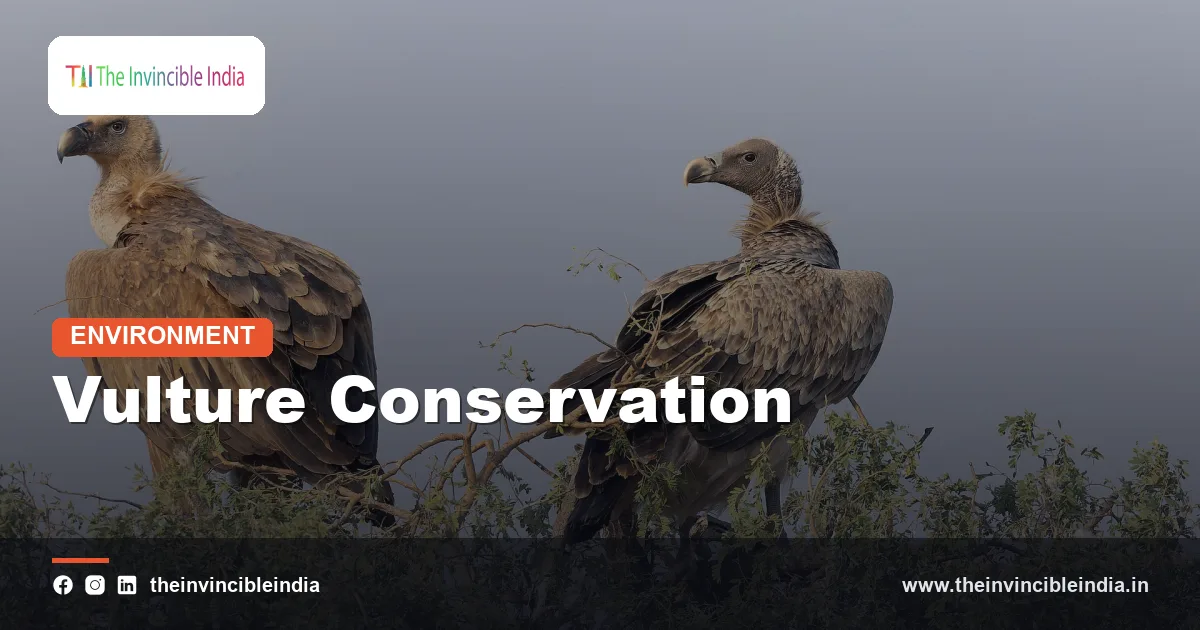
Vulture conservation in India is one of the most dramatic wildlife recovery stories of the twenty-first century, and one of the most sobering. Within barely a decade, three common vulture species of the subcontinent fell from a population in the millions to a few thousand birds, a collapse of over 90 per cent that ranks among the fastest declines ever recorded for any bird. The cause was not hunting or habitat loss but a veterinary painkiller left behind in the carcasses of treated cattle.
This explainer covers the species found in India, the ecological and cultural work that vultures perform, how the diclofenac poisoning unfolded and was identified, the 2006 ban that followed, and the long-term response built around Vulture Safe Zones, conservation breeding centres and a national recovery action plan. It also looks at why the story is far from over.
Quick Facts
| Feature | Details |
|---|---|
| Decline period | Mid-1990s to mid-2000s, with over 90 per cent loss in the worst-hit species |
| Main cause | Diclofenac, a veterinary non-steroidal anti-inflammatory drug (NSAID) |
| Mechanism | Kidney failure after feeding on carcasses of recently treated livestock |
| Most affected species | White-rumped, long-billed and slender-billed vultures |
| Veterinary diclofenac ban | 2006, covering manufacture, import and sale for veterinary use |
| Safe alternative | Meloxicam, found safe for vultures in testing |
| Legal protection | Wildlife (Protection) Act, 1972 (Schedule I species) |
| Key response | Vulture Safe Zones, conservation breeding centres and a national action plan |
Vulture Species of India
India has recorded nine species of vultures, a diverse group ranging from the small Egyptian vulture to the massive Himalayan griffon. Some are resident breeders in the plains, while others are mountain birds or winter visitors that move through the country. They belong to two broad groups: the Old World vultures, which locate food mostly by sight, in the family of hawks and eagles, and not the New World vultures of the Americas.
| Species | Typical habitat or note |
|---|---|
| White-rumped vulture (Gyps bengalensis) | Plains and plateau; once the most abundant; critically endangered |
| Long-billed vulture (Gyps indicus) | Peninsular and central India, nesting on cliffs; critically endangered |
| Slender-billed vulture (Gyps tenuirostris) | Northern and north-eastern India, notably Assam; critically endangered |
| Red-headed vulture (Sarcogyps calvus) | Solitary or paired birds, scattered across the country; critically endangered |
| Egyptian vulture (Neophron percnopterus) | Widespread, small and pale; endangered |
| Himalayan griffon (Gyps himalayensis) | High Himalaya, with winter movement to lower areas |
| Eurasian griffon (Gyps fulvus) | Western and northern regions in winter |
| Cinereous vulture (Aegypius monachus) | Large winter visitor from Central Asia |
| Bearded vulture or lammergeier (Gypaetus barbatus) | Himalayan cliffs; feeds on bones |
The IUCN status of several of these species has been revised upwards over time as their populations fell, which is why the red-headed and Egyptian vultures also appear in the threatened categories. All vultures are listed under Schedule I of the Wildlife (Protection) Act, 1972, which gives them the highest level of legal protection.
The Ecological and Cultural Role of Vultures
Vultures are nature’s sanitation workers. Their job is to find dead animals quickly and consume them completely, often within hours. A large flock can strip a cattle carcass to the bones in a short time, leaving little for flies, bacteria or other scavengers. Their stomachs are extremely acidic, and they can digest tissue that carries anthrax, botulism, tuberculosis or rabies without becoming ill, effectively ending the chain of infection.
What happens without them
When vultures vanished, the carcass-disposal system broke down. Dead livestock lay in fields and on riverbanks for days, and other scavengers, especially feral dogs and rats, moved into the space. A larger feral dog population is widely linked by researchers to a greater risk of rabies transmission to people and livestock, because the disease spreads through bites. Decomposing carcasses can also contaminate water sources.
- Disease control: rapid removal of infected carcasses reduces the spread of pathogens.
- Nutrient cycling: the energy in dead animals is returned to the ecosystem efficiently.
- Cost saving: they perform free carcass disposal that would otherwise require labour, transport and burial or incineration.
- Balance among scavengers: they limit populations of dogs and rats that thrive on carrion.
Vultures in culture and tradition
Vultures have a place in Indian religious and literary traditions. In the Ramayana, the vulture king Jatayu fights the demon Ravana to save Sita and is mortally wounded, while his brother Sampati later helps the search for her. This is why conservation programmes frequently use the name Jatayu for their initiatives.
For the Parsi community, vultures had a practical funerary role. Following Zoroastrian tradition, the dead were placed in open circular structures called Towers of Silence, where vultures consumed the remains. As vultures disappeared, the process slowed dramatically, forcing the community to adopt alternatives such as solar concentrators and, in some places, aviaries where captive vultures could be maintained for this purpose.
Value beyond religion and ritual
Communities that relied on vultures for carcass removal, including leather workers and cattle-rearing groups, also felt the loss. The decline was thus a public health, economic and cultural problem as well as an ecological one.
The Crash of the 1990s and 2000s
For much of the twentieth century, vultures were so common in India that they were a routine sight above villages, rubbish dumps and cattle carcass sites. The white-rumped vulture is widely described as having been among the most abundant large birds of prey in the world. In the mid-1990s, naturalists began reporting that birds were disappearing and that nests lay empty, with dead or dying vultures hanging limply from branches.
Systematic surveys by the Bombay Natural History Society, including long-term counts in places such as Keoladeo National Park in Rajasthan, confirmed the scale of the loss. By the early 2000s the decline in the three Gyps species exceeded 90 per cent, and in later assessments the loss for some populations approached 99 per cent. The fall was so rapid that it was compared to an epidemic.
The early hypotheses
Because the pattern resembled an infectious outbreak, researchers first suspected a disease. Dead birds showed signs of a build-up of uric acid in their organs, a condition resembling visceral gout. The geographic spread and the fact that all species feeding on livestock were affected also pointed to a food-borne toxin rather than a virus. Habitat loss, pesticides and food shortage were examined and then ruled out as the main explanation.
Diclofenac: How the Poison Worked
Diclofenac is a non-steroidal anti-inflammatory drug that was widely used in humans and, from the 1990s, was cheaply produced as a veterinary medicine for treating pain, fever and inflammation in cattle and buffaloes. It is safe for the animals it treats. The problem arose when treated livestock died and their carcasses were left in the open for vultures to eat.
Vultures are unusually sensitive to the drug. They cannot process it effectively, and even a very small residue in the meat is enough to cause fatal kidney failure within days. Modelling studies suggested that only a small share of contaminated carcasses in the landscape was sufficient to drive the population down at the rates observed. Because vultures feed in large groups, a single treated carcass could poison many birds at once.
Why the impact was so severe
- Extreme sensitivity: the drug is toxic to vultures at tiny doses.
- Heavy dependence on livestock: in India, domestic cattle carcasses formed the main food source for vultures.
- Social feeding: large flocks multiplied each poisoning event.
- Slow breeding: Gyps vultures usually lay a single egg a year and mature slowly, so populations recover very slowly.
Identifying the Cause
The link to diclofenac was established in 2004 through research in Pakistan, published in the journal Nature, in which scientists examined dead vultures and found residues of the drug in their tissue. Controlled experiments and further sampling then confirmed the connection. In India and elsewhere in South Asia, residues were found in the carcasses of cattle that vultures fed on, and the proportion of dead birds with kidney damage and gout matched the pattern found in poisoned vultures.
The discovery was significant because it showed how an everyday medicine could cascade through a food chain and devastate a species that was never its target. It also helped to open a wider scientific conversation about the unintended effects of veterinary pharmaceuticals on wildlife, a concern that has since been raised for other scavenger birds in different parts of the world.
The 2006 Ban and Alternatives
Once the cause was known, the Government of India moved to withdraw the drug from veterinary use. In 2006, the manufacture, import and sale of diclofenac for veterinary purposes were banned. Neighbouring countries, including Nepal, Pakistan and Bangladesh, adopted similar measures, since vultures roam freely across borders and a regional response was essential.
Researchers also tested alternative painkillers and found that meloxicam was safe for vultures at the levels they would be exposed to. This allowed veterinarians to switch to a viable option rather than being left without a treatment for livestock.
The problem of leakage
Enforcement has proved difficult. Diclofenac approved for human use continued to be sold, and multi-dose human vials were sometimes diverted for treating cattle. This led to further regulation, including limits on the size of human-use vials, so that large quantities could not be easily repurposed. Scientists also flagged other drugs, such as ketoprofen and nimesulide, as hazardous to vultures, and called for safety testing of veterinary drugs before they are marketed.
Vulture Safe Zones
A Vulture Safe Zone is an area in which the immediate environment is made free of toxic veterinary drugs so that wild vultures can survive and breed. The concept was developed under the regional alliance known as SAVE, short for Saving Asia’s Vultures from Extinction, which brings together conservation bodies, governments and researchers from South Asia and beyond.
Typically, a zone is drawn around the remaining nesting colonies, covering a radius of roughly one hundred kilometres, which is about the distance vultures routinely travel while foraging. Within it, the aim is to ensure that no harmful drug is sold or used for livestock.
What a zone involves
- Surveying pharmacies and veterinary clinics to remove toxic drugs from sale.
- Training veterinarians and livestock owners to use safe alternatives.
- Sampling carcasses at feeding sites to detect contamination.
- Monitoring nesting colonies and counting vulture populations regularly.
- Running awareness campaigns with farmers, schools and local panchayats.
Several states in India have established or proposed such zones around surviving colonies, with progress dependent on local enforcement and community participation.
Conservation Breeding Centres and the Role of SAVE and Jatayu
Because the wild populations fell to dangerously low levels, conservationists decided to secure insurance populations in captivity. In 2001, the Bombay Natural History Society, working with the Haryana Forest Department, set up a Vulture Care Centre at Pinjore, which developed into a conservation breeding centre. The Pinjore facility is widely known as the Jatayu Conservation Breeding Centre, named after the vulture hero of the Ramayana.
Further breeding centres were created in other parts of the country, including in West Bengal, Assam and Madhya Pradesh, so that the risk was spread across more than one site. These centres hold breeding colonies of white-rumped, long-billed and slender-billed vultures, which have bred successfully in captivity, although slowly given their low reproductive rate.
Release as the end goal
The purpose of captive breeding is not permanent confinement but eventual release. Captive-bred birds are intended to be moved to large aviaries in safe areas and then released into the wild once the environment is free of toxic drugs. Release is therefore closely tied to the success of Vulture Safe Zones and the continued ban on harmful medicines. SAVE helps coordinate this work, sets common standards and shares scientific data between countries.
The Recovery Action Plan
The Government of India has issued national action plans for vulture conservation, beginning with a plan in 2006 and followed by a revised plan covering the period 2020 to 2025. These documents set out how to stop the use of toxic drugs, strengthen monitoring, expand breeding and rescue centres, and establish safe zones across the vulture range.
- Phase out or tightly control veterinary drugs that harm vultures.
- Test new veterinary drugs for vulture safety before approval.
- Expand captive breeding and plan phased releases.
- Create rescue and care facilities for injured birds.
- Carry out regular population surveys and carcass sampling.
- Involve local communities and veterinary services in awareness work.
Signs of stabilisation
After the ban, monitoring showed that the rate of decline slowed in several areas and that numbers in some surviving colonies became stable or began to rise slowly. Experts caution that recovery will take decades, given the species’ slow breeding, and that the gains can be reversed quickly if toxic drugs return to use.
Challenges and the Road Ahead
Vulture conservation faces continuing threats. Illegal use of banned or harmful drugs, accidental poisoning of carcasses meant for predators, collisions with power lines and wind turbines, loss of nesting trees and declining carcass availability all play a part. The shift from open carcass disposal to burial or rendering also reduces the feeding opportunities that vultures depend on.
Experts therefore emphasise the need for strong regulation of veterinary medicines, regular testing of carcasses, and community-run vulture feeding sites that provide clean, uncontaminated food. Public awareness is crucial, since farmers and veterinarians are the ones who decide which medicine is given to livestock.
Conclusion
The vulture story shows how a single chemical can unravel an entire ecological service, and also how swift scientific and policy action can arrest a collapse. The ban, the breeding centres and the safe zones have created a foundation for recovery, but India’s vultures remain fragile. Protecting them means protecting the cleanliness, public health and cultural heritage that these birds have quietly supported for centuries. This article was last reviewed on 4 October 2026.
Frequently Asked Questions
Why did India’s vultures decline so rapidly?
The main cause was diclofenac, a veterinary painkiller given to cattle. When vultures fed on the carcasses of treated animals, they suffered fatal kidney failure. Because vultures feed in groups and breed slowly, populations of three species fell by over 90 per cent within about a decade.
When was diclofenac banned for veterinary use in India?
The manufacture, import and sale of diclofenac for veterinary use were banned in 2006. Later measures tightened the rules on human-use vials, because these were sometimes diverted for treating cattle.
What is a Vulture Safe Zone?
A Vulture Safe Zone is an area, usually with a radius of about one hundred kilometres around a surviving colony, where toxic veterinary drugs are kept out of use and carcasses are monitored. The aim is to make the surroundings safe enough for vultures to survive and breed.
Why are vultures important to the ecosystem?
Vultures consume dead animals quickly and safely, which prevents the spread of diseases such as anthrax and rabies. Without them, carcasses decay in the open and populations of feral dogs and rats grow, raising public health risks.
What do conservation breeding centres do?
Centres such as the one at Pinjore in Haryana, known as the Jatayu Conservation Breeding Centre, raise vultures in captivity as an insurance population. The long-term aim is to release the birds into the wild once the environment is free of harmful drugs.
Which alternative painkiller is safe for vultures?
Meloxicam was found to be safe for vultures in testing and is the commonly recommended alternative to diclofenac. Scientists continue to urge that all veterinary drugs be tested for vulture safety before they are approved for use.
{“@context”:”https://schema.org”,”@graph”:[{“@type”:”FAQPage”,”mainEntity”:[{“@type”:”Question”,”name”:”Why did India’s vultures decline so rapidly?”,”acceptedAnswer”:{“@type”:”Answer”,”text”:”The main cause was diclofenac, a veterinary painkiller given to cattle. When vultures fed on the carcasses of treated animals, they suffered fatal kidney failure. Because vultures feed in groups and breed slowly, populations of three species fell by over 90 per cent within about a decade.”}},{“@type”:”Question”,”name”:”When was diclofenac banned for veterinary use in India?”,”acceptedAnswer”:{“@type”:”Answer”,”text”:”The manufacture, import and sale of diclofenac for veterinary use were banned in 2006. Later measures tightened the rules on human-use vials, because these were sometimes diverted for treating cattle.”}},{“@type”:”Question”,”name”:”What is a Vulture Safe Zone?”,”acceptedAnswer”:{“@type”:”Answer”,”text”:”A Vulture Safe Zone is an area, usually with a radius of about one hundred kilometres around a surviving colony, where toxic veterinary drugs are kept out of use and carcasses are monitored. The aim is to make the surroundings safe enough for vultures to survive and breed.”}},{“@type”:”Question”,”name”:”Why are vultures important to the ecosystem?”,”acceptedAnswer”:{“@type”:”Answer”,”text”:”Vultures consume dead animals quickly and safely, which prevents the spread of diseases such as anthrax and rabies. Without them, carcasses decay in the open and populations of feral dogs and rats grow, raising public health risks.”}},{“@type”:”Question”,”name”:”What do conservation breeding centres do?”,”acceptedAnswer”:{“@type”:”Answer”,”text”:”Centres such as the one at Pinjore in Haryana, known as the Jatayu Conservation Breeding Centre, raise vultures in captivity as an insurance population. The long-term aim is to release the birds into the wild once the environment is free of harmful drugs.”}},{“@type”:”Question”,”name”:”Which alternative painkiller is safe for vultures?”,”acceptedAnswer”:{“@type”:”Answer”,”text”:”Meloxicam was found to be safe for vultures in testing and is the commonly recommended alternative to diclofenac. Scientists continue to urge that all veterinary drugs be tested for vulture safety before they are approved for use.”}}]}]}


