

The Patola saree of Patan in northern Gujarat is a textile of rare exactness, woven from silk in which both the lengthwise and crosswise threads are tied, dyed and patterned before weaving begins. Because the design emerges only when the two sets of threads meet on the loom, every motif depends on near-perfect alignment. Few cloths anywhere demand such discipline. For generations the saree has marked weddings, blessings and family prestige across Gujarat and beyond. It belongs to the great family of resist-dyed fabrics that includes Pochampally ikat, yet it stands apart for the sheer precision of its double ikat method and the slow, patient labour behind each piece.
Quick Facts
| Detail | Information |
|---|---|
| Craft | Double ikat silk weaving |
| Region | Patan, northern Gujarat |
| Material | Silk, with natural or fast dyes |
| Technique | Resist-dyeing of warp and weft |
| Traditional makers | Salvi family weavers |
| Cultural role | Wedding and festive attire |
What Is a Patola Saree?
A Patola saree is a handwoven silk garment in which the pattern is created by resist-dyeing threads before they are woven. The word patola is the plural of the Gujarati term patolu, and the cloth has long been associated with the town of Patan in northern Gujarat. What sets it apart from other ikat textiles is that both the warp, which runs the length of the cloth, and the weft, which crosses it, are individually patterned. When the two sets of threads are interlaced, the motifs appear with crisp edges and a distinctive shimmer.
The result is a fabric that looks identical on both sides, with colours that seem to glow from within the silk. Patola is therefore understood not simply as a saree but as a masterpiece of textile engineering, and the name itself carries a reputation for difficulty, patience and refinement that few other Indian weaves can claim.
The Meaning of Double Ikat
Ikat is a family of techniques in which yarns are bound and dyed in sections before weaving so that a pattern forms in the cloth itself. In single ikat, only one set of threads is treated, usually the warp or the weft. Double ikat treats both, and this is the feature that defines the Patola of Patan. Every thread in the fabric has been planned to fall at a precise point in the final design.
This doubling of effort multiplies the possibility of error. A slight shift in either set of threads will blur the edge of a motif, so the weaver must adjust the cloth continuously while working. Double ikat is consequently rare in the world, practised in only a few places, and the Patola tradition of Gujarat is regarded as one of its most celebrated living expressions. Its difficulty is the very source of its prestige.
Patan and Its Weaving Heritage
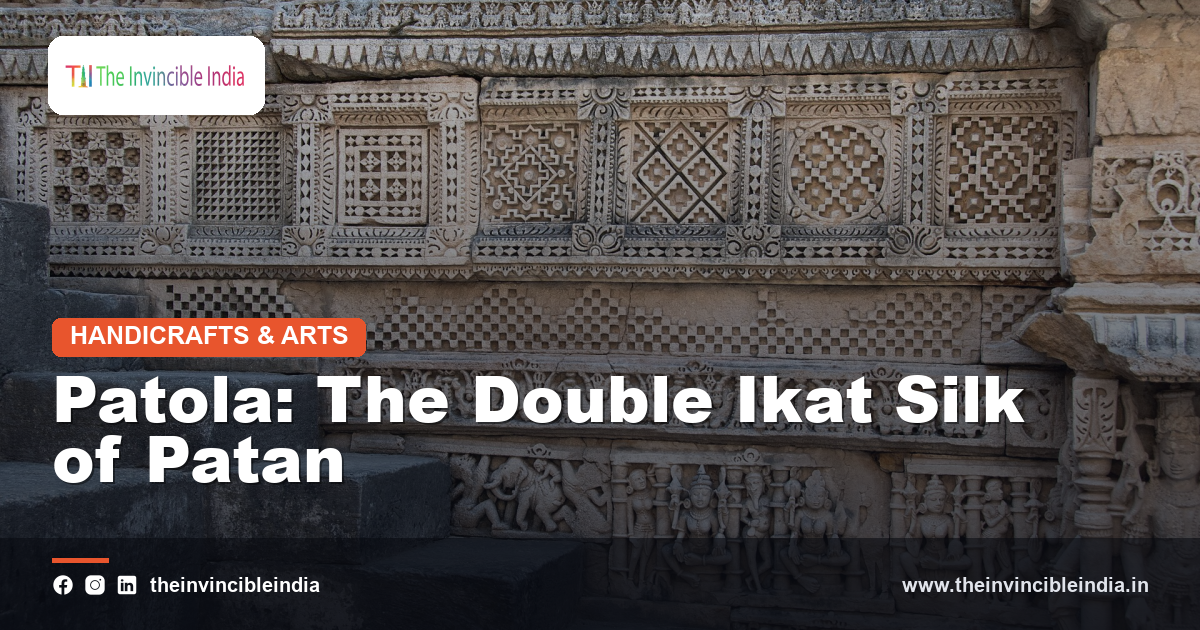
Patan, once the capital of the medieval Chaulukya rulers of Gujarat, is a historic town on the banks of the Saraswati and a long-standing centre of craft and trade. Textiles from this region found favour with courts and merchant families, and the Patola became a symbol of status within them. The town is also home to the celebrated stepwell Rani ki Vav, a monument whose richly carved panels are often remarked upon for their textile-like patterns.
The association between the town and the weave is so strong that the phrase Patan Patola has become a recognised name in itself, protected as a geographical indication. The identity of the cloth is tied to this place, to its families of weavers and to the knowledge handed down through them. Patan remains the emblem of the double ikat tradition in India.
The Salvi Weaving Families
The craft of Patan Patola has traditionally been carried on by the Salvi community, whose households have preserved the techniques across many generations. Within these families, knowledge passes from elders to younger members through years of watching and practising, rather than through written manuals. Different people take responsibility for different stages, from preparing the silk to calculating the design, tying the resist, dyeing and finally weaving.
This shared, family-based structure explains why the craft has endured. It is a collective effort in which every member understands how his or her task affects the next. The weavers are regarded as custodians of an inheritance, and the survival of the tradition today depends largely on the willingness of new generations within these families to continue the work while adapting it to contemporary life.
Preparing the Silk and the Design
The making of a Patola begins long before any dyeing. The silk yarn is first cleaned and prepared so that it will take colour evenly. The design is then planned on paper or in the weaver’s mind, often as a grid, and translated into calculations that determine how many threads will carry each colour and where the resist must be placed. The same pattern has to be reproduced faithfully on the warp and on the weft.
This stage requires both mathematical thinking and artistic judgement. Because the warp and weft will later be combined in a single fabric, any mismatch in measurement carries through into the finished motif. The preparation of silk and design is therefore the intellectual foundation of the craft, and the care invested here determines whether the cloth will reveal a clean pattern at the end.
Tying and Resist-Dyeing the Threads
Once the design is fixed, the silk threads are stretched on a frame and the areas meant to remain undyed are bound tightly with cotton thread. The bound sections resist the dye, so when the yarn is immersed in a colour bath, only the exposed portions absorb it. For a multi-coloured pattern, the process is repeated, with old ties removed and new ones added before the next colour is applied.
Each colour therefore requires its own sequence of tying and untying, and the work must be done by hand for both warp and weft bundles. The labour is slow and meticulous, and it is carried out with steady concentration because a loose tie can let dye seep into the wrong place. This patient resist-dyeing is the heart of the Patola and the reason the cloth takes so long to produce.
Colours and Dyes
Patola is known for its saturated, luminous palette, with deep reds, greens, blues, yellows and blacks set against one another in carefully balanced combinations. Historically, the dyes were drawn from natural sources such as plants, roots, flowers and minerals, and these gave the cloth a depth that is still admired. Many makers continue to value natural colour, while others use modern fast dyes to meet practical demand and keep the cloth affordable.
Whatever the source, the success of the colouring depends on the dyer’s skill in controlling shade and fixing it so that it holds through years of wear. The vividness of the palette is part of the cloth’s character, and well-made Patola is expected to retain its brilliance across generations. Colour in this tradition is not decoration added afterwards but a structural element built into every thread.
The Loom and the Art of Weaving
Weaving a Patola is a notable test of coordination. The loom is a simple handloom made largely of wood and bamboo, and it is often operated by two people seated side by side, who work together to pass the weft and to beat it into place. Before each pass, the weavers adjust the pre-dyed weft thread so that its pattern aligns exactly with the corresponding portion of the warp.
This constant correction is what gives Patola its characteristic slow pace. Only a small length of cloth can be completed in a day, and a full saree may take months from start to finish. The weaver does not merely interlace threads but reads and adjusts a pattern that exists across hundreds of separate fibres. The loom is therefore the place where all earlier labour is finally confirmed or undone.
Motifs and Their Meanings
The motifs of Patola are largely geometric or stylised, as the ikat technique favours bold, angular forms that can be built from threads. Traditional designs include repeating diamonds, lattices, flowers, leaves and rows of small figures arranged in a regular grid. Many of these have names within the weaving community and recur across different sarees, forming a shared vocabulary of pattern.
These designs often carry symbolic associations with prosperity, fertility, protection and auspiciousness, which explains why the saree features so prominently at celebrations. The balance of repeating motifs and bordered edges also reflects a sense of order and harmony valued in Gujarati aesthetics. In Patola, pattern is never purely ornamental. It communicates blessing, belonging and the continuity of a visual language handed down over centuries.
Nari Kunjar, Paan and Other Classic Patterns
Among the best-known Patola designs are those named after the images they represent. The nari kunjar pattern combines stylised female figures with elephants, while the paan bhat pattern is built around the heart-shaped leaf of the betel vine. Other familiar arrangements include floral designs and basket-like or lattice patterns that fill the body of the saree in orderly repeats.
These classic patterns are treasured because they demonstrate the full potential of double ikat, rendering curves, animals and figures within a structure made of threads. Weavers regard them as benchmarks of skill, and a well-executed piece in one of these traditional designs is held up as evidence of mastery. They remain the reference points against which newer variations are measured in the Patola tradition.
Patola in Gujarati Weddings and Rituals
In Gujarat, the Patola has long been regarded as an auspicious garment, closely linked with marriage and other family ceremonies. Brides in several communities wear a Patola, and the cloth is often given as part of wedding gifts or kept as a treasured heirloom. Its colours and patterns are considered lucky, and wearing one signals joy, prosperity and family standing.
Beyond weddings, Patola has been used in religious and festive settings within different Gujarati communities. The cloth is valued not only for its beauty but for the blessings associated with it, and it is frequently passed from mother to daughter. In this way, a single saree can carry the memory of several generations, turning a woven textile into a living record of family tradition and celebration.
Trade, Travel and the Wider World
Patola textiles have a long record of travel beyond India. Historically, Gujarat was a hub of maritime trade, and its fine cloth reached markets across the Indian Ocean, including Southeast Asia, where Indian patterned textiles were highly prized. In parts of Indonesia, imported Indian cloths of this type influenced local textile traditions and came to be treated as sacred or heirloom objects.
This history shows that Patola was never merely a regional curiosity but part of a wide network of cultural exchange. Its patterns and reputation travelled with merchants, inspiring admiration and imitation abroad. The enduring respect for the cloth in distant lands reflects how deeply the technique and its visual language impressed those who encountered it through centuries of trade.
Patan Patola and Rajkot Patola
The name Patola is used for textiles from more than one place in Gujarat, and it is helpful to understand the distinction. The Patan Patola is the double ikat cloth, in which both warp and weft are resist-dyed, and it is the version associated with the Salvi families and the geographical indication. Other centres in the state, such as Rajkot, produce a related cloth using single ikat, in which only one set of threads carries the pattern.
Both are legitimate expressions of the same wider ikat tradition, and both involve considerable skill. However, the double ikat of Patan is recognised as the more demanding and more costly form because of the additional labour and precision involved. Understanding the difference helps buyers and admirers appreciate what each type represents and how they should be valued.
Time, Cost and Rarity
A genuine Patan Patola is among the most expensive handwoven sarees in India, and the reasons are straightforward. The yarn must be silk, the design must be planned with care, and every thread must be separately tied, dyed and woven by skilled hands. A single saree consumes many months of work, and the output of a workshop is therefore very limited.
Because so few makers remain and each piece takes so long, the cloth is genuinely rare. Its price reflects the labour, the material and the expertise embedded in it, rather than mere brand value. Those who acquire a Patola often regard it as an investment in a living art and as a family heirloom, one that will retain its significance long after fashions have changed.
Recognising an Authentic Patola
Authentic Patola can be recognised by several features. The pattern should appear equally clear on both sides of the cloth, since the dyed threads run through the whole fabric rather than being printed on the surface. The edges of motifs in genuine double ikat have a slightly feathered quality, a natural outcome of the thread-by-thread method, and the weave should feel smooth and supple.
Printed imitations and machine-made versions can look similar at a distance but lack this reversibility and depth of colour. Buyers are advised to seek out cooperatives, recognised workshops and certified sellers, and to look for the geographical indication where relevant. Knowing what to look for protects both the purchaser and the weavers, whose livelihood depends on the integrity of the name.
Care and Preservation
A Patola is a long-lived textile, but it needs thoughtful handling to remain so. Silk is sensitive to moisture, direct sunlight and harsh chemicals, so the saree is best stored folded in soft cotton or muslin, away from damp and bright light. Refolding it periodically along different lines helps prevent permanent creases and weakening of the fibres.
Cleaning is usually entrusted to specialists, as ordinary washing can harm the dyes and the silk alike. With proper care, a Patola can be worn at ceremonies and then returned to safe storage, eventually becoming an heirloom. Many families keep such sarees for decades, and well-preserved examples in collections show how durable and beautiful the cloth can remain over time.
Patola Today
Today, Patola stands as both a proud inheritance and a fragile craft. The number of families practising double ikat is small, and the long hours and high skill involved make it difficult to attract new apprentices. Yet there is renewed interest in handloom heritage, and weavers have begun to adapt by producing scarves, stoles and other smaller items alongside the traditional saree.
Recognition through geographical indication, exhibitions and design collaborations has helped bring wider attention to the craft. The long-term future depends on fair pricing, awareness among buyers and continued respect for the artisans. As long as these conditions are met, the Patola of Patan will remain a luminous example of how patience, precision and community can keep a tradition alive in a changing world.
Sources & Further Reading
- Ministry of Culture, Government of India (indiaculture.gov.in).
- Ministry of Textiles, Government of India, Development Commissioner (Handicrafts) (handicrafts.nic.in).
Frequently Asked Questions
What makes a Patola saree different from other ikat sarees?
A Patola is made using double ikat, in which both the warp and weft threads are resist-dyed before weaving. Most other ikat sarees pattern only one set of threads, which makes the Patola far more demanding to produce.
Where is the Patola saree made?
The most celebrated Patola is woven in Patan in northern Gujarat, traditionally by the Salvi families. A related single ikat version is made in other places in Gujarat, such as Rajkot.
Why does a Patola take so long to weave?
Every thread must be tied, dyed and aligned by hand, and the weavers adjust the weft constantly during weaving to match the pattern. A single saree can therefore take many months to complete.
Is the pattern on a Patola the same on both sides?
Yes, a genuine double ikat Patola shows the design equally on both faces, because the colours are dyed into the threads themselves. This reversibility is one of the clearest signs of authenticity.
How should a Patola saree be stored?
It should be folded in soft cotton or muslin and kept away from damp, strong light and chemicals. Refolding it occasionally along different lines helps protect the silk and the dyes.


