

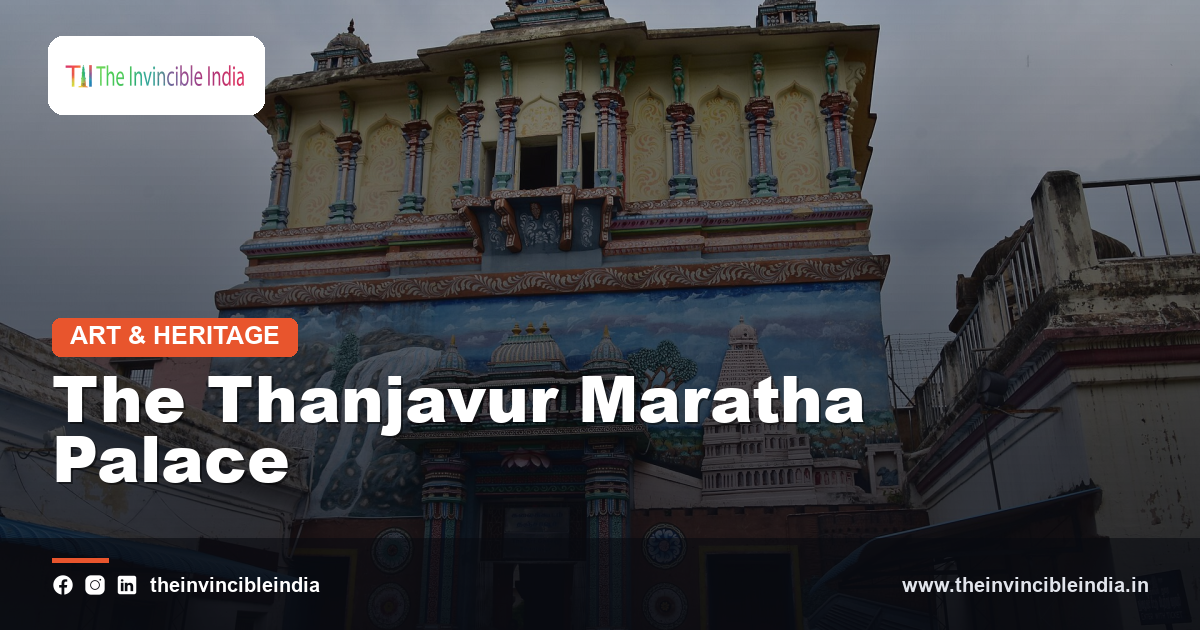
The Thanjavur Maratha Palace stands in the old heart of Thanjavur in Tamil Nadu, a sprawling royal complex that began under the Nayak rulers and reached its full cultural flowering under the Marathas who followed them. Its halls, courtyards and towers reflect a meeting of southern and Deccan traditions, while its collections of manuscripts, sculpture and art make it one of the great repositories of south Indian culture. As a counterpart to the northern courts described in the guide to the royal palaces of India, it shows how a regional dynasty could turn a palace into a centre of learning, music and craftsmanship that still shapes the identity of the city.
Quick Facts
| Detail | Information |
|---|---|
| Location | Thanjavur, Tamil Nadu |
| Built By | Thanjavur Nayaks, expanded by the Marathas |
| Style | Nayak and Maratha, with Deccan and Indo-Saracenic touches |
| Highlights | Durbar Hall, Sarja Madi tower, Saraswathi Mahal Library |
| Collections | Manuscripts, bronzes, paintings, weapons |
| Status | Heritage palace and museum |
A Royal Complex in the Cauvery Delta
Thanjavur lies in the fertile delta of the Cauvery river, a region long celebrated as the rice bowl of Tamil Nadu and as a cradle of south Indian art. The palace complex sits close to the centre of the old city, within a walled area that once housed the court, its offices, its residences and its places of worship. The surrounding landscape of irrigated fields supported a prosperous society that could sustain generous patronage of the arts. The palace is therefore not simply a building but the physical expression of a rich agrarian culture and the dynasties that governed it. Its location, a short distance from the great Brihadisvara temple, places it in one of the most culturally concentrated precincts of India. The palace stands as the secular counterpart to the sacred monuments of the city, completing the picture of royal Thanjavur.
The Thanjavur Nayaks and the First Palace
The earliest phase of the palace is associated with the Nayaks of Thanjavur, who governed the region in the sixteenth and seventeenth centuries as successors to the Vijayanagara tradition of rule. They established the foundations of the complex, built fortifications and laid out the principal halls. Nayak rulers were noted patrons of literature, music, dance and temple building, and their court became a lively centre of cultural activity. The architecture of this period shows the influence of Vijayanagara style, with its pillared halls and carved ornament. The legacy of that empire is still felt, and its echoes are clear in the Nayak work at Thanjavur. The Nayak foundation gave the palace its basic plan and artistic character, which later rulers would adapt and enrich.
The Arrival of the Marathas
In the seventeenth century the Nayak dynasty was succeeded by Maratha rulers, who established a new line of kings at Thanjavur. The founder of this line was a Maratha commander belonging to the family connected with the great Shivaji, and his descendants ruled the region for generations. They brought with them the culture of the Deccan, including its language, dress and courtly customs, and blended these with the established traditions of the Tamil country. The result was a distinctive court culture in which Marathi, Tamil, Telugu and Sanskrit all had a place. The Marathas expanded and modified the palace to suit their needs, adding new buildings and refining existing ones. The arrival of the Marathas marked a new chapter in the history of the palace, one in which the complex became a meeting ground for different regional cultures.
The Durbar Hall
The Durbar Hall is among the most impressive spaces of the palace, a grand pillared hall used for royal audiences and ceremonial gatherings. Its columns and arches create an atmosphere of dignity and openness, and its ceiling and walls were once richly decorated with painted ornament. The hall served as the setting where the ruler received officials, scholars, artists and visitors, and it embodied the authority of the court. Attached to it is an elevated platform where the ruler would sit. Traces of painted decoration still survive, giving a glimpse of the colour that once enlivened the interior. The proportions of the hall, with its broad span and carefully measured pillars, reflect the confidence of the Nayak builders who first raised it. The Durbar Hall remains the architectural heart of the palace, a space that still conveys the ceremony of royal life.
Painted Ceilings and Murals
Painted decoration is one of the glories of the Thanjavur palace tradition, and surviving murals and ceiling paintings show the skill of the court artists. The paintings typically portray religious themes, with figures of gods and goddesses rendered in rich colours and fine outline. Floral motifs and geometric borders frame the compositions, giving them a sense of order and elegance. The artists worked with natural pigments and techniques that had been refined over generations of temple and court painting in the region. Although time and weather have affected some surfaces, enough remains to demonstrate the high standard of craftsmanship. These murals belong to the larger south Indian painting tradition, which flourished under royal patronage. The painted surfaces of the palace remind visitors that Indian palaces were designed as total works of art, in which architecture and painting combined to create a complete visual world.
The Sarja Madi Tower
One of the most conspicuous structures of the complex is the tall tower known as the Sarja Madi, a multi-storeyed building that rises above the surrounding courtyards. It is commonly associated with the Maratha period and takes its name from a ruler of the dynasty. The tower was designed to offer commanding views over the palace and the city, and it also served as a place where the ruler could enjoy the surroundings. Its stepped storeys and arched openings give it a distinctive silhouette that is easy to recognise. Climbing it was once a privilege of the court, and today it offers visitors a broad outlook over the rooftops of Thanjavur and the distant spire of the great temple. The Sarja Madi functions as a landmark of the palace, a vertical accent that anchors the horizontal sweep of the surrounding halls.
The Bell Tower and the Arsenal
Within the complex stands a tall bell tower, a structure that served both practical and ceremonial purposes. Such towers were used to announce the hours and to mark important moments in the life of the court. The palace also includes an arsenal tower, a many-storeyed building that was used for storing weapons and military equipment. These structures remind us that the palace was not only a residence but also an administrative and defensive centre. The arsenal in particular shows the military side of royal power, even in a court famed for its cultural pursuits. Both towers contribute to the vertical character of the complex, giving it a recognisable skyline. Together, the bell tower and arsenal illustrate the multiple functions of a royal palace, which had to serve the needs of governance, defence, ceremony and daily life.
Courtyards, Halls and the Palace Plan
The palace is organised around a series of courtyards and halls that separate public spaces from private ones. Visitors and officials would enter through outer areas and proceed gradually toward the more restricted inner quarters. The arrangement reflects the careful hierarchy of royal life, in which access to the ruler was regulated by space as well as by protocol. Pillared corridors link the buildings, providing shade and shelter in the warm climate of the south. Some of the halls were used for administration, others for performance and entertainment, and still others as residences for members of the royal family. The overall plan is irregular, because the complex grew over centuries through additions by successive rulers. The layout of the palace thus records the long history of its occupation, with each generation leaving its mark on the shape of the whole.
The Saraswathi Mahal Library
The Saraswathi Mahal Library, housed within the palace complex, is among the most important manuscript libraries in India. Its origins lie in the collections of the Nayak and Maratha rulers, who prized learning and gathered books and manuscripts from many sources. The library holds a large number of palm-leaf and paper manuscripts in several languages, covering subjects such as literature, philosophy, music, medicine and the sciences. The collection was greatly enriched by a Maratha ruler of great scholarly interest, who devoted considerable effort to expanding it. Today the library serves scholars and researchers and houses rare works that illuminate the intellectual history of the south. Its survival is a remarkable achievement, since manuscripts are fragile and vulnerable. The Saraswathi Mahal Library stands as a monument to the value that the rulers of Thanjavur placed on knowledge and on the preservation of written culture.
Serfoji II and the Patronage of Learning
Among the Maratha rulers of Thanjavur, Serfoji II is especially remembered for his devotion to learning and the arts. He is celebrated as a patron of scholars, musicians, painters and scientists, and for his openness to new ideas from across the world. He supported the collection of manuscripts, the printing of books and the study of medicine, and he encouraged the arts of music and dance at his court. His curiosity and breadth of interest made the palace a centre of intellectual life in southern India. The library owes much of its present richness to his efforts. His example shows how a ruler could use his position to advance knowledge for the benefit of society. The legacy of Serfoji II remains a source of pride for Thanjavur, and it is closely woven into the identity of the palace.
The Art Gallery and the Chola Bronzes
A portion of the palace houses an art gallery that displays a celebrated collection of south Indian bronzes, many of them from the Chola period. These sculptures, cast by the lost-wax method, depict deities, saints and sacred figures with extraordinary grace and refinement. The standing and dancing poses, the flowing lines and the subtle expressions have made Chola bronzes famous around the world. The gallery also contains stone sculptures and other works of art gathered from temples and collections across the region. Seeing these pieces in the setting of a royal palace gives them added meaning, since the court was one of the patrons that sustained the bronze-casting tradition. The collection connects the palace with the wider story told in the wider story of Indian sculpture, and it stands among the most admired museums of the south.
Music, Dance and Court Culture
Thanjavur is closely associated with the classical arts of the south, and the palace court played a major role in nurturing them. Musicians, dancers and composers found patronage here, and the city became a centre for the development of Carnatic music and classical dance forms. The rulers supported the training of artists and the creation of new compositions, and the palace halls provided venues for performance. Families of artists who lived in and around Thanjavur passed their skills from one generation to the next, preserving a rich living tradition. This cultural environment shaped the character of the city and left a legacy that continues in concerts and festivals. The palace should therefore be understood not only as architecture but as a stage on which centuries of artistic creativity unfolded, leaving a legacy that still resonates in the cultural life of Tamil Nadu.
Thanjavur Painting and Craft Traditions
The city is also famous for its distinctive style of painting, known for its rich colours, gold leaf decoration and carefully modelled figures of deities. These works were produced for temples, homes and courts, and the royal patronage of the Nayaks and Marathas helped them flourish. Alongside painting, Thanjavur developed other crafts, including bronze casting, metal inlay work, musical instrument making and the creation of decorative plates. Artisan families preserved the techniques and passed them down over generations. Visitors to the city can still see craftspeople at work and purchase their products. The palace and its collections place these crafts in context, showing how court demand sustained a high level of skill. The craft traditions of Thanjavur remain an important part of the region’s living heritage, and the palace helps explain how they developed and why they are so highly valued.
A Blend of Architectural Influences
The architecture of the palace brings together several influences, reflecting the history of the people who built and used it. The Nayak work shows the pillared halls and ornament of the Vijayanagara tradition, while Maratha additions bring in elements typical of the Deccan. Later alterations introduced touches of European-inspired design, as was common in Indian palaces of the colonial era. Arches, columns, balconies and decorative plasterwork combine in a lively mixture. This eclecticism gives the palace a character that is quite different from the more uniform style of a single-period monument. It also illustrates the open and adaptive nature of Indian architecture, which absorbed new ideas while retaining its own identity. The blend of influences at Thanjavur offers a vivid lesson in cultural exchange, expressed in brick, stone, plaster and timber, and in the layered history of a living city.
Preservation, Ownership and Visiting
Parts of the palace complex are cared for by a heritage trust associated with the former royal family, while other sections are managed by public institutions. Some buildings have suffered from age and weather, and conservation efforts have focused on stabilising structures and protecting delicate paintings and manuscripts. The palace is open to visitors, who can explore the halls, towers, gallery and library according to the posted timings. A modest dress code and respectful behaviour are expected, particularly in places connected with worship and study. Visiting early in the day is often more comfortable in the warm climate. Many travellers combine the palace with the nearby Brihadisvara temple and other sites of the delta. The ongoing work of preservation reflects the shared responsibility of families, institutions and the public in safeguarding a heritage that belongs to everyone.
The Thanjavur Palace Today
Today the Thanjavur Maratha Palace stands as a cultural treasury that preserves the memory of two great dynasties and the artistic life of a remarkable city. Its halls and towers recall the ceremony of the court, its library safeguards a priceless body of manuscripts, and its gallery displays some of the finest bronzes in India. For scholars it is a resource of immense value, and for visitors it is an accessible introduction to the heritage of Tamil Nadu. The palace shows how political power, scholarship and art can reinforce one another when rulers choose to invest in culture. It remains closely tied to the identity of Thanjavur, a city proud of its traditions. The palace endures as one of the great royal monuments of southern India, valued for its beauty, its collections and the long story of learning it represents.
Sources & Further Reading
- Archaeological Survey of India (asi.nic.in).
- Ministry of Culture, Government of India (indiaculture.gov.in).
Frequently Asked Questions
Where is the Thanjavur Maratha Palace?
The palace is located in the old city of Thanjavur in Tamil Nadu, in the fertile Cauvery delta. It lies close to the centre of the town and not far from the Brihadisvara temple.
Who built the Thanjavur palace?
The complex was begun by the Thanjavur Nayaks and was later expanded and modified by the Maratha rulers who succeeded them. This long history explains the blend of architectural styles within the palace.
What is the Saraswathi Mahal Library?
It is a famous manuscript library housed within the palace complex, holding palm-leaf and paper manuscripts in many languages. It developed through the patronage of the Nayak and Maratha rulers, especially Serfoji II.
What can visitors see inside the palace?
Visitors can see the Durbar Hall, the Sarja Madi tower, courtyards, a bell tower, an art gallery with bronzes and the library. Painted decoration survives in some of the halls.
How does the palace relate to the Brihadisvara temple?
The two stand in the same city and together represent its royal and sacred heritage. The temple reflects earlier Chola grandeur, while the palace records the later Nayak and Maratha periods.


