

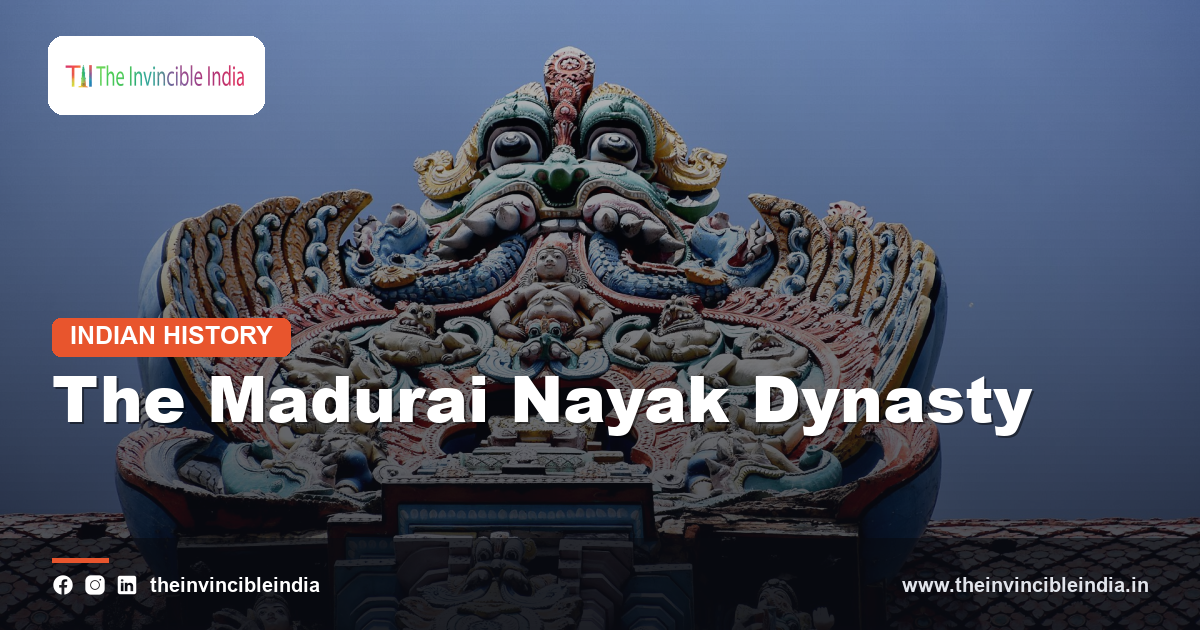
The Madurai Nayaks were the rulers who governed the far south of the peninsula during the centuries after the great age of Vijayanagara, and their influence is still visible in the skyline of Madurai. Beginning as military governors sent by the imperial court, they later acted as independent sovereigns, building palaces, expanding temples and creating a system of local chieftaincies that shaped the region’s politics. Their cultural impact was equally strong, touching architecture, literature, music and festival life. To understand the imperial background from which they emerged, readers may turn to our guide to the Vijayanagara Empire. This article outlines the Nayak story in general terms and avoids precise figures where scholarly dating is uncertain.
Quick Facts
| Detail | Information |
|---|---|
| Dynasty | Nayaks of Madurai, successors of Vijayanagara governors |
| Region | Southern Tamil Nadu, with Madurai as capital |
| Best-Known Ruler | Thirumalai Nayak |
| Architectural Legacy | Meenakshi temple expansion, gopurams, mandapas and palace |
| Administrative Legacy | Palayam (palayakkarar) system of local chiefs |
| Cultural Legacy | Temple festivals, Tamil literature and patronage of the arts |
The Vijayanagara Background
The Madurai Nayaks emerged from the political order of the Vijayanagara Empire, which at its height exercised authority across most of the southern peninsula. To govern distant provinces, the imperial court appointed military commanders known as nayakas, granting them territory in return for service and the maintenance of troops. In the far south, the region around Madurai had earlier experienced the decline of an older sultanate presence and the revival of local rule under imperial protection. The nayaka arrangement allowed the empire to manage a vast territory, but it also gave governors a power base of their own. This background explains how the Madurai Nayaks first appeared as imperial agents and then gradually became rulers in their own right.
Origins and the Rise of Viswanatha Nayak
Tradition attributes the establishment of the Nayak state at Madurai to a commander named Viswanatha Nayak, who is remembered as an able general serving the Vijayanagara court. He is said to have been sent south to restore order and to assume authority over the old Pandya country. Chronicles describe him as a ruler who reorganised the administration, rebuilt the fort and city, and set up arrangements for the defence of the realm. Exact dates for his rule vary in the sources and are debated among historians, so a careful account avoids pinning them down. What is clear is that he is regarded as the founder of the dynasty, whose organising work created the framework that later rulers inherited.
The Palayam System
One of the most significant administrative legacies attributed to the early Nayak period is the palayam, or palayakkarar, system. Under this arrangement, the kingdom was divided into territorial units, each placed under a chieftain who held land in return for military service and the payment of dues. The palayakkarars maintained local forces, guarded forts and kept order in their districts, while remaining answerable to the king at Madurai. Traditional accounts speak of a fixed number of such units, though the precise figure is best treated as a customary tradition. The system strengthened defence and local control but also created powerful local figures who could, in times of weakness, challenge the centre. It shaped the politics of the south for generations.
Madurai as a Capital City
Madurai had been a major centre of learning, commerce and worship for a very long time before the Nayaks, but their rule gave the city a new form. The Nayaks reorganised the layout around the great temple, with concentric streets arranged to accommodate processions and festivals. Markets, residences and administrative buildings clustered within the old fort walls. This design made the temple the symbolic and physical heart of the capital, a pattern common in Tamil urbanism. The city’s public life, with its processions, craft quarters and bazaars, reflected the close link between kingship and religion. Madurai under the Nayaks thus became both a seat of government and a living stage for ritual and cultural display.
Thirumalai Nayak and the High Point of the Dynasty
Among the Madurai Nayaks, Thirumalai Nayak is the most celebrated, remembered for an extended reign marked by ambitious building and lavish patronage. He is associated with the construction of palaces, mandapas and tanks, and with extensive additions to the great temple of the city. His court attracted poets, musicians and artisans, and his name became synonymous with the golden age of Nayak culture. At the same time, his reign saw political challenges, including conflicts with neighbouring powers and strains with other chieftains. Historians debate certain details of his reign, but his reputation as the dynasty’s greatest patron is firmly established. His legacy is read most vividly in the monuments of Madurai that still bear his association.
The Meenakshi Temple Under the Nayaks
The temple dedicated to Meenakshi and Sundareshwara is the cultural centre of Madurai, and the Nayaks played a decisive role in shaping its present form. Earlier dynasties had worshipped and built here, but Nayak patronage added many of the great gateways, pillared halls and corridors that define the complex today. The sanctuary is renowned for its colourful gopurams, sculpted with countless figures of deities, animals and mythical beings, and for its halls filled with carved pillars. The temple functioned as a centre of ritual, learning and charity, and its festivals drew pilgrims from distant places. The Nayak contribution turned an ancient shrine into a monumental religious city, and it remains one of the most visited sacred sites in the country.
Gopurams, Mandapas and the Nayak Style
The architectural vocabulary of the Nayak period is distinctive. Gateway towers rise in many storeys, covered with painted stucco figures, while pillared halls known as mandapas feature columns carved with rearing animals and divine figures. Long corridors, sacred tanks and processional streets complete the plan. This style builds on the earlier traditions of the Chola and Vijayanagara periods but expands their scale and ornament. The aim was to create a dramatic setting for worship and festival, in which architecture itself participated in ritual. Many Nayak-era temples across the Tamil country show these features. The Nayak style remains an important chapter in the history of South Indian architecture, admired for its exuberance and its skilled integration of sculpture and structure.
The Thirumalai Nayak Palace
The palace associated with Thirumalai Nayak stands as a notable secular monument of the dynasty. Its surviving portion is remembered for a vast courtyard surrounded by tall pillars supporting arches, and for a stately audience hall, showing a blend of local and external architectural influences. The decorative plasterwork and large scale suggest the grandeur of the original complex, which was far more extensive than what remains today. Over time, parts of the palace were dismantled or fell into disrepair, but the portion that survives is carefully conserved and used for public events. The palace illustrates the secular side of Nayak building and gives modern visitors a glimpse of the courtly life that surrounded the dynasty’s greatest ruler.
Festivals and the Public Life of the City
The Nayak period is closely associated with the festival culture of Madurai. Tradition credits Thirumalai Nayak with arranging the great spring festival so that two popular celebrations, one centred on the divine wedding of Meenakshi and Sundareshwara and the other on a related pilgrimage tradition, could be brought into harmony. Whether or not every detail is literal, the festival today draws vast crowds and remains central to the city’s identity. Processions, chariots and music fill the streets, and the event reflects the Nayak vision of kingship as a public, ritual and communal enterprise. Festivals of this kind linked rulers to ordinary citizens and gave the city a rhythm of celebration that has endured.
Literature, Music and Learning
The Nayak courts were generous patrons of Tamil and Telugu literature, as well as of Sanskrit learning and music. Poets composed praise poems, devotional works and narrative literature, and the courts supported scholars who wrote commentaries and treatises. Musicians and dancers found employment in the courts and temples, contributing to the continuity of the classical performing traditions of the south. Because the Nayaks often came from Telugu-speaking families, their courts reflected a blending of languages and cultures that enriched the region. The patronage of learning during this period helped keep the intellectual life of Tamil Nadu vibrant, and many works from the era continue to be studied for their literary and cultural value.
Rani Mangammal and Later Rulers
Among the later Nayak rulers, Rani Mangammal is remembered as a capable regent who governed during a period of political challenge. Tradition praises her for maintaining order, supporting public works and safeguarding the kingdom through careful diplomacy. Accounts of her rule highlight the construction of roads, rest houses and shrines, though specific details are best treated as traditional memory. Her place in history demonstrates that women could exercise real political authority in the Nayak realm. The later rulers faced increasing difficulties, including rivalry with neighbouring states and pressure from powerful chieftains. The achievements of rulers such as Rani Mangammal show that the dynasty continued to produce capable leadership even as its political position grew more precarious.
Foreign Contacts and Religious Diversity
The Nayak realm was not culturally closed. The southern coast saw the presence of European traders and missionaries during this period, and some missionaries lived and worked in the Madurai region, studying local languages and customs. Muslim and Christian communities coexisted with the Hindu majority, and Jain and other traditions had a longstanding presence in the area. The court generally tolerated this diversity, though relations among groups could vary with circumstance. Such contacts brought new ideas, goods and technologies into the region, and they left traces in local literature and society. The religious and cultural pluralism of the Nayak period forms an important part of its historical significance.
Warfare, Rivalry and the Decline of Power
The later history of the Nayak state was marked by conflict. Rivalry with neighbouring kingdoms, tension with powerful palayakkarars and the weakening of the Vijayanagara centre all undermined the stability of the realm. External invasions and shifting alliances added to the pressure, and the court sometimes depended on uncertain support from outside powers. Succession disputes further strained the kingdom. Historians describe a gradual loss of authority rather than a single dramatic collapse. The decline of the dynasty reflects a wider pattern in southern India, where the old imperial order gave way to competing regional states and, eventually, to new colonial powers that reshaped political life in the peninsula.
The End of Nayak Rule and the Palayakkarar Legacy
The Madurai Nayak state eventually ended when a stronger regional power took control of Madurai, after which the territory passed through several hands before coming under colonial administration. The palayakkarars, however, continued to play a role in the politics of the south, and some of them later resisted the expanding colonial authority. Their forts and traditions remain part of local memory, and several chieftains are celebrated in folk narrative. The palayam system thus outlived the dynasty that created it, influencing the social and political structure of the region for generations. This continuing legacy shows how Nayak institutions had become deeply embedded in the life of the Tamil country.
The Madurai Nayak Dynasty in Cultural Memory
The Nayaks are remembered through monuments, festivals, literature and local legend. In Madurai, their palaces and temple additions form part of the everyday landscape, while folk songs and stories recount the deeds of rulers and chieftains. The dynasty features in school lessons, public celebrations and the identity of the city itself. Historians continue to examine the Nayak period critically, studying inscriptions, chronicles and temple records to refine our understanding. This combination of public memory and scholarly work keeps the dynasty visible in modern cultural life. The Nayaks are valued not only as rulers but as custodians and creators of a heritage that continues to define Madurai.
The Madurai Nayak Dynasty Today
Today the legacy of the Madurai Nayaks is visible in the thriving temple city and in the continuing traditions of the Tamil country. The Meenakshi temple draws pilgrims and visitors from across the world, the surviving palace hosts cultural events, and the great festivals bring the streets to life each year. Scholars, architects and artists draw inspiration from the Nayak style, while the story of the palayam system informs studies of regional administration. The dynasty shows how governors who began as imperial agents could become patrons whose work shaped a region for centuries. Their achievements, though sometimes difficult to date precisely, endure in stone, ritual and memory.
Sources & Further Reading
- Archaeological Survey of India (asi.nic.in).
- Ministry of Culture, Government of India (indiaculture.gov.in).
Frequently Asked Questions
Who were the Madurai Nayaks?
The Madurai Nayaks were rulers of the far south who began as military governors under the Vijayanagara Empire and later governed as independent sovereigns. Their capital was Madurai, and they are remembered for temple building, palaces and the palayam system.
Who was Thirumalai Nayak?
Thirumalai Nayak is the best-known ruler of the dynasty, remembered for his extensive patronage of architecture, art and festival life in Madurai. Some details of his reign are debated, but his reputation as the dynasty’s great builder is firmly established.
What was the palayam system?
It was an administrative arrangement in which the kingdom was divided into territorial units under chieftains called palayakkarars, who held land in return for military service and dues. It strengthened local defence but also created powerful local figures.
How did the Nayaks shape the Meenakshi temple?
Nayak patronage added many of the temple’s great gateways, pillared halls and corridors, giving the complex its present monumental form. Earlier dynasties had also contributed to the sanctuary.
What happened to the Nayak dynasty?
The dynasty gradually lost authority through rivalry, invasion and internal disputes, and Madurai eventually passed to other powers. The palayakkarar system outlasted the dynasty and influenced the region for generations.


