

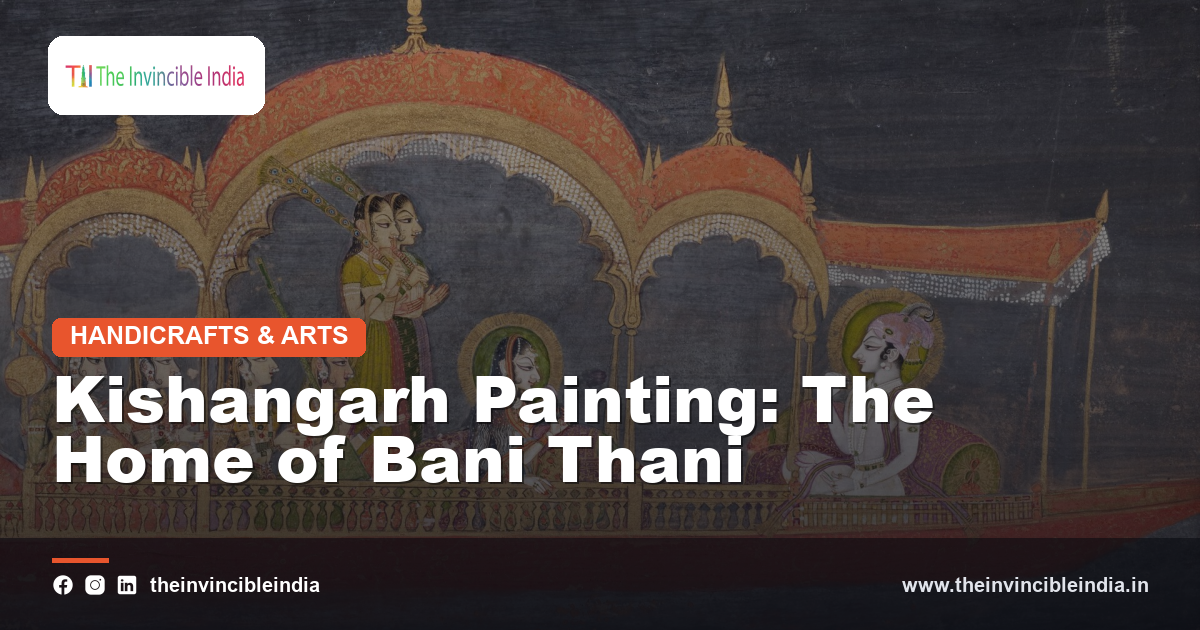
Kishangarh painting is among the most elegant and recognisable of the Rajput miniature schools, celebrated for its slender, elongated faces, lotus-shaped eyes and deeply devotional treatment of Radha and Krishna. Produced at the court of Kishangarh in Rajasthan, the school is inseparably linked with Bani Thani, the poised and graceful figure who has become an icon of Indian miniature painting. Its refined line, cool lake-side settings and lyrical mood distinguish it from the bolder manner of Basohli painting and from other Rajput centres. This guide explores the history, features, themes, techniques and lasting legacy of the Kishangarh school, along with the reasons Bani Thani continues to captivate admirers.
Quick Facts
| Detail | Information |
|---|---|
| Type | Rajput miniature painting |
| Region | Kishangarh, Rajasthan |
| Icon | Bani Thani, a celebrated courtly ideal |
| Signature | Elongated faces, lotus eyes, sharp noses |
| Key theme | Radha and Krishna devotion |
| Associated artist | Nihal Chand, the court master |
What Is Kishangarh Painting
Kishangarh painting is a school of Rajput miniature art that flourished at the princely court of Kishangarh in central Rajasthan. It is best known for a highly stylised, graceful treatment of the human face and figure, in which features are elongated and refined to express devotional and romantic longing. The school developed a lyrical atmosphere, combining courtly elegance with spiritual feeling, and its paintings often depict Radha and Krishna in dreamlike natural settings. Compared with many other Indian miniature traditions, Kishangarh work feels especially poetic and musical in mood. Its distinctive ideal of beauty has made the school one of the most admired and widely reproduced in the Indian miniature canon.
The Kishangarh Court and Its Setting
Kishangarh was a princely state in Rajasthan, with a fort and palace overlooking a lake that figures prominently in the paintings of the school. The court maintained a rich cultural life that valued poetry, music, devotion and the visual arts, creating an environment in which painters could thrive. The surrounding landscape of water, hills and gardens became the setting for many of the school’s most evocative scenes. Understanding this courtly and geographical background helps explain the refined, contemplative tone of Kishangarh painting. The art grew out of a small but culturally ambitious court that placed unusual importance on devotion and aesthetic refinement.
Origins and Royal Patronage
The golden age of Kishangarh painting is closely linked with a ruler who was himself a poet and a devoted follower of Krishna, writing devotional verse under a literary name. His personal piety and love of poetry shaped the subjects and mood of the court’s paintings, encouraging artists to translate verse into image. Royal patronage provided workshops with steady commissions and the freedom to refine a distinctive manner. Earlier local painting traditions and influences from neighbouring courts also contributed. The result was a style that combined technical polish with emotional depth, and it remains a striking example of how a ruler’s personal devotion could transform the artistic life of an entire court.
Bani Thani and the Ideal of Beauty
Bani Thani is the name associated with the most famous image of the Kishangarh school, a portrait of a woman of the court shown with long, tapering eyes, finely arched brows, a slender nose and an elegantly draped veil. The name is usually understood to describe a lady richly dressed and adorned, and she is traditionally linked with the court’s devotional and poetic culture. Rather than a simple likeness, the painting presents an ideal of beauty and refinement. The image has become so closely identified with the school that it is often the first picture that comes to mind when Kishangarh painting is mentioned, and it has been widely reproduced.
The Elongated Face and Lotus Eyes
The hallmark of Kishangarh painting is its treatment of the face, which is drawn long and delicate, with a pointed chin, a sharply defined nose and a high, sloping forehead. The eyes are large and elongated, shaped like lotus petals or fish and often tilted upward at the outer corners, giving the gaze a dreamy, intense quality. Brows arch gracefully, and lips are small and finely drawn. This formalised beauty is repeated across male and female figures alike, creating a unified aesthetic. The effect is stylised rather than naturalistic, and it conveys an emotional state of longing and devotion that suits the poetic subjects of the school.
Nihal Chand and the Court Painters
The brilliance of the Kishangarh school is commonly attributed to a master painter known as Nihal Chand, who is widely credited with leading the court workshop and shaping its mature style. Working with other artists, he is associated with giving form to the court’s devotional ideals, translating poetry into elegantly composed images. Like most artists of the period, painters in the workshop often worked collaboratively, with a senior master guiding the overall design. Naming individual artists is a reminder that Indian miniature painting was the work of skilled creators with distinct visions. The achievements of this group of painters established Kishangarh as a leading centre of Rajput art.
Radha and Krishna in Kishangarh Art
The central subject of Kishangarh painting is the devotional love of Radha and Krishna, treated with tenderness and spiritual feeling. Paintings show the divine couple meeting in groves, gazing at one another, sitting on a terrace or travelling together in a boat. The relationship is presented as a symbol of the soul’s longing for the divine, and each gesture and glance carries meaning within a devotional tradition. The courtly ideal of beauty becomes a vehicle for expressing this sacred love, with the lovers sharing the same elongated features. This fusion of earthly refinement and spiritual intensity is what gives Kishangarh paintings their distinctive emotional power.
Boat Scenes and Lake Landscapes
Among the most memorable compositions of the school are scenes of lovers drifting on a lake in a boat, set beneath a softly coloured sky. These pictures draw on the real lake beside the Kishangarh palace, reimagined as a dreamlike stage for divine romance. Water is rendered in cool, rhythmic strokes, while distant shores, pavilions and trees recede into a hazy, silvery horizon. The expanded sense of space and atmosphere is unusual in Rajput painting and gives these works a calm, contemplative quality. The boat scenes demonstrate how the painters combined observation of a real landscape with poetic imagination to create enduring images.
Colour, Light and Atmosphere
Kishangarh painters favoured a softer, cooler palette than many other Rajput schools, using pale blues, greys, whites and gentle pinks alongside touches of richer colour. Skies often fade from deeper tones at the top to pale shades near the horizon, creating a sense of atmosphere and distance. Light seems diffuse and quiet, enhancing the lyrical mood. White is used generously for garments and architecture, and delicate gold or silver accents highlight ornaments. This restrained, harmonious colour scheme supports the contemplative tone of the paintings and sets them apart from the more saturated palettes found elsewhere. Colour in Kishangarh work serves mood as much as description.
Costume, Jewellery and Ornament
Costume and ornament play an important part in the visual elegance of Kishangarh painting. Women are shown wearing sheer veils, long skirts and carefully arranged jewellery, with necklaces, earrings and nose ornaments painted in meticulous detail. Men appear in turbans and flowing garments, with garlands and fine accessories that signal rank and devotion. The fabrics are often rendered with transparent effects, allowing the contours of the body to show gently beneath the veil. These details reflect the refined fashions of the court and contribute to the overall impression of grace. Ornament in Kishangarh art is never excessive but always carefully measured and harmoniously placed.
Architecture and Garden Settings
Settings in Kishangarh paintings frequently include palace terraces, pavilions, balconies and enclosed gardens, rendered with clear lines and gentle perspective. Architecture is typically white or softly coloured, with delicate arches and railings that echo the refined mood of the figures. Gardens overflow with flowering trees, plantain leaves and pools, creating a sense of seclusion and romance. These elements frame the figures and give structure to the composition while remaining secondary to the emotional exchange. The careful balance of architecture, vegetation and sky shows the artists’ sophisticated sense of design. Settings thus act as extensions of the poetry, providing a graceful stage for the devotional narrative.
Materials and Painting Technique
Kishangarh miniatures are painted on prepared paper, built up from layers that are pressed and polished until the surface is smooth. The artist draws the composition in fine outline, then applies colour in thin layers, gradually adding depth, ornament and facial detail. Pigments derived from minerals and plants are ground and bound with a natural medium, while gold and silver are used sparingly for highlights. Very fine brushes allow the delicate lines of eyes, brows and jewellery. The work is slow and requires great control, since the elegance of the style depends on exact proportion and clean contours. Burnishing gives the finished painting its soft sheen.
Spread, Decline and Later Phases
As the original circle of royal patrons and master painters passed, the Kishangarh school gradually lost its early momentum, though the style continued in later generations. Some later works repeated the established conventions, sometimes with greater formalism, while court circumstances changed and workshops shrank. The influence of Kishangarh nevertheless extended to other centres, and its idealised features echoed beyond the court. The decline of princely patronage affected painting across Rajasthan, and Kishangarh was no exception. Even so, the best works of the school remained admired, and the later history of the tradition is part of the broader story of change in Indian courtly art.
Collections and Recognition
Kishangarh paintings are preserved in museums and collections in India and abroad, where they are regarded as highlights of Rajput miniature art. The image of Bani Thani gained wide popular recognition in the modern period and was even commemorated on a postage stamp, bringing the school to a broad audience. Exhibitions on Indian painting regularly feature Kishangarh works to illustrate the refinement of Rajasthani courts. Scholars study the school for its unusual union of poetry, devotion and visual design. This sustained attention has ensured that the achievements of the Kishangarh painters remain visible and appreciated, long after the court that produced them has passed into history.
Kishangarh Painting Today
Today Kishangarh painting survives through artists who continue to produce miniatures in the traditional style, using hand-prepared paper and natural pigments. Reproductions of Bani Thani and Radha Krishna scenes appear on prints, textiles, souvenirs and decorative objects, introducing the aesthetic to new audiences. Institutions and craft organisations support training in miniature techniques so that skills are passed on to younger painters. The school also inspires contemporary artists who reinterpret its elongated forms. By keeping the methods and ideals of Kishangarh alive, these practitioners preserve a tradition that links devotion, poetry and elegance, and that remains one of the most beloved expressions of Rajasthani artistic heritage.
Sources & Further Reading
- Ministry of Culture, Government of India, on Indian painting traditions (indiaculture.gov.in).
- National Museum, New Delhi, on Indian miniature painting collections (nationalmuseumindia.gov.in).
Frequently Asked Questions
What is Kishangarh painting?
Kishangarh painting is a Rajput miniature school from the princely court of Kishangarh in Rajasthan. It is known for elongated, elegant faces and devotional scenes of Radha and Krishna.
Who is Bani Thani?
Bani Thani is the name associated with the most famous Kishangarh portrait, showing a richly adorned woman with long eyes and a graceful veil. She has become an icon of Indian miniature painting.
What are the signature features of the Kishangarh style?
The style is marked by long faces, lotus-shaped eyes, sharp noses and arched brows. Cool, soft colours and lakeside settings add to its lyrical mood.
Who was Nihal Chand?
Nihal Chand is the master painter traditionally credited with leading the Kishangarh court workshop and shaping its mature style. He is associated with the school’s golden phase.
Where can Kishangarh paintings be seen?
Kishangarh miniatures are held in museums and private collections in India and abroad. Exhibitions on Rajput and Indian miniature painting often include them.


