

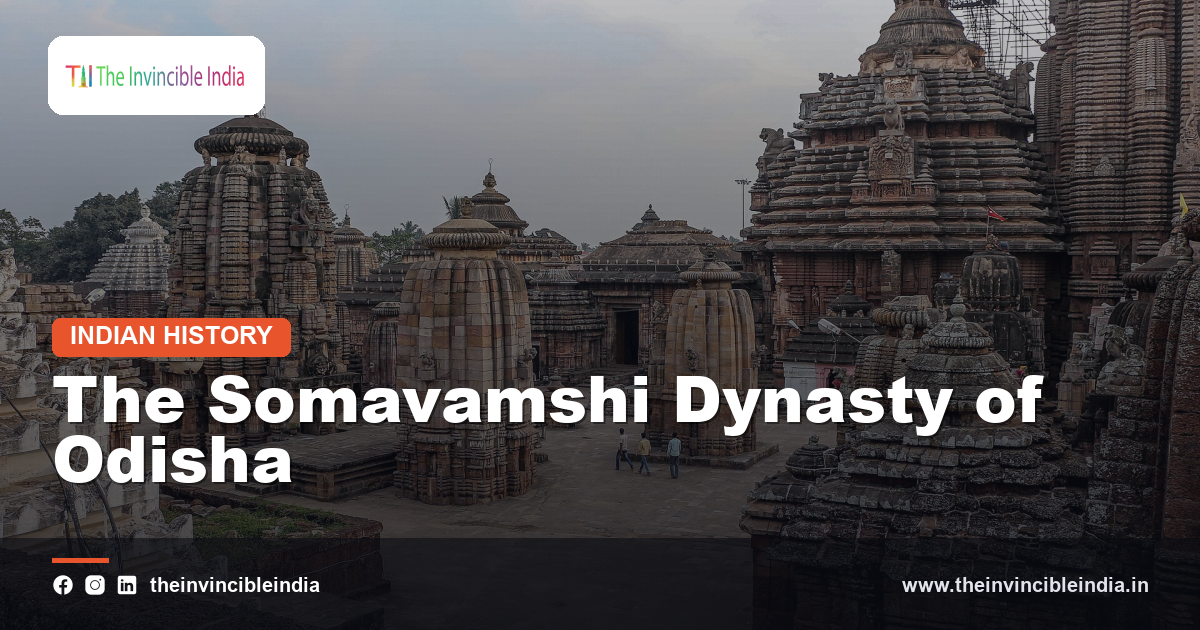
Odisha’s reputation as a land of temples owes a great deal to the dynasty known as the Somavamshis, who ruled large parts of the region in the medieval centuries and are often identified with the Kesari kings of local tradition. Their reign is remembered as a period when the temple architecture of Bhubaneswar reached maturity, when copper-plate charters recorded royal grants, and when the political life of coastal and inland Odisha was drawn into a single framework. Chronology and the exact relationship of the royal lines remain subjects of scholarly discussion. To see how another great regional power shaped eastern and southern India, readers may consult our guide to the Chola dynasty. This article presents the Somavamshis in general, carefully hedged terms.
Quick Facts
| Detail | Information |
|---|---|
| Dynasty | Somavamshi, associated by tradition with the Kesari kings |
| Region | Odisha, with ties to the older Kosala and Kalinga regions |
| Core Centre | Bhubaneswar, the temple city of ancient Kalinga |
| Architectural Legacy | Mature Kalinga-style temples with curving towers |
| Records | Copper-plate charters and stone inscriptions |
| Succeeded By | The Eastern Ganga dynasty |
Who Were the Somavamshis?
The Somavamshis were a medieval ruling dynasty whose name means those of the lunar line, a title common among royal families who traced their ancestry to the moon in traditional genealogy. In the context of Odisha, they are linked with a family of rulers who brought the central and coastal regions under their authority and who are often called the Kesari kings in later tradition. Scholars continue to discuss how the Somavamshi and Kesari names relate to one another and whether they describe one dynasty or overlapping lines. Because the evidence consists mainly of inscriptions, the dynasty is better known through its records and monuments than through narrative chronicles, which makes any detailed chronology tentative.
The Setting: Kalinga, Kosala and Utkala
To understand the Somavamshis, it helps to recall the older regional names that shaped Odisha’s historical geography. Kalinga referred to the coastal belt, Utkala to the northern and central stretches, and Kosala to the inland western region around the upper Mahanadi valley. Over the centuries, various dynasties ruled these areas separately or in combination. The Somavamshis are particularly associated with the process by which the inland and coastal zones were drawn together under one political structure. This background gives the dynasty historical importance beyond its monuments, since it contributed to the formation of a recognisably unified Odishan realm that later dynasties would inherit and expand.
Origins in the Inland Kosala Region
Historians generally trace the early Somavamshi rulers to the inland region of Kosala, where an earlier ruling lineage had held power along the middle Mahanadi. From this base, the family is understood to have expanded its authority toward the east, moving into the coastal plains that were the heart of ancient Kalinga. Traditional accounts and inscriptions offer genealogies, but they do not agree on every detail, and scholars continue to debate the identification of particular rulers. What matters for the broad story is the movement of political power from inland to coast, a shift that reshaped the cultural geography of the region. It opened the way for a vigorous temple-building culture centred on the old sacred city.
The Kesari Tradition and the Question of Chronology
Odishan tradition preserves the memory of a line of rulers bearing names ending in Kesari, credited with founding cities, building temples and ruling with justice. The temple chronicles, compiled in later centuries, contain stories that blend memory and legend, so modern historians treat them as valuable but not fully reliable. Inscriptions provide firmer anchors, yet they leave gaps and contain ambiguities. For this reason, assigning precise years to individual reigns is risky, and responsible accounts describe the period in broad terms. The debate over chronology is a reminder that medieval Indian history often rests on incomplete records, and that scholarly consensus can evolve as new inscriptions are read.
Political Consolidation and Capitals
Under the Somavamshi kings, the administrative geography of Odisha was reorganised. Inscriptions mention successive capital towns, sometimes named after rulers, which served as centres of government and royal ceremony. The movement of the court between inland and coastal sites reflects both the practical demands of governing a wide territory and the symbolic importance of the sacred city of the coast. Administration relied on officers who supervised districts, collected revenue and maintained the records that donors later inscribed on copper plates. This growing administrative sophistication supported large-scale building and patronage. The dynasty’s consolidation of power is therefore a necessary background to the great architectural achievements associated with its name.
Copper-Plate Charters and Administrative Records
Much of what is known about the Somavamshis comes from copper-plate charters recording grants of land to temples and learned families. These documents list royal titles, genealogies and the names of villages, and they show how the court sustained religious institutions through land endowments. The plates were issued in the royal name and often include dating formulas that scholars interpret in different ways, which is one source of chronological debate. Their language reflects a learned Sanskrit tradition used by royal clerks. Together with stone inscriptions in temples, the charters give a reliable if partial window into the structure of royal authority, the economy of land grants and the religious patronage of the period.
The Temple City of Bhubaneswar
Bhubaneswar, the ancient sacred centre of the Odishan coast, is often described as a city of temples, and the Somavamshi period is closely associated with the maturing of its architectural character. Shrines of many sizes rise around sacred tanks, each with a tower that curves gracefully upward. The concentration of monuments reflects centuries of royal and community patronage, and the Somavamshi era contributed a significant portion of what visitors see. The city thus functions as an open-air museum of Kalinga architecture, where the evolution of design can be traced from early small shrines to grand, elaborately carved structures. Its temples remain active centres of worship, linking present devotion to the medieval past.
The Kalinga Style of Temple Architecture
The temples of Odisha follow a distinctive plan, with a tall curvilinear tower over the sanctum, called the deul, and a lower pyramidal hall in front, called the jagamohana. Walls are divided into vertical sections and covered with sculpted niches, scrollwork and figures. The style developed gradually, and the Somavamshi phase represents a stage of confidence and refinement, when proportions became more balanced and ornament more disciplined. Stone carving of high skill adorned doorways, ceilings and exterior walls. The architectural tradition is also notable for its use of local building stone and a consistent iconographic programme. These features collectively define the Kalinga idiom, one of the principal regional schools of Indian temple architecture.
The Lingaraja Temple and Its Making
The Lingaraja temple, dedicated to Shiva, is the largest and most renowned shrine of Bhubaneswar, and its history is tied to the Somavamshi period and its successors. Scholars generally describe it as a work that took shape over time, with construction attributed in tradition to the Kesari rulers and later completion and elaboration under the dynasty that followed. Its soaring tower and richly decorated walls make it the supreme example of the mature Odishan style. The temple stands within a large enclosure and continues to host major festivals. The exact stages of its building are debated, but its association with the Somavamshi era is widely accepted as part of the story of Odisha’s architectural peak.
Mukteshvara, Rajarani and Other Monuments
Beyond the Lingaraja, several other Bhubaneswar monuments are linked with the Somavamshi age or its immediate surroundings. The Mukteshvara temple, admired for its compact elegance and a richly carved entrance arch, is often cited as a masterpiece of the earlier mature style. The Rajarani temple, notable for its elegant sculpture and refined proportions, is likewise associated with this broad period. Attributions and dates differ among scholars, and a careful account describes them as belonging to the general medieval phase of development rather than to a precise reign. Together, these shrines illustrate the variety within the Kalinga tradition and show how experimentation and refinement proceeded side by side in the temple city.
The Brahmeshvara Temple and Royal Women Patrons
The Brahmeshvara temple in Bhubaneswar is traditionally linked with a queen mother, remembered through inscription as the donor of the shrine. This association is significant because it highlights the role of royal women as patrons of temples and religious institutions in medieval Odisha. The temple is admired for its carved walls and proportioned tower, and it demonstrates how family members of the king shared in the work of endowment. Women patrons appear in inscriptions across India, but their presence in Odisha’s temple record is especially visible. Their gifts underline the broader pattern in which royal households, not only kings, sustained sacred architecture and ritual life.
Sculpture, Iconography and Religious Life
The Somavamshi age was marked by religious diversity. Shaivism was especially prominent in Bhubaneswar, while Vaishnava, Shakta and other traditions also flourished, and Buddhist and Jain communities retained a presence in the wider region. Temple sculpture reflects this variety, depicting deities, celestial maidens, guardians and scenes of daily life with remarkable fluency. The carvings were not mere decoration but part of a symbolic programme guiding the worshipper through the sacred space. Rituals, festivals and learned discussion centred on the temples, and endowments supported priests and teachers. This lively religious life nourished the arts and gave the period its enduring cultural character.
Trade, Economy and Society
The economy of Somavamshi Odisha rested on agriculture in the river valleys and the fertile coastal plain, supplemented by trade through ports and inland routes. The coast had long been connected with maritime contacts across the Bay of Bengal, and memories of such links remain strong in Odishan culture. Land grants to temples and learned families created stable religious and educational institutions that also played an economic role. Artisans, stone carvers and merchants worked in the towns that grew around temples. Although detailed economic data from the period is limited, the scale of building suggests a prosperous society capable of sustaining a large body of skilled craftsmen and substantial royal patronage.
Relations with Neighbouring Powers
The Somavamshi kings did not rule in isolation. Their territory bordered several powerful states, and records and traditions suggest alternating periods of conflict and accommodation. Campaigns by southern powers, including the Cholas, reached into eastern India during the medieval centuries and affected the balance of power in the region. Rivalry with neighbouring dynasties to the north and west also shaped royal fortunes. Marriage alliances and diplomatic exchanges were common instruments of statecraft. These external pressures contributed to the weakening of the dynasty over time, and they form part of the broader story of how political authority in medieval Odisha passed from one ruling line to another.
Decline and the Rise of the Eastern Gangas
The Somavamshi period gave way to the rule of the Eastern Gangas, a dynasty from the southern part of the coastal region that rose to dominate Odisha. The transition is understood as a gradual process involving political pressure, shifting alliances and the eventual assertion of a new royal house. Some of the great building projects begun under earlier rulers were continued or completed under the new dynasty, which is why certain temples carry the stamp of both periods. The Eastern Gangas would later build on the Somavamshi legacy to produce monuments of extraordinary scale at the coast. The change of dynasty thus involved continuity of culture even as the ruling family changed.
The Somavamshi Dynasty Today
Today the legacy of the Somavamshis lives on in the temples of Bhubaneswar, the inscriptions studied by historians and the architectural idiom that defines Odisha’s heritage. Pilgrims and visitors walk among shrines that took shape during this medieval age, and conservation agencies work to protect them. Scholars continue to refine the chronology, identify rulers and interpret the records, recognising that many questions remain open. The dynasty reminds us that a regional kingdom, even one with uncertain dates, can leave a lasting imprint through patronage of art and religion. In Odisha, the Somavamshi age remains a cherished chapter in the story of the region’s cultural development.
Sources & Further Reading
- Archaeological Survey of India (asi.nic.in).
- Ministry of Culture, Government of India (indiaculture.gov.in).
Frequently Asked Questions
Who were the Somavamshis of Odisha?
The Somavamshis were a medieval ruling dynasty associated with Odisha and often linked in tradition with the Kesari kings. They are remembered for consolidating the inland and coastal regions and for the flourishing of temple architecture at Bhubaneswar.
Are the Somavamshis the same as the Kesari dynasty?
Local tradition often identifies the two, but scholars still discuss their exact relationship and the chronology of individual rulers. The question remains open because the evidence is mainly inscriptional and incomplete.
Which temples are linked with the Somavamshi period?
Several Bhubaneswar temples are associated with this broad period, including the Mukteshvara, Rajarani and Brahmeshvara shrines. The great Lingaraja temple took shape over time, with its building linked to the Somavamshi era and its successors.
What is the Kalinga style of architecture?
It is the Odishan temple style, with a tall curved tower over the sanctum and a pyramidal hall in front, covered in carved ornament. The Somavamshi phase is seen as a period of refinement for this tradition.
What dynasty followed the Somavamshis?
The Eastern Ganga dynasty gradually became the dominant power in Odisha after the Somavamshi period. It continued and expanded the region’s temple-building tradition.


