

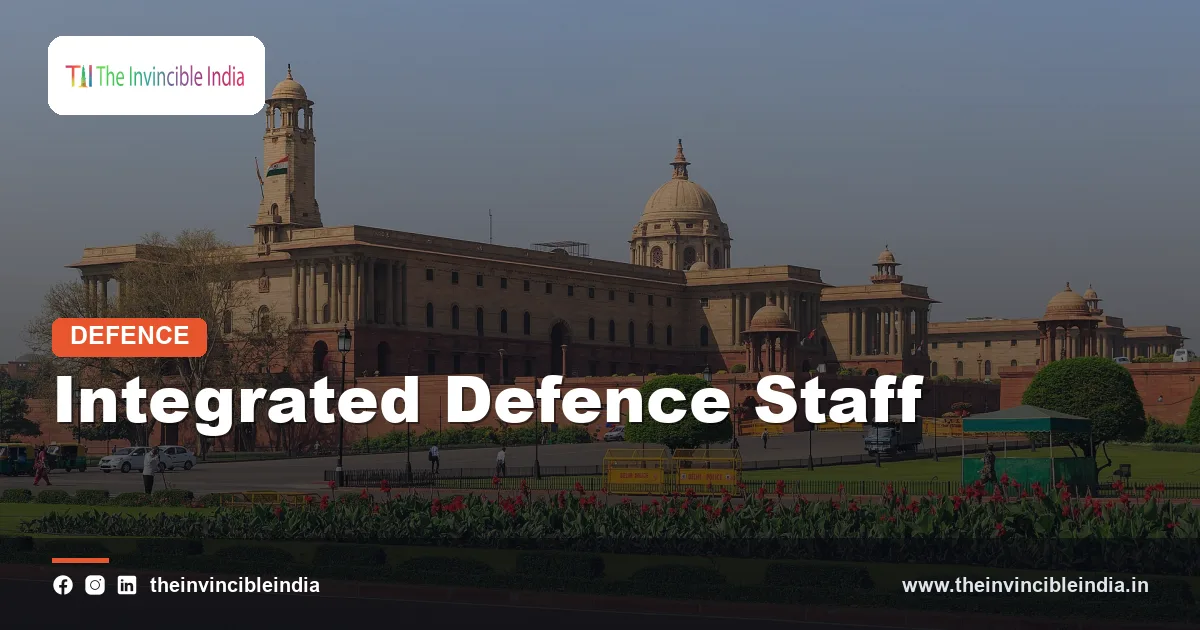
The Integrated Defence Staff is the tri-service organisation that brings the Indian Army, Indian Navy and Indian Air Force together for joint planning, policy and coordination under the Ministry of Defence. Created in 2001 as a direct result of the lessons of the Kargil conflict, it was India’s first major institutional step towards greater jointness among the armed forces, and it has since grown into the staff backbone of the Chief of Defence Staff and the Department of Military Affairs.
This explainer describes why the Integrated Defence Staff was created, how it is organised, what the Chief of Integrated Defence Staff does, how its role changed after the post of Chief of Defence Staff came into being in 2019, and which tri-service institutions have grown around it. It relies only on well-established public information about the structure of India’s higher defence management.
Quick Facts
| Item | Detail |
|---|---|
| Established | October 2001 |
| Origin | Kargil Review Committee (1999-2000) and the Group of Ministers report on national security (2001) |
| Parent organisation | Ministry of Defence (Integrated Defence Staff, now part of the Department of Military Affairs framework) |
| Head | Chief of Integrated Defence Staff, a three-star officer drawn from the three services |
| Original head’s superior | Chairman, Chiefs of Staff Committee |
| Present superior | Chief of Defence Staff (permanent Chairman, Chiefs of Staff Committee) |
| Key functions | Joint planning, force development, intelligence coordination, tri-service training and doctrine |
| Related bodies | Defence Intelligence Agency, Andaman and Nicobar Command, Strategic Forces Command, Defence Space and Cyber Agencies |
Why the Integrated Defence Staff Was Created
India’s higher defence organisation at Independence carried over a structure that kept the three services largely independent of one another, with the Ministry of Defence acting as a separate civilian body. Service Headquarters were technically “attached offices” of the ministry, and the Chiefs of Staff Committee, whose chairmanship rotated by seniority, had limited power to impose joint decisions. Over the decades this left gaps in coordination, particularly in long-term planning, acquisitions and operations that required more than one service.
The Kargil trigger
The 1999 Kargil conflict exposed weaknesses in intelligence sharing and in the integration of defence structures. The government set up the Kargil Review Committee under the strategic analyst K. Subrahmanyam, and its report, tabled in Parliament in 2000, called for a thorough review of the national security system. A Group of Ministers examined the recommendations, and in 2001 it endorsed a package of reforms, including the creation of an integrated defence staff and a Chief of Defence Staff.
Reforms accepted
The government accepted several recommendations at once, even though the CDS proposal itself had to wait. It set up the Integrated Defence Staff to be the secretariat for tri-service issues, a Defence Intelligence Agency to coordinate military intelligence, and tri-service commands in suitable theatres. The IDS thus began its life as the first practical step towards a more joint military.
Mandate and Role of the Integrated Defence Staff
The Integrated Defence Staff exists to synergise the work of the three Service Headquarters and the Ministry of Defence. It is a staff organisation, not a fighting formation: its officers advise, plan, coordinate and monitor, but operational command stays with the service chiefs or with designated tri-service commanders.
Core functions
- Joint planning: Preparing long-term, medium-term and annual plans that take the needs of all three services into account.
- Force development: Prioritising acquisitions and capabilities across the services, avoiding duplication and ensuring interoperability.
- Policy and doctrine: Formulating joint doctrines, concepts and procedures for the armed forces.
- Coordination with the ministry: Serving as the single window between the services and the Ministry of Defence on integrated matters.
- Intelligence coordination: Overseeing the Defence Intelligence Agency and related bodies.
- Training and exercises: Promoting joint training and tri-service exercises.
Staff, not command
It is useful to distinguish staff functions from command functions. Chiefs of the Army, Navy and Air Force command their own services. The IDS helps those chiefs and the Defence Minister plan and prioritise at the integrated level, but it does not command the forces. This principle continues even after the creation of the Chief of Defence Staff.
Organisation and Structure
The Integrated Defence Staff is headed by the Chief of Integrated Defence Staff, a three-star officer who is an Army lieutenant general, a Navy vice admiral or an Air Force air marshal. The appointment has historically rotated among the services, ensuring all three have a voice at the top of the staff. Under him work a number of principal staff officers and directors, each looking after a functional area.
Functional divisions
The headquarters is organised along functional lines with tri-service staff in each. The main areas, in broad terms, are:
- Operations: Joint operational planning and coordination, including support for tri-service commands.
- Intelligence: Military intelligence, linked with the Defence Intelligence Agency and with national agencies.
- Policy, planning and force development: Defence planning, capability development and long-term perspective plans.
- Doctrine, organisation and training: Doctrines, restructuring and joint training.
- Finance and procurement: Assessment of budgets, acquisitions and procurement planning.
- Medical and communications: Joint medical services policy and tri-service communication needs.
Officers from the three services serve here alongside civilian officials from the Ministry of Defence, which makes the organisation a rare meeting point between the military and civil bureaucracy within the defence establishment.
The Chief of Integrated Defence Staff
The head of the staff was originally known as the Chief of Integrated Defence Staff to the Chairman, Chiefs of Staff Committee, often abbreviated as CISC. The designation reflected the structure of the time, in which the senior-most service chief chaired the Chiefs of Staff Committee and the IDS served that chairman as principal staff officer.
Responsibilities of the post
The CISC headed the IDS, advised the Chairman and supported the work of the Chiefs of Staff Committee. He coordinated the preparation of the Defence Planning documents, represented the services in various inter-ministry forums and oversaw the integrated staff’s day-to-day business. He also supervised the working of certain tri-service institutions and agencies placed under the IDS.
After 2019
With the creation of the Chief of Defence Staff, the head of the IDS now functions as the Chief of Staff to the Chief of Defence Staff, and is generally referred to as the Chief of Integrated Defence Staff. In effect, the CISC became the CDS’s principal staff officer in the Headquarters, ensuring continuity in the staff structure while the leadership changed.
Key Milestones in the Evolution of Jointness
The IDS is best understood as one chapter in a long series of reforms. The table below places it in context.
| Year | Development |
|---|---|
| 1999 | Kargil conflict leads to a review of national security structures |
| 2000 | Kargil Review Committee report tabled in Parliament |
| 2001 | Group of Ministers report accepted; Integrated Defence Staff and the Andaman and Nicobar Command are created |
| 2002 | Defence Intelligence Agency raised under the IDS |
| 2003 | Strategic Forces Command established to manage nuclear forces |
| 2018 | Defence Planning Committee constituted under the National Security Adviser |
| 2019 | Announcement of the CDS post; Defence Space Agency, Defence Cyber Agency and Armed Forces Special Operations Division approved |
| 2019-2020 | Post of Chief of Defence Staff and Department of Military Affairs created |
The Defence Intelligence Agency
One of the most significant institutions to emerge under the Integrated Defence Staff is the Defence Intelligence Agency, formed in 2002. Before it, each service maintained its own intelligence directorate, and the integrated analysis of military intelligence was limited. The DIA was designed to coordinate the intelligence gathered by the Army, Navy and Air Force and to give a unified military picture to decision makers.
What the DIA does
The DIA collects, collates and analyses military intelligence, working with other agencies such as the Research and Analysis Wing, the Intelligence Bureau and the National Technical Research Organisation. It also controls specialised units for technical and imagery intelligence, which have contributed to better situational awareness along the borders and in the maritime domain. Its director general is a three-star officer, and its work is closely tied with the Joint Intelligence Committee machinery under the National Security Council system.
Why it matters
The agency was a direct answer to one of the most criticised failures revealed by the Kargil review, the lack of an integrated assessment of threats along the Line of Control. Since then, the principle that military intelligence must be pooled has become embedded in India’s security architecture.
Tri-Service Commands and Institutions
The Integrated Defence Staff works closely with a family of tri-service bodies, some of which it helped to create and some that were added later. These bodies show how jointness has deepened in practice.
- Andaman and Nicobar Command: Created in 2001 at Port Blair as India’s first and, for many years, only tri-service theatre command, covering the strategically located island chain.
- Strategic Forces Command: Formed in 2003 to administer and operate the country’s nuclear forces under the political direction of the Nuclear Command Authority.
- Defence Space Agency and Defence Cyber Agency: Approved in 2019 to integrate military capabilities in the space and cyberspace domains.
- Armed Forces Special Operations Division: Authorised in 2019 to coordinate special forces of the three services.
- Defence Imagery Processing and Analysis Centre: A body for the processing of imagery for military use.
- Tri-service training institutions: Establishments such as the National Defence Academy and the Defence Services Staff College bring officers from different services together for training.
The IDS has supported the development of these bodies by working out their organisation, manpower, funding and relationship with Service Headquarters.
The Chief of Defence Staff and the Department of Military Affairs
The Prime Minister announced the decision to create the post of Chief of Defence Staff in his Independence Day address in August 2019, and the cabinet approved it in December 2019. The first holder took office on the first day of 2020. At the same time, the government created the Department of Military Affairs within the Ministry of Defence, with the CDS as its secretary and the Principal Military Adviser to the Defence Minister.
Merging the staff into the new structure
The Integrated Defence Staff was placed within the new department and its headquarters became the main support for the CDS. This gave the IDS a firmer place in the ministry than before: where it had once been a secretariat to a rotating chairman, it was now the staff of a permanent four-star officer who also serves as the permanent Chairman of the Chiefs of Staff Committee.
Mandate of the department
The Department of Military Affairs deals with the armed forces, the Territorial Army, the works relating to the armed forces and procurement exclusive to the services, apart from capital acquisitions. Its stated aims include promoting jointness in procurement, training and staffing, facilitating restructuring of military commands for optimal use of resources, and encouraging the use of indigenous equipment.
Joint Planning and Perspective Documents
A major task of the IDS is planning. India’s defence planning has traditionally suffered from the mismatch between ambitions and available funds. The IDS prepares long-term documents that provide the services with a common frame of reference.
Perspective plans
The principal documents are the Long Term Integrated Perspective Plan, covering about fifteen years, the Services Capital Acquisition Plan, which covers about five years, and annual acquisition plans. These documents translate the Defence Minister’s operational directives into capability requirements and help in prioritising the capital budget across the three services.
Defence Planning Committee
In 2018 the government constituted a Defence Planning Committee under the National Security Adviser to improve strategy and planning. The IDS contributes the military inputs to its work, covering national defence and security priorities, defence diplomacy, defence manufacturing and capability development. This relationship ties the staff to the larger national-security system.
Challenges and the Road to Theatre Commands
The IDS and the CDS system have been central to the long-running discussion on theatre commands, an arrangement in which the forces of different services in a geographic region operate under a single commander. Supporters argue that this improves unity of command, resource use and operational responsiveness. Critics point to the need for careful planning of air power, the size of the Indian air arm and differing service cultures.
Persistent issues
- Balancing service autonomy with integrated planning.
- Deciding the number, location and structure of theatre commands.
- Developing officers with joint experience through postings and joint training.
- Avoiding duplication of staff between Service Headquarters and integrated headquarters.
- Aligning procurement with integrated rather than service-specific priorities.
These questions are debated in the public domain and are subject to government decisions rather than the staff’s own authority.
Conclusion
The Integrated Defence Staff began in 2001 as a modest but pioneering response to the Kargil experience. Over two decades it has anchored the Defence Intelligence Agency, supported tri-service commands, and become the headquarters staff of the Chief of Defence Staff and the Department of Military Affairs. While theatre commands and deeper integration remain evolving policy questions, the IDS has already changed how India’s armed forces plan, procure and train together.
Frequently Asked Questions
When was the Integrated Defence Staff created?
The Integrated Defence Staff was set up in October 2001. It followed the Kargil Review Committee report and the Group of Ministers recommendations on reforming India’s national security system.
Who heads the Integrated Defence Staff?
It is headed by the Chief of Integrated Defence Staff, a three-star officer from the Army, Navy or Air Force. Since the creation of the post of Chief of Defence Staff in 2019-20, he serves as the principal staff officer to the CDS.
Is the Integrated Defence Staff the same as the Chief of Defence Staff?
No. The Chief of Defence Staff is a four-star officer and the head of the Department of Military Affairs, while the Integrated Defence Staff is the tri-service staff organisation that supports the CDS. The IDS existed before the CDS post was created.
What is the Defence Intelligence Agency?
The Defence Intelligence Agency is a tri-service body formed in 2002 under the IDS to coordinate military intelligence from the Army, Navy and Air Force. It provides integrated assessments to the armed forces and the government.
Does the Integrated Defence Staff command the armed forces?
No. It is a staff organisation that plans, coordinates and advises. Operational command rests with the service chiefs and with commanders of the tri-service commands, such as the Andaman and Nicobar Command.
Why was the IDS considered necessary?
The Kargil conflict showed gaps in coordination among the services and in intelligence sharing. The IDS was created to provide integrated planning, policy and coordination across the three services and the Ministry of Defence.
{“@context”:”https://schema.org”,”@graph”:[{“@type”:”FAQPage”,”mainEntity”:[{“@type”:”Question”,”name”:”When was the Integrated Defence Staff created?”,”acceptedAnswer”:{“@type”:”Answer”,”text”:”The Integrated Defence Staff was set up in October 2001. It followed the Kargil Review Committee report and the Group of Ministers recommendations on reforming India’s national security system.”}},{“@type”:”Question”,”name”:”Who heads the Integrated Defence Staff?”,”acceptedAnswer”:{“@type”:”Answer”,”text”:”It is headed by the Chief of Integrated Defence Staff, a three-star officer from the Army, Navy or Air Force. Since the creation of the post of Chief of Defence Staff in 2019-20, he serves as the principal staff officer to the CDS.”}},{“@type”:”Question”,”name”:”Is the Integrated Defence Staff the same as the Chief of Defence Staff?”,”acceptedAnswer”:{“@type”:”Answer”,”text”:”No. The Chief of Defence Staff is a four-star officer and the head of the Department of Military Affairs, while the Integrated Defence Staff is the tri-service staff organisation that supports the CDS. The IDS existed before the CDS post was created.”}},{“@type”:”Question”,”name”:”What is the Defence Intelligence Agency?”,”acceptedAnswer”:{“@type”:”Answer”,”text”:”The Defence Intelligence Agency is a tri-service body formed in 2002 under the IDS to coordinate military intelligence from the Army, Navy and Air Force. It provides integrated assessments to the armed forces and the government.”}},{“@type”:”Question”,”name”:”Does the Integrated Defence Staff command the armed forces?”,”acceptedAnswer”:{“@type”:”Answer”,”text”:”No. It is a staff organisation that plans, coordinates and advises. Operational command rests with the service chiefs and with commanders of the tri-service commands, such as the Andaman and Nicobar Command.”}},{“@type”:”Question”,”name”:”Why was the IDS considered necessary?”,”acceptedAnswer”:{“@type”:”Answer”,”text”:”The Kargil conflict showed gaps in coordination among the services and in intelligence sharing. The IDS was created to provide integrated planning, policy and coordination across the three services and the Ministry of Defence.”}}]}]}


