

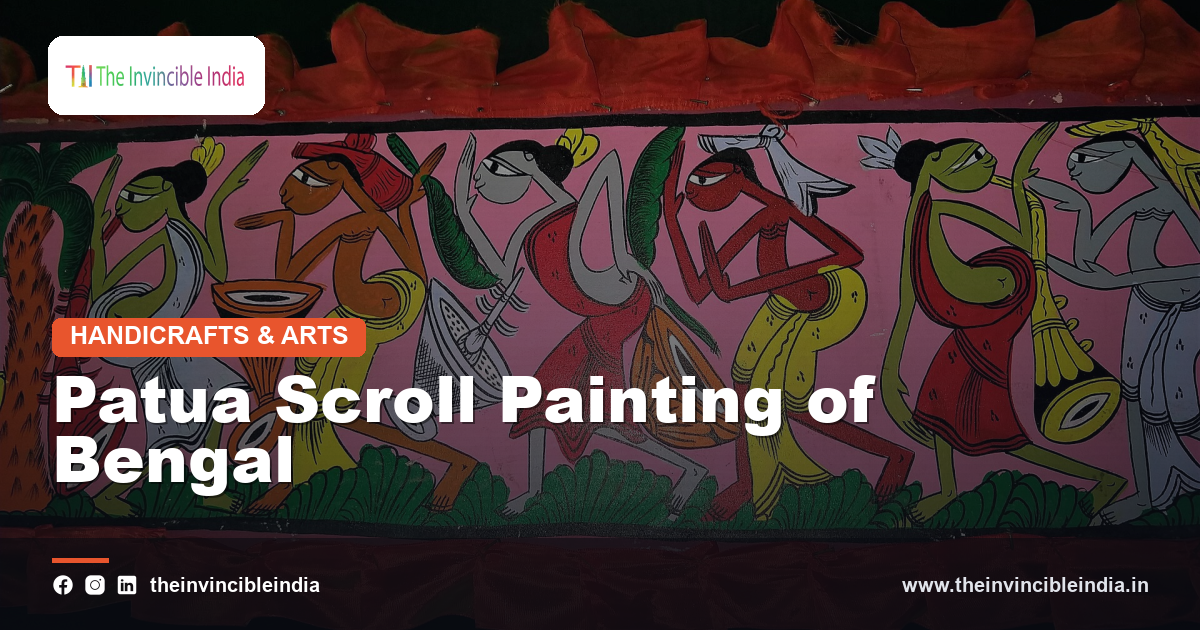
The Patua scroll is a long hand-painted narrative scroll made by the Patua community of Bengal and traditionally unrolled panel by panel while the painter sings the story it illustrates. Also called Patachitra of Bengal, pot paintings, pater pat or the Bengal scroll, it is one of India’s oldest living forms of picture storytelling, in which art, song and performance are inseparable. Its bold lines, flat colour and expressive figures link it with other narrative folk arts such as Madhubani painting, yet the scroll format and the singing painter make it unique. This guide explains who the Patuas are, how scrolls are made and performed, and why the tradition endures.
Quick answer: The Patua scroll is a traditional narrative scroll painting of Bengal, made by Patua artists, also known as chitrakars, who sing the story as they unroll it frame by frame. The performance tradition is called pater gaan, and the scrolls illustrate epics, village deities, folk tales and, increasingly, current social themes. Painted in natural colours with bold outlines, the Patua scroll is a living example of Indian storytelling that joins painting, poetry and music.
Key Takeaways
- The Patua scroll is a Bengal narrative painting tradition in which the artist sings the story while unrolling the scroll.
- Patuas, also called chitrakars, are a community of painter-singers found mainly in West Bengal and neighbouring regions.
- The sung performance that accompanies the scroll is known as pater gaan.
- Scrolls traditionally illustrate Hindu epics, village deities such as Manasa, and local folk tales, and Patua artists also paint contemporary subjects.
- Colours were traditionally prepared from natural sources such as plants, minerals and soot.
- Kalighat painting, a related single-sheet style from Kolkata, grew out of Patua artists working near the Kalighat temple.
The sections below describe the community, the craft, the stories and the efforts to keep this tradition alive.
Quick Facts
| Detail | Information |
|---|---|
| Type | Narrative scroll painting with song |
| Region | West Bengal and neighbouring areas |
| Artists | Patua community, also called chitrakars |
| Performance | Pater gaan, singing while unrolling the scroll |
| Colours | Traditionally natural plant and mineral pigments |
| Related style | Kalighat painting of Kolkata |
What Is a Patua Scroll?
A Patua scroll is a long, narrow painting on a roll of paper or cloth that tells a story through a sequence of framed pictures. The scroll is not simply hung or displayed; it is unrolled gradually by the artist, who sings the narrative so that the audience follows the images as the song unfolds. Each frame carries one episode, drawn with strong outlines and filled with flat, bright colour. Because image and voice work together, a scroll was traditionally a complete performance rather than a static artwork. This union of painting and song is the feature that most clearly defines the Patua tradition.
Who Are the Patuas?
The Patuas, also known as chitrakars, are a traditional community of painters and singers in Bengal who have practised scroll painting for many generations. Skills pass within families, with children learning to draw, mix colour and sing by watching and assisting elders. Many Patua families follow Islam while painting Hindu epic and deity themes, a combination that reflects the shared cultural life of rural Bengal. Historically the Patuas travelled from village to village, performing in return for grain, money or cloth. Their role as artist, storyteller and entertainer made them important carriers of popular memory and belief.
Where Is Patua Art Found?
Patua art is found mainly in the rural districts of West Bengal, with well-known centres in Paschim Medinipur, Birbhum, Murshidabad and parts of the southern districts. The village of Naya in Paschim Medinipur is especially famous as a community of scroll painters, and it hosts gatherings where artists display and sell their work. Related traditions of scroll painting and performance also exist in neighbouring parts of eastern India and in Bangladesh. Because the art travelled with its performers, its reach once extended across wide areas of the Bengal countryside, and today its centres are linked by craft fairs, cooperatives and online sales.
How Did Patachitra Begin?
Patachitra began as an ancient Indian tradition of narrative picture showmen, whose scrolls are mentioned in early literature as a way of teaching religion, morality and myth. In Bengal, the tradition developed as part of rural culture, where itinerant artists carried stories of gods, heroes and local legends to audiences who might never read a manuscript. The exact origins of the Bengal scroll are impossible to date, because the art was passed on orally and through practice rather than in written records. Even so, its long history is plain from its mature conventions of composition, narrative order and performance, which have remained remarkably consistent over time.
Pater Gaan: Song and Scroll Together
Pater gaan is the sung narrative that accompanies a Patua scroll, and it is as important as the painting itself. The singer holds the scroll in one hand, unrolls it gradually and points to each frame while chanting or singing the story in a rhythmic, folk melody. Verses explain the action, comment on the characters and sometimes add humour or moral reflection. The audience learns the tale through both eye and ear, which makes the experience immersive. Many Patuas compose their own songs, and in this way the tradition remains creative as well as inherited, with each performance shaped by the artist and the moment.
Types of Patua Scrolls
Patua scrolls come in several formats, the best known being the jorano pat, a long vertical scroll made of many frames sewn or pasted together. In this form the painting unrolls from top to bottom, revealing the story scene by scene. Shorter or simpler formats also exist, including single-frame pictures used for display or sale and square or rectangular panels that suit modern buyers. Different formats serve different purposes, from full storytelling performances to decorative art for homes and galleries. The variety shows how flexible the tradition has been, adapting its basic idea of sequential pictures to new needs without losing its identity.
What Themes Do Patua Scrolls Depict?
Patua scrolls depict Hindu epics, village deities, folk tales and local legends, with stories of Krishna, Rama, Durga and the snake goddess Manasa among the most popular. Narratives of Manasa and other regional deities hold special importance in Bengal, where they are tied to everyday hopes and fears. Scrolls may also portray Santhal and tribal tales, moral parables and stories of the afterlife that were once used to comfort mourners. Whatever the subject, the artist tells it clearly and dramatically, using expressive faces, strong gestures and a steady rhythm of scenes that keeps listeners engaged to the end.
Contemporary and Social Themes
Patua artists have a long habit of painting current events, and many modern scrolls address contemporary and social themes alongside traditional ones. Artists have created works on natural disasters, public health, communal harmony, women’s rights and environmental care, using the familiar scroll form to carry new messages. This adaptability has helped the art stay relevant, because it shows that a folk form can speak to present concerns. Organisations and institutions have also commissioned Patua scrolls for awareness campaigns. Far from weakening the tradition, such work demonstrates its strength as a living language of communication rather than a museum relic.
Materials and Natural Colours
Patua painters traditionally make their own materials, preparing colours from natural sources such as plants, minerals, earths and soot. Vegetable dyes yield yellows, greens and blues, while mineral and earth pigments supply reds and browns, and lamp black gives deep outlines. The colours are mixed with a natural gum so that they hold firmly to the surface. Brushes are handmade, and the ground is often paper mounted on cloth with a paste to make it strong enough to roll repeatedly. Although synthetic colours are now sometimes used, many artists still value natural pigments for their softness, their cultural meaning and their appeal to modern buyers.
How Is a Patua Scroll Made?
A Patua scroll is made by preparing the ground, drawing the story frame by frame, filling the forms with colour and finally finishing the outlines. The artist first joins sheets of paper onto cloth to create a long, flexible surface and then divides it into panels. Figures are drawn directly with a brush, without detailed pencil planning, and flat colour is laid in with confident strokes. Dark outlines are added last to give the figures strength and clarity. Because the painter must also compose the song, the scroll is conceived as a whole, with each frame planned to match a verse and to lead naturally into the next.
What Is Kalighat Patua Painting?
Kalighat painting is a related style of single-sheet pictures that grew up in the nineteenth century when Patua artists settled near the Kalighat temple in Kolkata and sold paintings to pilgrims and townspeople. Working in a fast, confident manner, they developed bold curving lines, smooth shading and simplified figures, often painted in bright watercolour. Their subjects included gods and goddesses as well as lively scenes of city life, including humorous and satirical pictures of changing social habits. Kalighat painting later influenced modern Indian artists who admired its strong line. It shows how the Patua tradition adapted to an urban market while keeping its core visual strength.
The Visual Language of Patua Art
The visual language of Patua art is built on bold outline, flat colour and clear, rhythmic composition. Figures are simplified into strong shapes with large eyes and expressive gestures, and backgrounds are kept plain so that the action stands out. Colours are chosen for emotional impact rather than realism, and the repeated patterns of borders and ornaments give the scroll a lively beat. This directness is no accident, since the images must be understood at a glance by an audience gathered around a singer. The result is an art of great immediacy, in which every frame communicates its meaning quickly and memorably.
Women in Patua Art
Women are among the leading painters and singers in many Patua villages, and their role has grown more visible in recent decades. They learn the craft within the family, compose songs, paint scrolls and take part in exhibitions and fairs. Some have gained recognition for work that blends traditional stories with women’s experiences and concerns. Their involvement has also brought economic benefits to households, since craft income supports families and encourages younger members to stay with the tradition. The prominence of women in Patua art shows how an old community art can offer opportunity as well as heritage.
How Is Patua Art Being Preserved?
Patua art is being preserved through craft fairs, cooperatives, training programmes, museum exhibitions and legal recognition of its regional identity. Government agencies, non-governmental organisations and cultural institutions have helped artists reach wider markets and receive fair prices, while Bengal Patachitra has been recognised under India’s Geographical Indication system. Festivals in Patua villages bring buyers and visitors directly to the artists, and online platforms extend the audience further. Younger family members are encouraged to learn both painting and singing so that the full tradition continues. These combined efforts help ensure that scroll painting remains a living livelihood and not only a memory.
Patua Scroll Today
The Patua scroll today is a thriving example of how folk art can honour its roots while meeting new audiences. Artists perform at festivals, schools and museums, sell scrolls and smaller works to collectors, and adapt their stories to modern themes. Visitors to Bengal’s craft fairs and artist villages can still watch a Patua unroll a scroll and sing the tale, an experience that has changed little in spirit across generations. The tradition proves that storytelling through pictures and song remains powerful in a digital age. Patua art continues to carry the voice of rural Bengal to the wider world.
Sources & Further Reading
- Ministry of Culture, Government of India (indiaculture.gov.in).
- Sangeet Natak Akademi (sangeetnatak.gov.in).
Frequently Asked Questions
What is a Patua scroll?
A Patua scroll is a long hand-painted narrative scroll made by the Patua community of Bengal and unrolled panel by panel while the artist sings the story. It combines painting, poetry and music in a single performance.
What is pater gaan?
Pater gaan is the sung narrative that accompanies a Patua scroll painting in Bengal. The singer unrolls the scroll frame by frame and points to each picture while performing the verses.
Who are the Patuas of Bengal?
The Patuas, also called chitrakars, are a traditional community of painter-singers in Bengal who have made scroll paintings for generations. Many Patua families follow Islam while painting Hindu epic and deity subjects.
What stories do Patua scrolls tell?
Patua scrolls tell stories of Hindu epics, village deities such as Manasa, folk tales and local legends, and artists also paint contemporary social subjects. The themes range from devotion and morality to current events.
How is Kalighat painting related to the Patua tradition?
Kalighat painting is a single-sheet style that developed when Patua artists settled near the Kalighat temple in Kolkata and painted for pilgrims and townspeople. It shares the bold line and flat colour of Patua scrolls while adapting them to an urban market.
Where can I see Patua scroll painters at work?
Patua scroll painters can be seen in West Bengal, especially at artist villages such as Naya in Paschim Medinipur and at craft fairs and festivals. Museums and cultural events across India also host Patua demonstrations.


