

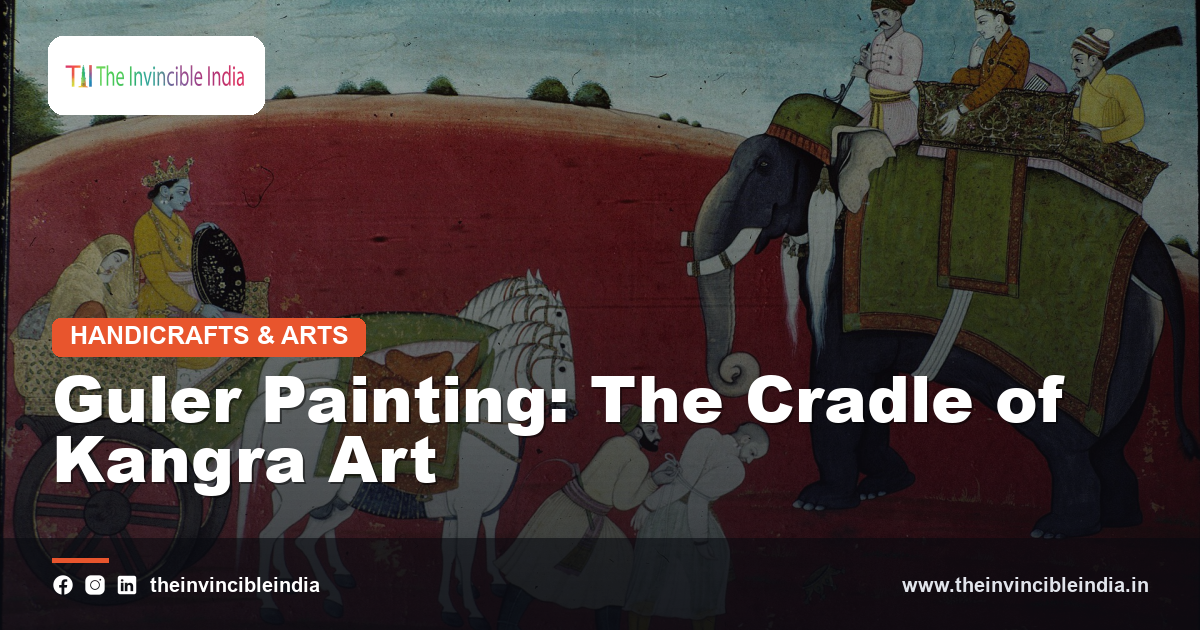
Guler painting is the early phase of the Kangra school of Pahari miniature art, developed in the small hill state of Guler in the western Himalayan foothills of present-day Himachal Pradesh. The style, also called the Guler Kalam, the Guler school or Guler-Kangra painting, is celebrated for its refined naturalism, gentle colour and graceful, idealised figures. It grew out of the bolder manner of earlier hill workshops and handed its lyrical vision to the court of Kangra, where it reached full flower. Like the miniature heritage described in traditional handicrafts of Rajasthan, it is a courtly art of small, jewel-like pictures made for patrons and poets.
Quick answer: Guler painting is a style of Pahari miniature art that originated in the hill state of Guler, in present-day Himachal Pradesh, and is widely regarded as the cradle of the Kangra school. It is known for soft naturalism, delicate lines and idealised, lyrical figures painted in opaque watercolour on paper. The workshops of Guler produced illustrations of Hindu epics, devotional poetry and court portraits, and their refined manner shaped the celebrated Kangra painting that followed.
Key Takeaways
- Guler painting is the earliest phase of the Kangra school of Pahari miniature painting.
- The style takes its name from Guler, a former hill state in the Kangra region of Himachal Pradesh.
- It is known for naturalistic detail, soft colour, fine line and an idealised face with a straight profile.
- The painters Manaku and Nainsukh, traditionally described as sons of Pandit Seu, are the best-known names linked to the tradition.
- Typical subjects include the Bhagavata Purana, the Gita Govinda, Ragamala themes, poetry and court portraits.
- The Guler manner passed to Kangra and other hill courts and became one of the most admired styles of Indian miniature art.
The sections below trace the history, artists, themes, techniques and continuing legacy of this graceful tradition.
Quick Facts
| Detail | Information |
|---|---|
| Type | Courtly miniature painting |
| Region | Guler, Kangra area, Himachal Pradesh |
| School | Early phase of the Kangra style of Pahari painting |
| Period | Flourished mainly in the eighteenth century |
| Medium | Opaque watercolour on paper |
| Best-known painters | Manaku and Nainsukh, linked to the family of Pandit Seu |
What Is Guler Painting?
Guler painting is a school of miniature art from the Himalayan foothills that is regarded as the first and formative stage of the wider Kangra style. Its pictures are small in scale, painted in opaque pigments on paper, and meant to be handled and studied closely rather than hung on a wall. What defines the school is a sense of calm refinement, in which figures move gracefully through gentle landscapes and emotion is expressed through gesture and glance rather than dramatic force. Because the style marks a shift from the bold hill manner toward softness and naturalism, historians often treat Guler as the moment when Pahari painting found its lyrical voice.
Where Is Guler and Why Did Art Flourish There?
Guler is a small former hill state in the Kangra region of Himachal Pradesh, with its old capital at Haripur set beside the Beas river and the lower slopes of the Dhauladhar range. The state was modest in size, yet its rulers maintained a cultured court that welcomed poets, musicians and painters. Fertile valleys, forested hills and flowing water gave local artists a rich visual world to observe, and these natural surroundings later appeared in the soft, observant landscapes of their paintings. The stability of a small, well-run court allowed a settled community of painters to develop its craft over several generations, which is exactly what a refined tradition requires.
How Did Guler Painting Begin?
Guler painting began as an offshoot of the earlier Pahari workshops, whose strong colour and firm outlines gradually gave way to a gentler manner at the Guler court. Scholars describe the change as a blend of local hill traditions with a growing taste for naturalism. One widely repeated account connects the new refinement with painters who moved into the hills from plains workshops, bringing finer drawing and subtler modelling, although the exact route of influence remains debated. What is certain is that the Guler studios produced a recognisably new visual language, and that this language became the seed from which the mature Kangra style later grew.
Pandit Seu and the Family of Master Painters
Pandit Seu is traditionally remembered as the head of a remarkable family of painters associated with the Guler court, whose members carried the workshop tradition through successive generations. Family workshops were the normal way of organising artistic work in the hills, with the father or elder brother planning compositions, younger members preparing paper and pigments, and everyone contributing to the finishing. The names of the family have survived in later accounts, which is unusual for a tradition where most painters remained anonymous. The family model explains how a coherent house style could last for decades, since each generation inherited both technique and vision from the one before.
Who Were Manaku and Nainsukh?
Manaku and Nainsukh are the most celebrated painters linked to the Guler tradition and are traditionally described as sons of Pandit Seu. Manaku is associated with large series illustrating sacred and poetic texts, in which clear storytelling and expressive faces carry the narrative. Nainsukh is remembered for intimate, observant studies of court life, including pictures of a ruler engaged in daily activities, that show a quiet interest in individual character. Together the two brothers represent the range of the tradition, from devotional illustration to near-portrait realism. Their reputations rest on the quality of work attributed to them, and they remain central to every discussion of Pahari painting.
How Is Guler Painting Different From Basohli Painting?
Guler painting differs from Basohli painting mainly in mood and handling, since Basohli favours flat, saturated colour and strong outlines while Guler favours soft modelling, fine line and naturalistic space. Basohli figures often have a bold, almost angular intensity, whereas Guler figures are rounded, delicate and calm. Backgrounds also change, with the plain colour fields of the earlier school giving way to trees, hills and gentle skies painted with careful observation. The two styles belong to the same hill family and share subjects, yet Guler reads as the more lyrical sibling. Understanding this contrast helps viewers place any Pahari miniature along the path from bold to refined.
Naturalism and Soft Colour
Naturalism and soft colour are the two qualities that most clearly set Guler painting apart from earlier hill styles. Painters observed the textures of leaves, the curve of rivers and the glow of the sky, and then translated these observations into delicate washes and carefully graded tones. Pastel greens, gentle blues, warm creams and tender pinks create a peaceful atmosphere in which even dramatic stories feel tender. Light often seems to settle evenly across the scene, giving the pictures a quiet, dreamlike clarity. This preference for harmony over contrast is a defining signature, and it explains why Guler works are often described as poetic rather than powerful.
The Guler Line and the Idealised Face
The Guler line is fine, flowing and controlled, and it gives the school its characteristic elegance. Contours are drawn with a very small brush in a single confident movement, so that the edge of a sleeve, a veil or a face seems to glide across the paper. Faces follow an idealised type, with a straight profile in which forehead and nose form one smooth line, together with long, softly curved eyes and a gentle mouth. Such features are not portraits of individuals but expressions of grace and beauty, particularly in pictures of women and divine figures. This stylised yet tender face is one of the quickest ways to recognise a Guler painting.
What Themes Do Guler Paintings Depict?
Guler paintings depict devotional stories, poetry, musical modes and scenes of court life, with Krishna and Radha among the most beloved subjects. Illustrations of the Bhagavata Purana and the Gita Govinda allow painters to show divine love set within tender, nature-filled landscapes. Other works follow Ragamala traditions, in which musical modes are pictured as human scenes, or portray heroines in the classical poetic categories of love and longing. Court portraits, hunting scenes and glimpses of palace routine complete the range. Whatever the subject, the tone remains reflective and affectionate, and this emotional warmth is what lends the tradition its lasting appeal.
Materials and Pigments
Guler painters worked with natural materials prepared by hand, using paper as the base and pigments ground from minerals, earths and plants. Sheets of handmade paper were often layered and burnished until smooth, giving the surface a fine, even finish that suited delicate brushwork. Pigments were mixed with a binder and applied in thin, opaque layers, while gold and silver were sometimes used for ornaments and details. Brushes were made with very fine hair so that lines could remain precise even at tiny scale. The reliance on natural materials explains the lasting freshness of surviving paintings, whose colours still glow after centuries.
How Is a Guler Miniature Made?
A Guler miniature is made in carefully ordered stages, beginning with a light drawing and ending with fine finishing touches. The artist first sketches the composition in thin lines, often transferring it from an existing drawing or master design, and then outlines the forms with a delicate brush. Flat colour grounds are laid down next, followed by successive layers that build depth and gentle modelling in faces, garments and landscape. Ornaments, borders and highlights come last, sometimes burnished to give a soft sheen. Because each stage depends on the one before, the process rewards patience, and a single small painting could occupy a skilled painter for a long time.
Royal Patronage at the Guler Court
Royal patronage sustained Guler painting by giving artists steady commissions, workshop space and standing at court. Rulers ordered series of paintings for devotion and pleasure, favoured poetic and religious subjects, and valued portraits that recorded court life with dignity. Such support did not simply pay for pictures; it shaped taste, encouraging the quiet refinement for which the school is known. Marriages between neighbouring hill dynasties and the movement of painters between courts also spread Guler ideas across the region. Without informed patrons who appreciated subtlety, the delicate manner of the school might never have matured, and the Guler court deserves much of the credit for its flowering.
From Guler to Kangra: How the Style Travelled
The Guler manner travelled to Kangra and other hill courts as painters, families and pattern drawings moved from one workshop to another, and in Kangra it matured into the style that made Pahari art famous. The Kangra court under its celebrated patron supported a flourishing studio in which Guler training met a taste for sweeter, more ornamental beauty. Many art historians therefore speak of Guler as the cradle of Kangra painting, since the earlier school supplied the techniques, the idealised face and the love of landscape that Kangra developed. This path from one court to the next shows how regional centres shared and refined a single artistic vision.
Where Can Guler Paintings Be Seen?
Guler paintings can be seen in museums and collections across India and abroad, with notable holdings in Himachal Pradesh, Chandigarh, Delhi and several international museums of Asian art. State museums in the hill region display Pahari miniatures as part of their local heritage, while national and university collections preserve many celebrated series. Because the works are small and sensitive to light, they are often shown in rotation, so a visitor may see different pieces from one visit to the next. Published catalogues and digital collections now make it possible to study many of these pictures closely from a distance, which has widened appreciation of the school considerably.
Preservation and Revival
Preservation of Guler painting depends on careful museum conservation, scholarly documentation and the revival of traditional skills among living artists. Paper, pigments and gold are fragile, so curators control light, humidity and handling to protect surviving works. At the same time, art schools and craft institutions in the hill region teach Pahari techniques, allowing new painters to learn brush control, pigment preparation and composition in the traditional manner. Some artists continue the tradition within families, while others adapt it for contemporary buyers. Together these efforts keep both the objects and the know-how alive, ensuring that the school survives as a practice and not only as a collection.
Guler Painting Today
Guler painting today is both a treasured historical legacy and a living inspiration for artists in Himachal Pradesh and beyond. Exhibitions, books and educational programmes present the school as a high point of Indian miniature art, while collectors prize its quiet elegance. Contemporary painters trained in the Pahari manner produce new works that echo the soft palette and fine line of the old masters, and designers borrow its motifs for textiles and decorative objects. The tradition reminds viewers that delicacy can be as powerful as boldness, and that a small hill court could shape the artistic imagination of a whole region. Guler remains the cradle from which Kangra art grew.
Sources & Further Reading
- Ministry of Culture, Government of India (indiaculture.gov.in).
- National Museum, New Delhi (nationalmuseumindia.gov.in).
Frequently Asked Questions
What is Guler painting?
Guler painting is the early phase of the Kangra school of Pahari miniature art, developed in the hill state of Guler in present-day Himachal Pradesh. It is known for soft naturalism, fine line and idealised figures painted in opaque watercolour on paper.
Why is Guler called the cradle of Kangra art?
Guler is called the cradle of Kangra art because its workshops developed the refined, naturalistic style that later matured at the Kangra court. The techniques, the idealised face and the love of landscape all passed from Guler painters into the Kangra tradition.
Who are the most famous Guler painters?
Manaku and Nainsukh are the most famous painters linked to the Guler tradition, and they are traditionally described as sons of Pandit Seu. Their work ranges from large devotional series to intimate studies of court life.
How is Guler painting different from Basohli painting?
Guler painting is softer and more naturalistic than Basohli painting, which uses flat, saturated colour and strong outlines. Guler artists favour fine line, gentle colour and observed landscapes, while Basohli artists favour bold intensity.
What subjects do Guler miniatures show?
Guler miniatures show devotional stories, poetry, musical modes and court life, with Krishna and Radha among the most popular subjects. Common sources include the Bhagavata Purana, the Gita Govinda and Ragamala traditions.
Where can I see Guler paintings?
Guler paintings can be seen in museums in Himachal Pradesh, Chandigarh and Delhi, as well as in several international collections of Asian art. Many pieces are displayed in rotation because the paper and pigments are light-sensitive.


