

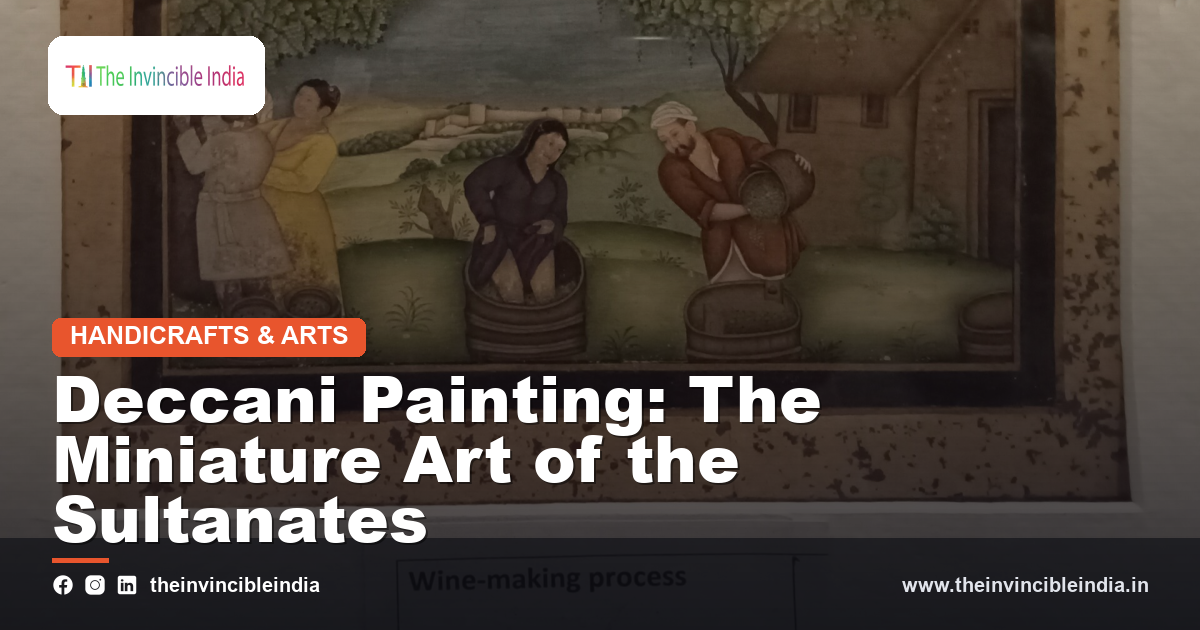
Deccani painting is the miniature art produced at the Muslim sultanate courts of the Deccan plateau in central and southern India, where Persian, Turkish, African and Indian traditions met in a brilliantly original style. Also known as Deccan painting, the Deccani school or Deccani Kalam, it flourished at courts such as Ahmadnagar, Bijapur and Golconda, and later in Hyderabad. Its works glow with rich colour, gold and imaginative landscape, standing apart from the more naturalistic painting of the north. Just as the weavers of Telangana described in Pochampally ikat turned a regional craft into art, Deccani painters turned court taste into a distinctive visual language.
Quick answer: Deccani painting is a school of Indian miniature art created at the Deccan sultanate courts, especially Ahmadnagar, Bijapur and Golconda, from the sixteenth century onward. It is known for rich colour, abundant gold, dreamlike landscapes and elegant figures that blend Persian, Turkish and Indian influences. Subjects include portraits of rulers, Ragamala musical modes, poetry and courtly pleasure, and the style remains one of the most original chapters of Indian painting.
Key Takeaways
- Deccani painting is the miniature art of the Deccan sultanates, with major centres at Ahmadnagar, Bijapur and Golconda.
- The style fuses Persian, Turkish and Indian influences, with further contact through trade with Africa and Europe.
- It is recognised by deep, jewel-like colour, generous use of gold and imaginative, almost dreamlike landscapes.
- Typical subjects include court portraits, Ragamala illustrations, poetry, Sufi themes and scenes of leisure.
- Deccani painting differs from Mughal painting by favouring lyrical fantasy and rich colour over strict naturalism.
- Major collections are held in Hyderabad and in museums across India and the world.
The sections below explain how the style began, how each court shaped it, and why it still matters.
Quick Facts
| Detail | Information |
|---|---|
| Type | Courtly miniature painting |
| Region | Deccan plateau, central and southern India |
| Main centres | Ahmadnagar, Bijapur, Golconda, later Hyderabad |
| Patrons | Sultanate rulers of the Deccan courts |
| Signature | Rich colour, gold, lyrical fantasy landscape |
| Influences | Persian, Turkish, Indian and European |
What Is Deccani Painting?
Deccani painting is the body of miniature work produced for the sultan-ruled courts of the Deccan plateau, and it forms one of the great regional schools of Indian art. The pictures are small, painted in opaque colour on paper, and were made for albums, manuscripts and private enjoyment. Their character is lyrical and imaginative, with luminous colour, decorative richness and a poetic sense of space. Figures are elegant, landscapes are fantastic and ornament is lavish. Because the courts that sponsored the art looked toward Persia and the wider Islamic world as well as toward India, the result is a distinctive and cosmopolitan style that cannot be mistaken for any other.
Where Is the Deccan and Why Did a Distinct Art Emerge?
The Deccan is the high plateau of peninsular India lying south of the Vindhya and Satpura ranges, spread across what is now Maharashtra, Karnataka, Telangana and neighbouring regions. Its distance from the northern capitals gave local rulers freedom to develop independent cultures, while its ports and trade routes connected the courts to Persia, the Ottoman world, East Africa and Europe. Ideas, goods and artists travelled in both directions, enriching local taste. This combination of political independence and open commerce explains why a distinct art emerged, one confident enough to absorb many influences and yet clearly its own.
Which Courts Shaped Deccani Painting?
The main courts that shaped Deccani painting were Ahmadnagar, Bijapur and Golconda, with Bidar and Berar playing smaller roles. Each belonged to a sultanate that emerged from the breakup of the earlier Bahmani kingdom, and each developed its own artistic personality while sharing a common Deccani foundation. Ahmadnagar is associated with early manuscript illustration, Bijapur with refined, lyrical court art, and Golconda with dark, richly gilded compositions. Rivalry and cooperation between the courts encouraged both competition and exchange. Looking at them together reveals a regional culture that was varied within itself and united by a love of luxury and poetry.
How Did Deccani Painting Begin?
Deccani painting began in the sixteenth century, when the successor sultanates of the Bahmani kingdom started to commission illustrated manuscripts and portraits. Early examples, linked especially to Ahmadnagar, show a vivid mixture of Persian and Turkish pictorial ideas with local Indian elements, including costume, architecture and plant forms. The first painters were probably drawn from a blend of Persian-trained artists and Indian craftsmen who adapted older traditions to court demands. Exact dates and attributions for early works are often debated among scholars, yet the general picture is clear. A new regional style was forming, and it was ready to flourish under confident and generous patrons.
The Ahmadnagar School
The Ahmadnagar school is associated with some of the earliest known Deccani paintings, including illustrated manuscripts made for the ruling Nizam Shahi dynasty. Its artists blended Persian, Turkish and Indian elements, producing lively pictures with strong decorative patterns, bright colour and a relaxed approach to space. Ragamala series, which picture musical modes as human scenes, are among the best known works linked with the court. The Ahmadnagar manner is often described as energetic and experimental, which fits a city that was both a political power and a cultural crossroads. These early achievements set the pattern that later Deccani centres refined.
The Bijapur School and Ibrahim Adil Shah II
The Bijapur school, patronised by the Adil Shahi dynasty, is celebrated for refined, lyrical paintings of unusual elegance. Ibrahim Adil Shah II, the court’s most famous ruler, is remembered as a learned lover of music, poetry and the arts, and he is associated with a golden age of Bijapur culture. Painters produced portraits, Ragamala series and scenes of courtly leisure in which delicate figures stand in gardens of flowering plants. Colour is rich and harmonious, and gold is used with restraint and taste. The Bijapur manner shows how patronage guided by poetry and music could shape an art of unusual sensitivity.
The Golconda School
The Golconda school, supported by the Qutb Shahi dynasty, is known for dark, glowing grounds, abundant gold and a love of ornament. Golconda was a prosperous trading kingdom whose wealth and international contacts are reflected in its art, with portraits and scenes of court life rendered in deep blues, greens and reds. Figures wear richly patterned garments, and architecture and furnishing are detailed with care. The overall effect is sumptuous and slightly theatrical. Later Golconda work also shows signs of Mughal influence, which grew stronger as the northern empire expanded southward. Even so, the school preserved a recognisable Deccani richness until the end of the dynasty.
Persian, Turkish, Indian and European Influences
Deccani painting drew on Persian, Turkish, Indian and European influences, and its originality lies in how freely it combined them. Persian art supplied ideas of delicate line, flowering gardens and poetic illustration, while Turkish and Central Asian traditions contributed costume and decorative motifs. Indian painting provided colour sensibility, local costume, plants and devotional themes, and European prints and goods that arrived through ports sometimes inspired details of dress or composition. The Deccani painter rarely copied any one source but instead blended them into a coherent whole. This openness to the wider world is among the style’s most admired characteristics.
How Is Deccani Painting Different From Mughal Painting?
Deccani painting differs from Mughal painting mainly in mood and method, since Deccani artists preferred lyrical fantasy and rich colour while Mughal artists increasingly emphasised naturalism and precise portraiture. Mughal workshops developed careful observation, fine modelling and historical documentation, whereas Deccani painters often treated space as a decorative, imaginative field. Landscapes in Deccani work may feature glowing skies, stylised rocks and dreamlike gardens, with figures set in poetic rather than strictly realistic surroundings. The two traditions did influence one another, particularly after the Mughal conquest of the Deccan. Yet each retained its own character, and comparing them is one of the best ways to appreciate both.
Colour, Gold and Fantasy Landscape
Colour, gold and fantasy landscape are the three features that most strongly define the look of Deccani painting. Painters used deep, saturated tones in lapis blues, emerald greens, warm reds and rich purples, and set them against glowing gold in skies, borders and ornaments. Landscapes are rarely literal views; instead they feature rolling hills, curling clouds and flowering trees arranged to create mood rather than record geography. The resulting scenes feel like the setting of a poem. This emphasis on atmosphere over accuracy gives Deccani painting its dreamlike quality and explains why it appeals so strongly to viewers who love colour and imagination.
What Subjects Did Deccani Artists Paint?
Deccani artists painted portraits of rulers and nobles, Ragamala musical modes, poetic and romantic scenes, Sufi and religious themes, and moments of courtly leisure. Portraits show sultans in splendid dress, often holding flowers or jewels and set against rich backgrounds. Ragamala illustrations transform music into pictures of heroes and heroines in expressive settings. Other works depict hawking, music gatherings and gardens, as well as holy men and mystics. Together these subjects reveal a courtly world devoted to beauty, learning and refined pleasure, and they provide valuable glimpses of dress, ceremony and taste in the sultanate period.
Materials and Technique
Deccani painters used the standard materials of Indian miniature art, with refinements suited to their rich style. Handmade paper was prepared and burnished to a smooth finish, and pigments were ground from minerals, earths and plant sources before being mixed with a binder. Gold and silver, applied as paint or leaf, formed an essential part of the effect, adding brilliance to skies, ornaments and borders. Fine brushes allowed delicate drawing, while successive layers of colour built depth. The careful preparation of these materials explains the lasting brightness of surviving works, whose gold still shines and whose colours remain remarkably strong.
The Mughal Conquest and the Hyderabad School
The Mughal conquest of the Deccan sultanates in the late seventeenth century ended the old courts but did not end Deccani painting. Artists dispersed to new patrons, and Mughal influence entered the style, softening its fantasy and strengthening its naturalism. Later, under the rulers of Hyderabad, a new phase of Deccani painting developed that combined regional traditions with the lessons of Mughal and other schools. This Hyderabad manner continued to produce portraits, courtly scenes and decorative pictures. The survival of the tradition through political change shows how deeply the art had taken root in the culture of the Deccan.
Where Can Deccani Paintings Be Seen?
Deccani paintings can be seen in major museums in India and abroad, with the Salar Jung Museum in Hyderabad among the best known Indian collections. Other national and state museums hold important examples, and several international museums of Asian art display Deccani works as highlights of their South Asian galleries. Because the paintings are delicate, they are usually shown for limited periods, so exhibitions and catalogues play a large part in public understanding. Digital archives and scholarly publications now allow close study of many pieces, helping to place Deccani painting alongside Mughal and Rajput art in the history of Indian miniature painting.
Why Does Deccani Painting Matter?
Deccani painting matters because it shows that Indian miniature art was never a single tradition but a rich conversation among many regions and cultures. It records the cosmopolitan outlook of the sultanate courts, where Persian poetry, Indian music and international trade shaped daily life. It also demonstrates that imagination and colour can be as powerful as realism in painting. For historians it offers evidence of dress, ceremony and cultural exchange, and for artists it remains a source of inspiration. Recognising the Deccani school gives a fuller and fairer picture of India’s artistic heritage.
Deccani Painting Today
Deccani painting today is studied, exhibited and admired as one of the most original achievements of Indian art. Museums in Hyderabad and elsewhere continue to display and research the school, and scholars keep refining knowledge of its courts, artists and workshops. Contemporary artists and designers draw on its glowing palette, ornamental richness and poetic landscapes, while heritage programmes introduce new audiences to the tradition. The style stands as a reminder of a time when the Deccan was a centre of learning, music and refined taste. Deccani painting remains a luminous link between the sultanate past and the living culture of the region.
Sources & Further Reading
- Ministry of Culture, Government of India (indiaculture.gov.in).
- Salar Jung Museum, Hyderabad (salarjungmuseum.in).
Frequently Asked Questions
What is Deccani painting?
Deccani painting is the miniature art produced at the sultanate courts of the Deccan plateau, mainly Ahmadnagar, Bijapur and Golconda. It is known for rich colour, gold and dreamlike landscapes that blend Persian, Turkish and Indian influences.
Which sultanates produced Deccani painting?
The main sultanates behind Deccani painting were Ahmadnagar, Bijapur and Golconda, with smaller contributions from Bidar and Berar. Each court developed its own flavour within a shared Deccani tradition.
How is Deccani painting different from Mughal painting?
Deccani painting favours lyrical fantasy, deep colour and gold, while Mughal painting increasingly stresses naturalism and precise portraiture. The two styles influenced each other, especially after the Mughal conquest of the Deccan.
What subjects are shown in Deccani miniatures?
Deccani miniatures show court portraits, Ragamala musical modes, poetry, Sufi themes and scenes of leisure such as hawking and garden gatherings. They give a vivid picture of sultanate court culture.
What is Ibrahim Adil Shah II known for in art?
Ibrahim Adil Shah II of Bijapur is known as a ruler who loved music, poetry and painting and who presided over a golden age of Bijapur culture. His court is associated with some of the most refined Deccani miniatures.
Where can I see Deccani paintings?
Deccani paintings can be seen at the Salar Jung Museum in Hyderabad and in other major Indian and international museums of Asian art. Exhibitions and digital catalogues also make many works accessible.


