

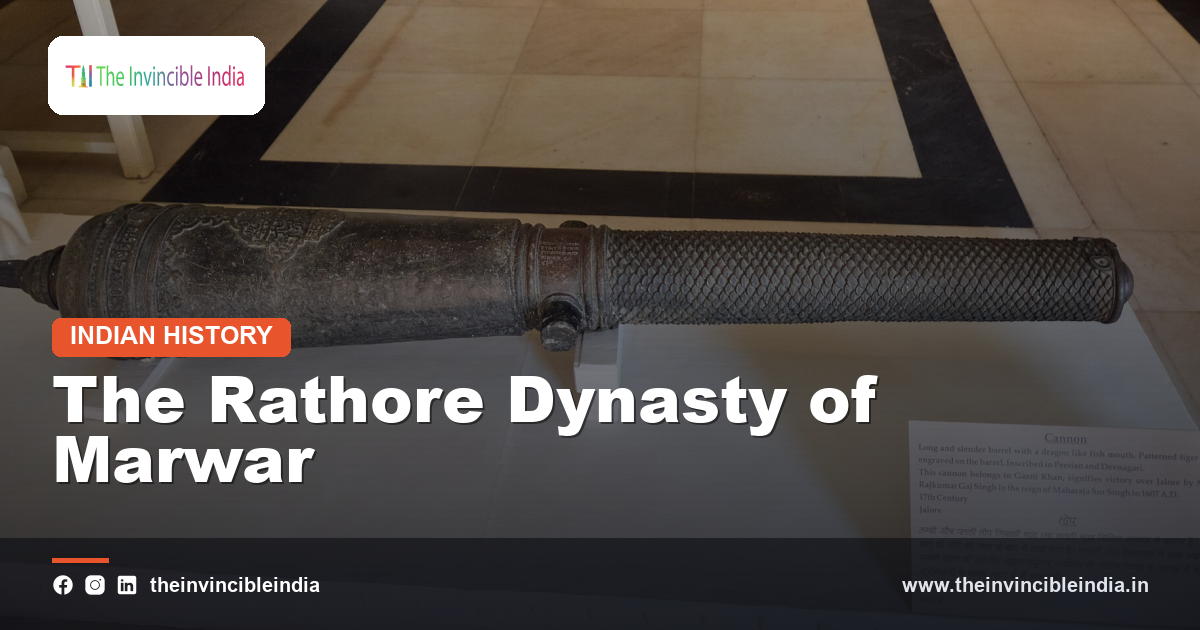
The Rathore dynasty of Marwar, also spelled Rathor or Rathaur and known as the Rathore Rajputs of Jodhpur, ruled the desert kingdom of Marwar in western Rajasthan from the medieval period until the mid-twentieth century. Their capital moved from Mandore to Jodhpur, where the towering Mehrangarh Fort still dominates the skyline. As one of the great Rajput houses described in our guide to the Rajputs, the Rathores combined fierce martial traditions with careful diplomacy toward Delhi. Their early origins are debated, so this guide keeps to general terms and avoids exact dates and counts.
Quick answer: The Rathore dynasty of Marwar was the Rajput ruling house of the desert kingdom of Marwar, in present-day Rajasthan, whose capital was Jodhpur and whose great fortress is Mehrangarh. The dynasty rose to prominence in the medieval period, resisted and later negotiated with the Mughals, and ruled as a princely state until it merged into independent India in the late 1940s. Its rulers are remembered for military valour, palace building and patronage of art and horses.
Key Takeaways
- The Rathore dynasty was the Rajput ruling house of Marwar in western Rajasthan, with its capital at Jodhpur.
- Rao Jodha is traditionally credited with founding Jodhpur and beginning Mehrangarh Fort in the fifteenth century.
- The Rathores earlier ruled from Mandore, whose gardens and cenotaphs survive near Jodhpur.
- The dynasty alternated between resisting and allying with the Mughals, and its Durgadas Rathore is remembered for loyalty to the royal line.
- Umaid Bhawan Palace, built in the twentieth century, is among the largest private residences in the world.
- Marwar merged into the Indian Union and then into Rajasthan after independence.
Read on for the history, culture, and legacy in detail.
Quick Facts
| Detail | Information |
|---|---|
| Dynasty | Rathore (Rathor) Rajputs of Marwar |
| Region | Marwar, western Rajasthan |
| Capitals | Mandore, then Jodhpur |
| Founder of Jodhpur | Rao Jodha, in the fifteenth century |
| Famous Monuments | Mehrangarh Fort, Jaswant Thada, Umaid Bhawan Palace |
| End of Princely Rule | Merger into independent India and Rajasthan in the late 1940s |
Who Were the Rathores of Marwar?
The Rathores were a leading Rajput clan who built the kingdom of Marwar, one of the largest and most enduring states of Rajasthan. Their rulers held the title of Rao and later Maharaja, and they governed a vast region of desert, scrub and trade routes. The dynasty rose from the late medieval period and, despite periods of crisis, held its throne until the end of the princely era. The Rathores were known for strong clan loyalties, a bardic tradition and a code of honour. They stand among the foremost ruling houses of north-western India, alongside the Sisodias of Mewar and the Kachhwahas of Amber.
Where Is Marwar?
Marwar is the western part of Rajasthan, centred on Jodhpur and bordered by the Thar Desert, the Aravalli hills and the plains of Gujarat and Sindh. The name Marwar is generally linked with maru, meaning desert, and the region has long been associated with arid land, resilient pastoral communities and caravan trade. The kingdom controlled routes that carried salt, textiles, opium and other goods between the coast and the northern plains. Its merchants, the Marwaris, spread across India and became known for commerce. Geography thus shaped both the military outlook and the economic life of the Rathore state.
What Are the Origins of the Rathore Clan?
The origins of the Rathore clan are debated, and several traditions compete. One view links the Rathores with the Rashtrakutas, the ancient dynasty described in our guide to the Rashtrakuta rulers, while another ties them to the Gahadavala rulers of Kannauj. A well-known story says that after the fall of Kannauj, a prince named Siha moved to Marwar and established the family there. Historians treat such accounts cautiously, since they were shaped by later clan genealogies and bardic memory. What is secure is that the Rathores were established in Marwar by the later medieval period and expanded their authority steadily.
Mandore: The Early Capital
Mandore was the early capital of the Marwar Rathores and a much older settlement, lying a short distance north of modern Jodhpur. It was already an important town before the Rathores took it, and it remained the seat of the dynasty until the move to Jodhpur. Today the site preserves a garden with royal cenotaphs, a hall of heroes carved from rock and ruined fortifications. The cenotaphs of the Rathore rulers, built in red sandstone, show the clan’s taste for memorial architecture. Mandore thus offers a window into the earliest phase of the dynasty before its later grandeur.
Rao Jodha and the Founding of Jodhpur
Rao Jodha is the ruler traditionally credited with founding Jodhpur and laying the foundations of Mehrangarh Fort in the fifteenth century. He chose a rocky hill commanding the plain and moved the capital from Mandore to the new city, which took its name from him. The decision was strategic, giving the Rathores a stronger fortress and a more central base. The city grew around the fort, with lanes, markets and temples spreading down the slopes. Jodha’s reign is remembered as the turning point when the Rathores became the dominant power of the region, and Jodhpur became the heart of Marwar.
Why Is Mehrangarh Fort So Famous?
Mehrangarh Fort is famous as one of the largest and best-preserved citadels in India, set high on a rocky hill above Jodhpur. Its walls rise sharply from the cliff, and its gateways, courtyards and palaces include delicately carved sandstone windows and screens. The fort was extended by successive rulers, and its museum now displays royal palanquins, weapons, paintings, textiles and musical instruments. Visitors often admire the contrast between the massive defensive walls and the fine ornament within. The fort remains the symbol of Rathore power and a centrepiece of Rajasthan’s heritage.
Rao Maldeo and the Age of Expansion
Rao Maldeo was the most powerful Rathore ruler of the sixteenth century, who extended Marwar’s authority over a wide area and strengthened its forts. He reportedly commanded a large following and played an important role in the politics of north India. His reign is also remembered for the clash with the Afghan ruler Sher Shah Suri, whose campaign into Marwar tested the Rathore forces. Historians differ on the details of the campaign, but the Rathore resistance is widely celebrated in local tradition. Maldeo’s rule marked a high point of territorial strength before the pressure of the Mughal empire grew.
The Rathores and the Mughal Empire
The relationship between the Rathores and the Mughals shifted from resistance to alliance and back to conflict over the centuries. Under Akbar, a Rathore ruler entered imperial service, and Marwar contingents fought for the Mughals in campaigns across the empire. Later rulers such as Maharaja Jaswant Singh held high Mughal ranks and served in Afghanistan and the Deccan. These alliances brought honours, income and security, yet they also bound the Rathores to the fortunes of Delhi. The story is part of the larger pattern described in our guide to the Mughal Empire, where Rajput houses were both partners and rivals.
Who Was Durgadas Rathore?
Durgadas Rathore was a Rathore nobleman and soldier remembered for his loyalty to the Marwar royal line during a crisis in the late seventeenth century. After the death of Maharaja Jaswant Singh, the Mughal emperor Aurangzeb sought to control the succession, and Durgadas is celebrated for protecting the infant heir, Ajit Singh. The long struggle that followed is known as the Rathore war, and it involved alliances with other Rajput houses. Folk songs and ballads preserve his name as a model of fidelity. The exact details of the episode are told with heightened colour, but its broad outline is well established in the historical record.
Maharaja Ajit Singh and the Recovery of Marwar
Maharaja Ajit Singh recovered Marwar after the long struggle with the Mughals and returned to rule from Jodhpur in the early eighteenth century. His reign followed a period of exile and war, and it was marked by shifting alliances as Mughal power weakened. The Rathores re-established their authority, reorganised the nobility and rebuilt their treasury. Court politics remained turbulent, with rivalries within the royal family and the nobility, but the throne was secure. The recovery under Ajit Singh restored the dynasty to the centre of Rajput politics.
How Did the Rathores Branch Out?
The Rathore clan spread beyond Marwar and founded other states, the most notable being Bikaner and Kishangarh. Bikaner was established by a prince of the Jodhpur line who left to seek his own domain in the northern desert, and Kishangarh was founded by another Rathore prince in the early Mughal period. These branches developed their own courts, forts and artistic styles, while keeping the shared clan identity. Kishangarh, for instance, became famous for a refined school of painting. The branching shows the dynamic character of Rajput lineage politics, in which younger sons carved out new kingdoms.
Jaswant Thada and the Royal Memorials
Jaswant Thada is a white marble memorial near Mehrangarh, built to honour Maharaja Jaswant Singh II in the late nineteenth century. Its domes, pavilions and carved marble screens shine in the desert light, and the nearby cenotaphs of later rulers add to the setting. The memorial reflects the long Rajput tradition of commemorating kings with open monuments called chhatris. Visitors often note how the thin marble panels glow when lit from behind. The site also includes a small lake and gardens, making it a quiet counterpart to the massive fort above.
Umaid Bhawan Palace
Umaid Bhawan Palace is a twentieth-century palace in Jodhpur, built by Maharaja Umaid Singh and counted among the largest private residences in the world. It is an example of the Indo-Deco style, combining Indian motifs with the modern lines of its period. Local tradition says that the project gave employment to many people during a time of drought and famine, a story often told in Jodhpur. Part of the building is now a hotel, part a museum, and part the home of the royal family. The palace shows how the Rathores adapted to the modern age while preserving their heritage.
Art, Horses and Jodhpuri Style
Marwar’s culture is known for painting, textiles, music, horse breeding and a distinctive style of dress. The Marwari horse, with its curved ears, is a celebrated indigenous breed that served the Rathore cavalry. The Jodhpuri coat and riding breeches, shaped by the court of the late nineteenth and early twentieth century, spread across India as fashion. Court painters developed the Marwar school of miniature painting, with bold colours and large forms. Folk music from the region, including the Manganiyar and Langa traditions, remains celebrated worldwide. These arts show how a martial state also nurtured a refined culture.
Marwar after Independence
Marwar joined independent India at the end of British rule, and the Jodhpur state merged with neighbouring states to form Rajasthan in the late 1940s. The final Maharaja, Hanwant Singh, took part in the negotiations before the merger, and his early death left the family to shape a new public role. The royal family preserved its heritage through trusts and museums, and Jodhpur became the second largest city of Rajasthan. The history of the merger is told differently by different writers, and this article does not attempt to resolve those debates. The state’s end brought the princely era to a close and opened a new chapter.
The Rathore Legacy Today
The Rathore legacy is visible today in the fort, the palaces, the blue-washed old city and the living traditions of Marwar. Mehrangarh hosts festivals of folk music and the Rajasthan International Folk Festival, and the region’s cuisine, textiles and crafts attract visitors from across the world. The memory of heroes such as Durgadas Rathore remains alive in ballads, and the royal family continues to be part of civic life. Debates over the early origins of the clan continue, yet they do not diminish the dynasty’s importance. The Rathores remain a defining presence in the story of Rajasthan.
Sources & Further Reading
- Archaeological Survey of India (asi.nic.in).
- Ministry of Culture, Government of India (indiaculture.gov.in).
Frequently Asked Questions
Who founded Jodhpur?
Jodhpur was founded by Rao Jodha, a Rathore ruler of Marwar, in the fifteenth century. He moved the capital from Mandore and began the construction of Mehrangarh Fort.
What is Mehrangarh Fort?
Mehrangarh Fort is the great citadel of Jodhpur, built on a rocky hill by the Rathore rulers of Marwar. It is one of the largest forts in India and now houses a museum of royal heritage.
Who was Durgadas Rathore?
Durgadas Rathore was a Rathore nobleman remembered for his loyalty to the Marwar royal line. He is celebrated for protecting the infant heir Ajit Singh during the succession crisis after the death of Maharaja Jaswant Singh.
What is Umaid Bhawan Palace?
Umaid Bhawan Palace is a twentieth-century palace in Jodhpur built by Maharaja Umaid Singh. It is one of the largest private residences in the world and now serves as a residence, hotel and museum.
Where did the Rathore clan come from?
The origins of the Rathore clan are debated. Some traditions link them with the Rashtrakutas, while others point to the Gahadavala rulers of Kannauj, and no single account is universally accepted.
Which other states did the Rathores found?
The Rathores founded Bikaner and Kishangarh, along with other smaller estates. These states were established by princes of the Marwar line and developed their own courts and traditions.


