

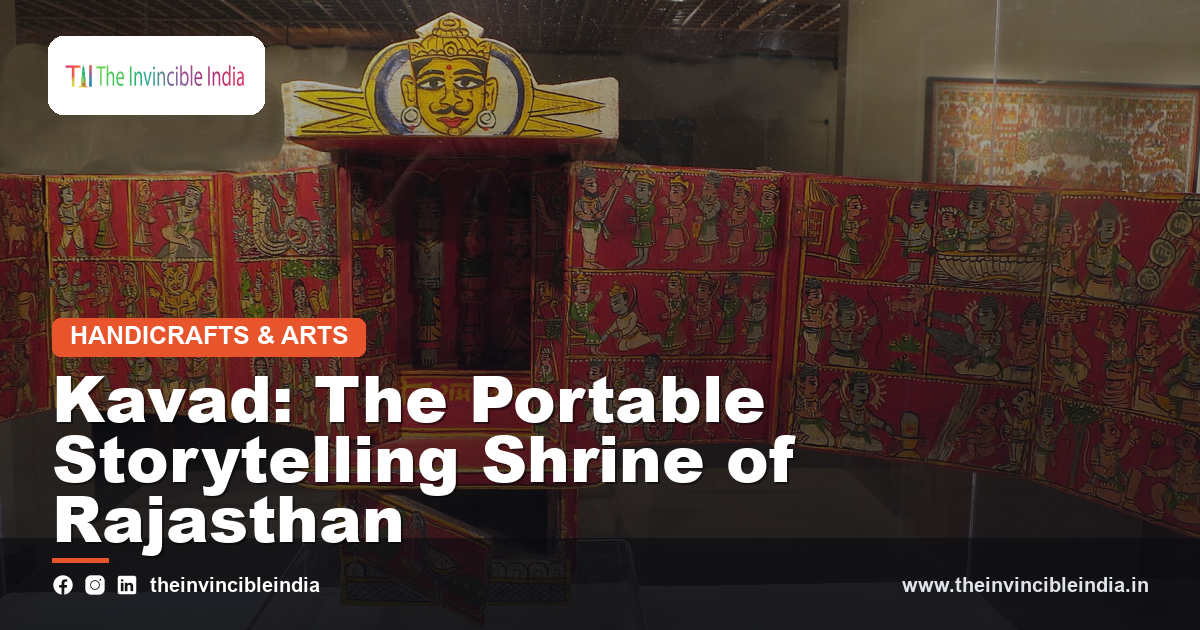
The Kavad is a portable wooden shrine of Rajasthan, painted on every surface and fitted with hinged doors that open one after another as a storyteller narrates the tales shown inside. Also spelled Kawad or Kavar, and known as a storytelling shrine or travelling temple, it is made by carpenters of the Bassi area near Chittorgarh and carried from village to village by a community of bards called the Kavadiya Bhats. It belongs to the same family of picture-based storytelling as the cloth scrolls described in traditional handicrafts of Rajasthan, yet it combines carpentry, painting and oral performance in a single object.
Quick answer: The Kavad is a portable, folding wooden shrine from Rajasthan, painted with gods, epic scenes and folk stories, which a Kavadiya Bhat storyteller opens panel by panel while narrating. Crafted by the carpenter community of Bassi in Chittorgarh district, it serves both as a mobile temple and as a visual aid for oral storytelling. The final panel reveals the central deity, and listeners traditionally make an offering to the bard.
Key Takeaways
- The Kavad is a portable wooden shrine with several hinged doors, each painted with figures and scenes from sacred and folk stories.
- It is traditionally made by the carpenter community of Bassi, a village in Chittorgarh district of Rajasthan.
- Kavadiya Bhats are the storytellers who carry the Kavad and narrate its tales as they open the doors one by one.
- Common subjects include the Ramayana, the Mahabharata, the avatars of Vishnu and the legends of folk heroes.
- The Kavad also records the genealogies of patron families, which gives the storytellers a social as well as a religious role.
- Today the Kavad is also made as a decorative craft object, in sizes from small tabletop pieces to large display shrines.
The sections below explain how the Kavad is built, painted, carried and performed, and how the tradition continues.
Quick Facts
| Detail | Information |
|---|---|
| Type | Painted portable wooden shrine |
| Region | Bassi, Chittorgarh district, Rajasthan |
| Craftspeople | Carpenter (Suthar) community of Bassi |
| Storytellers | Kavadiya Bhats |
| Subjects | Epics, deities, folk heroes and lineages |
| Use | Mobile temple and oral storytelling aid |
What Is a Kavad?
A Kavad is a wooden cabinet-like shrine whose outer and inner panels are covered with paintings and which opens like a book to tell a story. The closed object looks like a small painted box, but its hinged doors unfold in sequence, each revealing new scenes of gods, heroes and legends. The storyteller uses the images as a guide while narrating, and the audience follows the story as the doors open. At the end the final panels show a central deity in a small shrine, so the object becomes a place of worship as well as a story. This union of sculpture, painting and performance makes the Kavad a very rich folk form.
Where Does the Kavad Come From?
The Kavad comes from Rajasthan, and its best-known centre of manufacture is Bassi, a village in the Chittorgarh district of the southern part of the state. The surrounding region of Mewar has a long tradition of painting, temple building and storytelling, which provided a natural home for the craft. Kavadiya Bhat storytellers carried finished shrines far beyond Bassi, travelling through villages of Rajasthan and neighbouring areas. In this way a craft made in one place became known across a wide cultural region. The link between the carpenters of Bassi and the travelling bards forms the human core of the tradition and explains why Kavad is closely tied to this part of Rajasthan.
What Does the Word Kavad Mean?
The word Kavad, also written Kawad or Kavar, refers to a portable shrine or a door-bearing storytelling cabinet in the dialects of Rajasthan. The name is connected with the idea of doors or shutters, which is the feature that distinguishes the object from a flat painting. It is related to words used in other parts of India for travelling shrines and carried loads of devotion. Scholars note that the term and the form have regional variants, so the Kavad of Rajasthan should be understood as one particular expression of a wider tradition. The meaning of the name therefore points to both the practical structure of the object and its devotional use.
Who Are the Kavadiya Bhats?
The Kavadiya Bhats are a community of traditional bards and genealogists who carry the Kavad and narrate its stories. Their craft is oral, passed down from elders to younger members, and combines recitation, song and explanation. They travel on routes that have been used for generations, visiting the families who patronise them and performing before village audiences. Besides stories of gods and heroes, they keep records of family lineages, which gives their visits social importance. A patron family listens, receives its history from the storyteller and makes a gift in return. The Kavadiya Bhat is therefore at once priest, entertainer and keeper of memory, and without this role the Kavad would be only an object.
How Is a Kavad Performed?
A Kavad is performed by the storyteller opening its doors one at a time while narrating the corresponding episode in a rhythmic, half-sung style. The Kavadiya Bhat sets the shrine before the audience, begins with an invocation and then opens the first panel to show the opening scene. Each following door advances the story, with the bard pointing to figures and explaining their actions. The performance grows in intensity until the last panels are opened to reveal the central deity, at which point listeners offer money or gifts. Because the sequence of doors fixes the order of the tale, the object also acts as a memory aid. Image and speech are thus bound together in a single ritual of telling.
Who Makes the Kavad in Bassi?
The Kavad is made by the carpenter community of Bassi, known locally as Suthars, whose families have worked in wood for many generations. Skills of carving, joinery and painting are learned by watching and helping elders, and a single household may handle every stage from timber to finished shrine. The craftspeople of Bassi are also known for painted wooden toys and temple models, which share the same methods and vivid colours. Their work depends on a close relationship with the storytellers who commission and carry the shrines. The carpenters are therefore not only makers but also partners in a living oral culture, and their continuing work keeps the tradition alive.
What Wood and Materials Are Used?
The Kavad is built from lightweight local wood chosen for easy carving, joining and carrying, together with simple fittings such as hinges and fasteners. Panels are cut to size, smoothed and fitted so that the doors fold neatly against one another without catching. A priming layer is applied to the wood to make the surface smooth for painting. The use of light wood is practical, because the storyteller must carry the shrine on long journeys, often on foot. Careful joinery keeps the structure strong despite repeated opening and closing. The choice of materials thus reflects the working life of the object, which must be both beautiful and portable.
How Is a Kavad Painted?
A Kavad is painted by covering the prepared wood with a strong base colour, usually a bright red, and then adding figures and ornament in contrasting hues. Traditional painters used natural and mineral colours, and today many also use modern paints that are brighter and more durable. Outlines are drawn in dark colour, and the figures are filled with flat tones of yellow, green, white and black. Borders, flowers and geometric patterns frame each scene. The painter must plan the layout carefully, since every panel has to fit the story sequence and the shape of the doors. The result is a dense, colourful surface that holds the eye and invites close looking.
What Stories Does the Kavad Tell?
The Kavad tells stories from the Ramayana and the Mahabharata, accounts of the avatars of Vishnu, tales of Krishna, and legends of local heroes and deities. Moral tales, such as the story of Shravan Kumar and his devotion to his parents, are among the favourites, as they carry clear lessons for family life. Episodes from epic literature are adapted to the compact space of the doors, so each scene is simplified into a few clear figures. Storytellers shape the narrative to suit the audience, adding local detail and commentary. The Kavad therefore preserves widely shared religious literature while allowing a regional voice, which is why it has stayed popular for so long.
Why Is the Kavad Called a Portable Temple?
The Kavad is called a portable temple because it carries sacred images and functions as a shrine that can be taken to people who cannot easily travel to a temple. When the last doors open to reveal the deity, the audience may offer worship, and the act of viewing becomes a form of darshan. For villagers far from major pilgrimage centres, the arrival of the storyteller brought the sacred world to their doorstep. The object thus served both education and devotion. This role as a mobile place of worship explains the care taken in painting and the reverence shown to the Kavad. It is a temple, a book and a stage in one.
The Kavad and Family Genealogies
The Kavad is linked to the keeping of family genealogies, since the Kavadiya Bhats traditionally maintain records of the lineages of their patron families. During a visit the storyteller may recite the family history, noting births, marriages and notable events, and the family acknowledges the service with a gift. Such records are held in memory or in written registers and are passed from one generation of bards to the next. This custom gives the Kavad a social function beyond entertainment, because it strengthens ties between families and their hereditary storytellers. It also shows how oral tradition can serve as a form of archive, preserving the identity and history of communities that left few other records.
How Does the Kavad Differ from Phad Painting?
The Kavad differs from phad painting in form, since a phad is a long painted cloth scroll while a Kavad is a wooden shrine with hinged doors. Both are Rajasthani traditions of narrative art carried by performers, and both depend on a storyteller who explains the images to an audience. The phad is unrolled and displayed in front of the singer, whereas the Kavad is opened scene by scene like a book with shutters. Their painted figures share the bold colour and strong outline of regional folk art. Comparing the two helps viewers see how Rajasthan developed several ways of joining image and voice, each suited to a different craft community.
The Kavad as a Decorative Craft Today
The Kavad is now also made as a decorative craft, bought by collectors, visitors and institutions who admire its colour and construction. Craftspeople produce shrines of various sizes, from small tabletop models to large display pieces, and often adapt the themes for contemporary tastes. Exhibitions and craft fairs have given the Kavad wider recognition as an art object. This new market provides income for carpenter families, even though it may differ from the original devotional use. Many makers try to keep the traditional form, with its doors and sacred subjects, so that the object remains meaningful. The decorative Kavad thus extends the life of the craft beyond its first setting.
What Challenges Does the Tradition Face?
The Kavad tradition faces challenges as audiences shift to new forms of entertainment and travelling storytellers find fewer occasions to perform. Younger people may seek other work, which makes it harder to pass on carpentry, painting and oral skills. The craft also competes with cheaper factory goods and with imitations that lack its devotional meaning. Without regular patronage, the link between makers and storytellers weakens, leaving the shrine as an object without a performance. These pressures do not erase the tradition, but they make support necessary. Recognising the Kavad as a complete art of making and telling is the first step toward protecting it for future generations.
How Is the Kavad Being Preserved?
The Kavad is being preserved through craft fairs, museum displays, training workshops, cultural festivals and efforts to document the work of the Bassi carpenters and the Kavadiya Bhats. Government and cultural bodies promote handicrafts of Rajasthan, and artisans are encouraged to reach buyers directly. Performances at festivals show visitors how the doors open and the story unfolds, which restores the object to its living context. Younger family members who learn both the making and the telling help ensure continuity. Good documentation also records the stories and genealogical practices that might otherwise fade. Together these steps help maintain the Kavad as both a craft and a performing art.
Kavad Storytelling Today
Kavad storytelling today survives as a vivid expression of Rajasthan’s creative heritage, shown in festivals, museums and the homes of collectors. Visitors to Bassi and to Rajasthani craft fairs can still see painted shrines being made and, with luck, watch a storyteller open the doors and narrate. The tradition demonstrates that a craft can unite carpentry, painting, music and devotion without losing coherence. Its portable form, once practical for travel, now makes it an appealing object for display and education. By valuing the Kavad, modern audiences honour both the skill of the makers and the memory kept by the bards, and they help the shrine continue to open its doors.
Sources & Further Reading
- Ministry of Culture, Government of India (indiaculture.gov.in).
- Sangeet Natak Akademi (sangeetnatak.gov.in).
Frequently Asked Questions
What is a Kavad?
A Kavad is a portable wooden shrine from Rajasthan with painted, hinged doors that open one by one as a storyteller narrates the tales shown inside. It works as both a mobile temple and a visual aid for oral storytelling.
Where is the Kavad made?
The Kavad is traditionally made in Bassi, a village in the Chittorgarh district of Rajasthan. The work is done by the local carpenter community, whose families have practised the craft for generations.
Who are the Kavadiya Bhats?
The Kavadiya Bhats are traditional storytellers and genealogists who carry the Kavad and narrate its stories. They also maintain the family histories of their patrons and receive gifts in return.
What stories are painted on a Kavad?
A Kavad is painted with stories from the Ramayana and the Mahabharata, the avatars of Vishnu, tales of Krishna and legends of folk heroes. Moral tales such as that of Shravan Kumar are also very common.
How is a Kavad different from a phad?
A Kavad is a wooden shrine with hinged doors, while a phad is a long painted cloth scroll. Both are Rajasthani storytelling arts, but the Kavad is opened like a book and the phad is unrolled.
Can a Kavad be bought as a handicraft?
Yes, the Kavad is now made as a decorative handicraft and can be bought at craft fairs, emporiums and in Bassi itself. Buyers should choose pieces made by recognised artisans to support the traditional makers.


