

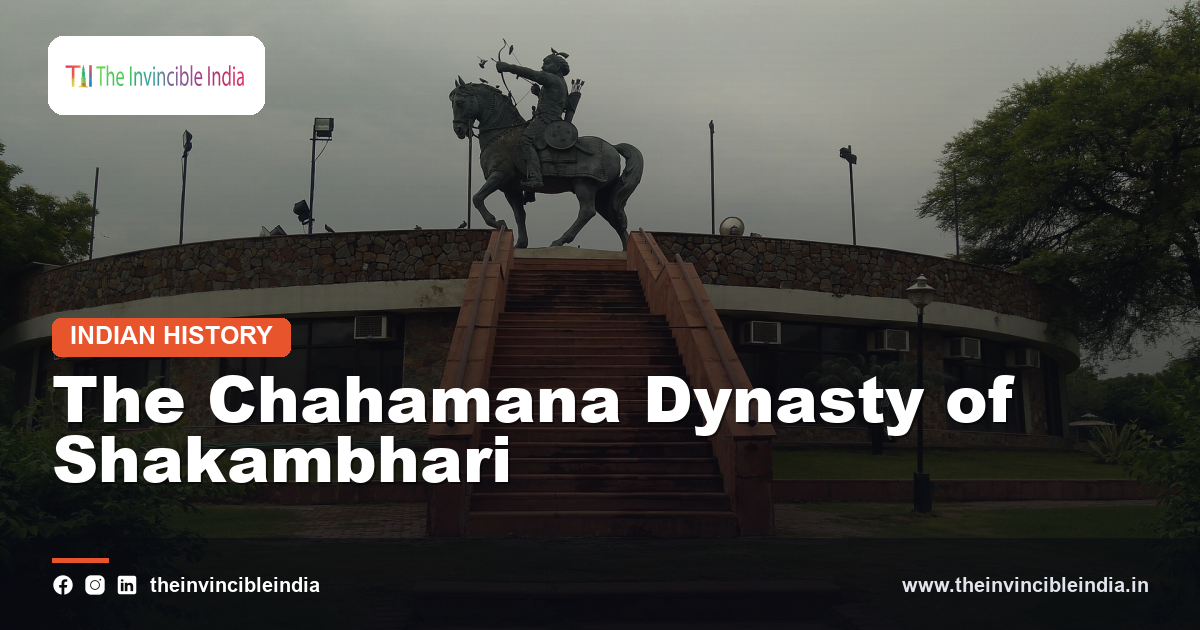
The Chahamana dynasty of Shakambhari, also spelled Chahamana or Chauhan and called the Chahamanas of Sapadalaksha, was an early medieval Rajput ruling family of eastern Rajasthan. Their first home lay around Shakambhari, the region of the salt lake now called Sambhar, and their power later centred on Ajmer, once known as Ajayameru. Several branches of the family ruled other places, and the best-known king of the main line is Prithviraj III. Many dates in the dynasty’s early history are debated, so this guide uses general terms. A closer portrait of the most famous Chahamana appears in our guide to Prithviraj Chauhan.
Quick answer: The Chahamana dynasty of Shakambhari was a Rajput ruling family, known as the Chauhans, that governed parts of present-day Rajasthan from the early medieval period, first from Sambhar and later from Ajmer. They fought regional rivals, patronised Sanskrit literature and built lakes, temples and forts. Their line is best known for Vigraharaja IV and for Prithviraj III, whose defeat in the late twelfth century opened north India to new powers.
Key Takeaways
- The Chahamanas were a Rajput dynasty, also called Chauhans, who began near Sambhar Lake and later ruled from Ajmer.
- Their domain was often called Sapadalaksha, and the goddess Shakambhari was their family deity.
- Vigraharaja IV, known as Visaladeva, is remembered for conquests and for his Sanskrit plays inscribed on stone.
- Prithviraj III is the most famous Chahamana, remembered for the battles of Tarain in the late twelfth century.
- Branches of the family founded kingdoms at Ranthambore, Nadol, Jalor and other places.
- Sources include inscriptions, Sanskrit poems and later bardic works, so many details are debated.
Read on for the history, culture, and legacy in detail.
Quick Facts
| Detail | Information |
|---|---|
| Dynasty | Chahamanas of Shakambhari (Chauhans of Sambhar and Ajmer) |
| Region | Eastern Rajasthan, the area called Sapadalaksha |
| Early Seat | Shakambhari (Sambhar), later Ajmer |
| Family Deity | Goddess Shakambhari |
| Best-Known Kings | Vigraharaja IV and Prithviraj III |
| Period | Early medieval to late twelfth century (main line) |
Who Were the Chahamanas of Shakambhari?
The Chahamanas of Shakambhari were an early medieval dynasty from the region of eastern Rajasthan who grew from local rulers into one of the leading Rajput powers of north India. The name Chahamana, later shortened in popular speech to Chauhan, appears in inscriptions that trace the family to a legendary ancestor, while the territory they ruled is often called Sapadalaksha. Their capital in the early period was Shakambhari, and by the later phase Ajmer served as the main seat. Historians study the family through temple and stone inscriptions, Sanskrit poems and chronicles written in praise of kings. Because these records can be partisan, the dynasty is reconstructed by comparing them. The picture that emerges is of a family that rose steadily through warfare, alliance and patronage of learning.
Where Is Shakambhari and Why Does It Matter?
Shakambhari is the name of the old region and town around Sambhar Lake in Rajasthan, and it matters because it gave the dynasty both its title and its first economic base. The lake produced salt, a valuable commodity in a dry land, and control of such resources helped the early rulers gather wealth and followers. The name also belongs to a goddess, Shakambhari Devi, a form of the divine feminine associated with plants and abundance, and the Chahamanas treated her as their family deity. A shrine of the goddess near Sambhar remains a place of pilgrimage. The link between place, goddess and dynasty explains why the family used Shakambhari in its identity long after its capital moved. It shows how medieval kingdoms fused geography, religion and politics.
What Is the Origin Story of the Chahamanas?
The origin of the Chahamanas is explained in inscriptions through a legendary ancestor and in later tradition through the story of the fire-born clans, and modern scholars debate how to read both. Some medieval inscriptions trace the family to a mythic hero, while later bardic works describe four Rajput lineages, including the Chahamanas, as born from a sacrificial fire on Mount Abu. Historians generally see the fire-born tale as a later literary device, and they discuss whether the early Chahamanas were local chiefs who rose in status in the post-Gupta age. The debate is unresolved, and no single theory is accepted by everyone. What is certain is that by the early medieval period the family held land in the Sambhar region, issued inscriptions and claimed a high place among the Rajput houses.
Who Were the Early Rulers of the Dynasty?
The early rulers of the Chahamana dynasty were regional chiefs whose names survive mostly in inscriptions, and they slowly built the kingdom that later kings enlarged. Inscriptions name a founding figure, often given as Vasudeva, and a line of successors who fought neighbours, supported temples and, in some cases, served stronger overlords in the age of the Gurjara-Pratiharas. Over time the family gained independence as the older empire weakened. The chronology of these first generations is debated because inscriptions are few and sometimes undated or damaged, so scholars give only approximate periods. The importance of this stage lies in the foundations it laid, namely control of Sambhar salt, fortified towns and a tradition of royal patronage. By the later period, the Chahamanas were ready to compete with the great powers of north India.
Why Is Ajmer Important in Chahamana History?
Ajmer is important in Chahamana history because it became the chief seat of the dynasty and a fortress guarding the passes of the Aravalli hills. Tradition credits Ajayaraja II, one of the early medieval kings, with founding the city under the name Ajayameru and with building the hill fort later called Taragarh. The city lay between the plains of north India and the routes towards Gujarat and Malwa, which gave its rulers strategic and commercial advantages. Under later Chahamana kings it grew into a centre of learning and worship, and its lake, Anasagar, remains a notable monument. Later powers, including sultans and Mughals, also valued Ajmer, and it became a major pilgrimage place for Muslims as well. Its layered history began, however, as a Chahamana capital.
What Did Arnoraja Contribute?
Arnoraja, also called Anaji, was a Chahamana king remembered for defending the kingdom and for creating the lake known as Anasagar at Ajmer. Inscriptions and later tradition describe him as a ruler who faced attacks from the west and who, according to the sources, won a notable victory over invading forces. He also engaged in conflict and alliance with the Chaulukyas of Gujarat, a pattern that would continue for generations. The lake attributed to him was designed to store water for the city and became a place of gardens and later marble pavilions. Exact details of his campaigns are debated, since our knowledge comes from inscriptions and from court poems with a laudatory tone. His reign is remembered as the time when the Chahamanas strengthened their hold on Ajmer and began to look outwards.
Why Is Vigraharaja IV Called a Scholar-King?
Vigraharaja IV, also known as Visaladeva, is called a scholar-king because he combined military expansion with patronage of Sanskrit literature and learning. Inscriptions describe campaigns that extended Chahamana influence over neighbouring territories, including the region of Delhi, and place his reign among the high points of the dynasty. He is also remembered for a play, the Harikeli Nataka, which is attributed to him and which was inscribed on stone slabs. A second drama, the Lalitavigraharaja, was composed in his honour by a court poet. These literary works make him unusual among medieval kings, because the written words of rulers rarely survive in such a form. His reign shows that the Chahamana court valued culture as well as power, and it left a legacy that later generations admired.
What Is the Adhai Din Ka Jhonpra Connection?
The Adhai Din Ka Jhonpra in Ajmer is a mosque with an elaborate screen of arches that incorporates carved stones from earlier buildings, and tradition links it to a Sanskrit college built in the time of the Chahamanas. The older structure is often associated with Vigraharaja IV, and the plays inscribed on stone slabs were reportedly found in the ruins. After the conquest of Ajmer by the Ghurid commanders, the building was converted into a mosque, and the surviving screen shows a blend of Hindu and Islamic craftsmanship. Historians continue to discuss which parts of the story are historical and which are later tradition. The monument remains valuable as evidence of how the city changed hands and how art and learning crossed cultural lines. Its carvings still draw scholars and visitors.
How Did the Chahamanas Relate to the Chaulukyas and Other Rivals?
The Chahamanas were involved in a long series of conflicts and alliances with neighbouring powers, especially the Chaulukyas of Gujarat, the Paramaras of Malwa, the Gahadavalas of Kannauj and the Chandellas of Bundelkhand. Medieval India had no single supreme state at this time, and kingdoms competed for fertile land, trade routes and prestige. Warfare often followed marriage alliances that failed or grew into rivalry, and inscriptions on all sides claim victories that are hard to compare. These conflicts weakened every party, so that when a strong external enemy appeared, the kings of north India could not easily unite. The Chahamana experience therefore illustrates the fragmentation of the age. It also explains why later chroniclers described the era as one of brave but divided Rajput houses.
Who Was Prithviraj III?
Prithviraj III, often called Prithviraj Chauhan, was the Chahamana king best known to history and legend, and he ruled from Ajmer in the late twelfth century. Inscriptions and the Sanskrit poem Prithviraj Vijaya, written in his time, present him as a young and ambitious king who fought neighbouring rulers and extended Chahamana control towards Delhi. Later popular memory made him a hero of Rajput valour, in part through the bardic work Prithviraj Raso, whose historical accuracy is debated. He is remembered above all for facing the invasions of Muhammad of Ghor. Because the legend is so powerful, careful readers separate the king of inscriptions from the figure of poetry. Both contribute to his lasting fame in Indian cultural memory.
What Happened at the Battles of Tarain?
The battles of Tarain were two clashes in the late twelfth century between Prithviraj III and the Ghurid ruler Muhammad of Ghor, fought on the plain of Tarain north of Delhi, and they changed the political map of north India. In the first encounter the Chahamana forces are generally said to have prevailed, while in the second the Ghurid army won and the Chahamana king was defeated. The exact numbers, tactics and personal details vary among sources and are debated, since Persian chronicles and Indian poems tell the story differently. The second battle opened the way to the Ghurid conquest of Delhi and Ajmer and to the later Delhi Sultanate. Its significance is therefore political and structural, marking a turning point from regional Rajput kingdoms to a larger sultanate order.
Who Were the Branches of the Chauhan Family?
The Chauhan family had several important branches that ruled other parts of northern and western India, and some outlasted the main line at Ajmer. After the defeat of Prithviraj III, a branch continued at Ranthambore, led by descendants who kept the fort for generations, while others held Nadol and Jalor in southern Rajasthan. Later clans such as the Hadas of Bundi and Kota also claimed Chahamana descent, as did other Chauhan groups in different regions. The spread of the family shows how Rajput identity travelled with ruling houses and warriors. Scholars discuss the exact links between these branches, since many genealogies were written later to assert prestige. The point to remember is that the Chahamana name survived long after the fall of Ajmer through collateral lines.
How Do Historians Use Inscriptions and Poems?
Historians reconstruct Chahamana history through a combination of inscriptions, Sanskrit court poems, Persian chronicles and later bardic works, and each source has strengths and weaknesses. Stone and copper-plate inscriptions give names, lineages and grants, but they praise their patrons. Sanskrit poems such as the Prithviraj Vijaya and the Hammira Mahakavya, the latter dealing with a later Chauhan king, offer narrative detail within a poetic framework. Persian chronicles present the viewpoint of the invading dynasties. Bardic compilations like the Prithviraj Raso preserve oral memory but contain legend and later additions. By comparing these sources scholars can test a claim, and where they disagree they leave the question open. This method explains why some Chahamana dates and episodes remain debated in modern scholarship.
What Was Chahamana Contribution to Architecture and Water Management?
The Chahamanas contributed to architecture and water management through forts, temples and reservoirs adapted to the dry landscape of Rajasthan. The hill fort at Ajmer, the lake of Anasagar and the temples dedicated to Shiva, Vishnu and the goddess reflect royal patronage of building and public works. Many of the original temples were later damaged or rebuilt, so the surviving record is incomplete, and the clearest evidence comes from inscriptions and from stones reused in later structures. The care for lakes and wells shows an understanding that in a semi-arid zone water was the foundation of settled life. This emphasis on practical infrastructure linked the rulers with their subjects and helped them hold the loyalty of farmers and traders. It remains a quiet but important part of their legacy.
The Chahamana Legacy Today
The Chahamana legacy today endures in the memory of Prithviraj III, the pilgrimage of Shakambhari, the lake and fort of Ajmer, and the many Chauhan families who trace their descent to the dynasty. Popular culture, from folk ballads to modern films and television, keeps retelling the story, sometimes blending fact and legend. Scholars continue to study inscriptions and texts to refine the chronology and understand the political world of the twelfth century. The dynasty reminds readers that Rajput history is not only about battles but also about literature, water engineering and religious devotion. Visiting Ajmer, Sambhar and the old fort sites with this background gives a richer sense of the layers of history in Rajasthan. The Chahamanas thus remain central to the story of early medieval India.
Sources & Further Reading
- Archaeological Survey of India (asi.nic.in).
- Ministry of Culture, Government of India (indiaculture.gov.in).
Frequently Asked Questions
Who were the Chahamanas of Shakambhari?
The Chahamanas of Shakambhari were a Rajput dynasty, known as Chauhans, who ruled eastern Rajasthan from Sambhar and later Ajmer in the early medieval period. Their most famous king was Prithviraj III.
Where was Shakambhari located?
Shakambhari was the region and town around Sambhar Lake in Rajasthan. It was also the name of the goddess worshipped as the family deity of the Chahamanas.
Who was the greatest Chahamana king?
Many historians regard Vigraharaja IV as the dynasty’s greatest builder and scholar-king, while Prithviraj III is the most famous in popular memory. Vigraharaja extended the kingdom and patronised Sanskrit drama, and Prithviraj became a symbol of resistance.
What happened at the Battles of Tarain?
The two Battles of Tarain were fought in the late twelfth century between Prithviraj III and Muhammad of Ghor. The Chahamana king is generally said to have won the first and lost the second, which led to Ghurid control of Delhi and Ajmer.
Are the Chauhans today descended from the Chahamanas?
Many Chauhan families today claim descent from the Chahamanas, and branches such as the Hadas of Bundi and Kota trace their origin to the dynasty. Exact genealogical links are often debated by historians.
What are the main sources for Chahamana history?
The main sources are inscriptions, Sanskrit poems like the Prithviraj Vijaya, Persian chronicles and later bardic works such as the Prithviraj Raso. Historians compare them because each has bias or limits.


