

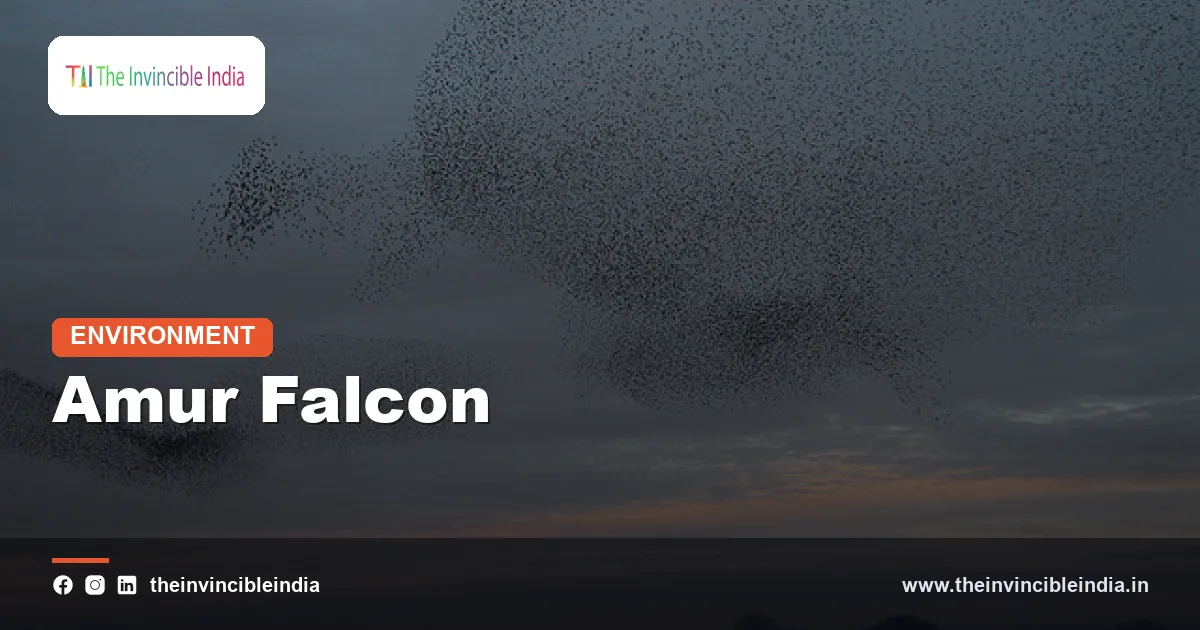
Amur falcon conservation in India is the effort to protect the Amur falcon (Falco amurensis), a small migratory raptor that travels between East Asia and southern Africa and stops in Northeast India, especially around the Doyang reservoir in Nagaland, to feed and roost on the way. The species is one of the longest-distance migrants among all birds of prey, and India hosts it for a few weeks each October and November, when hundreds of thousands of birds, by some estimates more than a million, gather in a handful of roosting sites.
The Amur falcon became a household name in India after reports around 2012 revealed that tens of thousands of roosting birds were being trapped and killed for meat in Nagaland. Within a few years, village councils, the state forest department and conservation groups turned the situation around, and the bird is now celebrated locally as a guest to be protected. The story is widely cited as a rare example of community-led wildlife protection working at scale.
| Scientific name | Falco amurensis |
|---|---|
| Common names | Amur falcon, eastern red-footed falcon |
| Type of bird | Small migratory falcon (bird of prey) |
| Breeding range | Southeastern Siberia and northern China, including the Amur River region |
| Wintering range | Southern and south-eastern Africa |
| Key stopover in India | Doyang reservoir, Wokha district, Nagaland, plus parts of Manipur and Assam |
| Season in India | Roughly October to November (autumn passage) |
| Local flagship village | Pangti, Wokha district, Nagaland (Lotha Naga community) |
| IUCN status | Least Concern globally, with concern about local hunting |
Key Takeaways
- The Amur falcon is a pigeon-sized raptor that breeds in southeastern Siberia and northern China and winters in southern Africa, making one of the longest migrations of any raptor.
- Northeast India, and above all the Doyang reservoir area of Wokha district in Nagaland, serves as the Amur falcon’s main refuelling and roosting stop in India each autumn.
- Reports around 2012 estimated that well over 100,000 Amur falcons were being netted and killed for meat in Nagaland in a single season, which triggered national and international outrage.
- Community-led protection by Naga villages, working with the Nagaland forest department and conservation groups, reduced the hunting sharply within a few years, and Pangti village is now known as the “falcon capital”.
- Amur falcons are legally protected in India under the Wildlife (Protection) Act, 1972, and the species is covered by international migratory-bird agreements.
- Satellite tagging of Amur falcons in 2016 showed that the birds cross the Arabian Sea in a long non-stop flight to reach Africa.
What is the Amur falcon?
The Amur falcon is a small raptor in the falcon family, named after the Amur River basin that forms part of its breeding range between Russia and China. Adults weigh only about 150 grams, which is lighter than most pigeons, and the wingspan is roughly 60 to 75 centimetres.
Males are mostly slate-grey with striking rust-red thighs and undertail, along with red-orange legs, feet and a ring of skin around the eye. Females are paler, with a whitish underside marked by dark streaks or bars, a slate-grey back and orange legs. Juveniles resemble females but have a browner, more streaked look.
The species was once treated as a form of the red-footed falcon of Europe, and it is still sometimes called the eastern red-footed falcon. Ornithologists now treat it as a separate species. The Amur falcon feeds mainly on insects, particularly flying termites, dragonflies, locusts and grasshoppers, which it catches in flight or hovers above grass to spot.
How far does the Amur falcon migrate?
The Amur falcon migrates roughly 20,000 kilometres or more in a round trip between its Asian breeding grounds and its African wintering areas, making it one of the longest annual journeys of any bird of prey. The exact distance depends on the route and individual bird, and estimates vary between sources.
After breeding in Siberia and northern China in the northern summer, the birds head south-west across China, passing through Northeast India in October and November. They then cross the Bay of Bengal region and peninsular India, and fly across the Arabian Sea to the Horn of Africa. From East Africa, the falcons move south to reach countries such as Kenya, Tanzania, Zambia, Botswana, Namibia and South Africa for the southern summer.
In spring, the falcons return north by a different route that is thought to pass farther west, and they are seen in India far less visibly on the way back. This loop migration, with different outbound and return paths, is common among long-distance migrants and is believed to take advantage of seasonal winds and insect supply.
Why do Amur falcons stop in Northeast India?
Amur falcons stop in Northeast India because the region offers a dependable autumn burst of insect food and tall trees for safe communal roosting, which lets the birds build up fat reserves before a long sea crossing. The timing coincides with the post-monsoon emergence of winged termites, and rice fields, forest edges and grasslands provide large insect numbers.
Nagaland, Manipur and Assam all host the falcons, but the Doyang reservoir in Wokha district is the best-known site. The reservoir, created by the Doyang Hydroelectric Project on the Doyang river, is surrounded by hills, jhum fields and forest patches. The falcons roost at dusk on trees and on electric wires, and in the early morning they spread out over the countryside to hunt before the next leg of the journey.
The falcons typically spend a few weeks in the region, gaining weight before heading south-west. Their numbers peak in late October and early November and fall off sharply by the end of November.
Where are the main Amur falcon roosts in India?
The main Amur falcon roosts in India are in Nagaland, especially around the Doyang reservoir in Wokha district, but the birds also gather in Manipur and Assam. In Nagaland, the villages of Pangti, Sungro and Ashaa, among others, lie close to the key roosting areas around the reservoir.
Smaller or less well-known roosts are reported from other Northeast Indian states and from parts of eastern India. The birds also pass through Meghalaya and Arunachal Pradesh in smaller numbers.
- Nagaland: Doyang reservoir and neighbouring villages in Wokha district, with Pangti as a focal village.
- Manipur: riverside and hill areas in districts such as Tamenglong, where the falcons also roost in large numbers.
- Assam: grassland and wooded zones along the migration corridor, usually with smaller aggregations.
What happened to the Amur falcons in Nagaland around 2012?
Around 2012, conservationists and journalists documented a mass slaughter of Amur falcons in Nagaland, where villagers were netting the roosting birds at night and selling them as meat. Initial estimates suggested that well over 100,000 birds, and by some accounts about 120,000 to 140,000, were being caught in a single season in the Doyang area.
The birds were caught using fishing-style nets strung across the roosting trees and valleys, then smoked, dried or sold fresh in local markets. Because the falcons fatten themselves on insects before migrating, they were seen as a seasonal food source and a source of extra income. The scale of the hunting alarmed ornithologists, because a species that roosts in such dense colonies can lose a large share of its population in a few nights.
Photographs and reports by conservation organisations and journalists spread quickly in India and abroad. The coverage led to public protests, parliamentary attention and strong calls for action from groups such as the Bombay Natural History Society (BNHS), the Wildlife Trust of India (WTI) and Conservation India. The 2012 exposure is generally treated as the turning point in the species’ story in India.
How did the community-led turnaround work?
The community-led turnaround worked by persuading villagers, village councils and local leaders to ban hunting themselves, with support from the Nagaland government, the forest department and non-governmental organisations. The approach relied on dialogue and local ownership instead of enforcement alone, which is important in Nagaland, where community and customary institutions carry strong authority.
After 2012, the Nagaland Wildlife and Biodiversity Conservation Trust, the state forest department and the Wokha district administration worked with village councils to stop the netting and the sale of the birds. Local activists, including members of the Natural Nature Conservation Society (NNCS) and conservation campaigners, ran awareness campaigns in schools and churches. Villagers who had hunted were encouraged to become guides, wardens or homestay hosts instead.
The state also introduced patrolling at the key roosting sites during the migration season and strict fines for hunting. Many villages passed their own bans and appointed local committees to enforce them.
Key elements of the turnaround
- Village council resolutions banning the hunting, trapping and sale of Amur falcons.
- Seasonal patrolling and monitoring by forest staff and village volunteers.
- Awareness drives in schools, churches and community gatherings.
- Livelihood alternatives, including guiding, homestays and bird-watching tourism.
- Media attention and support from national and international conservation groups.
Why is Pangti called the falcon capital?
Pangti village in Wokha district, Nagaland, is called the “falcon capital” because it became the symbolic centre of the protection effort and is closely associated with the Amur falcon’s annual visit. Pangti is a Lotha Naga village near the Doyang reservoir, and its residents were among the first to take part in awareness work and to commit publicly to protecting the birds.
The village hosts visitors, researchers and photographers during the migration season. Local residents now speak of the bird with pride, and the arrival of the falcons is treated as a seasonal event. The state government and local organisations have run falcon festivals and awareness events, and a growing nature-tourism economy has emerged around the birds.
The village’s name was also attached to one of the satellite-tagged falcons in 2016, which helped make Pangti known to a global audience of ornithologists and bird enthusiasts.
What did satellite tracking reveal about the Amur falcon?
Satellite tracking revealed that Amur falcons make a very long non-stop flight over the Arabian Sea from western India to the Horn of Africa. In 2016, the Wildlife Institute of India (WII), working with the Nagaland forest department and partners, fitted several Amur falcons caught near the Doyang reservoir with lightweight satellite transmitters.
The tagged birds were named after local places and communities, and their tracks were followed online by the public. They left Nagaland, flew across central India, and then crossed the Arabian Sea to East Africa over a few days, covering several thousand kilometres. Some of the data also showed long stretches of daily flight and rapid movement through Africa.
Tracking has helped scientists understand the route, timing and stopovers of the species, which is vital for planning protection along the whole flyway rather than only at one site. It also drew public attention to the bird as a living link between India, Siberia and Africa.
What threats do Amur falcons still face?
Amur falcons still face threats from hunting along parts of their route, loss of grassland and insect-rich habitat, pesticide use, climate change and collisions with infrastructure. The Nagaland ban reduced the biggest threat in India, but the species travels through many countries, and conditions along the route are uneven.
- Hunting and trapping: parts of Northeast India, East Africa and other countries on the route have reported occasional netting and shooting of migratory raptors.
- Habitat change: conversion of grassland, wetlands and forest edges reduces the insect food base for the falcons.
- Pesticides: heavy pesticide use can reduce insect numbers and may contaminate the food chain.
- Weather and climate change: storms over the sea and shifts in monsoon timing can affect crossings and food supply.
- Disturbance and development: reservoir level changes, power lines, and tourism pressure on roosting sites can disturb the birds.
Because the falcon’s global population is considered large, the species is listed as Least Concern by the International Union for Conservation of Nature (IUCN). Conservationists nonetheless treat the roosting sites in India as important because so many birds gather in so few places.
What laws and agreements protect the Amur falcon?
The Amur falcon is protected in India under the Wildlife (Protection) Act, 1972, which prohibits hunting, trapping and trade in protected wild birds, and it is also covered by international migratory-species agreements. Killing or capturing the birds is a punishable offence, with penalties that include fines and imprisonment.
At the international level, the Amur falcon is listed under the Convention on the Conservation of Migratory Species of Wild Animals (CMS), commonly called the Bonn Convention, and falls under the CMS Memorandum of Understanding on the Conservation of Migratory Birds of Prey in Africa and Eurasia, often called the Raptors MoU. India is among the countries that have joined the Raptors MoU, which commits parties to cooperate on protecting migratory raptors along their flyways.
Within Nagaland, the state government has also issued orders and run campaigns declaring the Doyang area a conservation priority. Customary community rules complement the statutory framework.
How can people help protect Amur falcons?
People can help protect Amur falcons by supporting community conservation, choosing responsible nature tourism, reporting illegal hunting and reducing pesticide use in farmland. Visitors to Pangti and nearby villages are encouraged to hire local guides, stay in village homestays and follow rules that keep disturbance at the roosts low.
- Visit during the migration season (October to November) with local guides and stay at community-run homestays.
- Avoid flash photography, drones and noise near the roosting sites.
- Report any suspected trapping or sale of migratory birds to the forest department.
- Support organisations that work with village councils and run awareness programmes.
- Share verified information about the species so that its story reaches schools and local communities.
Timeline of the Amur falcon story in India
| Period | Event |
|---|---|
| Before 2010 | Large flocks gather near the Doyang reservoir each autumn, and local hunting of the roosting birds goes largely unnoticed outside the region. |
| Around 2012 | Conservationists and journalists expose mass netting of roosting falcons, with estimates of well over 100,000 birds killed in a season. |
| 2013 onwards | Village councils, the Nagaland government and NGOs launch bans, patrols and awareness campaigns. |
| 2016 | The Wildlife Institute of India satellite-tags several falcons, revealing the Arabian Sea crossing to Africa. |
| Later years | Pangti and the Doyang area gain recognition for conservation, birdwatching tourism and local festivals, and the hunting largely ends. |
Bottom Line
Amur falcon conservation in India shows that migratory-bird protection depends on local communities as much as on law. A small raptor from Siberia and China that depends on Nagaland for a few weeks each year went from mass hunting to community pride within a few years. Protecting the species over the long term still requires care along the entire flyway, from the breeding grounds to southern Africa.
Frequently Asked Questions
What is the Amur falcon?
The Amur falcon is a small migratory bird of prey that breeds in southeastern Siberia and northern China and winters in southern Africa. It weighs about 150 grams and feeds mainly on insects such as termites and dragonflies. India hosts it in autumn, especially around the Doyang reservoir in Nagaland.
Where can Amur falcons be seen in India?
Amur falcons can be seen in Nagaland, Manipur and Assam, with the Doyang reservoir in Wokha district, Nagaland, being the best-known site. The birds appear in large numbers from about October to November. Pangti village is a common base for visitors who want to watch the roosting and morning dispersal.
How many Amur falcons come to India?
Estimates suggest that hundreds of thousands of Amur falcons, and by some accounts more than a million, gather in Northeast India during the autumn passage. Exact counts are difficult because the birds move quickly and roost in dense flocks. Figures vary by year and by source, so they should be treated as approximate.
Why were Amur falcons hunted in Nagaland?
Amur falcons were hunted in Nagaland because the fat-laden birds roosted in dense flocks that were easy to net and could be eaten or sold as seasonal meat. Reports around 2012 estimated well over 100,000 birds killed in one season. Public outrage, village-level bans and state action since then have largely ended the practice.
How long is the Amur falcon’s migration?
The Amur falcon’s migration covers roughly 20,000 kilometres or more in a round trip between Asia and Africa. The route crosses China, Northeast India, the Arabian Sea and East Africa before reaching southern Africa. Satellite tracking in 2016 showed that the birds cross the Arabian Sea in a long non-stop flight.
Is the Amur falcon an endangered species?
The Amur falcon is not endangered and is classified as Least Concern by the IUCN because of its large global population. It is still protected in India under the Wildlife (Protection) Act, 1972, and covered by international migratory-species agreements. Conservation efforts focus on protecting its roosting sites and migration route from hunting and habitat loss.
{“@context”:”https://schema.org”,”@graph”:[{“@type”:”FAQPage”,”mainEntity”:[{“@type”:”Question”,”name”:”What is the Amur falcon?”,”acceptedAnswer”:{“@type”:”Answer”,”text”:”The Amur falcon is a small migratory bird of prey that breeds in southeastern Siberia and northern China and winters in southern Africa. It weighs about 150 grams and feeds mainly on insects such as termites and dragonflies. India hosts it in autumn, especially around the Doyang reservoir in Nagaland.”}},{“@type”:”Question”,”name”:”Where can Amur falcons be seen in India?”,”acceptedAnswer”:{“@type”:”Answer”,”text”:”Amur falcons can be seen in Nagaland, Manipur and Assam, with the Doyang reservoir in Wokha district, Nagaland, being the best-known site. The birds appear in large numbers from about October to November. Pangti village is a common base for visitors who want to watch the roosting and morning dispersal.”}},{“@type”:”Question”,”name”:”How many Amur falcons come to India?”,”acceptedAnswer”:{“@type”:”Answer”,”text”:”Estimates suggest that hundreds of thousands of Amur falcons, and by some accounts more than a million, gather in Northeast India during the autumn passage. Exact counts are difficult because the birds move quickly and roost in dense flocks. Figures vary by year and by source, so they should be treated as approximate.”}},{“@type”:”Question”,”name”:”Why were Amur falcons hunted in Nagaland?”,”acceptedAnswer”:{“@type”:”Answer”,”text”:”Amur falcons were hunted in Nagaland because the fat-laden birds roosted in dense flocks that were easy to net and could be eaten or sold as seasonal meat. Reports around 2012 estimated well over 100,000 birds killed in one season. Public outrage, village-level bans and state action since then have largely ended the practice.”}},{“@type”:”Question”,”name”:”How long is the Amur falcon’s migration?”,”acceptedAnswer”:{“@type”:”Answer”,”text”:”The Amur falcon’s migration covers roughly 20,000 kilometres or more in a round trip between Asia and Africa. The route crosses China, Northeast India, the Arabian Sea and East Africa before reaching southern Africa. Satellite tracking in 2016 showed that the birds cross the Arabian Sea in a long non-stop flight.”}},{“@type”:”Question”,”name”:”Is the Amur falcon an endangered species?”,”acceptedAnswer”:{“@type”:”Answer”,”text”:”The Amur falcon is not endangered and is classified as Least Concern by the IUCN because of its large global population. It is still protected in India under the Wildlife (Protection) Act, 1972, and covered by international migratory-species agreements. Conservation efforts focus on protecting its roosting sites and migration route from hunting and habitat loss.”}}]}]}


