

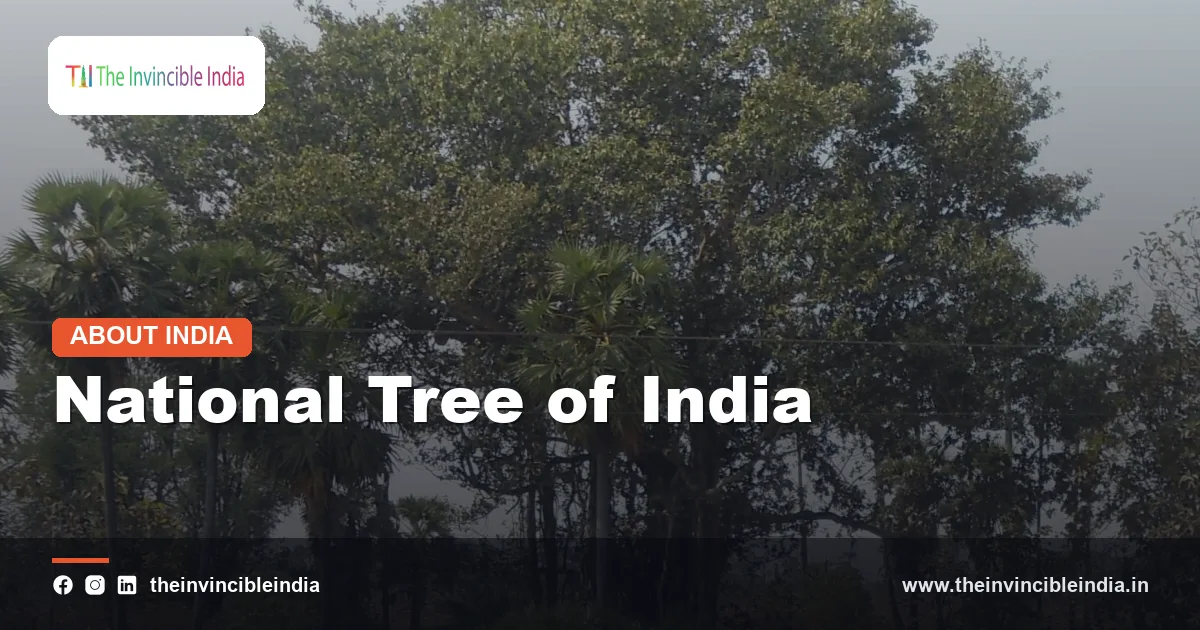
The national tree of India is the Indian banyan (Ficus benghalensis), a giant fig whose hanging aerial roots grow into new trunks and let a single tree spread into a shady grove. The banyan was chosen as a national symbol because its enormous canopy, long life and deep roots in village life and religion reflect the endurance and unity of the country.
The Indian banyan is native to the Indian subcontinent and grows across most of peninsular and northern India, from the plains to the lower Himalayan foothills. This guide explains why the banyan is the national tree of India, how it grows, where the largest specimens stand, what role it plays in forest ecology, and why it holds such a lasting place in Indian culture.
| Attribute | Details |
|---|---|
| Common name | Indian banyan, banyan fig (Hindi: bargad or vat; Sanskrit: vata) |
| Scientific name | Ficus benghalensis |
| Plant family | Moraceae (the fig and mulberry family) |
| Official status | National tree of India, one of the national symbols of the country |
| Native range | Indian subcontinent, including India, Pakistan, Bangladesh, Nepal and Sri Lanka |
| Typical height | Commonly 20 to 25 metres, with a canopy that can spread over thousands of square metres |
| Defining feature | Aerial prop roots that descend from branches and thicken into secondary trunks |
| Largest known canopy | Thimmamma Marrimanu, Anantapur district, Andhra Pradesh, recorded as the largest tree canopy in the world |
| Famous specimen | The Great Banyan, Acharya Jagadish Chandra Bose Indian Botanic Garden, Howrah, West Bengal |
Key Takeaways
- The national tree of India is the Indian banyan, Ficus benghalensis, a member of the fig family.
- The Indian banyan sends down aerial prop roots from its branches, and these roots thicken into trunks that let one tree cover an area the size of a small grove.
- Thimmamma Marrimanu in Andhra Pradesh holds a recorded status as the largest tree canopy in the world, covering close to five acres.
- The banyan is a keystone species because its figs feed birds, bats and mammals through much of the year, including seasons when other fruit is scarce.
- The banyan is associated with immortality in Hindu tradition, and the sacred Akshayavat at Prayagraj is the best-known example.
- A banyan can live for several centuries, and some old Indian specimens are believed to be between 250 and 700 years old.
What is the Indian banyan tree?
The Indian banyan is a large evergreen to semi-deciduous fig tree, scientifically named Ficus benghalensis, that begins life as a small plant and matures into one of the widest trees on earth. The tree belongs to the family Moraceae, which also includes the peepal (Ficus religiosa), the gular (Ficus racemosa) and the cultivated fig.
The leaves of the Indian banyan are broad, leathery and oval, usually 10 to 20 centimetres long, with a smooth upper surface and a slightly hairy underside. The bark is greyish, and every part of the plant exudes a milky white latex when cut. The small round figs, which turn red when ripe, grow in pairs along the twigs.
The English word banyan is widely believed to come from the Gujarati word for a trader, because merchants gathered and set up stalls in the shade of these trees. The tree has since given its name to a general idea in English: anything that spreads widely from a single source.
Why was the banyan chosen as the national tree of India?
The banyan was chosen as the national tree of India because its spreading form, longevity and cultural presence are seen as symbols of the unity, strength and continuity of the nation. The Government of India lists the banyan among the national symbols alongside the lotus, the peacock, the Bengal tiger, the Ganga river dolphin and the mango.
Three qualities explain the choice.
- Endurance: a banyan can survive for centuries, and a damaged trunk can be replaced by prop roots that have become new trunks.
- Shelter and community: a mature banyan offers shade to travellers, animals, traders and village councils, which makes it a natural image of collective life.
- Indigenous roots: the species is native to the subcontinent and has been part of Indian art, scripture and folklore for thousands of years.
The Ministry of Environment, Forest and Climate Change is the central ministry responsible for forests and national biodiversity policy, which includes the care of native tree species such as the banyan.
How does the banyan grow and spread its canopy?
The banyan grows by sending thin aerial roots down from its branches until they reach the soil, root there, thicken into pillar-like trunks and then support the branches above. This habit lets a banyan keep expanding sideways long after an ordinary tree would stop, which is why a single banyan can resemble a forest.
Stage 1: A seed in the crown of another tree
Many banyans begin as epiphytes. A bird or bat eats a ripe fig and drops the seed in a crack or fork of a host tree, a wall or a ruin. The seedling absorbs moisture from the air and from debris, then sends roots towards the ground. For this reason the banyan is often described as a strangler fig, because its roots may eventually surround and outgrow the host tree.
Stage 2: Prop roots become trunks
Once a young banyan has grown branches, those branches release long hanging roots. The roots are thin and rope-like at first. When a root touches the ground it anchors itself, and then it thickens year after year until it looks and works like a trunk. These prop roots carry water and nutrients upward and also bear the weight of the horizontal branches.
Stage 3: A canopy with no single centre
After many decades the original trunk may decay or be removed, yet the tree survives because the prop roots have become independent supports. The result is a wide, flat-topped canopy held up by dozens or hundreds of trunks. The banyan can therefore keep extending its crown outward, limited mainly by soil, water, space and human interference.
Where are the largest banyan trees in India?
The largest banyan trees in India include Thimmamma Marrimanu in Andhra Pradesh, the Great Banyan in Howrah, West Bengal, and several other heritage trees across the peninsula. The table below lists the best-known examples with commonly cited details. Ages and measurements differ between sources, so the figures are approximate.
| Tree | Location | Notable facts |
|---|---|---|
| Thimmamma Marrimanu | Kadiri area, Anantapur district, Andhra Pradesh | Believed to be around 550 years old; recorded as the largest tree canopy in the world, covering roughly 19,000 square metres; a small shrine stands beneath it |
| The Great Banyan | Acharya Jagadish Chandra Bose Indian Botanic Garden, Howrah, West Bengal | More than 250 years old; its original trunk was removed in the early twentieth century, yet more than 3,000 prop roots keep the canopy alive |
| Dodda Alada Mara | Ramohalli, near Bengaluru, Karnataka | Estimated to be about 400 years old and spread over roughly three acres |
| Pillalamarri | Mahabubnagar, Telangana | Estimated to be about 700 years old; its name means the banyan of children |
| Kabirvad | Island in the Narmada river near Bharuch, Gujarat | Linked by tradition to the saint Kabir; a well-known pilgrimage and picnic site |
Thimmamma Marrimanu
Thimmamma Marrimanu is the most famous banyan in India because its canopy is the widest ever recorded for a single tree. The tree has spread from one original trunk to a huge number of prop roots, and the complex is often described as a forest with one root system. The site was recognised for its size by the Guinness World Records in 1989, and local people regard it as sacred.
The Great Banyan at Howrah
The Great Banyan at Howrah is the best-known banyan of eastern India and a major attraction of the Acharya Jagadish Chandra Bose Indian Botanic Garden, which was founded in 1787 on the bank of the Hooghly river. The original central trunk was removed after it became diseased, but the many prop roots continued to support the crown. The tree now looks like a small wood rather than one plant.
What is the ecological role of the banyan tree?
The banyan is a keystone species in Indian ecosystems because its figs and shelter support a very large number of animals. A keystone species is one that has a disproportionately large influence on its habitat compared with its numbers.
The figs of the banyan ripen at times when many other trees carry no fruit. Birds such as barbets, bulbuls, mynas, parakeets and hornbills feed on the figs, and so do fruit bats, squirrels, monkeys and other mammals. These animals in turn disperse the seeds across towns, forests and farmland.
The fig and the fig wasp
The banyan depends on a tiny wasp for pollination. A fig is not a true fruit but a closed structure called a syconium, which holds many tiny flowers inside. A species-specific fig wasp enters the syconium, pollinates the flowers and lays its eggs there. The partnership between fig and wasp is a classic example of co-evolution, and the tree cannot produce viable seed without it.
A habitat in itself
The dense canopy of the banyan provides roosting and nesting places for birds, bats and insects. The hollows between the prop roots shelter reptiles, small mammals and amphibians. The shade it casts keeps the soil cooler and moister than open ground, which supports other plants and soil organisms.
Other environmental benefits
- The banyan stores carbon in its massive trunks, branches and roots.
- The wide canopy reduces surface temperature in towns and villages during the summer.
- The spreading root system helps bind soil on slopes and riverbanks.
- The leaf litter returns organic matter to the soil.
How long does a banyan tree live?
A banyan tree can live for several hundred years, and a few Indian trees are believed to be more than 500 years old. The exact lifespan is hard to state because a banyan does not form regular annual rings across its many trunks, so age is usually estimated from records, local tradition and the size of the canopy.
Several features help the banyan survive for so long.
- Prop roots replace a damaged or rotting main trunk, so the loss of the original stem does not kill the tree.
- The tree can regrow from broken branches and roots.
- The thick, leathery leaves lose water slowly, which helps the tree tolerate dry seasons.
- Many large banyans are protected by religious belief, which spares them from felling.
Cyclones, fungal infection, road widening, construction and soil compaction around the roots are the major threats to old banyans today.
What is the cultural and religious significance of the banyan in India?
The banyan is regarded as a sacred and immortal tree in Hindu tradition, and it also features in Buddhist, Jain and folk traditions across India. Its wide, enduring form has made it a symbol of life, longevity and the ties that hold a community together.
Akshayavat, the imperishable banyan
The Akshayavat is a sacred banyan inside the fort at Prayagraj, close to the confluence of the Ganga and the Yamuna. The word akshaya means imperishable, and tradition holds that the tree survives the dissolution of the universe. Pilgrims visiting the Sangam have long included the Akshayavat in their rites. A second Akshayavat at Gaya in Bihar is associated with ancestral offerings known as pind daan.
Vat Savitri
Vat Savitri is a Hindu observance in which married women fast and tie threads around a banyan to pray for the long life of their husbands. The ritual recalls the story of Savitri, who is said to have won back her husband Satyavan from Yama, the lord of death, under a banyan tree. The festival is observed widely in states such as Maharashtra, Gujarat, Uttar Pradesh and Bihar.
Shiva as Dakshinamurthy
In temple art of southern India, Shiva is shown as Dakshinamurthy, the supreme teacher, seated beneath a banyan and instructing sages in silence. This image links the tree with knowledge as well as with shelter.
The village banyan
In rural India a banyan often stands at the centre of a village. Elders hold meetings in its shade, traders spread their goods there, children play among the roots and travellers rest from the heat. The phrase village banyan is often used for any open, shared gathering place. Many such trees are older than the villages around them.
What are the traditional uses of the banyan tree?
The banyan is traditionally used as a shade tree, a source of fodder and a material for ropes, and various parts of the plant appear in Ayurvedic and folk medicine. Traditional uses do not amount to proven medical treatment, and anyone seeking medical advice should consult a qualified practitioner.
- Shade and shelter: the wide canopy offers cool resting places along roads, in marketplaces and at temples.
- Fodder: cattle and goats browse the leaves, especially in dry seasons.
- Rope and fibre: villagers have used the strong, flexible prop roots for ropes and as tent or tool handles.
- Lac cultivation: the banyan is one of the host trees on which lac insects can be reared.
- Plates and packaging: large leaves have been stitched into disposable plates.
- Traditional medicine: bark, latex, leaves and roots feature in classical Ayurvedic texts and in household remedies.
The wood of the banyan is soft and is not valued highly for timber, which has indirectly helped to spare many trees.
Is the banyan tree threatened, and how is it protected?
The Indian banyan is not classified as globally threatened and remains widespread, but individual heritage trees face real risks from urban development, disease and storms. Protection mostly comes from local custom, state forest departments and heritage-tree programmes rather than from a single national law for the species.
Several measures help to conserve old banyans.
- Forest departments and municipal bodies in some states maintain registers of heritage trees and require permission before felling.
- Botanical gardens such as the one at Howrah restrict foot traffic around the roots to prevent soil compaction.
- Tree surgeons use supports, drainage and fungicide treatment to prolong the life of old trunks.
- Community belief and temple ownership continue to shield many banyans from cutting.
Road widening is a recurring source of conflict, and highway authorities in several states have moved old banyans rather than felled them, although transplanting a mature tree is difficult and does not always succeed.
How does the banyan compare with other Indian national symbols?
The banyan is one of several national symbols of India that represent the country’s natural and cultural heritage. The table below places the national tree beside the other widely recognised national symbols of nature.
| National symbol | Choice | Scientific name |
|---|---|---|
| National tree | Indian banyan | Ficus benghalensis |
| National flower | Lotus | Nelumbo nucifera |
| National bird | Indian peafowl (peacock) | Pavo cristatus |
| National animal | Bengal tiger | Panthera tigris tigris |
| National aquatic animal | Ganges river dolphin | Platanista gangetica gangetica |
| National fruit | Mango | Mangifera indica |
| National river | Ganga | Not applicable |
Unlike the tiger or the dolphin, the banyan is not endangered, so its significance lies mainly in culture and in its ecological value rather than in conservation alarm. The peepal (Ficus religiosa) is a close relative and is also sacred, but the banyan is the one chosen as the national tree.
How is the banyan different from the peepal?
The banyan differs from the peepal mainly in its aerial roots and leaf shape: the banyan has prop roots and broad oval leaves, while the peepal has no prop roots and heart-shaped leaves with a long, drawn-out tip. Both are figs of the genus Ficus and both are sacred in India, so they are often confused.
- Roots: the banyan produces hanging aerial roots, whereas the peepal does not.
- Leaves: banyan leaves are thick, leathery and rounded; peepal leaves are thinner and end in a narrow tip that flutters in the breeze.
- Spread: the banyan spreads sideways to cover very large areas, while the peepal grows tall with a more compact crown.
- Association: the banyan is linked with Akshayavat and Vat Savitri, while the peepal is linked with the Bodhi tree at Bodh Gaya, where the Buddha attained enlightenment.
Bottom Line
The national tree of India, the Indian banyan, stands for endurance, shelter and unity because one tree can renew itself through its own prop roots and shade a whole community. Its ecological value as a keystone fig and its place in religion and village life explain why it remains one of the most recognisable national symbols of India. Last updated: 17 October 2026.
Frequently Asked Questions
What is the national tree of India?
The national tree of India is the Indian banyan, scientifically named Ficus benghalensis. It is a large fig tree known for its aerial prop roots that grow into new trunks. The banyan is regarded as a symbol of longevity, unity and shelter.
Why is the banyan the national tree of India?
The banyan is the national tree of India because its long life, spreading canopy and deep cultural roots are seen as symbols of the strength and unity of the nation. The tree is native to the subcontinent and features in religion, folklore and village life. It also supports a large range of birds, bats and other wildlife.
Which is the largest banyan tree in India?
The largest banyan tree in India is Thimmamma Marrimanu in Anantapur district, Andhra Pradesh, which is recorded as having the largest tree canopy in the world. The canopy covers roughly 19,000 square metres, or nearly five acres. The tree is believed to be about 550 years old.
How old is the Great Banyan in Kolkata?
The Great Banyan in the Acharya Jagadish Chandra Bose Indian Botanic Garden at Howrah is believed to be more than 250 years old. Its original trunk was removed in the early twentieth century after disease, but more than 3,000 prop roots continue to support the canopy. The tree is a leading attraction of the garden.
Why is the banyan tree sacred in India?
The banyan is sacred in India because Hindu tradition links it with immortality, divine presence and family well-being. The Akshayavat at Prayagraj is believed to be imperishable, and married women honour the banyan on Vat Savitri. Shiva is also shown beneath a banyan as Dakshinamurthy, the teacher of sages.
How does a banyan tree spread?
A banyan tree spreads by dropping aerial roots from its branches to the ground, where they root and thicken into new trunks. These trunks support the growing branches, so the canopy can keep widening for centuries. The tree also spreads through seeds carried by birds and bats that eat its figs.
{“@context”:”https://schema.org”,”@graph”:[{“@type”:”FAQPage”,”mainEntity”:[{“@type”:”Question”,”name”:”What is the national tree of India?”,”acceptedAnswer”:{“@type”:”Answer”,”text”:”The national tree of India is the Indian banyan, scientifically named Ficus benghalensis. It is a large fig tree known for its aerial prop roots that grow into new trunks. The banyan is regarded as a symbol of longevity, unity and shelter.”}},{“@type”:”Question”,”name”:”Why is the banyan the national tree of India?”,”acceptedAnswer”:{“@type”:”Answer”,”text”:”The banyan is the national tree of India because its long life, spreading canopy and deep cultural roots are seen as symbols of the strength and unity of the nation. The tree is native to the subcontinent and features in religion, folklore and village life. It also supports a large range of birds, bats and other wildlife.”}},{“@type”:”Question”,”name”:”Which is the largest banyan tree in India?”,”acceptedAnswer”:{“@type”:”Answer”,”text”:”The largest banyan tree in India is Thimmamma Marrimanu in Anantapur district, Andhra Pradesh, which is recorded as having the largest tree canopy in the world. The canopy covers roughly 19,000 square metres, or nearly five acres. The tree is believed to be about 550 years old.”}},{“@type”:”Question”,”name”:”How old is the Great Banyan in Kolkata?”,”acceptedAnswer”:{“@type”:”Answer”,”text”:”The Great Banyan in the Acharya Jagadish Chandra Bose Indian Botanic Garden at Howrah is believed to be more than 250 years old. Its original trunk was removed in the early twentieth century after disease, but more than 3,000 prop roots continue to support the canopy. The tree is a leading attraction of the garden.”}},{“@type”:”Question”,”name”:”Why is the banyan tree sacred in India?”,”acceptedAnswer”:{“@type”:”Answer”,”text”:”The banyan is sacred in India because Hindu tradition links it with immortality, divine presence and family well-being. The Akshayavat at Prayagraj is believed to be imperishable, and married women honour the banyan on Vat Savitri. Shiva is also shown beneath a banyan as Dakshinamurthy, the teacher of sages.”}},{“@type”:”Question”,”name”:”How does a banyan tree spread?”,”acceptedAnswer”:{“@type”:”Answer”,”text”:”A banyan tree spreads by dropping aerial roots from its branches to the ground, where they root and thicken into new trunks. These trunks support the growing branches, so the canopy can keep widening for centuries. The tree also spreads through seeds carried by birds and bats that eat its figs.”}}]}]}


