

The Seuna Yadava dynasty, also known as the Yadavas of Devagiri or simply the Seunas, was a Marathi-speaking Deccan power that rose to dominate much of present-day Maharashtra and neighbouring regions between roughly the twelfth and fourteenth centuries. Ruling from their great fortress capital at Devagiri, later renamed Daulatabad, the Yadavas presided over a flourishing period of Marathi language and culture before falling to the forces of the Delhi Sultanate under the Khaljis. Their rise followed the decline of earlier Deccan powers such as those described in our guide to the Rashtrakuta dynasty, and because some dates and details are debated, this account keeps to general terms where the record is uncertain.
Quick answer: The Seuna Yadava dynasty, also called the Yadavas of Devagiri, was a Marathi-speaking Deccan power that ruled much of present-day Maharashtra and adjoining regions from roughly the twelfth to the fourteenth century. Their capital was the great fortress of Devagiri, later renamed Daulatabad, and their most celebrated ruler was Singhana. The dynasty fostered Marathi language and culture before being conquered by the Khaljis of the Delhi Sultanate in the time of its last king, Ramachandra.
Key Takeaways
- The Seuna Yadavas, or Yadavas of Devagiri, were a Marathi-speaking Deccan dynasty of roughly the twelfth to fourteenth centuries.
- Their capital was the fortress of Devagiri, later renamed Daulatabad, one of the strongest forts of the Deccan.
- Singhana is generally regarded as one of the dynasty’s greatest and most expansionist rulers.
- The dynasty fostered the growth of the Marathi language and patronised scholarship and the arts.
- The scholar Hemadri, associated with the court, is a famous figure of the Yadava administration and learning.
- The dynasty fell to the Khaljis of the Delhi Sultanate during the reign of its last important ruler, Ramachandra.
Read on for the history, culture, and legacy in detail.
Quick Facts
| Detail | Information |
|---|---|
| Dynasty | Seuna Yadava dynasty (Yadavas of Devagiri) |
| Region | Present-day Maharashtra and neighbouring Deccan |
| Capital | Devagiri, later renamed Daulatabad |
| Language | Marathi-speaking court and country |
| Period | Roughly twelfth to fourteenth centuries |
| Notable Ruler | Singhana, a major expansionist king |
| Court Scholar | Hemadri, associated with administration and learning |
| Ended By | The Khaljis of the Delhi Sultanate |
Who Were the Seuna Yadavas?
The Seuna Yadavas were a Marathi-speaking dynasty that rose to rule much of the Deccan, centred on present-day Maharashtra, between roughly the twelfth and fourteenth centuries. The name Seuna is associated with the dynasty and its early territory, while Yadava reflects the lineage’s claimed descent, a common form of royal genealogy in medieval India. They emerged from among the feudatories of earlier Deccan powers and gradually built an independent kingdom of considerable extent. At their height they were one of the leading powers of the peninsula, governing a prosperous and culturally vibrant realm. Their rule is particularly important for the development of Marathi language and identity. The Seuna Yadavas therefore stand as a major regional dynasty whose achievements left a lasting mark on the Deccan, even though some details of their history remain debated.
Where Did the Yadavas of Devagiri Rule?
The Yadavas of Devagiri ruled over a large part of the Deccan plateau, centred on present-day Maharashtra and extending into neighbouring regions at the height of their power. Their heartland lay in the Marathi-speaking country of the western Deccan, a land of plateaus, river valleys and hill ranges well suited to agriculture and fortification. From their capital at Devagiri they controlled fertile territories and important routes across the plateau. At their greatest extent their authority reached into adjoining areas of the Deccan, bringing them into contact and conflict with other southern powers. The geography of the plateau, with its natural strongholds, supported the dynasty’s rise and the building of its mighty fortress. This central Deccan location placed the Yadavas at the heart of the peninsula’s politics.
What Was the Fort of Devagiri?
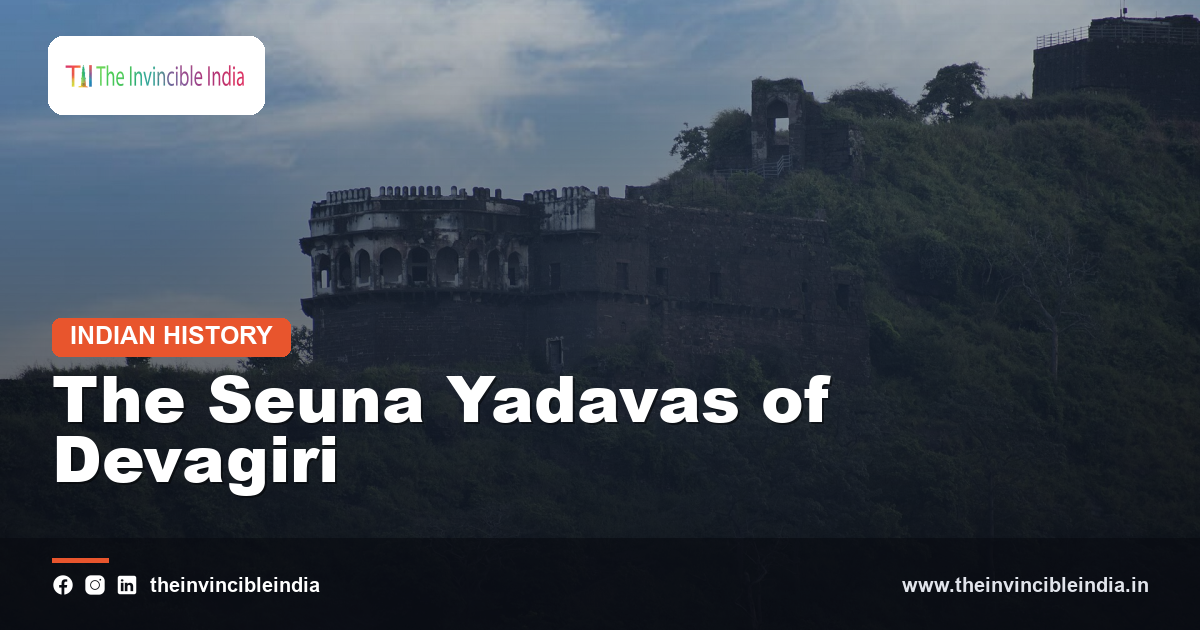
The fort of Devagiri, later renamed Daulatabad, was the magnificent fortress capital of the Seuna Yadavas and remains one of the most remarkable strongholds in India. Built around a conical hill with steep, scarped sides, the fort combined formidable natural defences with built ramparts, gateways, moats and intricate passages that made it extraordinarily difficult to capture. The Yadavas developed Devagiri into the centre of their kingdom, and its strength became legendary. After the dynasty’s fall, the fort passed to the Delhi Sultanate, and under the Tughlaqs it was renamed Daulatabad and briefly made a capital. The fortress continued to play a major role in Deccan history for centuries. Devagiri stands today as the most striking physical legacy of the Yadava dynasty and a monument of Indian military architecture.
How Did the Seuna Yadavas Rise to Power?
The Seuna Yadavas rose to power by gradually transforming their position as feudatories of earlier Deccan overlords into independent sovereignty. For a long period they held territory and office under greater powers of the plateau, building up their resources, lands and military strength. As the authority of these overlords declined, the Yadava chiefs asserted their independence and extended their control over the surrounding country. Successive rulers enlarged the kingdom, fortified Devagiri and established the dynasty as a leading Deccan power. The exact stages of this rise are reconstructed from inscriptions and later accounts, and some details are debated among historians. The pattern, however, is clear: a feudatory line that seized the opportunities offered by a changing political order to build a substantial kingdom of its own on the Deccan plateau.
Who Was Singhana, the Great Yadava King?
Singhana is generally regarded as one of the greatest rulers of the Seuna Yadava dynasty, a king remembered for expanding the kingdom to a wide extent and for patronising learning and the arts. Under his long rule the Yadava realm reached a high point of power, extending its authority across much of the Deccan and asserting itself against rival states. He is associated with campaigns that enlarged the kingdom and with the support of scholars, poets and works of learning at his court. His reign is often seen as the era in which the Yadavas became a truly major power of the peninsula. As with other medieval rulers, specific dates and the full extent of his conquests are reconstructed from sources that are not always precise. Singhana nevertheless stands as the dynasty’s most celebrated expansionist king.
Why Is the Yadava Period Important for Marathi?
The Yadava period is important for the Marathi language because it was an age in which Marathi grew in prestige and began to flourish as a language of administration, literature and devotion. As a Marathi-speaking dynasty ruling the western Deccan, the Yadavas presided over a time when the language gained ground alongside Sanskrit in official and cultural life. This era is associated with the early development of Marathi literature and with the devotional movements that would shape the region’s spiritual life. The use of Marathi in inscriptions and records from the period reflects its rising status. The Yadava age is therefore often seen as formative for Marathi cultural identity. This linguistic and cultural flowering is one of the most enduring legacies of the dynasty, carrying influence far beyond its political fall.
Who Was Hemadri and What Did He Do?
Hemadri, also known as Hemadpant in tradition, was a celebrated scholar and administrator associated with the Yadava court, remembered as one of the great figures of the dynasty’s intellectual life. He served in a high administrative capacity and is credited in tradition with important works of scholarship, including writings on religious observances and law. His name is popularly linked with a distinctive style of temple building in the Deccan, often called the Hemadpanti style, characterised by stone construction fitted without mortar, although the attribution is traditional and debated. Hemadri’s association with administration, learning and temple architecture made him a symbol of the cultural achievements of the Yadava age. Tradition has attached many accomplishments to his name, and historians treat some of these cautiously. He remains a renowned figure in the memory of the dynasty.
What Was Yadava Administration Like?
Yadava administration combined a central court at Devagiri with a network of officials, feudatories and local officers who governed the provinces of the kingdom. The ruler stood at the head of the state, supported by ministers, commanders and administrators who managed revenue, justice and defence across the plateau. Revenue came mainly from agriculture, supplemented by trade and the produce of a prosperous countryside, and was gathered through established arrangements. Learned administrators, of whom Hemadri is the most famous, contributed to the organisation and record-keeping of the state. Feudatory chiefs held lands in return for service, a common pattern in medieval India. This administrative order gave the Yadavas the stability and resources to maintain a large kingdom and to support their cultural patronage. The system reflected the mature statecraft of the medieval Deccan.
How Did the Yadavas Patronise Religion and Temples?
The Yadavas were patrons of Hindu religion and temples, endowing shrines and supporting worship in keeping with the devotional life of the Deccan. Their period is associated with the building and support of temples across their territory, and tradition links the dynasty with a distinctive regional style of temple architecture. The kings and their officials made grants to religious institutions, supported Brahmins and sustained the ceremonial life of their realm. The era also coincided with the growth of devotional movements that would deeply shape the spiritual culture of Maharashtra. Through such patronage the Yadavas tied their rule to the sacred landscape of the plateau and reinforced their legitimacy. The religious and architectural patronage of the dynasty forms an important part of its cultural legacy, visible in the temple heritage of the region.
How Did the Yadavas Relate to Other Deccan Powers?
The Yadavas related to the other powers of the Deccan and the south through a mixture of rivalry, warfare and shifting alliances as they contended for dominance of the peninsula. Their rise brought them into conflict with neighbouring dynasties of the plateau and the regions beyond, including powers to the south and east. Campaigns to extend or defend the kingdom were a recurring feature of the dynasty’s history, particularly under its more expansionist rulers. The competition for the fertile lands and strategic routes of the Deccan shaped these relations. At different times the Yadavas allied with or fought against their neighbours as circumstances demanded. These interactions placed the Yadavas firmly within the dynamic and competitive political world of the medieval Deccan, in which several strong regional powers vied for supremacy.
Who Was Ramachandra, the Last Great Ruler?
Ramachandra, also known as Ramadeva, was the ruler of the Seuna Yadavas at the time of the first major incursions of the Delhi Sultanate into the Deccan, and he is remembered as the last great king of the dynasty. During his reign the forces of the Khalji dynasty of Delhi launched an expedition against Devagiri, marking the beginning of the end of Yadava independence. Tradition holds that the Yadava capital was attacked and that Ramachandra was compelled to come to terms with the invaders, agreeing to tribute. His reign thus straddles the transition from Yadava sovereignty to subordination and eventual conquest. The details of these events are drawn from chronicles that historians read with some caution. Ramachandra’s rule stands as the pivotal period in which the long dominance of the Yadavas in the Deccan came under fatal pressure.
How Did the Khaljis Conquer the Yadavas?
The Khaljis conquered the Yadavas through a series of campaigns launched by the Delhi Sultanate into the Deccan around the turn of the fourteenth century, beginning with an expedition against Devagiri. The initial attack compelled the Yadava ruler Ramachandra to submit and to agree to the payment of tribute, bringing the kingdom into a tributary relationship with Delhi. In the following years, as the Yadavas sought to reassert themselves or fell behind in their obligations, further campaigns reduced their power, and the dynasty was eventually extinguished as an independent force. The conquest of the Yadavas opened the Deccan to the authority of the Delhi Sultanate and transformed the politics of the plateau. The fortress of Devagiri, renamed Daulatabad, became a key centre of the new order. This conquest marked a decisive turning point in the history of the south.
What Happened to Devagiri After the Yadavas?
After the fall of the Yadavas, Devagiri passed to the Delhi Sultanate and entered one of the most dramatic phases of its long history. Under the Tughlaq dynasty, the fortress was renamed Daulatabad and, in a famous and controversial episode, briefly designated as a capital, with an attempt to shift population from Delhi to the Deccan. The scheme proved difficult and was ultimately reversed, but it underlined the strategic importance of the fort. In later centuries Daulatabad remained a major stronghold, passing through the hands of the Deccan sultanates and other powers. Its massive defences continued to make it one of the most formidable forts in India. The later history of Devagiri thus extends far beyond the Yadavas, but it was the Yadavas who first made the fortress a great capital of the Deccan.
What Is the Cultural Legacy of the Yadavas?
The cultural legacy of the Seuna Yadavas is rich and enduring, embracing language, literature, architecture and administration. Above all, the dynasty is remembered for the flourishing of the Marathi language and the early growth of Marathi literature during its rule, a development that helped shape the cultural identity of Maharashtra. The temple-building tradition associated with the era, including the style linked with Hemadri, left a visible mark on the religious landscape of the Deccan. The learning and administrative achievements of the court, symbolised by scholars such as Hemadri, contributed to the intellectual life of medieval India. The great fortress of Devagiri stands as a monument to the dynasty’s power and ambition. Together these achievements make the Yadava period a formative age in the cultural history of the western Deccan.
Why Are the Seuna Yadavas Significant?
The Seuna Yadavas are significant as one of the last great indigenous powers to dominate the Deccan before the expansion of the Delhi Sultanate into the south. Their rule marked a high point of Marathi culture and language and left a lasting legacy in the literature, temples and traditions of Maharashtra. Their mighty fortress of Devagiri became one of the most important strongholds in Indian history, playing a central role in the wars of the Deccan for centuries. The conquest of the Yadavas by the Khaljis was a decisive moment that opened the south to new powers and transformed the political map of the peninsula. For students of Indian history, the Yadavas illustrate both the achievements of the medieval Deccan and the turning point of the early fourteenth century. Their significance spans politics, culture and the long history of the region.
The Seuna Yadavas Today
The Seuna Yadavas are remembered today chiefly through the great fortress of Devagiri, now known as Daulatabad, and through the enduring cultural legacy of their age. The fort, with its conical hill, scarped sides and intricate defences, draws visitors, historians and students of architecture and remains one of the most impressive heritage sites of Maharashtra. The flowering of Marathi language and literature that began under the Yadavas continues to be honoured as a foundation of the region’s cultural identity. Scholars study the inscriptions, literature and monuments of the period to deepen understanding of the dynasty. For readers of Indian history, the Yadavas offer a vivid picture of the medieval Deccan at its height. Their legacy endures in the fort of Devagiri, in the Marathi heritage, and in the memory of a powerful Deccan kingdom.
Sources & Further Reading
- Archaeological Survey of India (asi.nic.in).
- Directorate of Tourism, Government of Maharashtra (maharashtratourism.gov.in).
- Ministry of Culture, Government of India (indiaculture.gov.in).
Frequently Asked Questions
Who were the Seuna Yadavas?
The Seuna Yadavas, also called the Yadavas of Devagiri, were a Marathi-speaking Deccan dynasty that ruled much of present-day Maharashtra from roughly the twelfth to the fourteenth century. Their capital was the great fortress of Devagiri, later renamed Daulatabad.
Where was the capital of the Seuna Yadavas?
The capital of the Seuna Yadavas was Devagiri, a formidable hill fortress in present-day Maharashtra. After the dynasty’s fall it was renamed Daulatabad and briefly made a capital by the Tughlaqs of Delhi.
Who was the greatest Yadava ruler?
Singhana is generally regarded as one of the greatest Yadava rulers, remembered for expanding the kingdom across much of the Deccan and for patronising learning and the arts. His reign is often seen as the dynasty’s high point.
Who was Hemadri?
Hemadri, known in tradition as Hemadpant, was a celebrated scholar and administrator of the Yadava court credited with works of scholarship and associated with a distinctive Deccan temple-building style. Some accomplishments attached to his name are traditional and debated.
How did the Seuna Yadava dynasty end?
The Seuna Yadava dynasty ended when the Khaljis of the Delhi Sultanate campaigned against Devagiri around the turn of the fourteenth century, forcing the ruler Ramachandra to submit and pay tribute. Further campaigns eventually extinguished the dynasty’s independence.
Why are the Yadavas important for Marathi?
The Yadava period is important for Marathi because it was an age when the language grew in prestige and flourished in administration, literature and devotion. This era is seen as formative for Marathi cultural identity in Maharashtra.


