

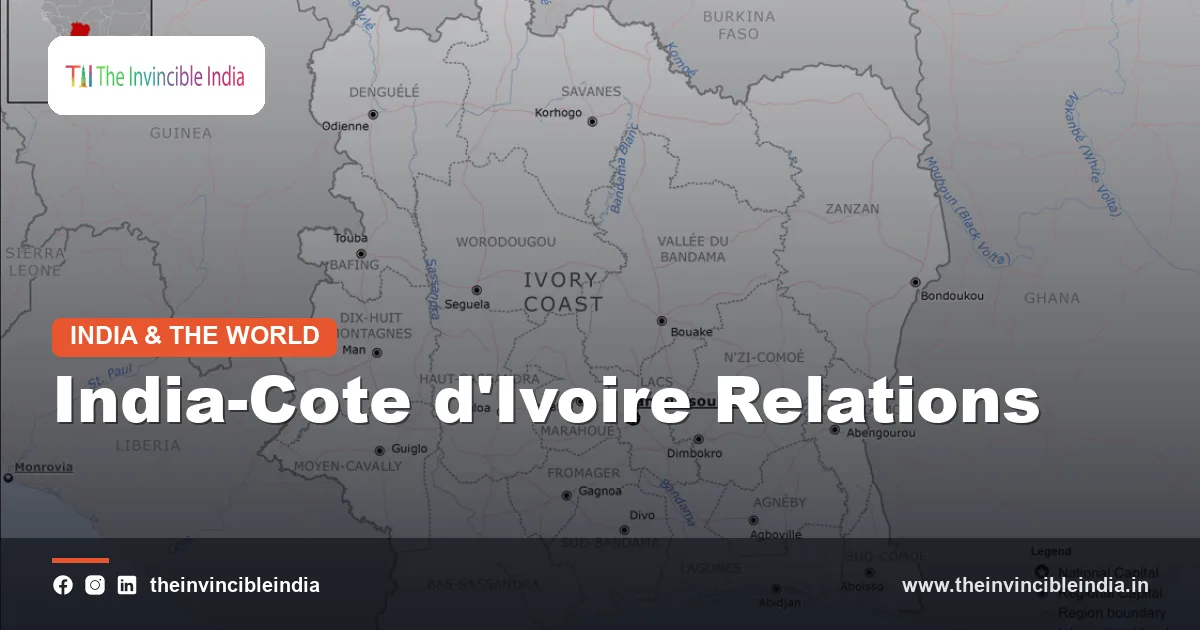
India-Cote d’Ivoire relations are the bilateral political, commercial and development ties between India and the Republic of Cote d’Ivoire (Ivory Coast), a West African country that is the world’s largest producer of cocoa and of raw cashew nuts and hosts the headquarters of the African Development Bank in Abidjan. The relationship is anchored in trade, above all India’s heavy reliance on West African raw cashew for its processing industry, and it is supported by Indian lines of credit, pharmaceutical exports, training programmes and cooperation within multilateral bodies.
India does not share a border, a colonial history or a common language with Cote d’Ivoire, which was a French colony until 1960, yet the two countries have built a practical partnership around agricultural commodities, development finance and technical cooperation. 19 October 2026 marks the latest review of this explainer, and readers should check official sources for current figures, visits and agreements.
| Attribute | Detail |
|---|---|
| Countries | Republic of India and Republic of Cote d’Ivoire (Ivory Coast) |
| Cote d’Ivoire’s independence | 7 August 1960 (from France) |
| Capitals | Yamoussoukro (political capital) and Abidjan (economic capital and seat of most embassies) |
| Regional groupings | ECOWAS and the West African Economic and Monetary Union (WAEMU); currency is the CFA franc (XOF) |
| Key commodity link | Raw cashew nuts exported to India for processing; cocoa is the country’s other major export |
| Multilateral link | African Development Bank (AfDB) headquarters in Abidjan; India is a non-regional member |
| Development finance | Indian lines of credit extended through EXIM Bank of India |
| Other areas of cooperation | Pharmaceuticals, capacity-building (ITEC), solar energy, health, UN peacekeeping history |
Key Takeaways
- India-Cote d’Ivoire relations are driven largely by trade in agricultural commodities, with Cote d’Ivoire supplying raw cashew nuts to Indian processors.
- Cote d’Ivoire has been the world’s largest producer of cocoa for decades and has become the world’s leading producer of raw cashew nuts, while India has been the world’s largest cashew processor.
- The African Development Bank has its headquarters in Abidjan, and India participates in the Bank and its concessional fund as a non-regional member.
- India has offered development finance to Cote d’Ivoire through lines of credit managed by the Export-Import Bank of India (EXIM Bank).
- Indian pharmaceutical exports, scholarships and training slots under the ITEC programme form a steady part of the relationship.
- Cote d’Ivoire is a member of the West African regional bloc ECOWAS and the monetary union WAEMU, which makes the country a commercial entry point for French-speaking West Africa.
How did India-Cote d’Ivoire relations develop?
India-Cote d’Ivoire relations developed after Cote d’Ivoire became independent from France in 1960, when India, newly committed to supporting decolonisation, established diplomatic ties with the new state. The first decades involved limited contact because India’s engagement with Africa focused on larger and English-speaking partners, and Cote d’Ivoire’s foreign policy under its first president, Felix Houphouet-Boigny, was closely aligned with France.
The relationship became more active from the late 1990s and 2000s as India expanded its economic engagement with Africa and as Indian demand for raw cashew nuts rose. India’s Africa policy gained formal structure through the India-Africa Forum Summit process, launched in 2008, which brought together leaders from across the continent, including delegations from West Africa.
The period of political instability in Cote d’Ivoire from 2002 to 2011 affected many international partnerships. India supported the United Nations peace effort, and Indian personnel served in the UN Operation in Cote d’Ivoire (UNOCI), which operated from 2004 to 2017. That role strengthened India’s standing as a development partner that was present during the country’s recovery.
Why is cashew central to India-Cote d’Ivoire relations?
Cashew is central to India-Cote d’Ivoire relations because India’s cashew-processing industry, concentrated in states such as Kerala, Karnataka, Tamil Nadu, Andhra Pradesh and Maharashtra, depends on large imports of raw cashew nuts, and West Africa has become the largest source of those nuts. Cote d’Ivoire is now the world’s leading producer of raw cashew, ahead of other major producers such as Vietnam, India, Tanzania and Nigeria, although rankings shift from year to year.
India processes cashews through a labour-intensive shelling and peeling industry that employs many workers, a large proportion of them women. India’s domestic production does not meet the industry’s needs, so processors import raw nuts, usually in the range of hundreds of thousands of tonnes a year, and then export processed kernels to markets such as the United States, the European Union, the Gulf and Japan.
The cashew trade involves an important policy tension, and a neutral summary is useful.
- Ivorian interest: Cote d’Ivoire wishes to process more of its cashew at home to capture more value and create jobs, and the government has supported local processing capacity and incentives.
- Indian interest: Indian processors want reliable raw supply and competitive prices, and they have invested in processing and trading relationships in West Africa.
- Common ground: Some Indian firms and Ivorian authorities have discussed joint ventures and technology cooperation, so the two interests are not necessarily opposed.
Cashew prices, harvest quality and export rules have varied from season to season, and these changes can affect Indian processors and Ivorian farmers alike.
What other commodities and goods do India and Cote d’Ivoire trade?
India and Cote d’Ivoire trade a range of goods beyond cashew, including cocoa, timber, rubber and petroleum-linked products from Cote d’Ivoire and pharmaceuticals, machinery, vehicles, rice-related products, textiles and electrical goods from India. India has generally imported more from Cote d’Ivoire than it has exported, so the balance has typically favoured Cote d’Ivoire, mainly because of cashew and, to a smaller extent, cocoa.
| Direction | Main goods | Notes |
|---|---|---|
| Cote d’Ivoire to India | Raw cashew nuts, cocoa beans and products, timber, rubber, gold and other minerals in some years | Cashew dominates; volumes vary with harvests and prices |
| India to Cote d’Ivoire | Pharmaceuticals, vehicles and two-wheelers, machinery, cereals and food items, textiles, electrical equipment | Indian generic medicines are widely available in West Africa |
| Services and investment | Indian trading and processing firms, small manufacturers, IT training | Investment is modest and largely private-sector |
Total bilateral trade has typically been counted in the range of a few hundred million to over a billion US dollars in different years, depending on commodity prices. These figures are approximate, and readers should consult official trade statistics for the latest numbers.
What is the role of cocoa in the relationship?
Cocoa plays a supporting role in India-Cote d’Ivoire relations, because Cote d’Ivoire is the world’s largest cocoa producer, supplying roughly forty per cent or more of global cocoa beans, and Indian chocolate and confectionery makers import cocoa from West Africa. India’s cocoa processing industry is much smaller than its cashew industry, but demand for chocolate has grown with rising incomes.
Indian companies buy cocoa beans and cocoa products from multiple origins, and Cote d’Ivoire is one of the main ones. Global cocoa prices rose sharply in the mid-2020s because of poor harvests and market pressures, and this affected Indian importers as well. The sector is also exposed to sustainability concerns, such as deforestation and farmer incomes, that apply to the whole West African cocoa belt.
How has India supported development in Cote d’Ivoire?
India has supported development in Cote d’Ivoire mainly through concessional lines of credit, grant assistance and capacity-building programmes. Lines of credit are loans on favourable terms extended by the Government of India through the EXIM Bank, with the condition that a major share of goods and services be sourced from Indian companies.
Projects reported under Indian lines of credit in West Africa have covered sectors such as power transmission and rural electrification, agriculture and agro-processing, water supply, health infrastructure and transport. The exact project list and amounts for Cote d’Ivoire have changed over time, and some projects have faced delays common to development finance, so details should be verified with EXIM Bank and the Ministry of External Affairs.
India’s Pan-African e-Network project, launched in 2009, was an earlier initiative that connected African institutions with Indian universities and hospitals for tele-education and tele-medicine. India has also joined other African countries in the International Solar Alliance, an India-led initiative on solar energy that includes Cote d’Ivoire among its members.
What is the connection through the African Development Bank in Abidjan?
The connection through the African Development Bank (AfDB) is that the Bank has its headquarters in Abidjan, and India is a non-regional member of the Bank group and a contributor to its concessional window, the African Development Fund. The AfDB was founded in 1964, started operations in Abidjan in 1966, relocated temporarily to Tunis between 2003 and 2014 because of political instability, and returned to Abidjan in 2014.
India has hosted AfDB annual meetings, including a meeting in Gandhinagar, Gujarat, in 2017, which underlined the growing partnership between India and African institutions. Indian companies seeking contracts in Africa often interact with AfDB-funded projects, so the Abidjan headquarters is also a practical point of contact for Indian firms and officials.
The AfDB presence gives Abidjan a role as a regional financial and diplomatic centre, which is one reason many countries, including India, maintain an embassy there.
How do pharmaceuticals and health cooperation feature?
Pharmaceuticals and health cooperation feature prominently because India is a major supplier of affordable generic medicines to West Africa, and Indian-made drugs, vaccines and medical supplies are widely used in Ivorian health care. India’s pharmaceutical industry, often described as the pharmacy of the developing world, supplies treatments for malaria, HIV, tuberculosis and other diseases at lower prices than many competitors.
During the COVID-19 pandemic, India supplied medicines and vaccines to many African countries through bilateral shipments and the Vaccine Maitri initiative, which helped to build goodwill across the continent. Beyond supplies, there is interest in Indian investment in local pharmaceutical manufacturing and in training health workers, although progress depends on regulatory approvals and market conditions in each country.
What are the capacity-building and people-to-people links?
The capacity-building and people-to-people links include training under the Indian Technical and Economic Cooperation (ITEC) programme, Indian Council for Cultural Relations (ICCR) scholarships, and a small Indian community in Cote d’Ivoire. ITEC offers short and medium-term courses to civil servants, engineers and entrepreneurs from partner countries, and Ivorian participants have taken courses in areas such as agriculture, IT, small enterprise development and governance.
The Indian community in Cote d’Ivoire is small, usually estimated at a few thousand people, and consists largely of traders, professionals working in manufacturing and processing, and employees of Indian companies. Language is a practical barrier, since French is the official language in Cote d’Ivoire, and some Indian institutions offer French-language courses to improve engagement with Francophone Africa.
Cultural exchange includes Indian films, yoga and cuisine, and Indian missions have organised events such as International Day of Yoga in Abidjan.
What challenges affect India-Cote d’Ivoire relations?
The challenges affecting India-Cote d’Ivoire relations include commodity concentration, the Ivorian push for local processing, the distance and limited direct connectivity, and the competition from larger partners such as France, China and the European Union. The relationship depends heavily on cashew, so changes in harvests, export duties or processing policy can influence the whole partnership.
- Concentration on cashew: A single commodity accounts for most of the trade, which makes the relationship sensitive to price swings.
- Value-addition debate: Cote d’Ivoire wants more local processing, which may reduce raw exports over time.
- Project delivery: Lines of credit and Indian-built projects have sometimes been delayed, a problem not unique to India.
- Francophone gap: Limited French-language capacity on the Indian side and limited English among some Ivorian partners slow engagement.
- Competition: France remains Cote d’Ivoire’s main European partner, and China is an active financier and builder in West Africa.
What is the future of India-Cote d’Ivoire relations?
The future of India-Cote d’Ivoire relations is likely to involve a gradual shift from raw commodity trade towards joint ventures in processing, deeper pharmaceutical and health cooperation, and more training and technology partnerships. India has also sought to strengthen its overall engagement with Africa, including the African Union’s inclusion as a permanent member of the G20 during India’s 2023 presidency, which India supported and which gave the continent a stronger global voice.
If Ivorian processing capacity expands and Indian firms invest in factories and technology, both sides could benefit through jobs in Cote d’Ivoire and secure supply for India. The pace will depend on investment conditions, infrastructure and political stability in the region.
Bottom Line
India-Cote d’Ivoire relations rest on a clear economic logic: Cote d’Ivoire grows cashew and cocoa, and India processes, consumes and supplies medicines, machinery and training. The partnership is steady but commodity-dependent, and its next phase is likely to be defined by how India and Cote d’Ivoire share the value added in processing.
Frequently Asked Questions
Why is Cote d’Ivoire important to India?
Cote d’Ivoire is important to India mainly as a leading supplier of raw cashew nuts for India’s processing industry and as a major cocoa producer. The country also hosts the African Development Bank headquarters in Abidjan and serves as an entry point to French-speaking West Africa.
Does India import cashew from Cote d’Ivoire?
Yes, India imports large quantities of raw cashew nuts from Cote d’Ivoire, which is now among the world’s largest raw cashew producers. Indian factories process the nuts and re-export kernels to markets such as the United States and Europe.
What is the African Development Bank’s link to India and Abidjan?
The African Development Bank has its headquarters in Abidjan, and India is a non-regional member of the Bank group and a donor to its African Development Fund. India hosted the Bank’s annual meetings in Gandhinagar in 2017.
Has India given lines of credit to Cote d’Ivoire?
Yes, India has extended concessional lines of credit to Cote d’Ivoire through the Export-Import Bank of India for projects in sectors such as power, agriculture and infrastructure. Amounts and project lists have changed over time, so current details should be checked with official sources.
Which Indian products are sold in Cote d’Ivoire?
India sells pharmaceuticals, vehicles and two-wheelers, machinery, food items, textiles and electrical equipment to Cote d’Ivoire. Indian generic medicines are especially visible in West African health markets.
How large is the Indian community in Cote d’Ivoire?
The Indian community in Cote d’Ivoire is small, usually estimated at a few thousand people. It is made up mostly of traders, professionals in manufacturing and processing, and employees of Indian companies, concentrated in and around Abidjan.
{“@context”:”https://schema.org”,”@graph”:[{“@type”:”FAQPage”,”mainEntity”:[{“@type”:”Question”,”name”:”Why is Cote d’Ivoire important to India?”,”acceptedAnswer”:{“@type”:”Answer”,”text”:”Cote d’Ivoire is important to India mainly as a leading supplier of raw cashew nuts for India’s processing industry and as a major cocoa producer. The country also hosts the African Development Bank headquarters in Abidjan and serves as an entry point to French-speaking West Africa.”}},{“@type”:”Question”,”name”:”Does India import cashew from Cote d’Ivoire?”,”acceptedAnswer”:{“@type”:”Answer”,”text”:”Yes, India imports large quantities of raw cashew nuts from Cote d’Ivoire, which is now among the world’s largest raw cashew producers. Indian factories process the nuts and re-export kernels to markets such as the United States and Europe.”}},{“@type”:”Question”,”name”:”What is the African Development Bank’s link to India and Abidjan?”,”acceptedAnswer”:{“@type”:”Answer”,”text”:”The African Development Bank has its headquarters in Abidjan, and India is a non-regional member of the Bank group and a donor to its African Development Fund. India hosted the Bank’s annual meetings in Gandhinagar in 2017.”}},{“@type”:”Question”,”name”:”Has India given lines of credit to Cote d’Ivoire?”,”acceptedAnswer”:{“@type”:”Answer”,”text”:”Yes, India has extended concessional lines of credit to Cote d’Ivoire through the Export-Import Bank of India for projects in sectors such as power, agriculture and infrastructure. Amounts and project lists have changed over time, so current details should be checked with official sources.”}},{“@type”:”Question”,”name”:”Which Indian products are sold in Cote d’Ivoire?”,”acceptedAnswer”:{“@type”:”Answer”,”text”:”India sells pharmaceuticals, vehicles and two-wheelers, machinery, food items, textiles and electrical equipment to Cote d’Ivoire. Indian generic medicines are especially visible in West African health markets.”}},{“@type”:”Question”,”name”:”How large is the Indian community in Cote d’Ivoire?”,”acceptedAnswer”:{“@type”:”Answer”,”text”:”The Indian community in Cote d’Ivoire is small, usually estimated at a few thousand people. It is made up mostly of traders, professionals in manufacturing and processing, and employees of Indian companies, concentrated in and around Abidjan.”}}]}]}


