

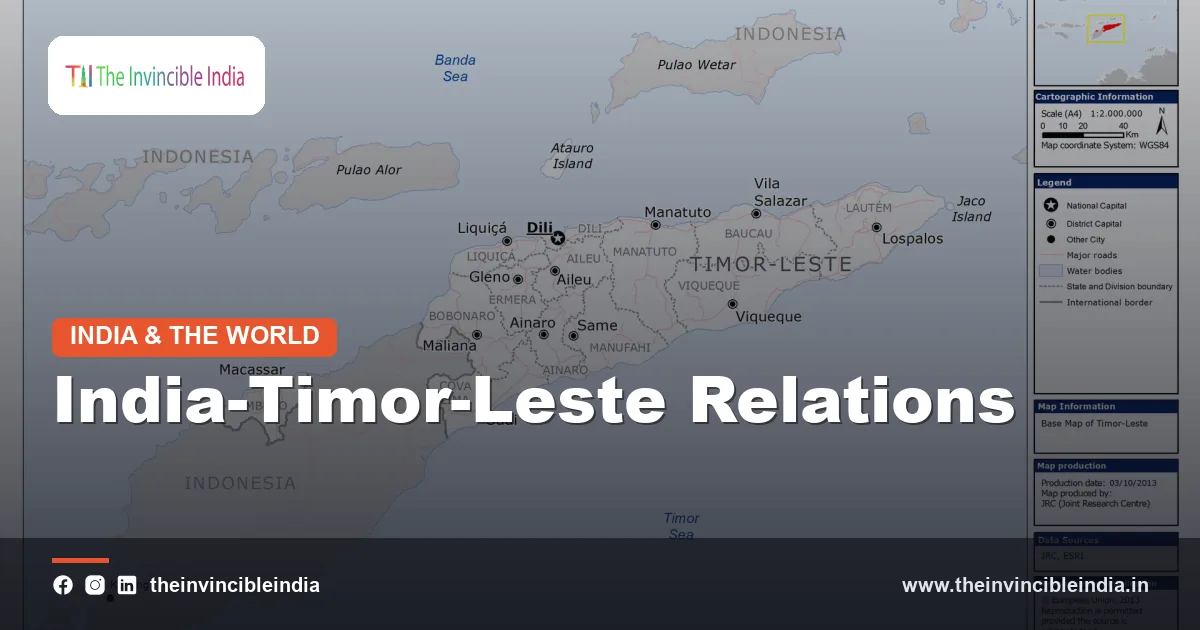
India-Timor-Leste relations are the diplomatic, development and people-to-people ties between India and the Democratic Republic of Timor-Leste (East Timor), Southeast Asia’s youngest nation, which restored its independence on 20 May 2002 and became the eleventh member of ASEAN in October 2025. The relationship began with Indian support for Timor-Leste’s transition to independence under United Nations administration and has since focused on capacity-building, development assistance, Indian backing for Timor-Leste’s regional integration and a modest but growing set of political and economic contacts.
Timor-Leste is a small half-island nation of roughly 1.3 million people, far from India in geography but connected through the wider Indo-Pacific region and through shared experiences of colonial rule, including a Portuguese heritage that Timor-Leste shares with the Indian state of Goa. 19 October 2026 marks the latest review of this explainer, and readers should confirm current agreements, visits and figures with official sources.
| Attribute | Detail |
|---|---|
| Countries | Republic of India and Democratic Republic of Timor-Leste |
| Timor-Leste’s independence | Restored on 20 May 2002 after UN administration (1999-2002) and Indonesian rule (1975-1999) |
| Capital and size | Dili; about 15,000 square kilometres; population of roughly 1.3 million |
| Official languages | Tetum and Portuguese (Indonesian and English are working languages) |
| Currency | United States dollar |
| Regional status | Eleventh member of ASEAN (admitted October 2025); member of the Community of Portuguese Language Countries (CPLP) |
| Main areas of cooperation | Capacity-building (ITEC, scholarships), development assistance, health, trade, diplomatic consultations |
| Indian diplomatic presence | Embassy of India in Dili |
Key Takeaways
- India established diplomatic relations with Timor-Leste after the country’s independence in 2002 and later opened an embassy in Dili.
- India supported Timor-Leste’s admission to ASEAN, which was completed in October 2025 when Timor-Leste became the bloc’s eleventh member.
- Indian cooperation with Timor-Leste is concentrated on capacity-building, including the ITEC training programme and scholarships for Timorese officials and students.
- Bilateral trade between India and Timor-Leste is very small, and economic cooperation is still at an early stage.
- A visit by Indian President Droupadi Murmu to Timor-Leste in 2025 was widely described as the first by an Indian head of state to the country.
- Timor-Leste and the Indian state of Goa share a Portuguese colonial heritage, which provides a cultural and historical point of connection.
How did India-Timor-Leste relations begin?
India-Timor-Leste relations began around 2002, when Timor-Leste became a sovereign state after a UN-supervised transition and India recognised the new country and established diplomatic ties. India had been a supporter of the UN process in East Timor, and Indian personnel took part in UN missions in the territory in the early 2000s, including the peacekeeping and support operations that followed the 1999 referendum.
The historical background is relevant. Portugal colonised Timor for several centuries, and in 1975 Indonesia invaded and annexed the territory, a move that the United Nations did not recognise. After a UN-organised referendum in August 1999 in which the majority voted against autonomy within Indonesia, a UN transitional administration (UNTAET) governed the territory until independence in 2002.
India’s historic position on the East Timor question was marked by caution, because India maintained friendly ties with Indonesia while generally supporting self-determination and the United Nations process. Once independence was achieved, India moved to build a direct relationship, and in the late 2000s it opened its resident mission in Dili.
Why does Timor-Leste matter to India?
Timor-Leste matters to India because the country sits at the southeastern edge of the Indo-Pacific, between Indonesia and Australia, and it has joined ASEAN, the regional grouping at the centre of India’s Act East Policy. India has a long-standing interest in a stable, independent and democratic Timor-Leste that is open to engagement with many partners.
Several considerations make the relationship useful for New Delhi.
- Act East Policy: India seeks closer ties with every ASEAN member, and ties with the newest member complete that circle.
- Indo-Pacific geography: Timor-Leste lies near key sea lanes linking the Indian and Pacific Oceans, including the Wetar and Ombai straits that are used for deep-draft transit.
- Multilateral support: As a small democratic state, Timor-Leste tends to support rules-based approaches in international forums, which aligns with some Indian positions.
- Development partnership: India’s identity as a Global South partner is reinforced by assistance to a least developed country.
For Timor-Leste, India offers a large democratic partner outside its immediate neighbourhood, which fits the country’s policy of friendly relations with all and enmity with none.
What did India do to support Timor-Leste’s ASEAN accession?
India supported Timor-Leste’s ASEAN accession by welcoming the application, backing the principle of its membership in diplomatic statements, and offering training and capacity-building that helps Timorese officials meet ASEAN obligations. Timor-Leste applied for membership in 2011, was granted observer status in the ASEAN decision-making process in 2022, and was admitted as a full member at the ASEAN summit in Kuala Lumpur in October 2025.
ASEAN membership involves joining numerous agreements, committees and economic frameworks, and a small administration such as that of Timor-Leste needs trained staff to participate. India is one of ASEAN’s dialogue partners and has run programmes for ASEAN countries, so Indian training offers on diplomacy, trade rules, digital governance and public administration are relevant.
India’s support is generally described in the context of a broader Indian policy of ASEAN centrality, under which New Delhi values a united and effective ASEAN. Timor-Leste also completed its accession to the World Trade Organization in 2024, another step in its integration with the international economy, although the extent of any Indian assistance in such processes is a matter of diplomatic record rather than headline figures.
What capacity-building programmes does India offer Timor-Leste?
India offers Timor-Leste capacity-building mainly through the Indian Technical and Economic Cooperation (ITEC) programme, scholarships administered by the Indian Council for Cultural Relations (ICCR), and special courses for diplomats and civil servants. These programmes are central to Indian engagement because Timor-Leste has a young population and a need for skilled administrators, teachers, health workers and technicians.
| Programme | Run by | What it offers |
|---|---|---|
| ITEC | Ministry of External Affairs | Short and medium-term civilian and defence training courses in India and in partner countries |
| ICCR scholarships | Indian Council for Cultural Relations | Undergraduate, postgraduate and doctoral study in Indian universities |
| Special training for diplomats | Foreign Service Institute and partner institutes | Courses on diplomacy, negotiation and international law |
| Technical cooperation | Indian agencies and institutions | Support in sectors such as agriculture, information technology and entrepreneurship |
Hundreds of Timorese trainees are reported to have benefited from ITEC and scholarship programmes over the years, although exact totals vary by source. These programmes give India long-lasting influence at relatively low cost, because alumni often rise to positions of responsibility in government and business.
How has India provided development assistance to Timor-Leste?
India has provided development assistance to Timor-Leste in the form of grants, small development projects, humanitarian aid and health-related supplies. Indian aid to small and least developed countries is usually modest in size but is delivered quickly and tied to local needs, such as community buildings, IT labs, vocational training facilities and medical equipment.
During the COVID-19 pandemic, India supplied vaccines and medical items to many developing countries under its Vaccine Maitri initiative, and similar support has been part of Indian outreach to small partners. India has also contributed funds to United Nations trust funds and to regional initiatives that benefit Pacific and Southeast Asian developing states.
Observers sometimes compare India’s assistance with that of larger donors such as Australia, Japan, China, Portugal and the European Union, which provide larger sums. India’s advantage lies in its flexibility, its English-language training and its willingness to share low-cost technologies, including digital public infrastructure such as identity systems and payment platforms, which several countries have explored.
How much do India and Timor-Leste trade?
India and Timor-Leste trade very little, with bilateral trade usually estimated at a few tens of millions of US dollars or less in a given year, and India typically exports more than it imports. The small value reflects Timor-Leste’s limited economy, which relies heavily on petroleum revenues, and the distance between the two countries.
- Indian exports to Timor-Leste: Pharmaceuticals, vehicles and parts, machinery, cereals and food items, textiles, and electrical goods.
- Indian imports from Timor-Leste: Small quantities of agricultural products, notably coffee, which is Timor-Leste’s best-known non-oil export, and occasionally other commodities.
- Potential sectors: Coffee, agro-processing, digital services, renewable energy, tourism and education.
Timor-Leste’s economy depends on offshore oil and gas revenues held in its Petroleum Fund, and the country has been trying to diversify. Indian companies could play a role in sectors such as information technology, health and training, though most business contact so far has been exploratory and small in scale.
What role did India play in UN peacekeeping in Timor-Leste?
India played a supporting role in UN peacekeeping in Timor-Leste by contributing military and police personnel and specialists to missions during the transition period after 1999. India has one of the largest records of participation in UN peacekeeping worldwide, and its involvement in East Timor formed part of that wider record.
The UN presence passed through several stages: the International Force for East Timor (INTERFET), led by Australia in 1999; the UN Transitional Administration in East Timor (UNTAET) from 1999 to 2002; the UN Mission of Support in East Timor (UNMISET) until 2005; and later smaller political and police missions, with the UN presence closing in 2012. India’s contribution was one among many from Asian countries, and it helped to establish Indian goodwill among Timorese leaders and officials.
Is there a cultural connection through Goa and the Portuguese heritage?
Yes, a cultural connection exists through Goa and the Portuguese heritage, because Goa, Daman and Diu in India and Timor in Southeast Asia were both Portuguese colonies, and both retain traces of Portuguese influence in religion, architecture, cuisine and language. Goa was integrated into India in 1961, while Timor-Leste remained under Portuguese control until 1975.
The link is more symbolic than institutional, but it has practical relevance. Portuguese is one of Timor-Leste’s official languages, and the country belongs to the Community of Portuguese Language Countries (CPLP), as does Portugal itself. Goan scholars, priests and community figures have at times been mentioned as having historic links with Timor, and Konkani and Portuguese-language studies in Goa provide possible academic bridges.
Indian cultural diplomacy, including yoga, cinema and festivals, has been visible in Dili in smaller ways, and Indian missions have organised International Day of Yoga events for Timorese audiences.
What challenges and opportunities lie ahead?
The challenges for India-Timor-Leste relations include distance, small economic scale and limited direct connectivity, while the opportunities lie in Timor-Leste’s ASEAN membership, its young population and the growing Indian interest in the Indo-Pacific. Both sides have the political will to deepen ties, but practical links are still being built.
- Connectivity: No direct flights link the two countries, and travel normally runs through hubs in Southeast Asia such as Singapore, Bali or Kuala Lumpur.
- Economic size: Timor-Leste’s small market limits trade and investment, and its economy depends on petroleum revenues that are expected to decline over time.
- Competing partners: Australia, Indonesia, Portugal, China and Japan are all influential partners, so India’s role is one of many.
- ASEAN integration: Timor-Leste’s entry into ASEAN gives India new reasons to engage, including through ASEAN-India frameworks.
- Human development: Education, health and skills training remain areas where India can offer practical help.
Bottom Line
India-Timor-Leste relations are cordial, small in scale and built on development partnership rather than trade or strategic bargaining. India’s support for Timor-Leste’s independence process, its capacity-building offers and its backing for ASEAN membership have laid a foundation that is likely to deepen as Timor-Leste integrates with Southeast Asia.
Frequently Asked Questions
When did India and Timor-Leste establish diplomatic relations?
India and Timor-Leste established diplomatic relations around 2002, when Timor-Leste restored its independence after UN administration. India later opened an embassy in Dili in the late 2000s.
Did India support Timor-Leste’s ASEAN membership?
Yes, India supported Timor-Leste’s ASEAN membership in line with its policy of ASEAN centrality and its Act East Policy. Timor-Leste became the eleventh ASEAN member in October 2025 after applying in 2011.
What does India do for Timor-Leste in capacity-building?
India offers Timor-Leste training and scholarships mainly through the ITEC programme and ICCR scholarships. These cover areas such as public administration, information technology, agriculture, health and diplomacy.
How much trade is there between India and Timor-Leste?
Trade between India and Timor-Leste is very small, usually put at a few tens of millions of US dollars or less per year. India mainly exports pharmaceuticals, vehicles, machinery and food items, while Timor-Leste’s coffee is the best-known potential import.
Is there a Goa connection with Timor-Leste?
Yes, Goa and Timor-Leste share a Portuguese colonial heritage, with traces visible in religion, language and cuisine. The link is mostly cultural and symbolic, but it offers a basis for academic and community contacts.
Has an Indian President visited Timor-Leste?
Yes, President Droupadi Murmu visited Timor-Leste in 2025, and the visit was widely described as the first by an Indian head of state to the country. Readers should check official Indian government sources for details of the agenda and outcomes.
{“@context”:”https://schema.org”,”@graph”:[{“@type”:”FAQPage”,”mainEntity”:[{“@type”:”Question”,”name”:”When did India and Timor-Leste establish diplomatic relations?”,”acceptedAnswer”:{“@type”:”Answer”,”text”:”India and Timor-Leste established diplomatic relations around 2002, when Timor-Leste restored its independence after UN administration. India later opened an embassy in Dili in the late 2000s.”}},{“@type”:”Question”,”name”:”Did India support Timor-Leste’s ASEAN membership?”,”acceptedAnswer”:{“@type”:”Answer”,”text”:”Yes, India supported Timor-Leste’s ASEAN membership in line with its policy of ASEAN centrality and its Act East Policy. Timor-Leste became the eleventh ASEAN member in October 2025 after applying in 2011.”}},{“@type”:”Question”,”name”:”What does India do for Timor-Leste in capacity-building?”,”acceptedAnswer”:{“@type”:”Answer”,”text”:”India offers Timor-Leste training and scholarships mainly through the ITEC programme and ICCR scholarships. These cover areas such as public administration, information technology, agriculture, health and diplomacy.”}},{“@type”:”Question”,”name”:”How much trade is there between India and Timor-Leste?”,”acceptedAnswer”:{“@type”:”Answer”,”text”:”Trade between India and Timor-Leste is very small, usually put at a few tens of millions of US dollars or less per year. India mainly exports pharmaceuticals, vehicles, machinery and food items, while Timor-Leste’s coffee is the best-known potential import.”}},{“@type”:”Question”,”name”:”Is there a Goa connection with Timor-Leste?”,”acceptedAnswer”:{“@type”:”Answer”,”text”:”Yes, Goa and Timor-Leste share a Portuguese colonial heritage, with traces visible in religion, language and cuisine. The link is mostly cultural and symbolic, but it offers a basis for academic and community contacts.”}},{“@type”:”Question”,”name”:”Has an Indian President visited Timor-Leste?”,”acceptedAnswer”:{“@type”:”Answer”,”text”:”Yes, President Droupadi Murmu visited Timor-Leste in 2025, and the visit was widely described as the first by an Indian head of state to the country. Readers should check official Indian government sources for details of the agenda and outcomes.”}}]}]}


