

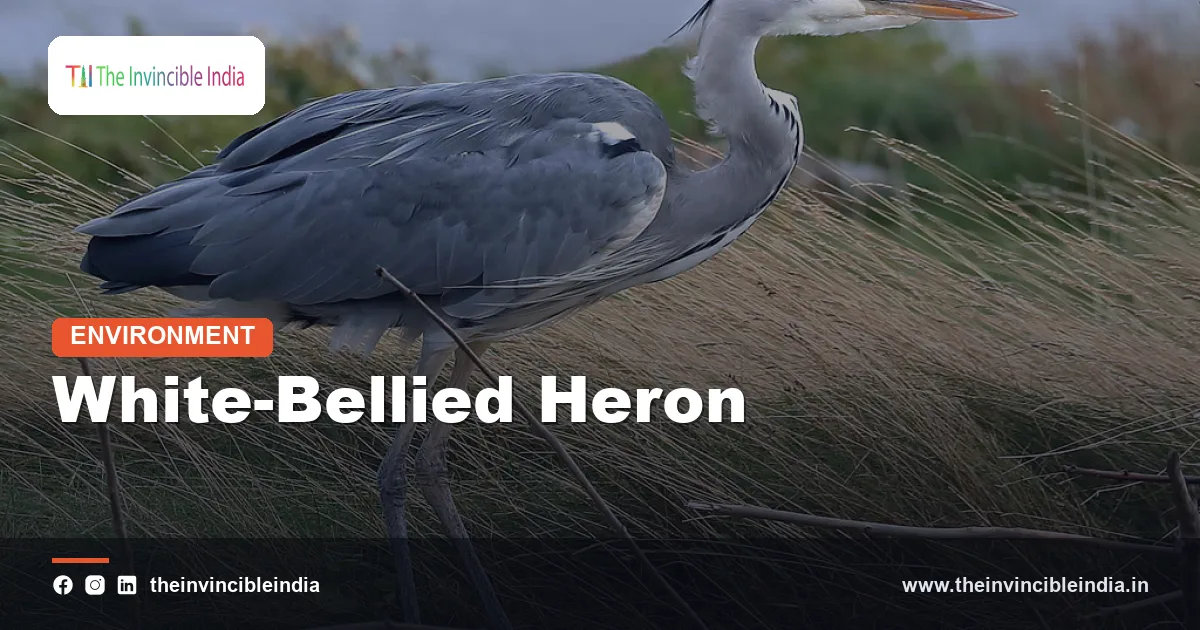
The white-bellied heron (Ardea insignis) is a very large, slate-grey heron with a white belly that lives along fast-flowing Himalayan foothill rivers in Northeast India, Bhutan and Myanmar, and it is one of the rarest birds in the world, assessed as Critically Endangered with a global population thought to number only in the low hundreds at most. Its survival depends on keeping clean, undisturbed river stretches with plentiful fish and tall nesting trees nearby.
In India the species is associated mainly with the Namdapha National Park and Tiger Reserve in Arunachal Pradesh, where sightings are infrequent. Conservation efforts, led most prominently in Bhutan, include river protection, nest monitoring, community engagement and a captive-breeding and rearing programme, but the bird remains perilously close to extinction.
| Attribute | Detail |
|---|---|
| Scientific name | Ardea insignis (also called the imperial heron) |
| IUCN status | Critically Endangered |
| Global population | Roughly 50 to 250 mature individuals, according to commonly cited estimates; counts vary by source |
| Size | About 120 to 130 cm tall; among the largest herons in the world |
| Range | Bhutan, Northeast India (notably Arunachal Pradesh and Assam), Myanmar; historic records from Nepal and Bangladesh |
| Key Indian site | Namdapha National Park and Tiger Reserve, Arunachal Pradesh |
| Habitat | Clear, fast-flowing rivers with gravel bars, in forested foothills |
| Main threats | Hydropower, sand and stone mining, fishing and disturbance, loss of forest and nesting trees |
Key Takeaways
- The white-bellied heron (Ardea insignis) is classified as Critically Endangered, and its global population is thought to number only in the low hundreds of birds at most.
- The white-bellied heron lives along clear, fast-flowing foothill rivers in Bhutan, Northeast India and Myanmar, and it is closely tied to undisturbed river stretches rich in fish.
- In India, the white-bellied heron is associated mainly with Namdapha National Park and Tiger Reserve in Arunachal Pradesh, where it is seen only rarely.
- Hydropower development, sand and stone extraction, fishing, road construction and loss of nesting trees are the main threats cited for the white-bellied heron.
- Bhutan runs a dedicated white-bellied heron conservation programme that includes nest monitoring, community outreach and a captive-breeding centre.
- Because the white-bellied heron needs wide, well-protected river corridors, its protection also benefits fish, other wildlife and local water resources.
What is the white-bellied heron?
The white-bellied heron is a large wading bird in the heron family (Ardeidae), recognisable by its dark grey back, long neck, dagger-like bill and contrasting white belly. It stands roughly as tall as a human child and is generally regarded as the second-largest living heron after the Goliath heron of Africa.
Adults have slate-grey upperparts, a pale throat and a white underside, and the bill is dark. Males and females look alike. The species is solitary or found in pairs, and it is wary of human presence, which makes observation difficult. It is also known as the imperial heron, a name sometimes used in older field guides.
The species was formally described by European naturalists in the late nineteenth century from specimens collected in the Himalayan region. Its scientific name, Ardea insignis, reflects its imposing stature. Because it favours remote river valleys and avoids disturbed areas, it has long been one of the least-known large birds in South Asia.
Where does the white-bellied heron live?
The white-bellied heron lives in the Eastern Himalayan foothills, with confirmed populations in Bhutan, Northeast India and northern Myanmar. Historic records also exist from Nepal and Bangladesh, and the species is thought to have declined across most of its former range.
It typically occupies clear, fast-flowing rivers and streams running through forested hills, usually in the subtropical or warm-temperate belt from low to mid elevations. Gravel and sand bars, shallow riffles and deep pools are important because they provide hunting grounds and resting places. Tall trees near the river, including pines in Bhutan, are used for nesting.
In Bhutan, the species occurs along stretches of the Punatsangchhu, Mangdechhu and neighbouring river systems and tributaries. In India, records come mostly from the rivers of eastern Arunachal Pradesh, such as the Dihing and Noa-Dihing systems around Namdapha, and from historical reports in parts of Assam. Myanmar’s northern river valleys are thought to hold a small population, though surveys there are difficult.
How many white-bellied herons are left?
Only a few dozen to a few hundred white-bellied herons are thought to remain, and the International Union for Conservation of Nature (IUCN) has classified the species as Critically Endangered. Commonly cited estimates place the population at roughly 50 to 250 mature individuals, and counts of birds actually observed are lower.
Bhutan’s annual surveys have recorded a few dozen birds in recent years, and the country is generally considered to hold the largest known share of the population. India’s count is very small, with only a handful of individuals reported from Namdapha and surrounding rivers in recent surveys. Myanmar’s numbers are uncertain.
These numbers should be treated cautiously. The species is secretive, the rivers are remote, and survey methods and effort differ between years. Even small shifts in counts can reflect observation conditions as much as real population change. Conservation bodies rely on repeated, standardised river surveys to track trends.
What does the white-bellied heron eat?
The white-bellied heron eats mainly fish, which it catches by standing still or slowly walking in shallow river water and striking with its long bill. It may also take amphibians, crustaceans and aquatic insects when fish are scarce, but fish form the core of its diet.
Because the bird depends on visual hunting in clear water, turbid or silty rivers affect its feeding success. Sand mining, construction runoff and landslides that cloud the water can therefore reduce hunting efficiency. Healthy populations of small and medium-sized native fish, which in turn need stable habitat and unobstructed river flow, are essential.
The bird’s reliance on fish makes it an indicator species for river health. Where white-bellied herons persist, the river typically has clean water, intact banks and low disturbance. Where they vanish, the loss often signals broader degradation that also affects local communities that depend on rivers.
How does the white-bellied heron breed?
The white-bellied heron breeds in solitary pairs, building large stick nests in tall trees close to rivers, typically in the pre-monsoon season from roughly the start of the year into spring. A clutch usually consists of a small number of eggs, and chick survival is low because of predation, weather and disturbance.
In Bhutan, nests have often been found in tall chir pine trees on valley slopes above rivers. Pairs return to preferred sites, so loss of nest trees or disturbance at the nesting area can cause breeding failure. The parent birds are sensitive to human activity near the nest, and noise or movement can lead them to abandon eggs.
The slow breeding rate, with few chicks per pair and not every nest successful, means that populations recover slowly even when threats are reduced. That is a key reason why small numbers are so dangerous: a few lost adults can have a large impact.
What threatens the white-bellied heron?
The main threats to the white-bellied heron are habitat loss and degradation from hydropower projects, sand and stone mining, road building, forest clearance and human disturbance along rivers. Each of these reduces the clear, quiet, fish-rich river stretches the bird requires.
- Hydropower and river modification: Dams, diversion tunnels and reservoirs alter flow, trap sediment and flood or dry out feeding and nesting areas.
- Sand and stone extraction: Mining of riverbeds destroys gravel bars, muddies water and brings people and machinery into heron habitat.
- Fishing and disturbance: Fishing by humans, including with destructive methods, reduces fish stocks and disturbs birds.
- Loss of nesting trees: Felling or fires can remove tall trees used for nests.
- Infrastructure: Roads and settlements bring noise, traffic and sometimes hunting pressure.
- Climate and weather extremes: Floods and landslides in a changing monsoon pattern can wash away nests and disrupt food supply.
Hunting was a historical threat in some regions, and incidental harm remains possible. Because the population is so small, even a single local event, such as a flood or the loss of a breeding pair, can matter for the entire species.
Why is Namdapha important for the white-bellied heron in India?
Namdapha National Park and Tiger Reserve in the Changlang district of Arunachal Pradesh is important because it contains some of the last known river habitat in India where the white-bellied heron has been recorded in recent decades. The park is one of India’s largest protected areas in the Eastern Himalayas and is notable for a very wide range of elevations and habitats.
Namdapha was notified as a national park in 1983 and also forms a tiger reserve under Project Tiger. It supports a broad array of wildlife, including several big cats, hornbills and numerous bird species. The Noa-Dihing river and its tributaries flow through the park and offer the sort of clear, gravelly stretches that the heron prefers.
Sightings in India are rare and often documented through occasional surveys by forest officials, ornithologists and conservation organisations. Remote terrain, limited access and security or logistic challenges make monitoring difficult. Securing the Namdapha river corridors, restricting disturbance and extending protection to rivers outside the park boundary are commonly recommended steps.
How is the white-bellied heron legally protected?
The white-bellied heron is protected in India under the Wildlife (Protection) Act, 1972, which prohibits hunting and trade in listed species and provides for protected areas, and internationally it is assessed by the IUCN as Critically Endangered. The Act places species on schedules that determine the level of protection, and legal placements are occasionally revised through amendments, so the current schedule should be verified in the latest text of the Act.
Within India, protected areas such as national parks and tiger reserves add a habitat layer of protection, while the Environment Impact Assessment (EIA) process applies to large projects such as hydropower dams. Critics argue that the cumulative impact of several river projects can be underestimated, and conservationists urge careful siting and monitoring.
In Bhutan, the species is protected under the country’s forest and nature conservation laws, and the heron is a recognised national conservation priority. Cross-border cooperation among India, Bhutan and Myanmar is valuable because the bird’s range crosses national boundaries and its rivers flow through several jurisdictions.
| Country | Role in white-bellied heron conservation |
|---|---|
| Bhutan | Holds the largest known share of the population; runs surveys, nest protection and a breeding centre |
| India | Small population, mainly in Namdapha and eastern Arunachal Pradesh; focus on habitat protection and monitoring |
| Myanmar | Thought to hold a small population in northern river valleys; surveys are difficult |
| Nepal and Bangladesh | Historic records only; the species is considered locally lost |
What is being done to conserve the white-bellied heron?
Conservation of the white-bellied heron includes river and nest monitoring, community education, habitat protection and, in Bhutan, a captive-breeding and rearing programme intended to build a safety-net population. The Royal Society for Protection of Nature (RSPN) in Bhutan has been a leading organisation in this work.
Key measures include:
- Annual population surveys: Teams walk or boat along rivers to count birds and note threats.
- Nest protection: Teams locate nests, monitor breeding and reduce disturbance during the season.
- Captive breeding and rearing: Eggs from vulnerable nests have been collected and incubated, with chicks reared at a dedicated conservation centre in Bhutan.
- Community involvement: Local residents are engaged as monitors and given awareness materials, and some conservation programmes support livelihood alternatives.
- Policy advocacy: Experts advise on hydropower siting, sand mining controls and protection of river stretches.
The captive programme has met with partial success. Rearing herons is demanding, chicks have a high mortality risk, and releasing birds into the wild requires safe, suitable rivers. Any release strategy depends on addressing the underlying habitat threats first.
Why does the white-bellied heron matter, and what is its outlook?
The white-bellied heron matters because it is a flagship species for the free-flowing rivers of the Eastern Himalayas, and its decline signals a broader loss of river health, biodiversity and ecosystem services. The outlook is uncertain: stabilising or modestly increasing the population is possible, but only with sustained habitat protection and continued monitoring.
India’s role is relatively small in numbers but significant in principle. Protecting Namdapha’s rivers, restricting destructive activities, and integrating heron needs into planning for dams and roads can make a real difference. Research on movement, diet and breeding in India remains limited, and more survey work would help.
Public awareness also matters. Because the bird is elusive and lives in remote areas, few people have seen it, and support for its conservation depends on communication by scientists, birdwatchers, local communities and media. The species offers a clear case where protecting a single bird also means protecting an entire river system.
Bottom Line
The white-bellied heron is one of the world’s rarest large birds and a symbol of Eastern Himalayan river health. Its survival depends on clean, undisturbed rivers, careful project planning, regional cooperation and long-term conservation action in Bhutan, India and Myanmar.
Frequently Asked Questions
How many white-bellied herons are left in the world?
Only a few dozen to a few hundred white-bellied herons are thought to remain, with commonly cited estimates of roughly 50 to 250 mature individuals. Bhutan holds the largest known share, while India and Myanmar hold much smaller numbers.
Where can the white-bellied heron be found in India?
The white-bellied heron in India is found mainly in Namdapha National Park and Tiger Reserve and nearby river systems in Arunachal Pradesh. Sightings are rare, and the species has also been reported historically from parts of Assam.
Why is the white-bellied heron critically endangered?
The white-bellied heron is critically endangered because its population is extremely small and its river habitat is under pressure from hydropower projects, sand mining, disturbance and loss of nesting trees. The bird also breeds slowly, so recovery is difficult.
What does the white-bellied heron eat?
The white-bellied heron eats mainly fish, which it hunts in shallow, clear river water. It can also take amphibians, crustaceans and insects, but its dependence on clean, fish-rich rivers makes it highly sensitive to river degradation.
What is Bhutan doing to save the white-bellied heron?
Bhutan has a dedicated conservation programme that includes annual surveys, nest monitoring, community engagement and a captive-breeding and rearing centre. The Royal Society for Protection of Nature (RSPN) has played a leading role in these efforts.
Is the white-bellied heron protected by law in India?
Yes, the white-bellied heron is protected in India under the Wildlife (Protection) Act, 1972, and its habitat in Namdapha is safeguarded as a national park and tiger reserve. The exact schedule placement should be verified in the current text of the Act, since schedules can be amended.
{“@context”:”https://schema.org”,”@graph”:[{“@type”:”FAQPage”,”mainEntity”:[{“@type”:”Question”,”name”:”How many white-bellied herons are left in the world?”,”acceptedAnswer”:{“@type”:”Answer”,”text”:”Only a few dozen to a few hundred white-bellied herons are thought to remain, with commonly cited estimates of roughly 50 to 250 mature individuals. Bhutan holds the largest known share, while India and Myanmar hold much smaller numbers.”}},{“@type”:”Question”,”name”:”Where can the white-bellied heron be found in India?”,”acceptedAnswer”:{“@type”:”Answer”,”text”:”The white-bellied heron in India is found mainly in Namdapha National Park and Tiger Reserve and nearby river systems in Arunachal Pradesh. Sightings are rare, and the species has also been reported historically from parts of Assam.”}},{“@type”:”Question”,”name”:”Why is the white-bellied heron critically endangered?”,”acceptedAnswer”:{“@type”:”Answer”,”text”:”The white-bellied heron is critically endangered because its population is extremely small and its river habitat is under pressure from hydropower projects, sand mining, disturbance and loss of nesting trees. The bird also breeds slowly, so recovery is difficult.”}},{“@type”:”Question”,”name”:”What does the white-bellied heron eat?”,”acceptedAnswer”:{“@type”:”Answer”,”text”:”The white-bellied heron eats mainly fish, which it hunts in shallow, clear river water. It can also take amphibians, crustaceans and insects, but its dependence on clean, fish-rich rivers makes it highly sensitive to river degradation.”}},{“@type”:”Question”,”name”:”What is Bhutan doing to save the white-bellied heron?”,”acceptedAnswer”:{“@type”:”Answer”,”text”:”Bhutan has a dedicated conservation programme that includes annual surveys, nest monitoring, community engagement and a captive-breeding and rearing centre. The Royal Society for Protection of Nature (RSPN) has played a leading role in these efforts.”}},{“@type”:”Question”,”name”:”Is the white-bellied heron protected by law in India?”,”acceptedAnswer”:{“@type”:”Answer”,”text”:”Yes, the white-bellied heron is protected in India under the Wildlife (Protection) Act, 1972, and its habitat in Namdapha is safeguarded as a national park and tiger reserve. The exact schedule placement should be verified in the current text of the Act, since schedules can be amended.”}}]}]}


