

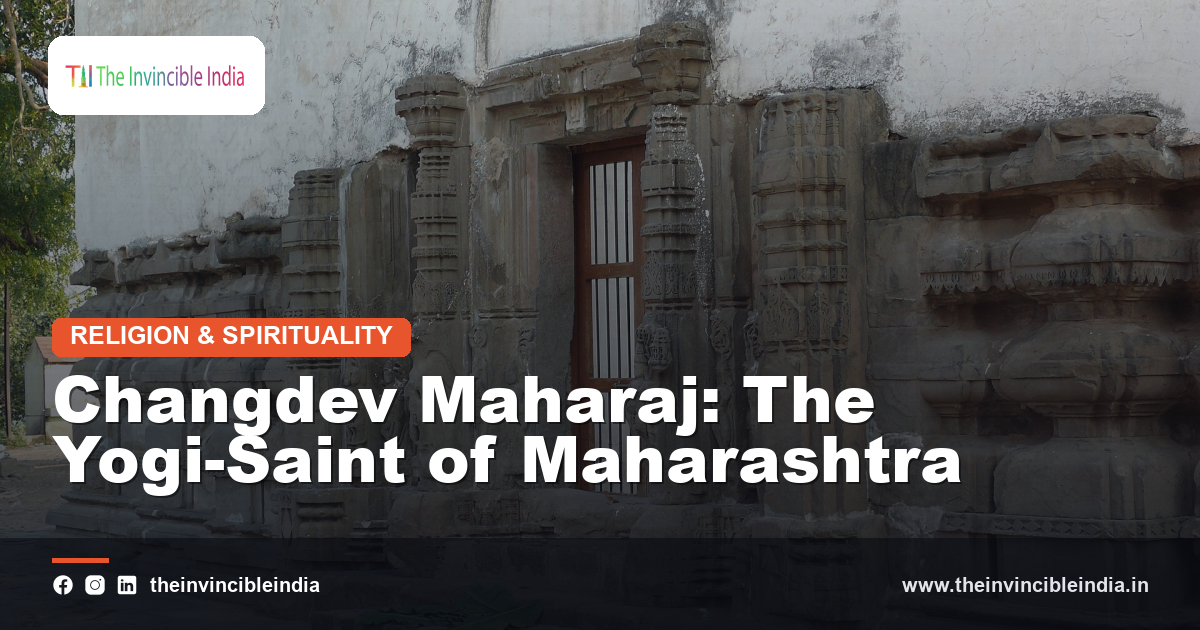
Changdev Maharaj, also called Changa Vateshwar, was a yogi-saint of Maharashtra whom tradition credits with an extraordinarily long life and great yogic powers. He is remembered above all through the cherished story of how the young saint Jnaneshwar humbled his pride, the tradition telling that Jnaneshwar came to meet him riding upon a wall, and through the Changdev Pasashti, the sixty-five verses of spiritual counsel that Jnaneshwar is said to have addressed to him. Associated with the region of the Tapi river, Changdev is honoured as a great yogi who, for all his powers, learned humility and devotion at the feet of the saints. His story belongs to the wider world of Shaivism and the Nath yogic tradition, and though much of his life is told through devotional tradition, his place in the memory of Maharashtra is firmly held. He is traditionally dated to the thirteenth century.
Quick answer: Changdev Maharaj, also called Changa Vateshwar, was a yogi-saint of Maharashtra whom tradition credits with an extraordinarily long life and great yogic powers. He is remembered through the cherished story of how Jnaneshwar humbled his pride, riding upon a wall to meet him, and through the Changdev Pasashti, the verses of counsel Jnaneshwar is said to have addressed to him. He is associated with the Tapi river region and traditionally dated to the thirteenth century.
Key Takeaways
- Changdev Maharaj, also called Changa Vateshwar, was a yogi-saint of Maharashtra.
- Tradition credits him with an extraordinarily long life and great yogic powers.
- He is associated with the region of the Tapi river.
- The tradition tells how Jnaneshwar humbled his pride, riding upon a wall to meet him.
- The Changdev Pasashti is the verses of counsel Jnaneshwar is said to have addressed to him.
- He is traditionally dated to the thirteenth century and honoured in the Nath and Varkari streams.
The sections below explain his life as told by tradition, his great yogic powers, the Nath tradition, his link with the Tapi river, the cherished story of Jnaneshwar and the wall, the Changdev Pasashti and his continuing place in devotion.
Quick Facts
| Detail | Information |
|---|---|
| Also called | Changa Vateshwar |
| Tradition | Nath yogic and Varkari streams, Maharashtra |
| Era | Thirteenth century, traditionally dated |
| Region | Maharashtra, Tapi river region |
| Language of works | Marathi (tradition) |
| Associated text | Changdev Pasashti (addressed to him by Jnaneshwar) |
| Known for | Yogic powers; long life (by tradition) |
| Contemporary | Sant Jnaneshwar |
Who Was Changdev Maharaj?
Changdev Maharaj, also called Changa Vateshwar, was a yogi-saint of Maharashtra whom tradition credits with an extraordinarily long life and great yogic powers. He is remembered above all for his meeting with the young saint Jnaneshwar, who is said to have humbled his pride and drawn him to humility and devotion.
Tradition pictures Changdev as a yogi of great attainment, master of austerities and wonders, who yet had to learn the deeper devotion and humility that the saints taught. His story is bound to the Nath yogic tradition and to the devotional world of the Varkari saints, and the region of the Tapi river is associated with his memory. Although much of his life is handed down through devotional tradition rather than documented record, his place in the memory of Maharashtra, as the great yogi humbled and guided by Jnaneshwar, is firmly and lovingly held.
What Do His Names Signify?
The saint is known as Changdev Maharaj and also as Changa Vateshwar, and these names help readers recognise him and understand his place in the tradition. Changdev is his name as a saint, with the honorific Maharaj marking the reverence in which he is held, while Changa Vateshwar is another form by which he is remembered.
The title Maharaj, meaning great lord or master, is given to revered saints and teachers as a mark of honour, and it reflects the standing of Changdev as a yogi-saint. The name Changa Vateshwar links him to the memory of the yogi honoured in the tradition. Recognising that these names refer to the same figure helps a reader follow him across the different accounts. The names thus mark him as a venerable yogi-saint, and recognising their meaning helps a reader appreciate the honour in which Changdev Maharaj is held in Maharashtra.
What Yogic Powers Does Tradition Credit to Him?
Tradition credits Changdev Maharaj with great yogic powers and with an extraordinarily long life, remembering him as a master of austerities and of the wonders said to attend the accomplished yogi. These powers are central to the way he is remembered, and they should be understood as devotional tradition.
The accounts of the tradition picture Changdev as a yogi who, through long austerity and discipline, gained command of remarkable powers and lived through many generations. Such stories are cherished in the Nath and yogic traditions as signs of spiritual attainment, yet they also set the stage for the deeper lesson of his life, that powers alone are not the goal. Careful writers present these feats explicitly as devotional tradition, honouring their meaning for the faithful while not treating them as documented history. The memory of his powers serves above all to magnify the humility he is said to have learned from Jnaneshwar.
What Is the Nath Yogic Tradition?
The Nath tradition is a stream of yogic and devotional practice in India, associated with great yogis such as Matsyendranath and Gorakhnath, that teaches the disciplines of yoga as a path to spiritual realisation. Changdev Maharaj is remembered within this yogic world.
The Nath yogis are honoured for their mastery of yoga and austerity and for a lineage of teaching passed from guru to disciple. In Maharashtra the Nath tradition is closely woven with the Varkari devotion, for the four saintly siblings, including Jnaneshwar, received their spiritual heritage through the Nath lineage. Changdev, as a great yogi, belongs to this world of yogic attainment, and his story shows the meeting of the path of yogic power with the path of loving devotion and humility. Understanding the Nath tradition helps a reader appreciate the yogic setting of Changdev’s life and the lesson his story is held to teach.
How Is Changdev Linked to the Tapi River?
Changdev Maharaj is associated in tradition with the region of the Tapi river in Maharashtra, where his memory is honoured and where shrines connected with the yogi-saint are found. The river region gives his memory a setting in the sacred geography of the land.
The Tapi is one of the great rivers of the region, and the tradition links the yogi-saint to its banks, where he is remembered as having lived and practised his austerities. The association of Changdev with the Tapi river roots his memory in a particular landscape and draws the devotion of those who honour him. This link is cherished in the tradition as part of the story of the great yogi. Understanding his connection with the Tapi river helps a reader place the life of Changdev Maharaj within the devotional map of Maharashtra and the shrines where his memory is kept alive.
Who Was Jnaneshwar in His Story?
Jnaneshwar, the great saint and author of thirteenth-century Maharashtra, is central to the story of Changdev Maharaj, for the tradition tells how the young Jnaneshwar humbled the pride of the aged yogi and became, in effect, his guide to true devotion. Their meeting is the heart of Changdev’s memory.
Jnaneshwar is revered as one of the greatest saints of Maharashtra, the author of a celebrated commentary on the Bhagavad Gita and a central figure of the Varkari tradition, and one of the four saintly siblings. In the story of Changdev, the youthful Jnaneshwar, for all his tender years, possessed a spiritual wisdom and humility that surpassed the yogic powers of the aged Changdev. Their encounter is cherished as a lesson that true greatness lies in humility and devotion rather than in power. Understanding the place of Jnaneshwar helps a reader appreciate the meaning of the story told of Changdev.
What Is the Story of Jnaneshwar and the Wall?
The most cherished story of Changdev Maharaj tells that, when the proud yogi came to meet Jnaneshwar in state, the young saint came out to greet him riding upon a wall, so humbling the pride of the master of yogic powers. This account is held in the tradition as a devotional belief rather than documented history.
Tradition relates that Changdev, confident in his powers, approached riding upon a tiger with a serpent for a whip, and that Jnaneshwar, to show that true power lies in the spirit, caused the very wall on which he sat to move forward to meet him. Seeing this, Changdev is said to have been humbled and to have turned from pride to devotion. The story is cherished as an image of the triumph of humble devotion over mere yogic power. Careful writers present this episode explicitly as devotional tradition, honouring its meaning for the faithful while not treating it as historical record.
What Is the Changdev Pasashti?
The Changdev Pasashti is a work of sixty-five verses that Jnaneshwar is said in tradition to have addressed to Changdev Maharaj, offering him counsel on the spiritual path and the nature of the divine. It is cherished as a jewel of Marathi devotional literature connected with the yogi-saint.
The word pasashti refers to the sixty-five verses of the work, which the tradition holds Jnaneshwar composed as teaching for Changdev when he found the great yogi still in need of true wisdom. The verses are revered for their profound expression of the non-dual vision and of the path of devotion. Because the work belongs to the living tradition and is studied within it, careful accounts describe it in general terms rather than claiming detailed knowledge of every verse. The Changdev Pasashti keeps the memory of Changdev bound forever to the teaching of Jnaneshwar and to the devotional literature of Maharashtra.
What Does His Story Teach About Pride and Humility?
The story of Changdev Maharaj teaches that true greatness lies not in yogic power but in humility and devotion, for the aged master of wonders was humbled by the young and humble saint Jnaneshwar. This lesson is the heart of the meaning the tradition finds in his life.
In the Hindu and yogic traditions, great powers may be gained through austerity, yet they are held to be of little worth without the humility and devotion that lead to the divine. The story of Changdev gives this teaching a vivid and memorable form, showing the yogi of many powers brought low and then raised up by learning humility. His turning from pride to devotion is cherished as a model for the seeker. For devotees the lesson of Changdev is a reminder that the goal of the spiritual path is not power over the world but the surrender of the heart in humble devotion to the Lord.
When and Where Did Changdev Maharaj Live?
Changdev Maharaj is traditionally dated to the thirteenth century, the age of Jnaneshwar and of the devotional flowering of Maharashtra, and because much of his life is handed down through tradition it is wise to describe his era in general terms rather than fix exact dates. He is associated with the Tapi river region.
His life is placed in the Marathi country during a period cherished as a great age of saints, when the Varkari tradition and the Nath yogic lineage flourished together. This was the time of Jnaneshwar, whose meeting with Changdev is the heart of the yogi’s story. Because the accounts of his life, including the great span of years tradition assigns to him, come through devotional tradition, careful writers describe his region and general period with confidence while treating the wonders of his life in the spirit of the tradition that hands them down.
How Does Changdev Reflect the Meeting of Yoga and Devotion?
Changdev Maharaj reflects the meeting of the path of yoga and the path of devotion, for his story tells of a great yogi who, through the grace of the saint Jnaneshwar, came to crown his yogic attainment with humble devotion. His memory unites the two streams of the spiritual life.
In the tradition the disciplines of yoga and the love of devotion are sometimes seen as different paths, yet the great saints are held to unite them. The story of Changdev shows the yogi of many powers learning that his attainment was incomplete without devotion and humility, and so being led to the fullness of the spiritual life. This union gives his memory its particular meaning within the Nath and Varkari streams of Maharashtra. For devotees the figure of Changdev is a reminder that the powers of yoga find their true purpose only in the love of the Lord and the surrender of the heart.
How Is Changdev Maharaj Remembered in Tradition?
Changdev Maharaj is remembered in the tradition of Maharashtra as a great yogi-saint, honoured above all through his connection with Jnaneshwar and the Changdev Pasashti, and venerated at shrines associated with his memory in the Tapi river region. His story is cherished as a lesson in humility and devotion.
Devotees honour him as the master of yogic powers who was humbled and guided by the young saint Jnaneshwar, and whose story teaches the triumph of devotion over pride. His memory is kept alive through the retelling of the story of the wall, through the Changdev Pasashti and through the shrines linked with his name. His place in the tradition reflects the devotional world in which the paths of yoga and devotion met. The honour given to Changdev Maharaj keeps his story present as a beloved and instructive episode of the age of the saints of Maharashtra.
Why Does Changdev Maharaj Still Matter Today?
Changdev Maharaj still matters today because his story remains a cherished lesson in the tradition of Maharashtra on the triumph of humility and devotion over mere power, and because the Changdev Pasashti keeps his memory bound to the great saint Jnaneshwar. His life continues to inspire reflection on the true goal of the spiritual path.
For devotees he is the great yogi who was humbled and raised up, a reminder that powers alone do not lead to the divine. Scholars value the Changdev Pasashti as a jewel of Marathi devotional literature. Careful readers honour the context of his tradition and treat the wonders of his life, including his long years and the story of the wall, explicitly as devotional belief, while recognising his enduring importance as a figure whose story unites the paths of yoga and devotion in the memory of Maharashtra.
Changdev Maharaj Today
Changdev Maharaj today is remembered as a great yogi-saint of Maharashtra, honoured through the cherished story of his meeting with Jnaneshwar and through the Changdev Pasashti, and venerated at shrines in the Tapi river region. His memory endures as a beloved lesson in humility and devotion.
Through the story of the yogi humbled by the young saint and raised to true devotion, he became an enduring image of the triumph of the heart over power. Much of his life is told through tradition, and its wonders are held as devotional belief, yet the living honour given to his memory and the reverence for the Changdev Pasashti keep him present. His legacy endures as a reminder that the powers of yoga find their purpose only in humility and in the loving surrender of the soul to the divine.
Sources & Further Reading
- Ministry of Culture, Government of India (indiaculture.gov.in).
- Sahitya Akademi general references on Marathi devotional literature.
Frequently Asked Questions
Who was Changdev Maharaj?
Changdev Maharaj, also called Changa Vateshwar, was a yogi-saint of Maharashtra whom tradition credits with an extraordinarily long life and great yogic powers. He is remembered above all for his meeting with the young saint Jnaneshwar, who is said to have humbled his pride, and for the Changdev Pasashti addressed to him.
What is the story of Jnaneshwar and the wall?
Tradition relates that when the proud yogi Changdev came to meet Jnaneshwar, the young saint came out to greet him riding upon a moving wall, so humbling the master of yogic powers. The story is cherished as a devotional image of the triumph of humble devotion over mere power, not as documented history.
What is the Changdev Pasashti?
The Changdev Pasashti is a work of sixty-five verses that Jnaneshwar is said in tradition to have addressed to Changdev Maharaj, offering counsel on the spiritual path and the nature of the divine. It is cherished as a jewel of Marathi devotional literature connected with the yogi-saint.
Where is Changdev Maharaj associated?
Changdev Maharaj is associated in tradition with the region of the Tapi river in Maharashtra, where his memory is honoured and where shrines connected with the yogi-saint are found. The river region gives his memory a setting in the sacred geography of the land.
What does the story of Changdev teach?
The story of Changdev Maharaj teaches that true greatness lies not in yogic power but in humility and devotion, for the aged master of wonders was humbled by the young and humble saint Jnaneshwar. It is cherished as a lesson that the goal of the spiritual path is loving surrender rather than power.
When did Changdev Maharaj live?
Changdev Maharaj is traditionally dated to the thirteenth century, the age of Jnaneshwar and of the devotional flowering of Maharashtra. Because much of his life is handed down through devotional tradition, his era is best described in general terms rather than by exact dates.


