

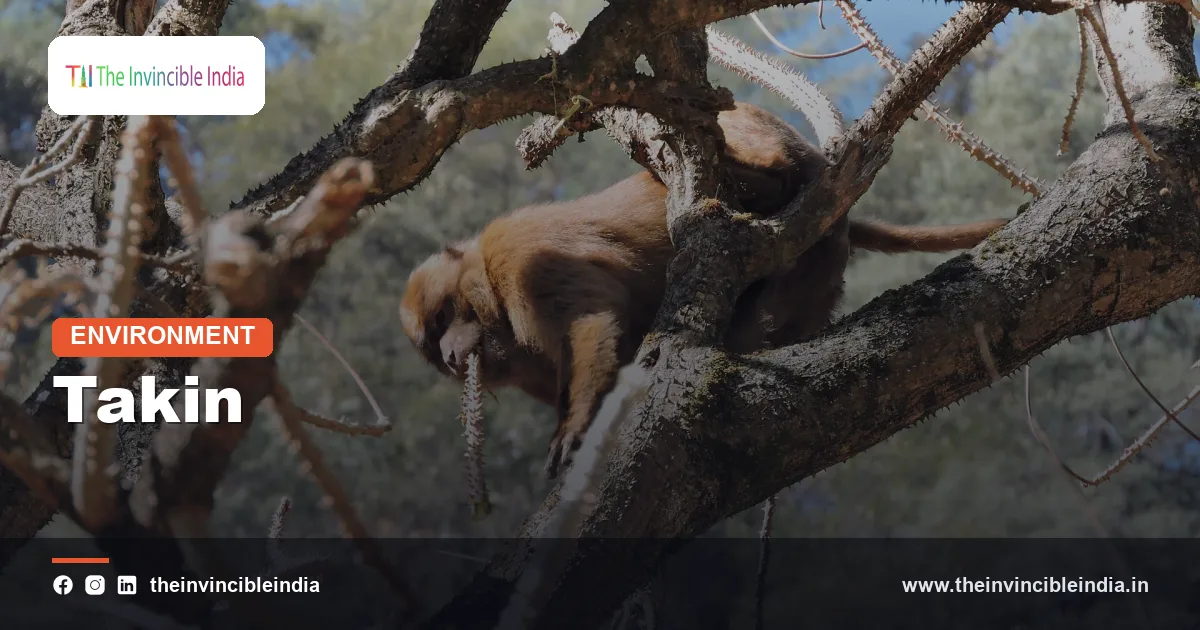
The takin (Budorcas taxicolor) is a stocky, heavily built goat-antelope of the eastern Himalaya, and in India the animal found in Arunachal Pradesh is known as the Mishmi takin. Takin conservation in India is focused on the high, cloud-covered forests and alpine meadows of the Mishmi Hills and neighbouring ranges, where the species survives in small, scattered groups and depends on wild habitat that remains remote and little disturbed.
The takin looks like a cross between a cow, a goat and a moose, which is why it puzzled early naturalists. Its closest relatives are not any of those animals but the muskox and other members of the goat-antelope tribe. This explainer covers what the takin is, where it lives in India, how it moves with the seasons, what threatens it and how it is protected. Information was last reviewed on 20 October 2026.
| Attribute | Detail |
|---|---|
| Common name | Takin; Mishmi takin in Arunachal Pradesh |
| Scientific name | Budorcas taxicolor (Mishmi takin is Budorcas taxicolor taxicolor) |
| Family and group | Bovidae; subfamily Caprinae (goat-antelopes) |
| Size | Shoulder height roughly one metre to 1.3 metres; weight commonly in the range of 200 to 350 kilograms |
| Habitat | Temperate and subalpine forest, bamboo thickets and alpine scrub in the eastern Himalaya |
| Indian range | Mainly Arunachal Pradesh, in the Mishmi Hills and other eastern Himalayan areas |
| Seasonal movement | Moves uphill in summer and downhill in winter |
| Global conservation status | Assessed by the IUCN as Vulnerable |
| Legal protection in India | Protected under the Wildlife (Protection) Act, 1972, generally cited as a highest-protection (Schedule I) species; verify the current schedule |
Key Takeaways
- The takin is a stocky Himalayan goat-antelope whose nearest relatives include the muskox, not cattle or true antelopes.
- The Mishmi takin is the form of the takin found in India, mainly in the forests of Arunachal Pradesh.
- Takin groups move to high alpine meadows in summer and descend to bamboo and broadleaf forests in winter, following food and snow.
- Mineral salt licks are important gathering places for takin, and these sites also make the animals easier to hunt.
- Hunting, snaring and loss of forest habitat are the main threats to the takin in India, and the global IUCN status of the species is Vulnerable.
- Protected areas such as Mehao Wildlife Sanctuary and Dibang Wildlife Sanctuary in Arunachal Pradesh help safeguard takin habitat.
What Is a Takin?
A takin is a large, thick-set hoofed mammal of the family Bovidae that lives in the mountain forests of the eastern Himalaya and adjoining ranges. Despite a name that sounds like a cross between a goat and an ox, the takin is classified with the goat-antelopes, the subfamily Caprinae, which also contains goats, sheep, serows and the muskox.
The animal has a short, powerful body, short stout legs, a deep chest, a thick neck and a broad, arched snout often described as moose-like. Both sexes carry horns, which sweep outward and then curve back and upward, and the horns are thick at the base. A takin’s coat is shaggy and thick, and it produces an oily secretion that helps shed rain and snow.
The takin is a heavy animal despite living on steep ground. Adults generally weigh in the region of 200 to 350 kilograms, and sizes vary between populations and sexes.
What Is the Mishmi Takin and Where Is It Found in India?
The Mishmi takin is the subspecies of takin found in the Mishmi Hills of Arunachal Pradesh, as well as in adjoining parts of Myanmar and Tibet. It is the form most closely associated with India, and it occurs mainly in the eastern part of Arunachal Pradesh, in districts such as Dibang Valley, Lower Dibang Valley, Lohit and Anjaw, although exact local distribution is not fully mapped.
Scientists usually recognise several takin forms, and their taxonomy has been revised more than once. The commonly cited forms are summarised below.
| Form | Typical region | Notes |
|---|---|---|
| Mishmi takin (taxicolor) | Mishmi Hills of Arunachal Pradesh, adjoining Myanmar and Tibet | The Indian form; relatively dark coat with variable tones |
| Bhutan takin (whitei) | Bhutan and nearby western Arunachal Pradesh and Tibet | Associated with Bhutan, where the takin is the national animal |
| Golden takin (bedfordi) | Qinling Mountains, China | Pale golden coat, the source of “golden fleece” associations |
| Sichuan takin (tibetana) | Sichuan and neighbouring Chinese mountains | Darker than the golden takin |
Takin may also occur at the edge of Indian territory in parts of western Arunachal Pradesh, where the animals link to the Bhutan form. Cross-border populations mean that conservation in India is tied to what happens in neighbouring countries.
What Does a Takin Look Like?
A takin looks like a massive, short-legged, shaggy goat-antelope with a golden-brown to dark brown coat and a heavy, drooping face. The colour varies by form and individual: the Chinese golden takin is famous for a bright golden coat, while the Mishmi takin typically shows darker tones, often with a brownish, reddish or blackish back and a lighter flank.
Features that identify a takin
- A short, thickset body with a humped appearance at the shoulders.
- A large, convex, bulbous nose with a slightly swollen look.
- Stout, down-curved and then upturned horns on both males and females.
- A thick coat of coarse outer hair over a dense woolly underlayer, with an oily skin secretion in cold wet weather.
- Cloven hooves with well-developed side toes that help grip rocky and steep slippery ground.
Adult males are larger than females, and calves are born with a paler or grey tone coat that darkens with age. Observers sometimes describe the takin’s call as a hoarse cough or roar.
How Does the Takin Move With the Seasons?
The takin makes seasonal altitudinal migrations, moving to higher meadows and shrubland in summer and descending to lower, more sheltered forests in winter. This vertical movement lets the animal exploit fresh alpine vegetation when snow melts and avoid deep snow and extreme cold when winter arrives.
In India, takin have been reported across a wide altitude band, roughly from the lower temperate zone around one to two thousand metres up to alpine habitat well above three thousand metres. In summer, groups may gather in larger herds in open high ground, while in winter they split into smaller groups in bamboo and rhododendron forest.
Group size varies with season and region. Several adults together with young are common in winter, while older males may be more solitary. Because the animals follow vegetation and snow, protecting only one altitude band is not enough. Conservation planning for the takin therefore needs corridors from lowland forest to alpine meadow.
What Do Takin Eat and Why Do They Visit Salt Licks?
Takin are herbivores that browse and graze on leaves, shoots, bamboo, grasses, herbs and shrubs, and they also visit natural mineral licks to obtain salts. Their diet changes with the season: in summer they feed on fresh alpine and subalpine plants, while in winter they depend more heavily on bamboo, evergreen foliage and woody browse.
The role of salt licks
Salt licks, sometimes called mineral licks, are patches of ground where natural springs or soil provide sodium and other minerals. Takin, like many herbivores of the Himalaya, visit these sites regularly, and groups may congregate there. Licks matter for the animals’ nutrition, but they also create a risk: hunters who know the location of a lick can wait or set snares there.
For this reason, conservation experts often argue that known licks should be mapped, monitored and given particular attention in patrolling and community awareness programmes.
Why Is the Takin Threatened?
The takin is threatened mainly by hunting, snaring and the loss and fragmentation of its forest habitat. The IUCN assesses the species as Vulnerable, which reflects a declining trend in parts of its range, though accurate population numbers for India are not available and any figure should be treated as approximate.
| Threat | Why it matters for the takin |
|---|---|
| Hunting and snaring | Takin are targeted for meat, horns and hides, and snares set for other animals also trap takin |
| Habitat loss | Roads, jhum or shifting cultivation, logging and infrastructure reduce and break up forest |
| Development projects | Roads, dams and settlements can cut migration routes and bring people into remote areas |
| Climate change | Warmer conditions may push vegetation zones upward, shrinking the alpine habitat on which takin depend in summer |
| Cross-border pressure | Hunting and habitat change on the Myanmar and Tibet side can affect the same wider population |
| Livestock competition and disease | Cattle and mithun grazing in forest may compete with takin for food and could pass on disease |
Researchers note that remoteness has been the takin’s best protection in India. As roads and settlements spread into the Mishmi Hills, that natural protection weakens, which makes planned conservation more important.
How Is the Takin Protected in India?
The takin is protected in India under the Wildlife (Protection) Act, 1972, which prohibits hunting and trade, and it is also covered by international trade controls under CITES. Commonly cited lists place the takin among the most strictly protected animals, in Schedule I of the Act, though the schedules were revised by the Wildlife (Protection) Amendment Act, 2022, so the current placement should be confirmed from official notifications.
Key protected areas
- Mehao Wildlife Sanctuary: Located in the Lower Dibang Valley district of Arunachal Pradesh, the sanctuary protects forest on the Mishmi Hills and is associated with Mehao Lake.
- Dibang Wildlife Sanctuary: A very large protected area in the Dibang Valley district, covering high-altitude eastern Himalayan terrain that is important for many rare mammals.
- Other eastern Arunachal areas: Namdapha National Park and Kamlang Wildlife Sanctuary lie in the wider landscape, and parts of western Arunachal protect the Bhutan takin.
Mehao and Dibang are the two sanctuaries most often linked with takin conservation in the Mishmi Hills. Exact boundaries, areas and species lists should be checked from forest department sources.
What Is the Role of Local Communities, Including the Mishmi?
Local communities, including the Idu Mishmi, Digaru Mishmi and Miju Mishmi peoples, are central to takin conservation because they live in and around the animal’s habitat and hold traditional knowledge of wildlife. Hunting has long been part of some hill cultures in the northeast, and in the Mishmi Hills the takin and other animals have featured in food, ritual and material use.
Modern wildlife law prohibits hunting of protected species, which creates tension between customary practice and legal protection. Conservation programmes increasingly work through village councils, community-run patrols, awareness efforts, alternative livelihoods such as ecotourism and bird watching, and community-conserved areas. Successful efforts generally focus on cooperation rather than purely on enforcement.
Several Mishmi communities have also been engaged in biodiversity surveys and camera-trap monitoring, which helps document takin presence in areas that formal surveys rarely reach. Such local participation improves data for a species that is hard to count.
How Is the Takin Studied and What Is Still Unknown?
The takin is studied mainly through camera traps, sign surveys, interviews with local hunters and herders, and genetic work, because the animal lives on steep, remote and often cloud-covered terrain. Even so, much remains unknown about its numbers, exact ranges and migration paths in India.
Several questions are still open.
- How many takin live in the Indian Himalaya, and whether populations in different valleys are connected.
- How the Mishmi takin differs genetically from the Bhutan, Sichuan and golden forms, and whether current subspecies divisions are accurate.
- How climate change will shift the alpine meadows used in summer.
- Which salt licks are most used and how best to protect them.
Filling these gaps requires long-term monitoring, collaboration between forest departments, researchers and communities, and cross-border cooperation.
Bottom Line
The takin is a heavy, shaggy goat-antelope of the eastern Himalaya, and the Mishmi takin of Arunachal Pradesh depends on large intact forest corridors that run from low valleys to high meadows. Takin conservation in India rests on stopping hunting at salt licks, protecting habitat in sanctuaries such as Mehao and Dibang, and working with Mishmi communities.
Frequently Asked Questions
Where can the takin be found in India?
The takin is found in India mainly in Arunachal Pradesh, where the Mishmi takin lives in the forests and alpine meadows of the Mishmi Hills and nearby areas. A related form, the Bhutan takin, occurs towards the west of the state near the Bhutan border. Detailed distribution is not completely mapped, and the animals live at low density in remote terrain.
Is the takin a goat or an antelope?
The takin is a goat-antelope, which means it belongs to the subfamily Caprinae in the family Bovidae. This group includes goats, sheep, serows and the muskox, and the muskox is often cited as a close relative of the takin. The takin is not a true antelope, a deer or a cow, although it resembles each of them in some ways.
Is the takin endangered?
The takin is assessed by the IUCN as Vulnerable, which is one step below Endangered. The assessment reflects declines caused by hunting and habitat loss across its range. In India it is legally protected, but reliable population figures are limited and local numbers may differ greatly from valley to valley.
Why does the takin visit salt licks?
The takin visits salt licks to obtain sodium and other minerals that are scarce in its plant diet. Natural licks occur at springs and mineral-rich soils, and several animals use them. Because takin gather at these sites, hunters can exploit them, so licks are priority places for patrolling and monitoring.
What is the difference between the Mishmi takin and the golden takin?
The Mishmi takin is the subspecies found in the Mishmi Hills of India, Myanmar and Tibet, while the golden takin lives in the Qinling Mountains of China. The golden takin is known for a bright golden coat, whereas the Mishmi takin generally has a darker brownish coat. Both belong to the same species, Budorcas taxicolor, and their taxonomy is still debated.
Which protected areas in India protect the takin?
Mehao Wildlife Sanctuary and Dibang Wildlife Sanctuary in Arunachal Pradesh are the protected areas most often linked with the Mishmi takin. Other eastern Arunachal areas, such as Namdapha National Park and Kamlang Wildlife Sanctuary, lie within the wider landscape. The exact presence of takin in each area should be confirmed from current forest department or research records.
{“@context”:”https://schema.org”,”@graph”:[{“@type”:”FAQPage”,”mainEntity”:[{“@type”:”Question”,”name”:”Where can the takin be found in India?”,”acceptedAnswer”:{“@type”:”Answer”,”text”:”The takin is found in India mainly in Arunachal Pradesh, where the Mishmi takin lives in the forests and alpine meadows of the Mishmi Hills and nearby areas. A related form, the Bhutan takin, occurs towards the west of the state near the Bhutan border. Detailed distribution is not completely mapped, and the animals live at low density in remote terrain.”}},{“@type”:”Question”,”name”:”Is the takin a goat or an antelope?”,”acceptedAnswer”:{“@type”:”Answer”,”text”:”The takin is a goat-antelope, which means it belongs to the subfamily Caprinae in the family Bovidae. This group includes goats, sheep, serows and the muskox, and the muskox is often cited as a close relative of the takin. The takin is not a true antelope, a deer or a cow, although it resembles each of them in some ways.”}},{“@type”:”Question”,”name”:”Is the takin endangered?”,”acceptedAnswer”:{“@type”:”Answer”,”text”:”The takin is assessed by the IUCN as Vulnerable, which is one step below Endangered. The assessment reflects declines caused by hunting and habitat loss across its range. In India it is legally protected, but reliable population figures are limited and local numbers may differ greatly from valley to valley.”}},{“@type”:”Question”,”name”:”Why does the takin visit salt licks?”,”acceptedAnswer”:{“@type”:”Answer”,”text”:”The takin visits salt licks to obtain sodium and other minerals that are scarce in its plant diet. Natural licks occur at springs and mineral-rich soils, and several animals use them. Because takin gather at these sites, hunters can exploit them, so licks are priority places for patrolling and monitoring.”}},{“@type”:”Question”,”name”:”What is the difference between the Mishmi takin and the golden takin?”,”acceptedAnswer”:{“@type”:”Answer”,”text”:”The Mishmi takin is the subspecies found in the Mishmi Hills of India, Myanmar and Tibet, while the golden takin lives in the Qinling Mountains of China. The golden takin is known for a bright golden coat, whereas the Mishmi takin generally has a darker brownish coat. Both belong to the same species, Budorcas taxicolor, and their taxonomy is still debated.”}},{“@type”:”Question”,”name”:”Which protected areas in India protect the takin?”,”acceptedAnswer”:{“@type”:”Answer”,”text”:”Mehao Wildlife Sanctuary and Dibang Wildlife Sanctuary in Arunachal Pradesh are the protected areas most often linked with the Mishmi takin. Other eastern Arunachal areas, such as Namdapha National Park and Kamlang Wildlife Sanctuary, lie within the wider landscape. The exact presence of takin in each area should be confirmed from current forest department or research records.”}}]}]}


