

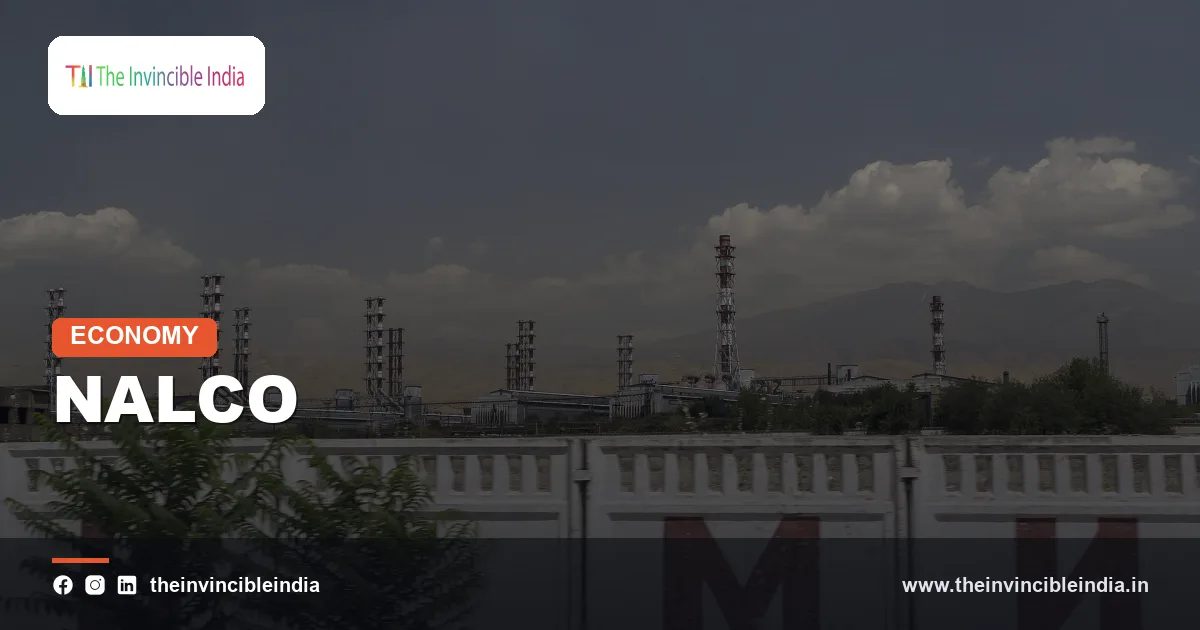
The National Aluminium Company (NALCO) is a Navratna public sector enterprise under India’s Ministry of Mines that mines bauxite, refines it into alumina and smelts it into aluminium in the eastern state of Odisha. Incorporated in 1981 with its headquarters in Bhubaneswar, the National Aluminium Company runs a fully integrated chain that starts at the Panchpatmali bauxite mines in Koraput district, passes through the Damanjodi alumina refinery and ends at the Angul smelter and captive power plant.
Few Indian companies control every step from ore to metal, and the National Aluminium Company is one of them. Its output feeds domestic users in power, packaging, transport and construction, and a meaningful share of its alumina and aluminium is sold overseas. This explainer sets out how NALCO began, how its plants work, what it sells and where its growth plans are heading.
| Attribute | Details |
|---|---|
| Full name | National Aluminium Company Limited (NALCO) |
| Incorporated | 7 January 1981 |
| Headquarters | Bhubaneswar, Odisha |
| Administrative ministry | Ministry of Mines, Government of India |
| Status | Navratna central public sector enterprise (conferred in 2008); listed company |
| Mines and refinery | Panchpatmali bauxite mines and Damanjodi alumina refinery, Koraput district, Odisha |
| Smelter and power | Aluminium smelter and captive power plant at Angul, Odisha |
| Early technology partner | Aluminium Pechiney of France (design and technology support for the original project) |
| Ownership | Majority held by the Government of India, with the remainder with public shareholders and institutions |
Key Takeaways
- The National Aluminium Company (NALCO) was incorporated on 7 January 1981 and is headquartered in Bhubaneswar, Odisha.
- NALCO is an integrated producer: it mines bauxite at Panchpatmali, refines alumina at Damanjodi and smelts aluminium at Angul.
- NALCO received Navratna status in 2008, which gave it wider financial autonomy for investment decisions than an ordinary public sector enterprise.
- The Angul complex combines an aluminium smelter with a large captive coal-based power plant of roughly 1,200 MW, so most of its electricity needs are met in-house.
- NALCO exports both alumina and aluminium, which has made the Government-owned company a regular earner of foreign exchange.
- NALCO is a Government of India majority-owned company whose shares are listed on Indian stock exchanges, and it reports to the Ministry of Mines.
What is the National Aluminium Company (NALCO)?
The National Aluminium Company, universally shortened to NALCO, is an Indian central public sector enterprise that produces alumina and aluminium from domestic bauxite. It was created to make India less dependent on imported aluminium and to build a large, modern metal industry in a mineral-rich but underdeveloped part of the country.
NALCO belongs to a small group of Indian state-owned companies that have been awarded Navratna status, a category used for well-performing enterprises. It is administratively controlled by the Ministry of Mines, and the Government of India remains its majority shareholder. The company is also known for operating inside a single state, Odisha, which holds a very large share of the country’s bauxite reserves.
Besides the metal business, NALCO operates wind and other power assets, a port-linked export operation and a range of downstream products. These supporting units are small compared with the mine-refinery-smelter backbone, but they show how the company has gradually widened its activities.
How and why was NALCO set up?
NALCO was set up in 1981 because India wanted a large integrated aluminium project based on its own bauxite and its own power, rather than relying on imports and on a few existing private producers. The Government of India incorporated the company on 7 January 1981 to turn the east coast bauxite belt into a metal industry.
The original project was designed with technical support from the French firm Aluminium Pechiney, which provided know-how for the refinery and smelter. The mines and refinery were built in the Koraput highlands, while the smelter was placed far away at Angul, where coal from the nearby Talcher coalfield could fuel a dedicated power station. The linking of two distant sites by rail and road was one of the defining design choices of the project.
The first units began operating in the second half of the 1980s, and the company then spent years ramping up and later expanding. Several rounds of capacity addition followed in the decades after, both at the refinery and at the smelter and power plant.
Why was Odisha chosen?
Odisha was chosen because it has large bauxite deposits, abundant coal in the Talcher area and access to the sea along the east coast. These three advantages are exactly what an integrated aluminium project needs, since bauxite, energy and an export outlet all affect cost.
Where are NALCO’s mines, refinery and smelter located?
NALCO’s operations sit at two principal Odisha locations: the mines and refinery in the south, and the smelter and power complex in the centre of the state. The Panchpatmali bauxite deposit and the Damanjodi alumina refinery are in Koraput district, while the aluminium smelter and the captive power plant are at Angul.
- Panchpatmali bauxite mines (Koraput): an open-cast bauxite operation on a hill plateau, considered one of the major bauxite mines in the country.
- Damanjodi alumina refinery (Koraput): a refinery near the mines that converts bauxite to alumina, with capacity of roughly 2 million tonnes of alumina a year after expansion.
- Angul smelter and power plant: a smelter with a nameplate capacity of roughly 460,000 tonnes of aluminium a year, supported by a captive thermal power station.
- Port facility at Visakhapatnam: NALCO uses dedicated handling arrangements at a port on the east coast for alumina shipments to overseas buyers.
Capacity figures for the refinery and smelter have been revised upward over time, and the numbers above are approximate; the company’s annual reports give the latest authoritative values.
How does NALCO turn bauxite into aluminium?
NALCO turns bauxite into aluminium in two main steps: the Bayer process extracts alumina from the ore, and the Hall-Heroult electrolytic process then reduces that alumina to aluminium metal. The two steps happen at different plants, which is why NALCO needs both a refinery and a smelter.
Step 1: Mining and refining at Damanjodi
At Panchpatmali, bauxite is mined from the surface, crushed and transported to Damanjodi. In the Bayer process, the crushed ore is dissolved in hot caustic soda, the dissolved aluminium compound is separated from impurities and then crystallised, and the crystals are heated to produce a white powder called alumina. The leftover residue, known as red mud, is stored in specially engineered ponds.
Step 2: Smelting at Angul
At Angul, alumina is dissolved in molten cryolite inside large electrolytic cells called pots. A strong electric current passes through the pots and splits the alumina into aluminium metal, which collects at the bottom and is tapped, cast into ingots, billets or other forms. Making one tonne of aluminium takes roughly two tonnes of alumina and a very large quantity of electricity, so power cost largely decides the economics.
Why does NALCO have its own captive power plant?
NALCO has its own captive power plant because aluminium smelting consumes enormous amounts of electricity, and producing that power in-house protects the smelter from grid price swings and supply interruptions. The coal-based power station at Angul has a capacity of roughly 1,200 MW and is dedicated mainly to the smelter, with some surplus power supplied to the state grid.
Electricity is typically the biggest single cost in smelting, often cited as a third or more of the cost of producing aluminium. By owning both the power station and the nearby coal supply arrangements, the National Aluminium Company reduces exposure to that cost. The company has also developed wind power projects in several states to reduce its carbon footprint and to generate renewable electricity for its needs.
Because the smelter depends heavily on coal, NALCO’s carbon intensity is closely watched. The company has talked about adding renewable energy and improving efficiency, although coal remains central to the existing smelter.
What products does NALCO make and sell?
NALCO makes alumina hydrate and calcined alumina as well as primary aluminium in the form of ingots, billets, wire rods, rolled products and cast strips. Alumina and aluminium are its two main revenue sources, and the company sells to both domestic and international customers.
- Alumina: sold for use in other smelters worldwide and for chemical and ceramic uses.
- Aluminium ingots and billets: sold to extruders and fabricators.
- Wire rods and rolled products: used in the electrical, packaging and general engineering industries.
- Power: surplus electricity from its power and wind facilities.
Domestically, aluminium goes into overhead power transmission lines, cables, vehicles, rail coaches, packaging, building facades and consumer goods. Internationally, the company has exported to markets in Asia, Europe and the Middle East, and in some years exports have accounted for a significant share of its sales.
What is NALCO’s ownership and Navratna status?
NALCO is a Government of India majority-owned company whose shares are traded on Indian stock exchanges, and it was conferred Navratna status in 2008. The Navratna label places the company in a tier above the Miniratna categories, giving its board greater freedom to make investments and joint ventures without prior approval from the Government, up to defined limits.
The administrative ministry is the Ministry of Mines, and board members include a mix of company executives, Government nominees and independent directors. Like other central public sector enterprises, NALCO is accountable to the Comptroller and Auditor General of India and to Parliament through the ministry.
Navratna status is awarded based on criteria such as a strong track record, a favourable credit rating and a financial performance score. The status does not change ownership and is not the same as privatisation.
What are NALCO’s expansion plans and ventures?
NALCO’s expansion plans centre on adding refining and smelting capacity, securing coal and bauxite supply, developing renewable energy and entering overseas critical-mineral ventures. The company has publicly discussed proposals to enlarge the Damanjodi refinery, to build a second smelter-scale facility and to extend its mining leases.
- Refinery expansion: proposals to raise alumina output from Damanjodi to roughly 3 million tonnes a year and beyond, which would need additional bauxite supply.
- Smelter expansion: proposals for more smelting capacity, possibly with a new power source, subject to approvals and investment decisions.
- Coal mines: captive coal blocks in Odisha’s Talcher region to reduce fuel risk for the power plant.
- Critical minerals: NALCO is a partner, along with Hindustan Copper and Mineral Exploration and Consultancy Limited, in Khanij Bidesh India Limited (KABIL), a joint venture created to acquire strategic mineral assets abroad.
- Value-added products: a push towards higher-value rolled and fabricated aluminium rather than only ingots.
Because these plans depend on approvals, land, environmental clearances and market conditions, timelines tend to change. Readers should check the latest company disclosures for current status.
Why does NALCO matter to India?
NALCO matters to India because it supplies a strategic metal, supports a large industrial base in Odisha and earns foreign exchange through exports. Aluminium is vital for electricity transmission, defence, aerospace, transport and packaging, and a home-grown supplier lowers the risk of import dependence.
The company also anchors regional development. Its townships at Damanjodi and Angul, its contracts with local suppliers and its payments of royalty and taxes to the state have shaped the economy of the districts where it operates. In addition, it runs schools, health services and other community programmes in those areas under its social responsibility initiatives.
India’s aluminium consumption per person is still low compared with many developed countries, and demand is expected to rise with infrastructure, electric vehicles, renewable energy equipment and packaging. This underlying demand is part of the case for further expansion.
What challenges does NALCO face?
NALCO faces challenges from volatile global aluminium prices, rising input costs, environmental management and competition from large private producers. Aluminium is traded on international exchanges, so the company’s revenue moves with global prices, while its costs for coal, caustic soda and power are set by different markets.
- Price cycles: profits tend to be strong when aluminium prices are high and thinner when they fall.
- Environmental issues: red mud disposal, emissions from the power plant and mining impacts on forests and communities need continuous management.
- Raw material security: long-term bauxite and coal access depends on mining leases and allocation policies.
- Competition: private Indian groups and Chinese producers influence the market.
NALCO at a glance: key milestones
| Period | Milestone |
|---|---|
| 1981 | NALCO incorporated by the Government of India on 7 January |
| Mid-to-late 1980s | Mines, refinery, smelter and power plant begin operations in phases |
| Late 1980s to 2000s | Capacity additions at the refinery and smelter; growth of exports |
| 1990s | Public share offering by the Government; shares listed on stock exchanges |
| 2008 | Conferred Navratna status |
| 2010s | Further expansion of refining capacity and growth in wind power |
| 2019 onward | Participation in KABIL for overseas critical minerals; new expansion proposals |
Bottom Line
The National Aluminium Company is one of India’s few fully integrated aluminium producers, linking Koraput bauxite to Angul metal through the Damanjodi refinery and a captive power plant. Its Navratna status, export earnings and expansion plans make it a significant strategic metals enterprise, even as it deals with price cycles and environmental scrutiny.
Frequently Asked Questions
What does NALCO stand for?
NALCO stands for the National Aluminium Company Limited. It is a Government of India majority-owned enterprise, headquartered in Bhubaneswar, Odisha, that produces alumina and aluminium.
When was NALCO established?
NALCO was incorporated on 7 January 1981. Its first mines, refinery, smelter and power units began operating in phases during the second half of the 1980s.
Where are NALCO’s plants located?
NALCO’s bauxite mines and alumina refinery are in Koraput district at Panchpatmali and Damanjodi, while its smelter and captive power plant are at Angul, all in Odisha. The company also has wind power assets in other states and port-handling arrangements on the east coast.
Is NALCO a Navratna company?
Yes, NALCO has been a Navratna central public sector enterprise since 2008. This status gives its board greater powers to approve investments and joint ventures without seeking Government clearance for each one.
What does NALCO produce?
NALCO produces alumina and primary aluminium, sold as ingots, billets, wire rods and rolled products. It also generates and sells surplus power from its captive and wind facilities.
Does NALCO export its products?
Yes, NALCO exports both alumina and aluminium to several overseas markets. Exports have contributed a notable share of revenue in many years, depending on global prices and demand.
{“@context”:”https://schema.org”,”@graph”:[{“@type”:”FAQPage”,”mainEntity”:[{“@type”:”Question”,”name”:”What does NALCO stand for?”,”acceptedAnswer”:{“@type”:”Answer”,”text”:”NALCO stands for the National Aluminium Company Limited. It is a Government of India majority-owned enterprise, headquartered in Bhubaneswar, Odisha, that produces alumina and aluminium.”}},{“@type”:”Question”,”name”:”When was NALCO established?”,”acceptedAnswer”:{“@type”:”Answer”,”text”:”NALCO was incorporated on 7 January 1981. Its first mines, refinery, smelter and power units began operating in phases during the second half of the 1980s.”}},{“@type”:”Question”,”name”:”Where are NALCO’s plants located?”,”acceptedAnswer”:{“@type”:”Answer”,”text”:”NALCO’s bauxite mines and alumina refinery are in Koraput district at Panchpatmali and Damanjodi, while its smelter and captive power plant are at Angul, all in Odisha. The company also has wind power assets in other states and port-handling arrangements on the east coast.”}},{“@type”:”Question”,”name”:”Is NALCO a Navratna company?”,”acceptedAnswer”:{“@type”:”Answer”,”text”:”Yes, NALCO has been a Navratna central public sector enterprise since 2008. This status gives its board greater powers to approve investments and joint ventures without seeking Government clearance for each one.”}},{“@type”:”Question”,”name”:”What does NALCO produce?”,”acceptedAnswer”:{“@type”:”Answer”,”text”:”NALCO produces alumina and primary aluminium, sold as ingots, billets, wire rods and rolled products. It also generates and sells surplus power from its captive and wind facilities.”}},{“@type”:”Question”,”name”:”Does NALCO export its products?”,”acceptedAnswer”:{“@type”:”Answer”,”text”:”Yes, NALCO exports both alumina and aluminium to several overseas markets. Exports have contributed a notable share of revenue in many years, depending on global prices and demand.”}}]}]}


