

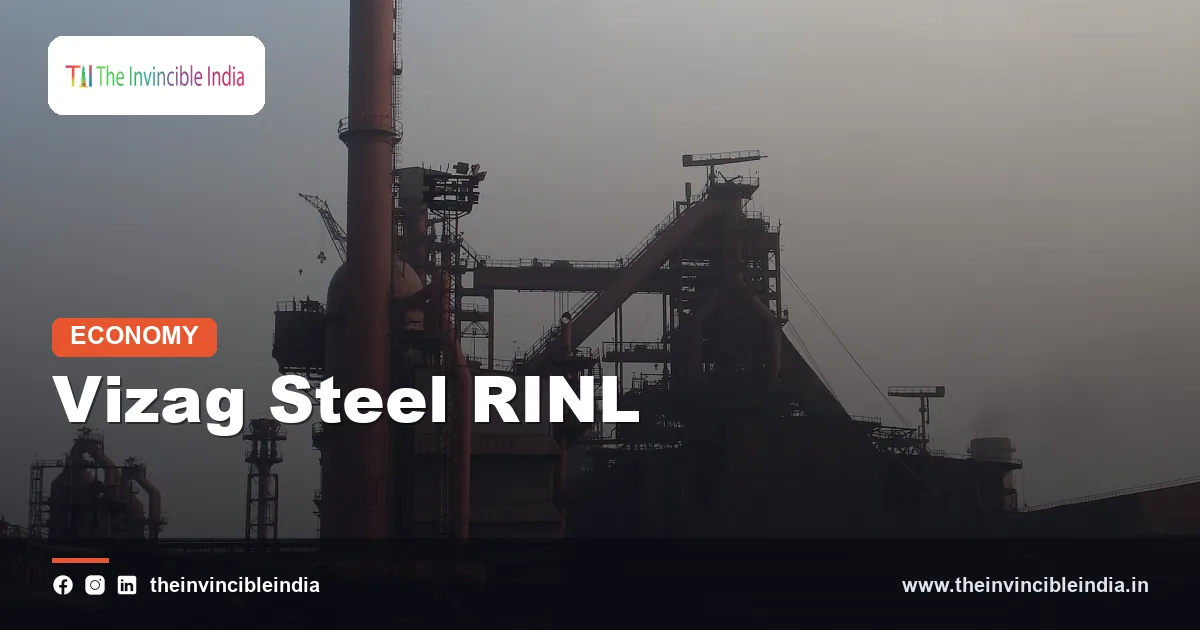
Rashtriya Ispat Nigam Limited (RINL) is the Government of India company that owns and runs the Visakhapatnam Steel Plant, popularly called Vizag Steel, India’s first shore-based integrated steel plant. Incorporated in 1982 and based in Visakhapatnam, Andhra Pradesh, Rashtriya Ispat Nigam is a Navratna public sector enterprise under the Ministry of Steel that makes long steel products such as rebars, wire rods and structural sections.
Few industrial units in India carry as much regional sentiment as Vizag Steel, whose creation followed a popular agitation in the 1960s. This explainer covers how the plant came about, what it makes, how it is structured, and why debates about its finances, revival and possible strategic disinvestment have attracted so much attention.
| Attribute | Details |
|---|---|
| Full name | Rashtriya Ispat Nigam Limited (RINL) |
| Plant | Visakhapatnam Steel Plant (Vizag Steel, VSP) |
| Company incorporated | 1982 |
| Foundation stone of plant | 1971 |
| Production begins | Early 1990s, with the first blast furnace commissioned in 1992 |
| Headquarters | Visakhapatnam, Andhra Pradesh |
| Administrative ministry | Ministry of Steel, Government of India |
| Status | Navratna central public sector enterprise (conferred in 2010) |
| Main products | Long products: rebars, wire rods, structurals, medium merchant bars and special bars |
| Notable first | India’s first shore-based integrated steel plant |
Key Takeaways
- Rashtriya Ispat Nigam Limited (RINL) owns the Visakhapatnam Steel Plant, known as Vizag Steel, in Andhra Pradesh.
- Vizag Steel is India’s first shore-based integrated steel plant, built beside the Bay of Bengal near Visakhapatnam port.
- The plant was a result of the Visakha Ukku Andhrula Hakku movement of the 1960s, which demanded a steel plant for Andhra Pradesh.
- Rashtriya Ispat Nigam specialises in long products such as TMT rebars, wire rods and structural steel, and sells them under the Vizag Steel brand.
- In January 2021 the Government of India gave an in-principle approval for strategic disinvestment of RINL, which prompted protests and a long public debate.
- Rashtriya Ispat Nigam was conferred Navratna status in 2010 and is administered by the Ministry of Steel.
What is Rashtriya Ispat Nigam (Vizag Steel)?
Rashtriya Ispat Nigam Limited is a Government of India steel company whose single large operating unit is the Visakhapatnam Steel Plant, an integrated plant that turns iron ore, coal and fluxes into finished steel. The Hindi word Ispat means steel and Nigam means corporation, so the name translates roughly as National Steel Corporation.
The company was set up as a separate public sector enterprise and not as part of the Steel Authority of India Limited (SAIL), the older steel PSU that runs plants such as Bhilai, Rourkela and Durgapur. This gave Vizag Steel its own management, financial structure and brand.
Because the plant sits on the coast, it can receive imported raw materials, such as coking coal, directly through the port, and can ship finished products by sea as well as by rail and road. That location is the basis of its description as a shore-based plant.
How was the Visakhapatnam Steel Plant created?
The Visakhapatnam Steel Plant was created after a mass movement in the 1960s demanded a steel plant for Andhra Pradesh, followed by a Government decision in 1970 and a foundation stone laid in 1971. The agitation, known as Visakha Ukku Andhrula Hakku, meaning that Visakhapatnam steel is the right of Andhras, took place around 1966 and reportedly cost dozens of lives in police action.
Prime Minister Indira Gandhi laid the foundation stone in January 1971. Construction took many years, and the Soviet Union provided important technical and design assistance, in keeping with its role in several Indian steel projects of that era.
The company, Rashtriya Ispat Nigam Limited, was incorporated in February 1982 to build and operate the plant. The first blast furnace came on stream in the early 1990s, and the plant was formally dedicated to the nation in 1992.
Why does the plant carry emotional weight?
The plant carries emotional weight because many in Andhra Pradesh view it as the outcome of a people’s struggle rather than just an industrial project. That history explains why proposals to sell or restructure it have drawn organised protests from workers, political parties and civil society.
Where is Vizag Steel located and why does that matter?
Vizag Steel is located on the coast of the Bay of Bengal at Visakhapatnam, Andhra Pradesh, on a site of well over 20,000 acres that includes the plant, a township and a large buffer area. The coastal setting matters because steelmaking requires bulk movement of raw materials and finished products, and sea access lowers transport costs.
- Port access: imported coking coal and other inputs can come in via the Visakhapatnam port area.
- Rail connectivity: iron ore and other materials arrive by rail from mines in Chhattisgarh and Odisha.
- Market reach: southern and eastern India are close, as are ports for exports.
- Water and power: a coastal site provides water supply and room for a captive power plant.
The land bank is itself a subject of discussion in the privatisation debate, since the plant occupies a large area near a growing port city.
What does Rashtriya Ispat Nigam produce?
Rashtriya Ispat Nigam produces long steel products, principally reinforcing bars, wire rods, structural sections and medium merchant bars. Long products are rolled in bar or section form, as against flat products like sheets and plates, and are used mainly in construction, infrastructure and engineering.
| Product | Common uses |
|---|---|
| TMT rebars | Reinforcement for buildings, bridges, roads and dams |
| Wire rods | Wire drawing, fasteners, nails, mesh and cables |
| Structural sections (angles, channels, beams) | Industrial sheds, transmission towers, bridges |
| Medium merchant bars | General engineering and fabrication |
| Special steel bars and rounds | Engineering and automotive-related applications |
| Pig iron and semi-finished steel | Sold as surplus or for further rolling |
The plant also produces by-products, including slag used in cement manufacturing, and coke-oven chemicals. The company sells through a network of branch offices, stockyards and dealers under the Vizag Steel brand.
How does an integrated steel plant like Vizag Steel work?
An integrated steel plant like Vizag Steel makes steel from raw materials in a continuous sequence: coke ovens and sinter plants prepare inputs, blast furnaces make hot metal, steel melting shops refine it, and rolling mills shape it. This is different from a mini steel plant, which melts scrap or sponge iron in electric furnaces.
- Raw material handling: iron ore, coal, limestone and dolomite are received and stored.
- Coke ovens and sinter plant: coal is converted to coke, and ore fines are agglomerated into sinter.
- Blast furnaces: coke, sinter and ore are charged, and molten iron is produced. Vizag Steel runs a set of large blast furnaces named after Indian rivers.
- Steel melting shops: hot metal is converted to liquid steel in converters, then cast into blooms and billets.
- Rolling mills: billets and blooms are heated and rolled into bars, rods and sections.
After its expansion the plant’s rated capacity rose to roughly 6.3 million tonnes of liquid steel a year, from about 3 million tonnes originally. Actual output has varied with raw material supply, working capital and market conditions.
What are Rashtriya Ispat Nigam’s strengths and weaknesses?
Rashtriya Ispat Nigam’s main strengths are its coastal location, modern large-scale blast furnaces, strong brand recognition for long products and a trained workforce. Its main weaknesses have been the lack of large captive iron ore mines, heavy debt and thin margins during periods of high raw material costs.
- Strength – location: proximity to the port and consumer markets.
- Strength – scale: an integrated plant with multi-million-tonne capacity.
- Weakness – raw materials: RINL has depended largely on purchased iron ore, notably from NMDC, and on imported coking coal, which exposes it to price swings.
- Weakness – finances: debts from the expansion phase and periods of low capacity use have squeezed cash flows.
Compared with some competitors that own captive iron ore mines, the absence of such mines has been a repeatedly cited disadvantage in analyses of the company.
What is the debate on privatisation and revival of Vizag Steel?
The debate on Vizag Steel centres on a January 2021 Government of India decision, in principle, to strategically disinvest Rashtriya Ispat Nigam, which was followed by a prolonged agitation and later by a financial revival effort. Strategic disinvestment means selling management control and a majority stake to a private buyer.
The Union Government argued that it should withdraw from sectors where private firms can operate and that the sale proceeds could be used for public spending. Employee unions, political parties across the spectrum and the state government of the time under Chief Minister Y. S. Jagan Mohan Reddy opposed the plan, citing the plant’s history, jobs and the region’s sentiment. Workers held sustained protests in Visakhapatnam.
In the following years the Government explored options for easing the company’s financial stress. In January 2025, the Union Cabinet approved a financial revival package of well over Rs 11,000 crore, aimed at improving working capital, restarting idle furnace capacity and stabilising operations. The package did not by itself settle the long-term ownership question, and readers should check current official announcements.
What are the main arguments on each side?
- Arguments for disinvestment: reducing Government exposure, bringing in private capital and management and ending recurring losses.
- Arguments against: protecting jobs, retaining a strategic public asset, the plant’s history and the value of its land and infrastructure.
- Middle positions: proposals for revival through capital support, captive mines and operational improvements before considering any sale.
Who works at Vizag Steel and what is its workforce like?
Vizag Steel employs well over ten thousand regular employees, with a large additional number of contract and indirect workers in the plant, township and supply chain. The exact numbers change as people retire and recruitment is limited, and the figure should be treated as approximate.
The workforce is represented by several trade unions, and industrial relations have often been shaped by the privatisation debate. A township near the plant houses many employees and their families, with schools, hospitals and recreational facilities.
Beyond direct jobs, the plant supports a wide ecosystem of suppliers, transporters, traders and small fabricators in and around Visakhapatnam. This indirect employment is a core reason that local economic and political stakeholders watch the company closely.
What joint ventures and mines does Rashtriya Ispat Nigam have?
Rashtriya Ispat Nigam has taken part in several joint ventures and has sought captive mineral assets to strengthen its raw material position. The most visible joint venture is RINL-MOIL Ferro Alloys Private Limited, formed with MOIL Limited, the manganese ore producer, to make ferro-alloys at Visakhapatnam.
The company has also held limestone and dolomite resources linked to its plant, and it has long sought iron ore blocks of its own. Securing allocation of captive iron ore has been among its most discussed strategic aims.
How does Vizag Steel handle environmental and social responsibilities?
Vizag Steel handles environmental and social responsibilities through pollution control equipment, waste reuse, green belt development and community programmes around its township. Steelmaking produces dust, gases, slag and wastewater, so the plant uses measures such as dust extraction, water recycling and slag utilisation to limit its footprint.
Slag from the blast furnaces is processed and supplied to the cement industry, and a green belt of trees surrounds parts of the complex. The company also supports schools, healthcare and skill programmes in nearby communities and displaced-family settlements, which trace back to the land acquired for the plant in the 1970s and 1980s.
Like all large Indian steel plants, Rashtriya Ispat Nigam operates under conditions set by the Ministry of Environment, Forest and Climate Change and the state pollution control board. Decarbonisation of steel, through greater energy efficiency and future use of alternative fuels, is an emerging topic for all integrated producers.
Vizag Steel at a glance: timeline
| Year | Event |
|---|---|
| 1966 | Visakha Ukku Andhrula Hakku movement gathers momentum |
| 1970-71 | Government approves the plant; foundation stone laid in January 1971 |
| 1982 | Rashtriya Ispat Nigam Limited incorporated |
| 1992 | First blast furnace commissioned; plant dedicated to the nation |
| 2010 | Conferred Navratna status |
| 2021 | In-principle Government decision on strategic disinvestment announced; protests follow |
| 2025 | Union Cabinet approves a financial revival package |
Bottom Line
Rashtriya Ispat Nigam runs Vizag Steel, India’s first shore-based integrated steel plant, and is a Navratna PSU known for long products. Born out of a mass movement, it faces ongoing questions about debt, raw material access and ownership, and its future depends on how revival and disinvestment proposals unfold.
Frequently Asked Questions
What is Rashtriya Ispat Nigam Limited?
Rashtriya Ispat Nigam Limited (RINL) is a Government of India steel company that owns the Visakhapatnam Steel Plant, or Vizag Steel. It is headquartered in Visakhapatnam and administered by the Ministry of Steel.
Why is Vizag Steel called India’s first shore-based steel plant?
Vizag Steel is called India’s first shore-based integrated steel plant because it was built on the coast of the Bay of Bengal beside a port. This lets it receive imported raw materials and dispatch products by sea as well as by rail and road.
What does Vizag Steel manufacture?
Vizag Steel mainly manufactures long steel products such as TMT rebars, wire rods, structural sections and medium merchant bars. These are widely used in construction and infrastructure.
Is Vizag Steel being privatised?
The Government of India gave an in-principle approval for strategic disinvestment of RINL in January 2021, but the plan drew strong opposition and the company has continued under Government ownership. In January 2025 a financial revival package was approved, so readers should check the latest official position.
When was the Visakhapatnam Steel Plant established?
The foundation stone of the Visakhapatnam Steel Plant was laid in 1971, and Rashtriya Ispat Nigam Limited was incorporated in 1982. The first blast furnace began operating in the early 1990s, and the plant was dedicated to the nation in 1992.
Is RINL a Navratna company?
Yes, Rashtriya Ispat Nigam was conferred Navratna status in 2010. The status gives its board more financial autonomy for investment and joint venture decisions than ordinary public sector enterprises have.
{“@context”:”https://schema.org”,”@graph”:[{“@type”:”FAQPage”,”mainEntity”:[{“@type”:”Question”,”name”:”What is Rashtriya Ispat Nigam Limited?”,”acceptedAnswer”:{“@type”:”Answer”,”text”:”Rashtriya Ispat Nigam Limited (RINL) is a Government of India steel company that owns the Visakhapatnam Steel Plant, or Vizag Steel. It is headquartered in Visakhapatnam and administered by the Ministry of Steel.”}},{“@type”:”Question”,”name”:”Why is Vizag Steel called India’s first shore-based steel plant?”,”acceptedAnswer”:{“@type”:”Answer”,”text”:”Vizag Steel is called India’s first shore-based integrated steel plant because it was built on the coast of the Bay of Bengal beside a port. This lets it receive imported raw materials and dispatch products by sea as well as by rail and road.”}},{“@type”:”Question”,”name”:”What does Vizag Steel manufacture?”,”acceptedAnswer”:{“@type”:”Answer”,”text”:”Vizag Steel mainly manufactures long steel products such as TMT rebars, wire rods, structural sections and medium merchant bars. These are widely used in construction and infrastructure.”}},{“@type”:”Question”,”name”:”Is Vizag Steel being privatised?”,”acceptedAnswer”:{“@type”:”Answer”,”text”:”The Government of India gave an in-principle approval for strategic disinvestment of RINL in January 2021, but the plan drew strong opposition and the company has continued under Government ownership. In January 2025 a financial revival package was approved, so readers should check the latest official position.”}},{“@type”:”Question”,”name”:”When was the Visakhapatnam Steel Plant established?”,”acceptedAnswer”:{“@type”:”Answer”,”text”:”The foundation stone of the Visakhapatnam Steel Plant was laid in 1971, and Rashtriya Ispat Nigam Limited was incorporated in 1982. The first blast furnace began operating in the early 1990s, and the plant was dedicated to the nation in 1992.”}},{“@type”:”Question”,”name”:”Is RINL a Navratna company?”,”acceptedAnswer”:{“@type”:”Answer”,”text”:”Yes, Rashtriya Ispat Nigam was conferred Navratna status in 2010. The status gives its board more financial autonomy for investment and joint venture decisions than ordinary public sector enterprises have.”}}]}]}


