

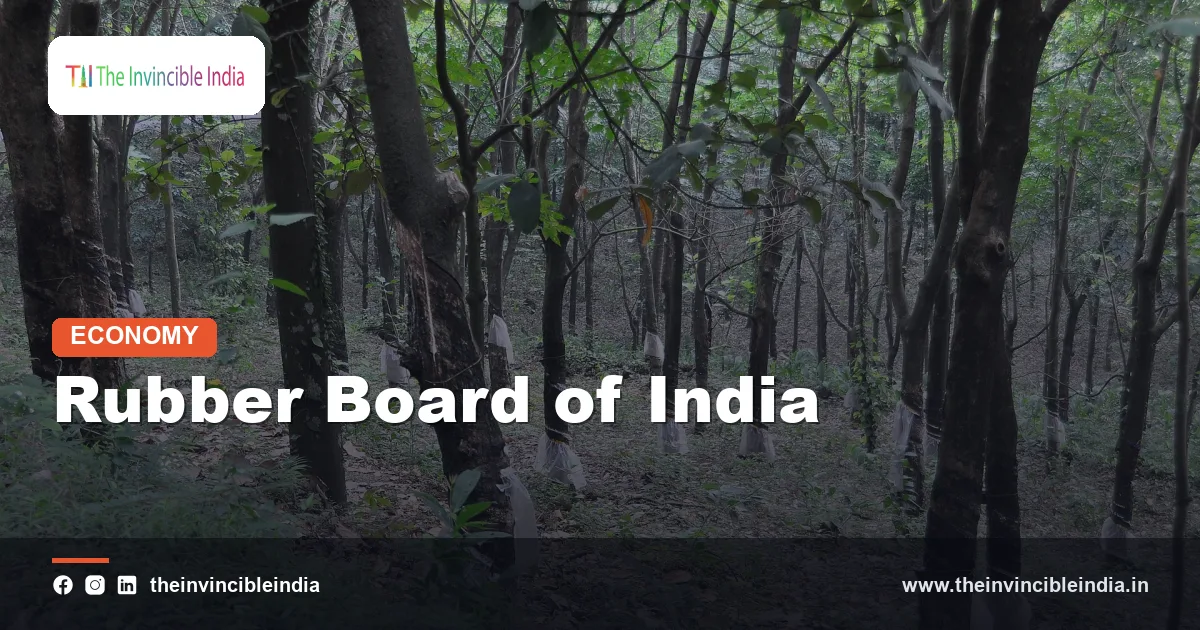
The Rubber Board of India is the statutory body, constituted under the Rubber Act, 1947 and headquartered in Kottayam, Kerala, that develops and regulates the natural rubber industry in India. It works under the Ministry of Commerce and Industry and is best known for its research arm, the Rubber Research Institute of India (RRII), and for its support to the smallholders who grow most of the country’s rubber.
This explainer sets out what the Rubber Board of India is, how it is organised, what it does for growers, how planting and replanting support works, and where natural rubber is grown. Figures are approximate and dated, because area, production and prices change every year. Last updated: 20 October 2026.
| Attribute | Detail |
|---|---|
| Full name | Rubber Board of India (commonly, the Rubber Board) |
| Established | 1947, under the Rubber Act, 1947 (originally passed as the Rubber (Production and Marketing) Act and later renamed) |
| Type | Statutory body of the Government of India |
| Administrative ministry | Ministry of Commerce and Industry |
| Headquarters | Kottayam, Kerala |
| Research arm | Rubber Research Institute of India (RRII), Kottayam |
| Crop covered | Natural rubber from the Para rubber tree (Hevea brasiliensis) |
| Leading state | Kerala, which accounts for roughly three-quarters of India’s natural rubber output |
| Typical grower | Smallholders, who form the overwhelming majority of rubber growers |
Key Takeaways
- The Rubber Board of India is a statutory body constituted under the Rubber Act, 1947, and it has its headquarters in Kottayam, Kerala.
- The Rubber Board of India functions under the Ministry of Commerce and Industry and is responsible for the development of the natural rubber sector.
- Kerala produces roughly three-quarters of India’s natural rubber, and Tamil Nadu, Karnataka, Tripura and Assam are other growing states.
- The Rubber Research Institute of India in Kottayam is the Board’s research centre, and it has developed high-yielding clones suited to Indian conditions.
- Smallholders with small plots make up the great majority of India’s natural rubber growers, which is why grower welfare and price stability are core concerns of the Rubber Board of India.
- India both produces and consumes large quantities of natural rubber, and demand, particularly from the tyre industry, exceeds domestic supply, so imports fill the gap.
What is the Rubber Board of India?
The Rubber Board of India is the national statutory agency that promotes the growing, processing and marketing of natural rubber in the country. It acts as the central point for research, technical advice, financial assistance and statistics on the rubber plantation sector.
Natural rubber is obtained from the milky latex of the Para rubber tree, a species native to the Amazon basin that was introduced to India during the colonial period. The Rubber Board of India supports the industry across the full chain, from planting material and tapping practices to processing of latex into sheets, block rubber and concentrated latex. It also advises the government on policy matters such as trade measures, and it publishes market and production information that growers, traders and manufacturers rely on.
When was the Rubber Board of India set up and why?
The Rubber Board of India was set up in 1947 under an Act of the central legislature, passed to organise the development of rubber production and marketing in the country. The Act was initially called the Rubber (Production and Marketing) Act and was later amended and renamed the Rubber Act, 1947.
Rubber had been cultivated commercially in India since the early twentieth century, with the first major plantations in what is now Kerala. By the time of independence, rubber was strategically important for tyres, industrial goods and defence needs, but the sector lacked a coordinated body for research and quality. The Board was meant to fill that gap. In later decades its remit widened from plantations alone to include small growers, rubber products manufacture and export promotion.
How is the Rubber Board of India organised?
The Rubber Board of India is run by a Chairman, appointed by the central government, and a board of members who represent growers, dealers, manufacturers, labour, state governments and Parliament. A Rubber Production Commissioner and other senior officers manage the departments.
The organisation is divided into functional wings:
- Research: the Rubber Research Institute of India and its regional research stations.
- Development and extension: regional offices and field staff who assist growers.
- Training: the Rubber Training Institute, which offers courses in tapping, processing and plantation management.
- Statistics and market analysis: collection of data on area, production, consumption and prices.
- Processing and product development: support for processing technology and rubber-based industries.
The Board also works with grower bodies such as Rubber Producers’ Societies, which pool smallholders for training, input supply and collective marketing.
What does the Rubber Research Institute of India do?
The Rubber Research Institute of India (RRII) conducts scientific research on rubber cultivation, genetics, disease control and processing, and it is the Rubber Board of India’s main research centre. It is located at Puthuppally near Kottayam, with research stations in other rubber-growing regions, including the Northeast.
Its work has included:
- Clone development: breeding high-yielding rubber clones, such as the RRII 105 series widely planted in India.
- Climate adaptation: developing planting material suited to non-traditional areas, such as the cooler or drier belts of the Northeast and parts of central and eastern India.
- Disease management: studying leaf fall diseases that appear in the monsoon and recommending spraying and plant-protection methods.
- Tapping systems: advising on tapping frequency and stimulation that preserve tree health and improve yield.
- Processing technology: improving the quality of sheet, block and latex products.
Institute findings reach growers through the Board’s field staff and training programmes.
How does the Rubber Board of India support planting and replanting?
The Rubber Board of India supports planting and replanting by offering technical advice, quality planting material and, under various schemes, financial help for growers who replace old or low-yielding trees. Rubber trees yield latex for about 25 to 30 years, after which output declines, so replanting is a recurring need.
Both new planting and replanting involve a long wait, because a young rubber tree normally takes several years before it can be tapped. This makes the early years costly for smallholders. Support from the Board therefore tends to cover planting material, field preparation and, in some schemes, subsidies spread over the immature period. Programmes have also encouraged planting in the Northeast, particularly Tripura and Assam, to widen the country’s rubber belt. Scheme names and subsidy rates are revised from time to time, so growers should consult the Board’s current notices.
Where is natural rubber grown in India?
Natural rubber in India is grown mainly in Kerala, with additional production in Tamil Nadu, Karnataka, Tripura, Assam and some other states. Kerala’s warm, humid climate and well-distributed rainfall make it the traditional heartland of rubber cultivation.
| Region | Role in rubber production |
|---|---|
| Kerala | Largest producer by area and output, with Kottayam and neighbouring districts forming the core |
| Tamil Nadu | Production concentrated in Kanyakumari district and some adjoining areas |
| Karnataka | Mainly the coastal and Western Ghats districts such as Dakshina Kannada and Kodagu |
| Tripura | Second-largest producing state in recent years, with expanding area |
| Assam and other Northeast states | Growing non-traditional area promoted through Board schemes |
| Other states | Small areas in Andaman and Nicobar Islands, Goa, Odisha and elsewhere |
Who grows natural rubber in India?
Natural rubber in India is grown overwhelmingly by smallholders, whose individual plots are typically less than a hectare, and not by large estates. Such growers account for the great majority of both the area and the production.
This structure shapes the work of the Rubber Board of India. Smallholders have limited capital, depend on a single crop and are exposed to price swings, so the Board puts effort into group formation, training and market information. Rubber Producers’ Societies, which are local grower cooperatives promoted by the Board, help with collective processing and sale. Large plantation companies still exist, particularly in the older growing areas, but they are a minor share of the total.
What production and price data does the Rubber Board of India publish?
The Rubber Board of India publishes statistics on area, production, consumption, imports and exports, and it reports daily and monthly market prices for key grades of natural rubber. The best-known benchmark is the price of RSS-4, a widely traded grade of ribbed smoked sheet.
These figures matter because they inform growers when to sell, help manufacturers plan purchases, and guide policy. The Board’s regular publications include statistical bulletins and technical journals. As natural rubber prices move with international markets, particularly the Asian benchmarks, the Indian price tends to follow global trends, subject to import duties and exchange rates.
Why does natural rubber matter to the Indian economy?
Natural rubber matters because it is an essential raw material for tyres, the largest consumer by far, as well as for footwear, medical gloves, belts, hoses and many industrial goods. India is both a major consumer and a mid-sized producer, and the gap between the two is met by imports.
Rubber also supports livelihoods. Planting, tapping, processing and trading employ large numbers of people, mainly in Kerala and increasingly in the Northeast. For this reason the rubber economy affects rural incomes, local markets and the prices of consumer goods. Because India does not produce enough to meet industry demand, policy debates often involve import duties, trade agreements and the balance between protecting growers and keeping inputs affordable for manufacturers.
What challenges does the Indian rubber sector face?
The Indian rubber sector faces low and volatile prices, rising labour costs, ageing plantations, disease pressure and competition from imports. The Rubber Board of India addresses these through research, replanting support and market information.
- Price volatility: low prices in some years have made tapping unprofitable and led some growers to abandon or convert plantations.
- Labour: skilled tappers are in short supply, and tapping is labour-intensive.
- Climate: changing rainfall patterns and disease outbreaks can reduce yields.
- Land and scale: small plots limit productivity and bargaining power.
- Regulation: a new law to replace the Rubber Act has been discussed in policy circles, and its status should be checked from official sources.
How is natural rubber tapped and processed?
Natural rubber is tapped by making a thin, shallow cut in the bark of the Para rubber tree so that white latex drips into a collecting cup, and the latex is then processed into sheets, blocks or concentrated latex. The Rubber Board of India trains growers in each step to protect both yield and tree health.
- Tapping: a trained tapper cuts a thin slice of bark on a downward slope, usually in the early morning when latex flow is best, and repeats the cut on a set rotation. Careless deep cuts can damage the tree and shorten its productive life.
- Collection: latex runs into a cup and is gathered in buckets. Rain guards are often fixed above the cut so tapping can continue in wet weather.
- Coagulation and sheeting: in the common smallholder method, latex is diluted, coagulated with acid, rolled into thin sheets and smoked or dried, producing ribbed smoked sheet (RSS), a traditional Indian grade.
- Block rubber: factories make technically specified block rubber, such as the ISNR series of grades, from field coagulum and latex for tyre makers who require consistent quality.
- Centrifuged latex: some latex is concentrated by centrifuge for use in gloves, balloons, foam and similar dipped products.
A rubber tree usually becomes ready for tapping about six to seven years after planting, depending on the clone and growing conditions, so planting decisions have long-term effects on a household’s income. Good tapping practice, a suitable tapping frequency and rest periods in the dry season help keep trees productive. The Rubber Board of India runs courses for tappers and supports group processing, because a shared processing centre can give smallholders better quality and prices than home-based sheeting.
Standard grades matter for trade. Buyers expect predictable quality in sheet, block and latex, and the Board’s quality and standards work, along with the grading used in market reports, gives the industry a common language for price discovery.
Bottom Line
The Rubber Board of India, based in Kottayam, is the central body that guides India’s natural rubber sector through research, grower support and data. Because Kerala’s smallholders produce most of the country’s rubber and domestic output does not cover industrial demand, the Board’s work on yields, replanting and price information remains central to the industry.
Frequently Asked Questions
What is the Rubber Board of India?
The Rubber Board of India is a statutory body constituted under the Rubber Act, 1947, to develop and regulate the natural rubber industry in India. It is headquartered in Kottayam, Kerala, and works under the Ministry of Commerce and Industry. It runs research, supports growers and publishes production and price data.
Where is the headquarters of the Rubber Board of India?
The headquarters of the Rubber Board of India is in Kottayam, Kerala. Its research arm, the Rubber Research Institute of India, is also based near Kottayam at Puthuppally. The Board has regional offices and research stations in other rubber-growing areas.
Which state produces the most natural rubber in India?
Kerala produces the most natural rubber in India, accounting for roughly three-quarters of national output. Tamil Nadu, Karnataka, Tripura and Assam also grow rubber, and Tripura has become an important producer in recent years. The Rubber Board of India has promoted new planting in the Northeast.
What does the Rubber Research Institute of India do?
The Rubber Research Institute of India does scientific research on rubber cultivation, breeding, disease control and processing. It has developed high-yielding clones adapted to Indian conditions and advises on tapping and plant protection. It is the main research centre of the Rubber Board of India.
Who grows most of India’s natural rubber?
Smallholders grow most of India’s natural rubber, typically on plots of less than a hectare. Large estates account for only a small share of area and output. The Rubber Board of India therefore focuses on training, group formation and market information for small growers.
Does India produce enough natural rubber for its industry?
No, India does not produce enough natural rubber to meet industry demand, so it imports part of its requirement. The tyre industry is the largest consumer, and demand has generally grown faster than domestic output. Import duties and trade policy are regular topics of discussion for the sector.
{“@context”:”https://schema.org”,”@graph”:[{“@type”:”FAQPage”,”mainEntity”:[{“@type”:”Question”,”name”:”What is the Rubber Board of India?”,”acceptedAnswer”:{“@type”:”Answer”,”text”:”The Rubber Board of India is a statutory body constituted under the Rubber Act, 1947, to develop and regulate the natural rubber industry in India. It is headquartered in Kottayam, Kerala, and works under the Ministry of Commerce and Industry. It runs research, supports growers and publishes production and price data.”}},{“@type”:”Question”,”name”:”Where is the headquarters of the Rubber Board of India?”,”acceptedAnswer”:{“@type”:”Answer”,”text”:”The headquarters of the Rubber Board of India is in Kottayam, Kerala. Its research arm, the Rubber Research Institute of India, is also based near Kottayam at Puthuppally. The Board has regional offices and research stations in other rubber-growing areas.”}},{“@type”:”Question”,”name”:”Which state produces the most natural rubber in India?”,”acceptedAnswer”:{“@type”:”Answer”,”text”:”Kerala produces the most natural rubber in India, accounting for roughly three-quarters of national output. Tamil Nadu, Karnataka, Tripura and Assam also grow rubber, and Tripura has become an important producer in recent years. The Rubber Board of India has promoted new planting in the Northeast.”}},{“@type”:”Question”,”name”:”What does the Rubber Research Institute of India do?”,”acceptedAnswer”:{“@type”:”Answer”,”text”:”The Rubber Research Institute of India does scientific research on rubber cultivation, breeding, disease control and processing. It has developed high-yielding clones adapted to Indian conditions and advises on tapping and plant protection. It is the main research centre of the Rubber Board of India.”}},{“@type”:”Question”,”name”:”Who grows most of India’s natural rubber?”,”acceptedAnswer”:{“@type”:”Answer”,”text”:”Smallholders grow most of India’s natural rubber, typically on plots of less than a hectare. Large estates account for only a small share of area and output. The Rubber Board of India therefore focuses on training, group formation and market information for small growers.”}},{“@type”:”Question”,”name”:”Does India produce enough natural rubber for its industry?”,”acceptedAnswer”:{“@type”:”Answer”,”text”:”No, India does not produce enough natural rubber to meet industry demand, so it imports part of its requirement. The tyre industry is the largest consumer, and demand has generally grown faster than domestic output. Import duties and trade policy are regular topics of discussion for the sector.”}}]}]}


